Monday, September 4, 2023

How Much Is Enough?

Note: This post was actually written about a week ago, but life got in the way, the weather's since been up and down, and we're at the beginning of another heat wave. The musings, however, still hold.

Late August morning in McKinney; First clouds in weeks!

The Beloved Spouse and I were enjoying the cool, breezy morning--after weeks of blistering temperatures with only one, short, previous break. This is beginning to look like a harbinger of Fall, but we're not celebrating extended good fortune quite yet. Still, even a short-lived respite is welcome, and recognizing good fortune often results in good conversation.

As often happens among the philosophically inclined, we were discussing the conditions that have created the current socio-political situation: climate change, energy consumption, consumption in general, the kind of materialism that convinces people that they need more and more stuff (instead of the kind of materialism that focuses on what exists rather than what people imagine might be out there), greed, The Future. In other words, Life, the Universe, and Everything. As we often do.

After we had mused about what we could do to ameliorate things (acquire an electric car, increase our solar production/battery capabilities), I wondered out loud about how much of what we already do makes even a dent in the overall condition of the planet: cut unnecessary consumption of consumer goods rather drastically, eliminate food waste, conserve power, reduce reliance on natural gas, minimize water use, eliminate single-use plastics, rely as much as possible on locally sourced food (sustainably grown and humanely raised),  minimize car use--all of which we're already pretty good at.

But to what end? If as few people actually make these efforts as seems to be the case, are we really accomplishing anything? 

We also live in an area of the country that's experiencing monstrous growth with the accompanying environmental degradation, increased pollution, massive addition of concrete and other problematic infrastructure materials, and demand for (and ultimate shortage of) water resources. The influx of population is bringing with it not only more people, more jobs, increasing property values, and a larger tax base (which are all considered Good Things in Texas), but is also exacerbating all of the problems conscientious people are trying to deal with.

A few signs of hope occasionally appear, like the increasing presence of local farms practicing regenerative agriculture (even as land gets snatched up by developers), urban farmlets cropping (sorry) up in South Dallas's food desert, cooperative enterprises that involve farmers, artisans, restaurateurs, food purveyors, and other socially and environmentally responsible entrepreneurs. But can they keep up with the "progress as growth" ethos built into the kind of consumer capitalism that dominates the current economy?

Another hopeful sign is the increasing number of "slow" movements sneaking into the existing economic forecast. Backlashes against destructive consumerism, especially in food and fashion, are appearing in the news, online, and in shelter magazines. The permaculture movement, most visibly evident in Australia, but catching on in Great Britain, the US, and Canada fairly conspicuously, is becoming a "thing." I've become an avid reader of Tom Hodgkinson's The Idler, which advocates slowing down and smelling flowers, but also a slower, more engaged, less frenetic economy. I only subscribed after it became available digitally because of my problematic relationship with print publications. (Digital subscriptions are also less expensive.) It is, however, highly entertaining, and often quite instructive.

Oddly enough, given my technologically skeptical bent, social media platforms like Pinterest and YouTube are helpful in promulgating practices that lead to slowing down and less active forms of consumption. For example, TBS and I have become followers of a few travel vlogs that allow us to enjoy activities out of our financial reach (such as sailing, or wandering around Scotland, or boating on the British canal system, or living in a Japanese satoyama and restoring a rice farm) vicariously. Every day we can learn something about the latest astrophysics news, watch Italian nonnas make pasta, or clever chefs show us how to make dishes from recipes published in the New York Times food section. Pinterest allows me to collect and curate inspiring photos and articles like those I used to cut out of the shelter magazines I subscribed to and save in notebooks. Now I can do much more with the interesting ideas I come across. At least until the EMP comes and fries the Cloud.

And so, while we still have pipe dreams about buying an electric truck and pulling an electric caravan, it's more likely that we'll keep plugging away at doing what we can to lower our planetary impact. I may not be able to maintain a completely waste-free household (the kind of effort that frequently appears in the newspaper and magazine articles I consume), over the last decade we have managed to reduce our trash output to a single green bin per month (stuff headed for the tip), and our recycle bin goes out every month or so. New clothing purchases are primarily confined to tennis shoes (TBS's avocation requires properly supportive foot ware) and underwear, neither of which are suitably acquired at charity shops.  I'm also hoping to solve some of our energy-consumption challenges by creating insulated portieres to help us isolate single rooms when we need an air conditioner to escape the heat, or a heated room to withstand the cold. We're currently recycling old woven serapes, but they're not as efficient as they could be. Over the years, however, I've collected large bins of fabrics--from worn clothing, bed linens, remnants from old projects, and thrift-store finds, all of which will allow me to make use of my antique-looking sewing machine or (if I'm feeling especially frugal) my grandmother's treadle machine, on which I learned to sew in the first place.

In fact, ruminating on the conditions in which my grandmother grew up (isolated Nevada ranch with no running water, indoor plumbing, nor electricity), and remembering the little two-room cottage with a single water spigot in the kitchen and outdoor toilet where my family spent a year in Japan, provides a reality check when I feel a bit picked on by the cosmos.

All of this navel gazing has come about in part because of the 100-degree (F) exterior heat that's characterized the last two months, and that seeps into a wood-frame house with brick cladding and little insulation (and not much we can really do about it). Upgrading heating and cooling sources, and otherwise improving a century-old house built to withstand nineteenth-century temperatures, requires more money (and in some cases, physical effort) than we can expend. So we make do, as inventively as we can, because we chose this house, and love it enough to keep living in it. 

We are deeply aware that there are unimaginable numbers of people in this world, and even in this very state, who are far worse off than we are. And if our meager efforts to make a difference aren't any where near enough, at least they're not nothing.

And maybe, at least for now, that has to be enough.

Tuesday, August 1, 2023

Summer, Do Your Worst!

These wee wispy things pass for clouds these days

Happy Lammas Day, everyone! 

Although the first of August here in north Texas is only partly about harvesting (I'll have some peppers from the garden, and the last of the tomatoes, tonight in celebration), the need to find something to celebrate rises with the temperature. My antipathy toward Texas is always at its height in summer, and more so this one, during which it looks like we could have weeks of 100ish days before we get a break. 

Lammas Day pretty much marks the true Midsummer, occurring as it does about halfway between the summer solstice and the autumnal equinox. In Medieval times in Scotland it was called the Gule of August, perhaps from the Latin gule, for throat or gullet, and hence "opening"--but perhaps also, or instead, from associations with gluttony or feasting. My Latin dictionaries don't provide any direct origins, but either might work. In Ireland, it's called Lughnasad, and established by the Celtic god Lugh in honor of his foster mother Tailtiu, who died on August 1. (See the article on Newgrange.com for a more complete account.) Robert Burns had his way with Annie on Lammas night (The Rigs O' Barley), so there's that aspect as well. I'm thinking that The Beloved Spouse and I can forgo the French murder mysteries we've become addicted to and instead opt tonight to revisit the 1998 film, Dancing At Lugnasa, which I remember enjoying, and which we have on DVD.

As I write this, I sit at my desk drenched in perspiration. It's "only" 98 outside (on its way to 105), but the humidity (40%) and the dew point (70 F) make it feel like 104 already.  The window air con is set at 78, but there's no real insulation in the walls, so even having all the shades and curtains drawn doesn't help all that much. 

In fact, however, the temperatures here haven't hit much higher than 100 most days, and if I get out in the morning, it can be quite pleasant if there's a breeze. The snug is kept cooled for the Very Large and Very Hairy Dog, and even the heat-tolerant cat has been kipping upstairs where we also keep a unit on all day. She and I spend time up there in the early afternoon, where I read or nap, and she sploots like a squirrel. Except upside down, belly bared. We have another week of this before there's a chance of cooler temperatures and even a bit of rain. I'll believe it when I see it--and may go out and dance a bit to celebrate that.

For anyone who's been wondering about my attempts to save the Eastern Black Swallowtail butterflies, I've had one success out of two. The first one pupated, but never hatched. The second pupated much later, and hatched after only about 10 days. I was so anxious to free it from the hatchery that I didn't get a photo. Its egg was laid in a pot of parsley, so I was able to keep it fed and sheltered until it created its chrysalis, and then transferred it to the net cage for metamorphosing. Fewer than two weeks later I was checking on the other one when I noticed a fully transformed male butterfly and promptly let him out.  

While all this was going on I was reading Becky Chambers's compelling novella about space travel (To Be Taught if Fortunate) in which she describes the metamorphosis of a moth. Here's a snippet:

It walks and eats and walks and eats and walks and eats, until one day, it stops. It finds a branch or a leaf. It wraps itself in a protective net of protein. And then, improbably: it dissolves. 

The rest is science poetry, and I urge you to read the book.

Caterpiller #2, walking and eating

Our red neon skimmer dragonflies are back, and one is very fond of a long piece of rebar in our raised bed. I got a nice closeup, and now have a five-year collection of portraits. Every year we also harbor a couple of dagger moths (American?) who blend in beautifully with our big pecan trees. It's common for us to walk by without seeing them, and then they flit off to another tree.


Red neon skimmer dragonfly


Some sort of dagger moth

Making sure that there are enough pollen sources, watering holes, and other amenities is a major preoccupation at the Farm during inclement weather of all sorts. Fortunately, there are enough perennials to provide nectar and other food for birds and bugs passing through. I do like how the trumpet vine looks on its trellis, because it provides nutrition for hummingbirds--and ants (which probably get sucked in with nectar by the birds). 

The one disappointment this time of year is ho-hum skies. For days we'll see no clouds at all, which means that sunrises and sunsets don't offer much excitement. But tonight we'll get to enjoy the Full Sturgeon Moon--with a blue supermoon at the end of the month. I probably won't try to get a shot of the Sturgeon moon because it rises rather late for us, and heat-wise it's still in the 90s when we head upstairs. But by the time I'm ready for sleep it should be up, so I should be able to spend a little time gazing at it before I call it quits for Lammas night. 

By the way, the title of this post comes from Dorothy Parker's almost metamorphic (as well as metaphoric) poem, August, with which many of us who get ourselves mixed up with plants can empathize.

Be (and stay) cool, and dance for rain.


Tuesday, June 20, 2023

June Daze: Sumer Is Icumin in*

Morning sky, last day of Spring 2023

'Tis really only the last day of spring, and although it's in my nature to celebrate seasonal changes--like tomorrow's solstice--most of what's worth anticipating is a (probably short) respite from the week's long Excessive Heat Warnings we've been living through for much of the month. That and quarter-sized hail and a scary, noisy night last week.

In fact, it hasn't really been all that bad; we've managed to avoid turning on an air conditioner until about 10 am each morning, and we have time to spend out of doors before shutting all the windows and drawing all the blinds and curtains. Even this morning, which required air-con to dispel the absurd humidity in the house at 6 am, gave us cool enough outdoor temperatures to get a few garden chores done. The Beloved Spouse mowed the back green patch, and I got a bit of bronze fennel transplanted into a pot to help keep our one black swallowtail caterpillar alive until he's ready to build his chrysalis. More on that in a bit.

At any rate, it's 90 F ("feels like" 100) now at noon, and we may actually be heading out of the worst of the heat. At least until the week-end, when we'll probably hit a genuine 100-102. So I plan to get out and frolic tomorrow morning when it's only 77; or maybe wait a day until it's down to 73.

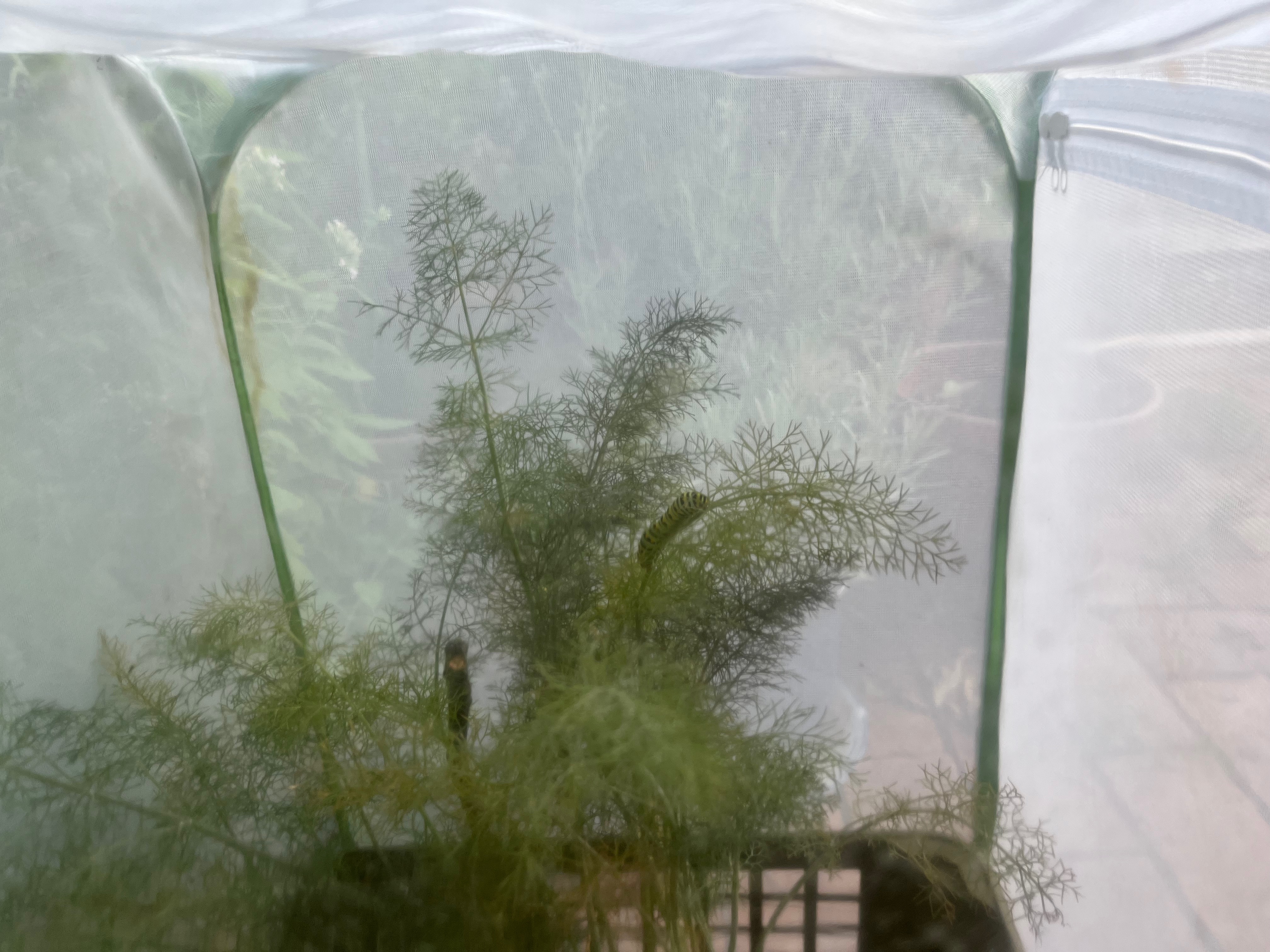
So far, for most of the week, I've managed to get out with animals at breakfast and do the crossword, TBS has had some tennis practice, and my one wee beastie of a caterpillar has managed to fatten up on my now-depleted fennel plant without having been lunched upon by cardinals or anoles. This morning I managed to move him onto the newly potted fennel now housed in the butterfly haven I bought a few years ago but haven't yet used. A couple of days previously I had enveloped him in a mesh bag, but his new quarters are portable and there's much more food:

Black Swallowtail caterpillar in mesh bag shelter

New digs; note eggs above stick

Stick on left, caterpillar on right; not sure where the eggs are

What I didn't know until a few minutes ago, was that before I'd made off with the bronze fennel planted in another part of the garden, eggs had been laid on it! They look like more black swallowtail ova, and as a species they are fond of fennel, so we'll see. This does mean that if they hatch, I'll need to find some more fennel. 

The Canadian wildfire haze did get down to us, but blew away quickly. Still, those ominous photos of orange skies in New York City were rather too close to those depicted in the Apple+ series I mentioned last month (Extrapolations). An article in the New York Times this morning by Paul Bogard, "We're Watching the Sky as We Know It Disappear," noted the recent wildfire smoke in the Minnesota Lake Country, lamented the changes we're all beginning to notice. Bogart edited Solastalgia: An Anthology of Emotion in a Disappearing World, which is high on my reading list. I first learned the term, "solastalgia" from an entry in Climate Words. Coined by Aussie philosopher Glenn Albrecht, it's used "to describe the feelings of anxiety and sorrow that follow immediate impacts to our environments." "Algia" comes from the Greek for "pain" (algos). Although we use it today mostly to refer to body-related pain (e. g. neuralgia), to Homer it was more akin to suffering, as in grief. The "solas" part is from Latin: solacium (comfort, as in solace). The etymology of most neologisms can be problematic, but this one seems to offer hope in context. But the notion of being unsettled, sad, even angry about climate change--especially if we're aware of it and seem to be pretty powerless to stem the rate of change or to mitigate it, is hard to live with.

Maybe that's why I derive such satisfaction from figuring out how to save a (potential) butterfly, or re-wild some of my little yard. The bunnies and the 'possums may not all make it, but maybe some of them will. And even though the cardinals and anoles may be deprived of a fat larval form of butterfly (or more!), there are plenty of mosquitoes and other varieties of bird and reptile noshes available.

And maybe that's why I've been so heartened in the last couple of days to see articles in the Daily Poop* about regenerative farming and family farms in general. Today's front page featured an article on agritourism and soil replenishment: "Farmers market of agritourism? One is 'like buying local on steroids,' farmer says; reducing tillage and increasing soil organic matter are part of regenerative agriculture." On Friday, along with my delivery from Profound Foods, I found the latest issue of Edible: Dallas Fort Worth. In addition to its usual fare (ahem), there is a lovely article about Sister Grove Farm. The owners, Sarah and Rodney Macias, bought a plot of historic Texas farmland in 2016 and have turned it into a working farm and a retreat that fosters responsible living on the land. She quotes people I already love (Robin Wall Kimmerer and Wendell Berry), and the way of life they've made for themselves near Van Alstyne is truly inspiring. 

It does seem that every time I get all grumpy and pessimistic, a few items pop up here and there that lift me up a little, and give me time to reflect on the fact that 1) I'm not dead yet (again; I'll write about that later) and 2) I have a pretty damned good life, all things considered.

Like nostalgia--the combination of sweetness and sadness about home enmeshed in memory--perhaps learning to understand how solastalgia fits into this new world can help us negotiate new ways of approaching modern problems that promise some hope for what comes next.

Happy summer, People. Lhude sing cuccu!***


Notes: 

*On the Canon quoted in my title (Sumer is icumen in): this is a lovely Medieval English song for several voices to be sung in a round. The author(s) are unknown, but may be either W. de Wycombe or John of Fornsete. For an image of the manuscript, its history, the words (both original Middle English and in translation), see the Wikipedia page linked. This is a wonderful poem to read, or song to listen to, on the Summer solstice.

**My irreverent nickname for The Dallas Morning News, to which we subscribe and which we read daily.

***"Sumer is icumen in, Lhude sing cuccu! (Summer has come in, Loudly sing, Cuckoo!)