Showing posts with label electricity. Show all posts

Sunday, July 17, 2022

In The Bleak Midsummer


 Oy!

The Ides of July have recently passed, and we've only had a single below-100F day in the entire month. The forecast for the next week or so is not only over100, but between 103 and 107. Our single 95-ish day brought surprisingly tolerable temperatures overnight (down into the mid-70s), and allowed our brick-clad solid wood house to cool down enough that moving from room to room didn't require walking through a blast furnace. 

Anyone who reads this blog probably already knows that we don't have "proper" whole-house (central) air conditioning. Rather, we rely on four window units in frequently occupied rooms. Old-fashioned portières (hanging door curtains) keep the cool in the designated spaces, allowing ingress and egress through the aforementioned over-heated areas. The Beloved Spouse has also brought in what we call "the auxiliary unit": a window-vented portable machine that we've placed in our upstairs bathroom (adjacent to the bedroom, which has its own unit) to help keep the dog from panting all night. It blows cool air in, helps lower the humidity (with the help of an overhead shower fan), and does a decent job of allowing us to sleep through the night fairly comfortably.

Our morning routine involves getting up at 6 am, turning off the auxiliary unit (but leaving the upstairs window unit on to keep the wood from heating up). Our overhead attic is well-insulated, but not the one that extends out over the front porch, and none of the walls are insulated at all (almost impossible to do, as we discovered when we began to renovate). We leave the downstairs windows open all night, with ceiling fans on. This manages to cool the house down enough that we can abide a morning in the living room under the ceiling fan, reading papers and doing crossword puzzles. Or it did until I started having to take Molly out for her morning exploration before the temperature rises to uncomfortable levels. So I've been reading the paper out under the trees and patio umbrellas, while doing some strategic garden watering. With a breeze, I can usually make it until 9 am or so before I have to go back in.

Then it's time to shut all of the windows, close off the screened porch, pull all the curtains and shades, and move to the one or two rooms downstairs we use during the day. I also try to get any meal prep needed for the day done as early as possible, because the kitchen doesn't have a good spot for an A/C unit. The fan works well to keep the cook from sweating all over the food, so we get by reasonably well. A small slow cooker and a "pizza" oven in the range keep both kitchen-heating and electrical use to a minimum. This situation doesn't strike me as particularly onerous, because I endured summers in Taiwan with no air conditioning at all, and my Owens Valley ancestors made it through countless high desert summers with hand fans.

The fact that this process will be continuing for the foreseeable future isn't what bothers me, however. My tolerance for heat is relatively substantial, and Molly is the most heat-tolerant cat I've ever known, Nylah just sleeps through it all when we can keep the humidity down. We bought a "cool pad" for her to sleep on upstairs, and when she's out of doors she finds a cool, shady spot, digs a shallow depression, and naps pretty comfortably. We spend time out of doors with the animals in the morning and late in the evening, with occasional short trips out during the day as necessary. Our back yard is generously shaded with a dozen or so full-grown trees, and our hog-wire fence on two sides allows for ample wind-flow. So we will no doubt be able to soldier on and make it through the next two months with only our high electric bill (for the curious, it's about USD300 for a 2300 square-foot house). 

Unless, of course, the infamous, badly planned, and inexpertly maintained Texas grid fails us yet again. My February 2021 post (In A Bleaker Midwinter; with apologies to Christina Rossetti for my multiple ham-handed uses of her title for what has become a beloved Christmas carol) I recounted our adventures during what has become known around here as "Snowmageddon." Although ERCOT (the Electric Reliability Council of Texas; I should probably place quotation marks around the "reliability" part) swears that it will be able to handle the expected summer demand, grid customers have been asked at least three times already to conserve electricity by restricting our use of it between peak hours of 2 pm to 8 pm--and the worst is yet to come. 

We do have the little backup Bluetti power station that can be charged with solar panels. We used it to power a heater during the winter 2020 tribulations, and we should be able to power our refrigerator if the lights go out this summer. We had hoped that the state would get on its horse and gin up the grid with additional wind and solar, but it's so beholden to the fossil fuel industry that change in a renewable direction will require a change of governor and the state legislature.

According to our Green Mountain weekly reports,  we've managed to cut our household use down significantly (we've never been exactly profligate in our use anyway). But it will be interesting to see how things work out once the McMansion owners can't "manage" with their thermostats up to 78F. One neighbor in the local Nextdoor group seemed positively giddy about keeping hers at 62, but her example doesn't seem to have been followed. One local news station reported that the initial request (which included avoiding the use of large appliances) resulted in the return of 400 megawatts to the grid: enough to power 80,000 homes. 

I'm not sure what's happened since, but did see that bitcoin miners were magnanimously going offline in order to preserve energy. Which is just plain benevolent of them, since they're potentially responsible for using as much energy as the city of Houston. Really??? I don't even understand what it is these people do, but I sure don't want to have anything to do with it--no matter how wealthy bitcoins are making their addicts users (or whatever they're called). The Wikipedia article is useful if you're as ignorant about this operation as I am, but I'm not sure I really want to know. Everything I do find out makes it sound more and more like an enormous, energy depleting, carbon creating scam. 

At any rate, if the gird does goes down, and we start experiencing the so-called "rolling" blackouts we did back in the winter version of this kind of dysfunction, it won't be just air conditioning units that go out. It will be refrigerators and freezers, and other appliances that make it possible for folks to live and work in the modern world. The only reason I can even imagine how people in apartment buildings and without any means to cool themselves down will deal with this (or die because they can't) is because I recently read Kim Stanley Robinson's description of a deadly heat wave in India that has haunted me since (see the first chapter of The Ministry For The Future).

Human beings are doing this to ourselves, with our refusal to do what needs to be done to reverse the damage we've already inflicted and to prevent future disasters. The deniers have had the upper hand for too long. We all know what to do, and we need to do it. 78 degree thermostat settings are only a baby step. But if enough people do it, it's not nothing.


Image note: The opening photo was taken on the day the temperature drifted downward to 95 and Dallas actually got a little rain. We only got clouds, but the difference between 105 and 95 is absolutely life-enhancing.

Tuesday, February 26, 2013

Food, Culture, and Common Sense

 
The latent Scotswoman in me keeps popping up, with David Hume whispering in one ear, and Thomas Reid in the other.  Those of you who haven't downed enough Scottish Enlightenment philosophy along with your Macallen or Lagavulin won't know what I'm talking about, but I took a memorable course with Victor Worsfold many long summers ago and what I learned then is creeping back into my consciousness now.  The empiricist argues with the pragmatist. Almost daily.

"Common sense" today refers to a kind of received knowledge tempered by reason, as in a "common-sense approach to government" or "for crying out loud, use your common sense." Trouble is, there doesn't seem to be much sense among the common folk these days, and what might seem to be evidence of actual common sense appears to come as a surprise to many.

Take diet.  Real common sense would suggest that if a large population of people suffers significantly less heart disease than another, perhaps we should compare lifeways: diet, activity, occupation, etc. You may remember that several years ago, the "Mediterranean diet" hit the news, and the foodie faddists went at it energetically. I certainly didn't need much encouragement (fully one half of my 300-odd cookbook collection already included books on Spanish, Italian, Greek, French, Israeli, Turkish, Egyptian, and North African cuisines; the rest are about culinary history, much of which involves the ancient Mediterranean), and quickly added The Mediterranean Diet, The Slow Mediterranean Diet, A Mediterranean Feast, and The Essential Mediterranean to the shelves.

Of course, diet is only part of the equation.  People in Crete, whose food-traditions go back to the Minoans, ate lots of fruits, veg, unprocessed meat (chicken, lamb), fish and seafood--the usual culprits. What often got left out of the discussion, however, was that these same people toiled on their farms from dawn to dusk, drank Retsina, and didn't sit around on their duffs playing video games all day.  Nor did they keep a supply of Twinkies stashed in the root cellar (where they kept their root crops, dried fruits, etc. for use during the not-terribly-cold winter).

So, when the newspapers fill up with articles on Startling Discoveries, such as connections between general bad health and highly processed foods, or the "surprising" (to whom, exactly?)  results of the recent Mediterranean Diet study, or that type 2 diabetes afflicts more, younger people every year, or that gluten intolerance is rising precipitously, or that sitting on one's duff playing video games is bad for us, I just get the vapors and reach for a glass of Zinfandel.

Are we, collectively, so flaming stupid that we can't see the equation: 16 oz. Slurpee = potential diabetes?  Highly processed foods with four different kinds of sugars, two days' worth of sodium, and multiple unpronounceable "ingredients" (none of which is actual food) = potential heart disease? Foods so far removed from their natural state as to be unrecognizable = rare diseases becoming far more common?  Hormones in our meat, hormone-disrupters in our air fresheners = premature puberty in children? 

One then wonders about the very notion of common sense, because it seems to be so, well, un-common.  I can't, however, help but assign at least part of the blame to Big Agriculture, Big Pharma, relentless advertising on behalf of food processing conglomerates (Big Everything Else). Big Food is a huge part of the American economy, and we're spreading the "wealth" everywhere else (witness the Big Mac effect in China)--including the Mediterranean region (if that's not irony, I want to know what is). I used to think that folks in other countries were just smarter, or at least more practical than we are, but now, not so much.

The trouble is, at least in part, that in the modern world, an abundance of meat, fat, sugars, and other once-rarer commodities are all emblems of wealth.  Another moment of high irony: cucina povera, essentially Italian peasant cooking (literally "cooking of the poor") is hot stuff in foodie world. Popularized by Mario Batali,  who's a food conglomerate unto his own self (if you're a fan like I am, read his cookbooks; don't visit his website), it's nevertheless an admirable approach to food. One cooks well what one has, as most poor people in the increasingly distant past once did.  This is another example of real common sense at work--what we used to be good at.  I've recently been making an effort, tied to reducing food waste, to finish up what's in the fridge, using staples from the pantry. This often involves making what I call "Leftover Soup," an amalgam of whatever leftover meat and/or veg are available, with broth, onions, and anything else that seems fitting.  Sometimes I add pasta or rice if it needs body, but essentially dinner is what's there, cooked up with some herbs and flavors that make it appetizing. Of course, this frequently leads to irreproducible results, but unpredictability has its own charms.

One of the real problems in America is that bad food tends to be cheaper than good food, and urban food deserts (with little access to supermarkets with fresh produce) are nonetheless seldom without a corner fast food joint.  

Anyway, the world's quest for questionable evidence of wealth may be killing it. I once wrote about redefining what it means to be poor, because a significant amount of what we now see as "poverty" is really just a lack of the trappings of modernity.  Having electricity, which might, indeed, raise some very poor people out of abject squalor, isn't consequence-free.  Producing electricity without polluting the environment irreparably is a continuing problem.  Cheap electricity breeds waste, because if the energy source is inexpensive, people pay less attention to need than to desire.  More access to stuff inevitably generates more waste. (The links are to previous posts on these topics.)

I'll undoubtedly return to this subject in future, but I've probably vented enough for today.  I would like to note, however, that all this advice we're getting through various media, as results from various tests and studies roll in, amounts to a plea for moderation and--yes--common sense.  It makes so much more sense to eat what we love, and if it's not terribly good for us, limit it rather than exclude it.  If what we love, however, is Twinkies and Doritos, it's time to re-educate our desire. What's good for us can taste really good, and it's not all that hard to cook like a poor person. All you really need is a few basic ingredients, a pot, a spoon, and a heat source.

And a good bottle of olive oil. And a decent bottle of wine.

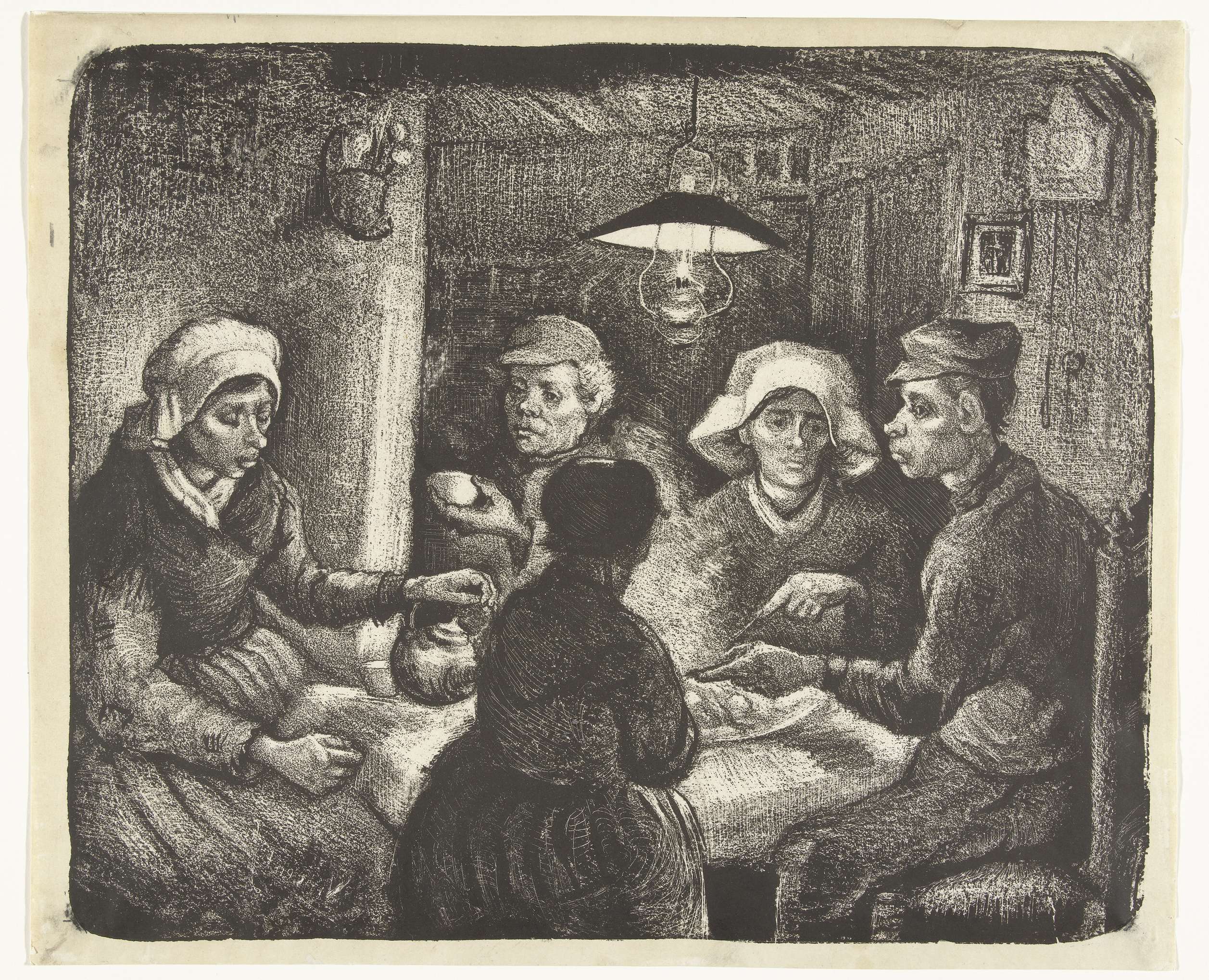
Image credit: This is a lithograph of Vincent van Gogh's The Potato Eaters, courtesy of Wikimedia Commons. For the painted version, see the Google Art Project page. Although not one of his most popular works, the subject is appropriate to the topic of this post: peasants eating food they dug from the ground.  It captures many of the artist's different influences: genre painting, realism, post-Impressionism, and even hints at his expressionism.

Sunday, November 14, 2010

Reconsidering Electricity

While doing research on the effects of EMPs (electromagnetic pulses) on Life As We Know It for a short story this week, I kept coming across comments about how we'd be jerked back to 5000 BCE were one of these events to knock out electricity.

EMP survival is a staple on the armageddon/end-times/survivalist websites and blogs, and it's really the only potential catastrophe I worry about because there is some real possibility that it could happen--whether as a result of a terrorist explosion of a nuke over the US or in space, or as an effect of an especially large solar coronal ejection (CME), as occurred in 1859 (now referred to as the Carrington Event). I've been getting quite a lot of CME chatter in my mailbox from science news feeds, so this stuff is on my mind.

I won't go into the details, because the dangers are nicely outlined in the Report of the Commission to Assess the Threat to the United States from Electromagnetic Pulse (EMP) Attack. But I do want to consider the claim that modern civilization would come to a screeching halt, and we'd be consigned to neolithic lifeways (I refuse to say "lifestyles" in contexts like these--because of the element of choice implicit in our current use of the word) if we were to suddenly lose access to electricity.

In the first place, the real danger is to solid state electronics and all the fancy computer devices (like the laptop I'm using to write this post, and the internet I'm using to publish it) that rely on sophisticated infrastructural and telecommunications technologies upon which the United States and other first-world countries have come to depend. As the report points out, less well-developed countries are potentially in much less danger of collapse than we are:

"Our vulnerability is increasing daily as our use of and dependence on electronics continues to grow. The impact of EMP is asymmetric in relation to potential protagonists who are not as dependent on modern electronics." (Report of the Commission, 5)

In fact, simple electrical devices would still work--or could easily be developed--but almost everything we do these days depends on more complex systems. Most doomsday scenarios follow similar assumptions about how we'd end up in the aftermath of an EMP: cultural collapse, mass rioting and mayhem, takeover by one militia or another (foreign or domestic), rampant chaos, and eventually we'd be consigned to small pockets of "good" survivors at the mercy of "evil" ones.

Really? Good, helpful neighborly folk will turn on one another, co-operation wouldn't even be considered, the gun-toters would rise triumphant and ascendant, and shoot all the tree-hugging liberals and/or rape all their women folk and steal all their stuff.

To me this all amounts to a pretty dismal view of human nature (not that I really think there is any such thing). I can sort of understand the Apocalyptos who think the end is near and that god's going to rain tribulation down on all us non-believers (and on those who don't truly believe in their hearts according to one website I'm not going to link), smite us with hellfire and brimstone, set loose the beasts to devour us and all that. I mean, these folks rely on their literal interpretation of the most metaphorical text in the literary pantheon (fortunate choice of word, that), and they've been waiting for something like this since Jesus died, so they're actually looking forward to it.

But the rest of us? Wouldn't we be able to band together and sort things out? In the worst of times, don't we tend to work together--even when our government drops the ball (as with Hurricane Katrina)? And without electricity?

It's no coincidence that in my own view of utopia the occupants choose not to use electrical devices--and they get along fine without them. Of course, they've planned their lives around the complete absence of electricity (it's the first thing they decide they don't need), but they end up living pretty well, and with technologies that surpass those of the neolithic to some significant degree. Bronze Age, maybe, but not neolithic. In truth, there are degrees of technological sophistication that don't require any electricity at all, such as steam power. Just remember how much fun people are having with Steampunk these days.

Today's edition of the Daily Poop, in the "Lifestyles" section, there's an article by Alison Miller called Recovering Lost Arts: Brazos de Dios carefully crafts cheese, furniture, community--and a way of life. This is another reason why I still read the newspaper, and why I so enjoy coincidence. Just last weekend, as we drove south on I 35 to San Antonio, I noticed for the first time ever (after twenty years of making this drive) a sign for a town called "Elm Mott." I joked about how British it sounded, and wondered why I'd never seen it before--and then here it is: the very spot where Brazos de Dios is located.

The subject of the article consists of a community of about a thousand people on five hundred or so acres who "place great value in traditional craftsmanship, doing things by hand, and gathering ingredients from the earth and animals that surround them" (Miller E1). Begun in the seventies (like so many other intentional communities, only a few of which still exist) by a group of New York Christians, they now operate as Homestead Heritage and provide educational programs in crafts from cheese-making to boat building to letterpress printing. Their beautifully designed website offers this evocation of ideals that William Morris would have loved: "Our Traditional Crafts Village showcases a community of craftsmen who have returned, not to the past, but to the enduring values exemplified in handcraftsmanship. True craft requires more than skill: it expresses the craftsmen's care and concern, their personal investment in everything they do."

Now, I know that places like these are relatively scarce, although I'm going to spend some time finding more of them (before I lose the use of my electrical devices), because this kind of effort gives me hope for the future. I've been laboring under the illusion that my views of the good life are alien to most Texans (hence my continuing sense of exile). It's good to know that I'm wrong, at least to some extent.

It's also good to know that I'm right about the attractiveness of simple technologies. The folks at Brazos de Dios use electricity. But I don't imagine for one minute that they couldn't carry on just fine without it.

If, of course, they could also manage to keep the zombies and whackos from invading their farmstead in the event of an EMP.

Image credit: The Aurora Borealis, or Northern Lights, shines above Bear Lake, U.S. Air Force photo by Senior Airman Joshua Strang, taken at Eielson Air Force Base, Alaska in 2005. It was the Wikimedia Commons Featured Picture of the Year in 2006. The photo has been manipulated a bit, but the original is posted on the commons. For an artistic interpretation, see the painting by Frederic Edwin Church, below, from 1865--also from Wikimedia Commons. Some really good photos and videos
of solar activity in general are available from the Telegraph (UK) page on solar flares, coronal mass ejections, and aurora borealis in pictures.

Tuesday, April 22, 2008

Surviving Plutopia

Now here's a series of coincidences for you. My husband (who is usually spot-on in these matters; after all, he led me to Firefly) casually mentioned during our Sunday morning newspaper-read that "you might find this interesting; Alan Cheuse liked it," referring to Jeanette Winterson's newest novel, Stone Gods. Part of the novel takes place in ancient, pre-environmental-disaster Easter Island, which also happened to have been featured in the Sunday Travel section of the paper. Anyway, after reading the review, I looked her up on the web and opened up yet another window in my serendipitous world.

I read her biography, and discovered that she's another arrogant, cranky middle-aged writer (we should start a club!), but one long-published, with an interesting rep, and recipient of an OBE (now I'm really impressed). I read an excerpt from the new book--which is now on my to-buy list--and then wandered over to her essays, where I hit on "Society for the Preservation of Ancient Buildings." This, of course, raises a bright flag, because this is the organization William Morris founded in 1877 to prevent the wholesale tearing down of historically important buildings, and/or their cheap and nasty "restoration" or "modernization." Lo and behold, Winterson had purchased an eighteenth-century derelict in Jack The Ripper territory and restored it, complete with a ground-floor shop that now houses a Continental deli run by chef Harvey Cabaniss (of whom I had already heard). Moving on to an essay called "Good Housekeeping" I came across this gem:

We are eating too much and we are paying too little for our food. . . . My philosophy is to eat modestly and buy the best you can afford. In our crazy world a chicken costs less than a cinema ticket. Our obsession with cheap food has destabilised farming throughout the world, polluted our soils, driven small producers and small shops into the ground, allowed the supermarkets to monopolise our lives, and made us fat.

Had I "met" Jeanette Winterson before I had finished More News From Nowhere, I'd have pinched her for a character.

In an essay about Philip Pullman, author of the series His Dark Materials, she describes Pullman's attitude toward modern education:

For Pullman, the obsession with invented standards, pointless testing, endless form-filling and a moribund National Curriculum are killing the joy of learning, and driving the best teachers out of the system. 'I used to teach the things that excited me', he says, 'and when the teacher is excited, so are the children. What do we want to do? Stuff them with facts or open their minds?'

Had I read The Golden Compass (or, as it's called in the UK, The Northern Lights) and met Pullman before MNFN, he'd be in there, too. As it is, I've only read the one book, and seen the disappointing film based on it, but I'm already a lifelong fan.

Both of these writers share my disdain for two important constituents of "plutopia" (my new name for the greed-based economy in which the West now wallows. It's not wholly dystopic--yet--but our attitudes toward both food and education are symptoms of increasing intellectual and ethical impoverishment, portending further ill for the future). Our lack of education--of desire (in terms of what and how we eat), and of the mind (in terms of how we teach our young)--have helped to build plutopia, and only by addressing these failures can we hope to replace it with anything that even vaguely resembles a world in which everyone can be accommodated in some measure of fairness, justice, and peace.

Only by adjusting our own perceptions of "need" vs. "want" can we begin to understand the true nature of poverty. And I am getting sick to death of pundits who describe anyone who lacks electricity as "living in abject poverty." (For my perspective on the larger questions, see "Rethinking What it Means to be Wealthy" and "Rethinking What It Means to be Poor.") The line usually runs something like "They're so poor they don't even have electricity"--as if this particular technology is necessary to the very notion of civilization. But it's not. It's perfectly possible for people to work the land, provide sufficient food and clothing for themselves, and dwell in thriving communities without ever having seen a light bulb!

Although knowledge of electrical principles has been around since antiquity, and had come under serious study by the eighteenth century (remember Mr. Franklin's kite and key experiments), it wasn't until the nineteenth century that it became practical to bring electricity into commercial and domestic use. It may be "necessary" to modern life--hence the science fiction scenario of an electromagnetic pulse as the threshold of disaster--but it is certainly not necessary to life itself, nor even to "civilized" life. Plenty of civilization happened before the nineteenth century. Of course, that's also when things started falling apart, what with the industrial revolution, Blake's "dark Satanic mills," Ruskin's hated locomotive, and the end of pastoral life as we knew it.

But few people even know these things these days, because we're so intent on stuffing our children's heads full of factoids we can measure on standardized "assessment tools" that only test what they can memorize--not their ability to think, interpret, translate, imagine, create, or use what they've learned. "Irrelevant" information isn't taught because it doesn't fall into the current catchment basin of what education "experts" think kids need to know. Knowledge doesn't actually happen until the child has managed to integrate information into some kind of cultural context--so most of the information they commit to memory only long enough to spit it back on the exam is useless anyway. And of course the reason they need to know anything at all is in order to be successful in the marketplace.

We in the US complain bitterly and loudly about the price of gasoline and food, both of which cost more in the rest of the West than they do here. But if we truly understood what's involved--if we were better educated about economic realities instead of having been spoon-fed the pabulum we get predigested into sound bites from media sources--we'd be complaining that they cost too little. The true cost, in lives and life ways, is profoundly higher than most of us realize--or want to realize. But plutopia has taught us to think only in terms of monetary cost, and even the word economy doesn't mean what it once did, since it's now synonymous with "market economy" and any other use of the term is suspect.

I'd really like to spend Earth Day in my "nowhere"--without electricity or formal education. But since I can't, I'll keep prowling through Winterson's lively website, and dig into the second segment of Pullman's series (The Subtle Knife). I'll spend a couple of hours this morning in my little carbon sink, amidst the wild grasses and the primroses, and hope that the birdsong drowns out the traffic from the highway. There I can celebrate a smaller footprint, and be grateful for what I don't have.

Addendum (7 May 2008): This month's Orion Magazine contains an excellent and highly relevant article, "The Gospel of Consumption, and the Better Future We Left Behind." I'm encouraged both by the content of the article, and by the discussion that follows.

Photo: A lovely carbon sink at a bend in the Owens River, near Lone Pine, California.

Monday, August 27, 2007

Mea Culpa, Mea Maxima Culpa


The papers are full of disaster this week, some apparently natural, some caused by human agency: wildfires in one of the cradles of Western civilization; hurricanes in the Gulf of Mexico; bombs everywhere. But even the “natural” disasters arise because of human activity, either accidental or deliberate.

At least some of the “wild” fires in Greece may have been deliberately set by greedy developers who cannot legally build on forest land. If developer-arsonists were to succeed in clearing these areas and build what they want, the people who would buy housing constructed on burnt-out areas are not the villagers who now live adjacent to them. Those who occupy these lands today would be replaced by rich Athenians looking for vacation homes, or rich foreigners. Greece, like other chronically dry regions—such as the Owens valley—is subject to periodic wildfires. Fire is actually necessary for the regeneration of certain forest species (like the Jack pines on Long Island). But persistent drought and human greed can over-burden the forest’s ability to “fix” itself. The irony here, as it is with any concept of razing existing spaces for new construction, is that what makes the area desirable in the first place (nature, neighborhood) is destroyed in the process.

The presence of human beings in the world, with their big, active, inventive, restless brains, has initiated such a complex web of actions, reactions, and interactions, that the only way to ameliorate the consequences is to stop. Period.

If we want to save the world, it’s pretty clear that we’d better stop doing most of what we’re doing, and quickly. We need to slow down, breathe, think, ponder, deliberate, talk. I was going to add “do” to that list, but “doing” needs to be curtailed. Thinking before doing—and not just paying lip service to the thinking part—is something we really must do more of.

Unfortunately, deliberation can be debilitating, in the sense that thinking things through, weighing consequences, and choosing alternatives can lead to inaction. When faced with a multitude of possibilities, how does one choose the correct path? How does one choose, in the end, what to do?

Thinking things through is tough enough on a personal level, but nigh impossible on even a local level. In small-scale, face-to-face communities, with a relatively homogeneous citizenry (homogeneous not necessarily in the sense of ethnicity, race, or even religious affiliation; but in the sense of philosophical orientation, as in many of the “alternative” communities set up in the sixties and seventies), such deliberation might be possible, and even promise some success. But we don’t breathe local air.

And therein lies the rub. What everybody else does on this planet affects us down to the level of individual entities. So coal-mine fires in India and China may be polluting the air and warming the atmosphere to an extent similar to that of the car-loving, energy-hogging West. Nobody escapes guilt, because even the peasant farmers who aspire to what we have will do what they can to achieve our level of “civilization.” So, we try to do what we can to reduce our impact, our carbon footprint, our level of consumption—and we end up feeling angry and frustrated with our puny efforts.

Sometimes I really do want to live on another planet: one we haven’t messed up beyond repair. It’s pretty obvious to me that there’s nowhere on this formerly-green earth in which to start over—to stop doing what we’re doing and go back to considering the consequences of our actions before we actually take action. Not going to happen. Everybody breathes the same air, and there are few places left that are isolated enough to avoid political confrontation with neighbors. But that doesn’t mean we can’t conduct thought experiments designed to consider alternatives--and that might help us over the hump of despair.

In the current issue of Orion magazine, “Altar Call for True Believers: Are we being change, or are we just talking about change?” Janisse Ray exhorts the already-faithful to start making more significant changes in our lives. But we’re awfully comfortable, some of us believers who are well-educated, reasonably well-healed, and well-informed. Each small step we take toward lowering our dependency on fossil fuels and other exploitative technologies is just that: small. We’re part of the group Stanley Fish mentions in his blog for the New York Times yesterday, “Blowin' in the Wind,” in which he describes the fallacy of relying on “renewable” energy. In his experience, wind-generated power is so intrusive that his neighbors (many of whom fit the description of True Believers) don’t want any part of it. And I’m pretty sure that I wouldn’t feel nearly as smug about getting my energy from Green Mountain (with its wind-farms in west Texas and other areas) if its turbines were next door.

The solution is, quite simply, to vastly decrease our dependence on energy of any kind. The thought experiment that might help us solve the problem goes something like this: What if we were to give up electricity? What kind of life could we imagine that relied completely on the sun, animals (see the article on “Horse Power,” also in this issue of Orion), and other natural sources? Of course we’re not going to do this (I wouldn’t be able to write this blog, were it not for the highly exploitative computer technology at my fingertips), but thinking about it might help with the education of desire: How much of this do we really need? How much of it could we reasonably do without?

The very small attempts in my household include the minimization of air conditioning. Last night, despite the fact that yesterday’s temperature reached the mid- to high-90s in our area, we slept without turning on the small window unit in our bedroom. We did cool the room where the (heavily furred) dogs sleep, although the thermostat is set at 80. In fact, for most of this summer, we’ve relied on the two attic fans, one atop the other, in the center of the house, which had been the only source of cooling in the house (built in 1922) for most of its existence. The summer here in north Texas has been relatively mild, with only four days in which the temperature hit 100 (last year the total number was more like forty), and (except for the mosquitoes brought on by the early summer rains) pretty tolerable. At my age I’m not sure how much heat I could stand before caving in, but we don’t have central air conditioning and make do with window units to cool the three rooms we use most. But before freon-based air conditioning was invented, people used the attic fans and the designs of their houses (solid timber on pier-and-beam foundations) to make it through the prairie summers. Janisse Ray’s article has renewed my effort to think even more carefully—beyond the recycle/eat organic food/seek humanely-raised food sources efforts most of us already practice—about how I live in the world. As long as all this deliberation doesn’t lead to immobility (sometimes I do just want to give up and go live in a cave) or complete lassitude, there are probably plenty of small choices we can make that, while not exactly saving the world, might help change it. But we have to choose more of these.

Try the electricity thought experiment. If nothing else, it’ll make you aware of how much you rely on this one technology. And then maybe you can find ways to minimize that reliance.