Showing posts with label garden. Show all posts

Saturday, June 18, 2022

It's Not Easy Being Green

For the last several years I've let the Virginia creeper take over large swaths of space in the garden, and it's become a tradition to let it overflow the decrepit, mangled (from branch that fell from the elm overhead) Adirondack chairs and an old sawed-off patio table. After the elm branch fell, I thought I'd just have to get rid of them, but now, more than a year later, they're still there, swathed in viney decorations that now include wild grapes (descendants of vines that grew on the south fence and once provided fruit for some really bad wine we found under the house) and English ivy from next door--as well as the creeper. It won't be long before wisteria and trumpet vine gain a foothold, since I've no plans to eradicate any of it.

An article in the New York Times (Yes, You Can Do Better Than the Great American Lawn) prompted me to muse on the unorthodox nature of our own "lawn," and to offer an alternative to the tidy, suburban, pesticide-laden, water-hungry model that presides around here. There is some attendant irony in that the city motto of McKinney, Texas, is "Unique By Nature." But the fact that there are no other houses on our block with fireflies may suggest the duplicity in that coinage. I'm clearly not the only one mindful of these problems (see especially Margaret Renkl's May 16 article for The New York Times, "One Way to Do More for the Environment: Do Less with Your Lawn," which I only just got around to reading), but the older I get, the louder and judgier I become.

This morning, whilst potting up a rescued plant from the back (one I'd tried to kill earlier in the spring, but that proved amazingly hardy), I watched the neighbor across the street mowing his smallish patch with a large, loud gas thing with a grass catcher. He dumped the clippings into a large paper bag for the city to pick up next Friday. He then brought out his new, also loud, also gas trimmer, tidied up, and then use a blower (also loud, also gas) to blow the stray bits out onto the street. Weenie that I am, I said nothing, because I have to live here, and most of my neighbors already think I'm a tree-hugging commie.

But we don't do that. We use our electric (battery-powered) utensils to mow and mulch, trim, and blow the bits back onto the "lawn." Such as it is. A large section of the front yard is composed of mulch from various trimmings of the eighteen Very Large Trees within the property boundaries. We've got another pile sitting in the driveway, waiting for The Beloved Spouse to distribute it appropriately after the most recent care-taking (see last week's post). 

We have in place a few rules that have endured for many years, beginning long before we moved to McKinney, and that have served us well:

If it's green, let it grow--at least until you know what it is (and if it's in a place you might want lawn, mow it).

We do have some hardy St. Augustine grass growing, but where it doesn't, we let anything grow that wants to. Our yard is also replete with edibles (henbit, purslane, dandelion, plantain, chickweed, cleavers, wood sorrel, onionweed, pigweed, mullein) that periodically get added to salads. I'm hoping to add lambs quarters to the list, if I can get some to root out of what I bought from Profound Microfarms. It used to grow wild, but I haven't seen any in some time. Were I to spend more time at it, I'd probably discover more, but it's getting harder to spend that kind of time out in the heat.

When we first moved in, everything was very tidy, with the southwestern section of the property set aside for growing veg. There were the grapes, too, and blackberries galore. Those kept up for a few years, but eventually got shaded out from all the squirrel- and bird-planted trees that now line the back part of the lot. After trying a more formal herb garden, I eventually gave up and let a copse grow, which (much later) was mostly cleared for a caravan driveway/parking area when we bought our little Shasta. 

Before we began the house renovations, the garage was painted white, and most of what grew around it was what most folk would call weeds. As below, to the left, where the garage peeks out from behind a stand of cow parsley. We don't grow much of that now, though, because it turns into burrs that love dogs' tails. So it only grows outside of the fence. Occasionally I pick it for wildflower bouquets, which I like to keep on my writing table on the screened porch. 
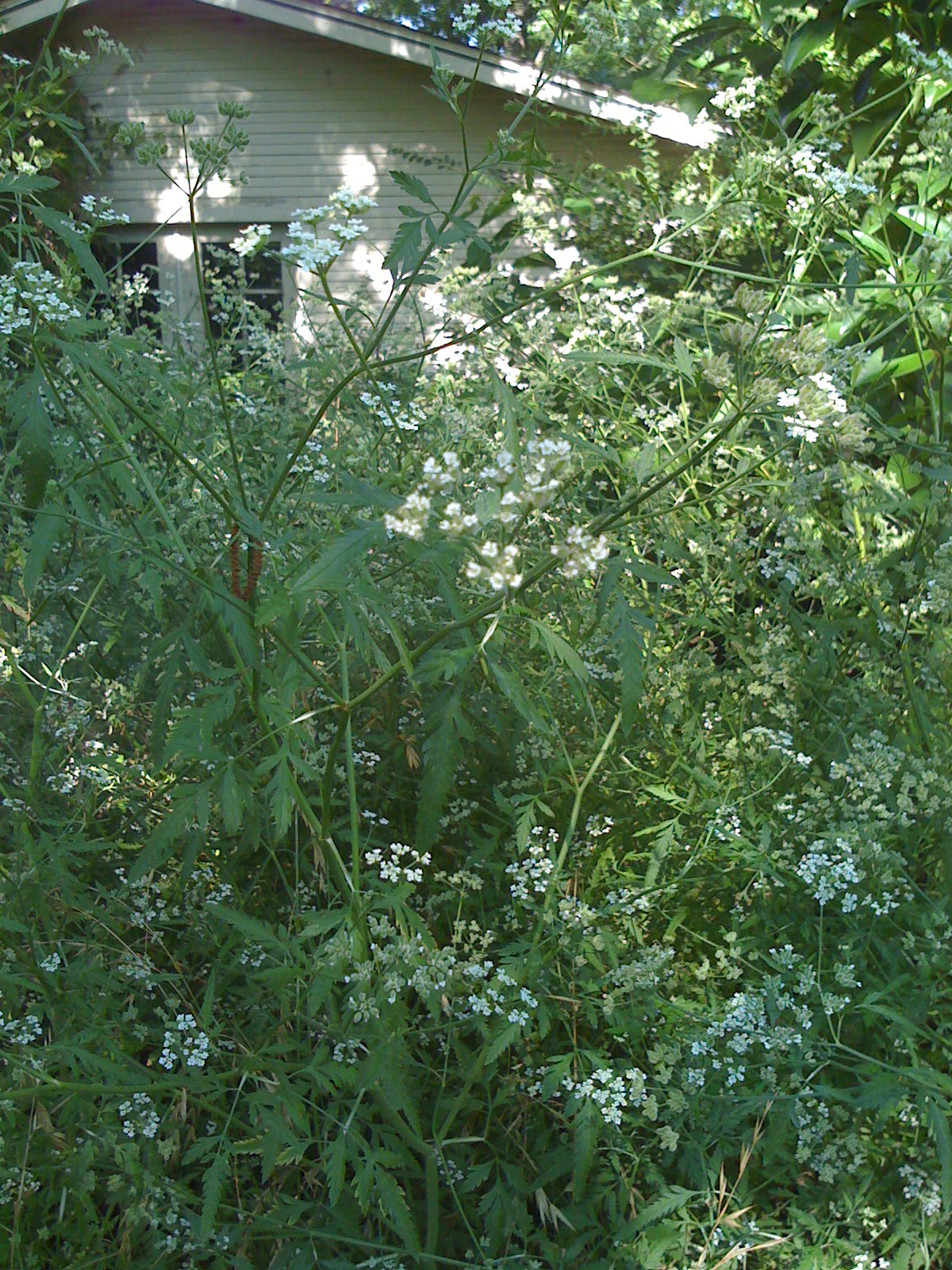
Above the back door to the garage (which you can barely see at left) we installed a miniature pergola (below) to support a heavy branch of wisteria.  It was so successful that the growth extended onto the roof--until one of this spring's storms knocked the whole plant over and off the support. Reluctantly, we cut it down and are now training stray shoots back up the structure, but it will take another year or two for it to offer much decorative cover. I'm trying to root some more, but am not having much success because the heat keeps drying out my twiglets. It will clearly be a while before it regains some of its flamboyancy.

But perhaps not as long as I thought, because just this morning I noticed that the  stump of the big vine we'd had to cut off was (as TBS had suggested it might) sprouting anew. Vigorously. So, we may have some well-established beginnings of a refreshed tangle of wisteria by the end of the summer. 

With humidity at tropical levels, things will continue to grow lushly until the summer drought takes over and I have to spend time judiciously watering to keep it all from dying off. 

All this has illustrated the lesson of letting things be: that it's not always easy to maintain any kind of order, even if one doesn't demand much. I'm not a total anarchist in the garden; I do decide where I want things to grow, and often move them about from place to place. Mostly, I'm successful--but then I have to ride herd on what I change. 

At some point during one of our evening animal outings, I realized that Woody's garden (a circular planting area ringed by tree stumps from previous prunings) really needs to be a butterfly haven. I've already got some attractors planted in there, so realized that a few more might help support the few visitors we see once or twice a day: Tiger and Black Swallowtails, an occasional Monarch, and various smaller and less regal types. This leads me to another rule: 

Focus on supporting wildlife, not people.

This morning I transferred some yarrow (suggested in an article I'd read only yesterday, but can't remember where) into Woody's garden, and will find some salvia to move as well. Because the summer heat is already here, I won't get more ambitious until next spring, but this will fill in some bare spots, and provide more food for the abundant number of pollinators who already visit. Unlike most of our neighbors, we don't try to get rid of most bugs (the main exceptions are the mozzies that see me as food dispenser), and thus provide haven for bees, wasps, fireflies, dragonflies, ladybird beetles, spiders, and others generally seen as beneficial. But we also harbor all manner of less well appreciated critters, like assassin bugs. As annoying as all the "baddies" can be, they still provide food for all the birds we capture on our Merlin sound-identification app and for the bats that whiz past us overhead in the evenings.

Occasionally we're rewarded with something especially nice, and late yesterday afternoon this beauty showed up on one of the repurposed logs:


I saw it from across the yard, and proceeded to sneak up on it--after having run into the house for my phone. Although it's not the first Luna Moth to show up in the yard, it came in earlier and stayed longer than the only other one I'd seen in the garden. One showed up on the front screen door several years ago, but this is the first one I've seen taking advantage of the habitat. 
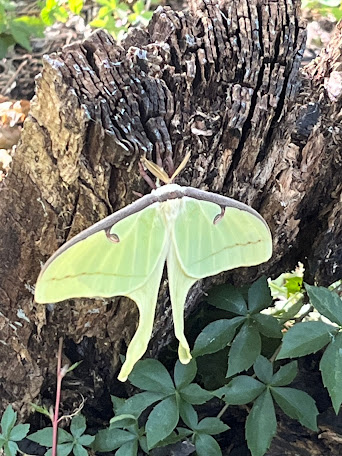
 

Habitat lounging is common in this kind of a garden. The arborist who came to assess the recent tree job was very impressed with the number of places critters could comfortably occupy. Even the structures provided for plants can offer a perch for an anole on the hunt:


This one is lazing on the support frame for the fennel we use to harbor swallowtail larvae--not a good sign for this summer's prospects. But I'm hoping to harvest at least a few baby butterflies to host in my mesh hatchery, where I can keep them safely away from this guy. Although chances are that Molly will already have had his tail by then, and he might not be so spry. She's separated at least four other anoles from theirs already.

Many years ago, Kermit the Frog lamented the difficulty of greenness, which can still be seen as a metaphor for current problems in the human world. On several levels. But this gives rise to one more rule worth considering:

It may not be easy being green, but it's our only hope.

This week's events in Yellowstone are bringing home more of the reality of climate change. If we don't start making efforts to restore the environment immediately, precious habitats everywhere will just be washed away. Or suffer from another of the myriad plagues our species is inflicting on the planet.

Earth Island Institute's piece from last year,  "It's Not Easy Being Green: What if we were mutually accountable not only to the environment, but to each other?" takes this a step further, and challenges us to to embrace the whole: humanity and environment, persons of every color, all beings, the whole planet. Everything we do has impact. Responsible choices, meaningful gestures--anything we can do to acknowledge the fact that no matter what color or gender we are, we are all part of the natural world. It could all go away as quickly as a road can be washed into a raging river. 

I'll be celebrating Juneteenth with both the brown and green anoles in the garden tomorrow. I'll be remembering my father, who taught me that race was a human invention, and that color had nothing to do with being human. And I'll be grateful for every person I've known who has reinforced that understanding throughout my life. 

Recognizing that the earth belongs to us all and that we all depend on its survival for our own should be a universal goal. But starting small, in the garden, and keeping safe what we can is easier than it might seem.


Sunday, March 20, 2022

Spring in War Time

Mammatus-ish clouds after this week's storm

Seasonal changes always cause mischief around north Texas. This year's wind- and hail-storms and wildfires on the cusp of spring seem more frequent and more intense than usual, although I'm too lazy to look up the stats. Counties to the east are burning, and under emergency evacuation notices. We've had two thunderstorms (with golfball to baseball sized hailstones in some areas) in the last two weeks, resulting in swarms of roofing companies in local neighborhoods with offers to repair roof damage that's "visible from the street" (it is not, in most cases). Our big cable-spool picnic table out back has been artfully polka-dotted, but we've avoided any major damage--although in a previous windstorm a very large elm branch broke off and knocked things about, fortunately missing the greenhouse. 

But today is lovely. Daffodils are fully in bloom, and the grape hyacinths are popping up all over. Both have been naturalizing over the property during the last twenty years, and their numbers have increased significantly. It's as if our old house is gussying herself up to celebrate her centennial this year. Our "house clock" seems to be off by a day this year (the first sunrise appeared through the window yesterday), probably because of precessing equinoxes, but the shift to Daylight Saving Time has meant extra time in the evening to potter around and get things done in the garden. 

Clocks have been on many minds these days, especially since there may be a significant change in the works. For many, many years now I've been seasonally annoyed by the spring and fall changing of our clocks to and from "Central Standard Time" to "Central Daylight Time." I get so discombobulated by the shift that I've often grumbled about why we still do it at all. This week, however, the United States Senate agreed with me and voted unanimously to make Daylight Saving Time year-round. I like having more sun in the evening to enhance Animal Companionship Time when the weather's fine, so I'd rather this be the choice--even though sleep experts seem to think that standard time is preferable. And if we want the entire country and its territories to be uniform, we should adopt uniform standard time, so that those who don't ever follow daylight time won't still be different from everybody else. I don't really care; I just want to stop switching back and forth. Every year it seems to take me longer to adjust, although that seems a trivial complaint these days.

The usual celebrations of spring around this house have been severely muted by the war in Ukraine. We've stayed up later at night watching commentary from Hungary and elsewhere about the plight of the Ukrainian people, and feel no real impulse to celebrate anything (even though Purim, St. Patrick's Day, and Holi were all on the menu). We're sending money that would otherwise go to frivolities (like more books) to charities we regularly support that are also aiding the relief effort in Ukraine, as well as to international animal welfare groups trying to rescue lost and abandoned pets. There's not much more we can do, except perhaps share our concern with fellow bloggers and readers, and urge people to rely on news organizations that report factually and avoid the ones that don't. Newspeople are risking their own lives to get the story out, and I'm particularly sympathetic to what their families must be going through. My own mother was a foreign correspondent during the aftermath of the second of the Taiwan Strait Crises (1958-59), and my father had been deployed to Taiwan at the last minute (we were scheduled to go to the Philippines) because of the threat of war. I'm not sure why the whole family was allowed to go, but I grew up with photos of the damage done by the shellings and a political climate colored by the possibility of nuclear war. The Russia-Ukraine conflict is currently being compared to that of the recurring China-Taiwan issues, so it all seems uncomfortably familiar.

In addition, recent events keep reminding me of my maternal grandfather, who served as a medic toward the end of WWI in France. I've finished transcribing his letters to my grandmother, and have lately remembered a poem Sara Teasdale published in 1917 in response to reports of casualties in Europe. I stole the title, "Spring in Wartime," for this post.

I feel the spring far off, far off,

    The faint, far scent of bud and leaf—

Oh, how can spring take heart to come

    To a world in grief,

    Deep grief?

The sun turns north, the days grow long,

    Later the evening star grows bright—

How can the daylight linger on

    For men to fight,

    Still fight?

The grass is waking in the ground,

    Soon it will rise and blow in waves—

How can it have the heart to sway

    Over the graves,

    New graves?

Under the boughs where lovers walked

    The apple-blooms will shed their breath—

But what of all the lovers now

    Parted by Death,

    Grey Death?

I hope fervently that by the time the autumnal equinox rolls around (and preferably much sooner) there will be cause to celebrate, and that the wanton killing will have ended, and the Ukrainian people will no longer be threatened by autocratic ambition and hunger for power. The fortitude and resilience of Ukraine's president and citizens is profoundly inspiring. May it be rewarded with peace and freedom.

Image note: Almost-mammatus clouds after last week's hailstorm. Mammatus clouds are often a tornado omen, but these are rather less threatening. They provided for a gorgeous sunset, and folks to the north were treated to a huge double rainbow. But we had better clouds.


Thursday, August 26, 2021

Deep Summer Busy-ness

As the summer begins to wane, we on the Farm find ourselves busier than we've been in quite a while. There are injured trees to fell, caravan projects to complete, software programs to learn, clearing out to accomplish--all in addition to the daily necessities of newspaper reading, puzzle solving, cooking, cleaning, laundry, and pet service. 

I suppose I've mentioned innumerable times that we do a large measure of the daily stuff without benefit of central air conditioning. This isn't generally a problem, at least in the morning, when things are cool enough (if we're sitting under fans) to read the paper, do the crosswords, and even tidy up. But after noon, we try to shut down and work in one of the rooms with a window unit (living room, snug, study, bedroom) in order to conserve power. Fortunately, Porco has its own air con, so any of the projects we're undertaking in preparation for our rather ambitious, month-long road trip west can be done in relative comfort.

We still take time in the morning and evening to spend time out of doors with the animals, and so our activities are pretty well-paced. Not long ago, we installed a more efficient ceiling fan in the kitchen, which makes it easier to cook. If I'm on the ball, I get something prepped and put together in the morning, then put it in the oven to bake later, rather than simmer on the stove top. Or we have salad nights. Having come from pioneer stock that made their lives in the western Nevadan and eastern Californian basin and range deserts, I have good models for dealing with heat, and because the humidity demonstrates the relative abundance of water in north Texas, there is really little to complain about. 

But climate change is certainly "messaging" us, and strongly nudging us in the direction of some preparatory gestures. Last winter's Big Freeze (as they're now calling it in the Daily Poop) has prompted us to buy a lovely ceramic cast iron log burner, which will take its place in front of the fireplace at the end of this month. The greenhouse also falls into the prepper device category, and after we're home from our trip, stepped up efforts to fortify our food-growing capabilities will begin: enhancing the veg space wherever we can. My old, battered copy of Ruth Stout's No Work Garden Book (saved from some flood or another), and Helen and Scott Nearing's books on the Good Life are on my autumn reading list, and there are several more books on my shelves with similar themes: making do with less, all written before it became trendy again to "make do and mend."

Work on Porco Rosso has produced new "classic" faucets with metal handles, a cargo carrier for hauling what TBS quaintly refers to as the "honey wagon" (don't ask) and extra water. We also installed, inexpertly but eventually adequately, a new awning. The old one was once white, but the spring rains and dying trees had ruined it, so we got something a bit too cute but much more serviceable. 


There are also a new lock and new keys, after it proved too difficult to get a damaged key replaced. We also got better locking devices for the exterior storage bins. Interior storage will be enhanced with numerous IKEA amenities, from boxes to baskets to small shelves for stashing spices. And my makeshift pillowslip curtains will finally be cut to fit and insulated. We're planning to leave just before the solstice, camping first at Cedar Breaks State Park on the night of the Full Corn Moon (they call it the Harvest moon around here, but I grew up with the Corn moon). The new binoculars TBS gave me for my last birthday will be put to use taking photos for a later Skywatch entry, from a good Dark Sky site.

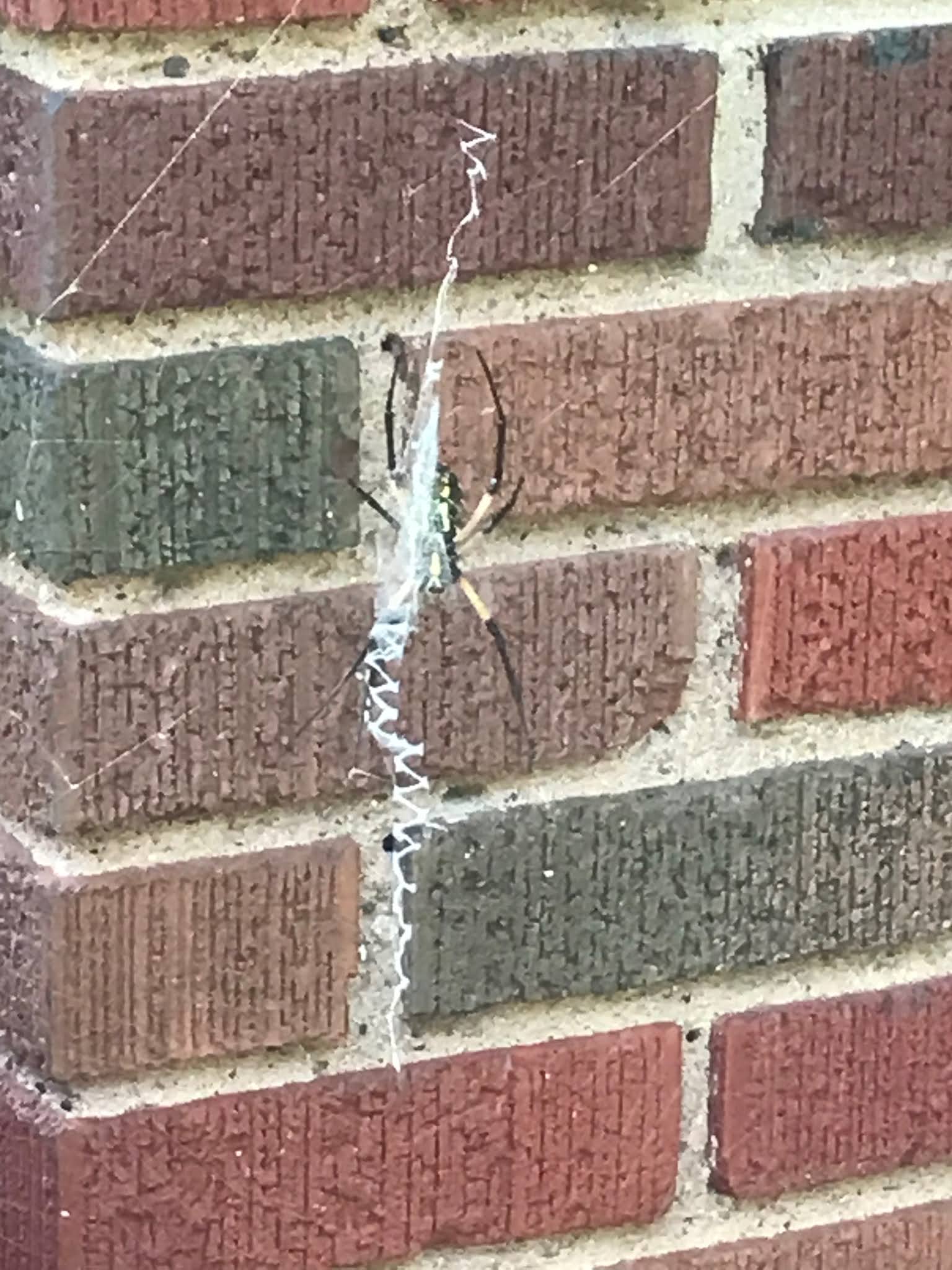
The travel planning is pretty much complete now, and we've had time to clear out some of the winter damage and tired remains of spring's extravagant growth. Pottering around in the yard has led to a few wildlife discoveries, the best of which is another spider. Last time, I included a shot of a tiny argiope in a cedar tree--the first I'd seen in years. This last week, however, we discovered a much larger variety and I've been watching it faithfully over several days. The first time I noticed her, Nylah had already barged through her very large web (strung between the downspout and rain butt on the northwest corner of the house, and a large pecan tree about six feet away), and the spider (now known as Shelob; much smaller, but with similar habits, for those of you Tolkien fans) was already busy repairing it.

My feline correspondent, Tigger (see last post's comments) hasn't seen this variety before, so I thought I'd provide her a much larger example. Two days ago, there was also ample evidence of mayhem. I'm including a sequence of photos to illustrate the dramatic goings on, and to give you (perhaps) an idea of why my family has always been so fascinated by these industrious beasties.


Argiopes are orb spinners, which you should be able to see in the last picture; it and the one above it were taken after she had devoured her packet of Japanese beetle. The opening shot on this post is the only one taken from behind the web. At first she was pretty skittish, and every time I came near, she'd run up to the eave to hide. But more recently, I've been able to get closer--although getting my cheesy excuse for a Skywatch Friday entry required crouching down in back of the web. 

The next few days are forecast to be a little cooler (93F instead of today's 97), although the rain promised for the weekend seems to have left the map. But now that the major project work is done, I'll be spending a few more hours trying to master a new web design program (Pinegrow) which I'm hoping will allow me to get back to work on revising the old owlfarmer.com page and a couple of other web efforts.

Stay safe, folks. And have a good weekend (to those of you for whom weekends still mean something).

Friday, July 23, 2021

Midsummer Murders


The title of this post is a (shamelessly opportunistic) corruption of the perennial British crime fiction TV favorite, Midsommer Murders, but roughly describes the latest observations in the accidental/anarchist's garden.

A few days ago, during my first perambulation of the morning with Molly, I noticed evidence of utter mayhem: feathers everywhere, apparently from a mockingbird, which had met its demise at the claws of one of our local raptors.


She looks guilty, but is not responsible.

I attributed the carnage (although there were no grisly bits) to a hawk or an owl, both of which hunt in our yard, and went about my business. The next day, however, evidence of further havoc appeared in the same area, and this time it might have been a mourning dove. Since we often see barred owls, and sharp-shinned, red-tail, and other hawks flying about, activity like this does happen occasionally, and I thought I'd identified the culprit(s) when I captured some video of the swoops and glides of a group of raptors a couple of days later, after hearing their cries. The winds were up a bit and these birds (which I now think might have been Mississippi kites) were having a great time soaring on the thermals.

As it turns out, however, if these were indeed kites, as insectivores they were not the perpetrators of the previous days' butchery. If I were Detective Chief Inspector Barnaby, I would be able to rely on the skills of an excellent forensic scientist and his or her team in order to solve the crime. But I'm not terribly good at this sort of investigation, and haven't even been able to reliably identify the birds I filmed for two minutes after I caught one of them in the opening shot. I've only managed to locate a couple of websites that can help with silhouettes, and will just have to keep the real camera handy for the next time I hear tell-tale raptor noises. Maybe then I can get clearer evidence. 

I should probably note that the day before all this happened, I had caught in mid-air a downy, floating feather from what was probably a large juvenile bird--possibly an owl. Since we've had experience with these chaps (one is likely responsible for the untimely demise of our beloved Emma, Molly's predecessor), one of their young'ns is now my chief suspect. 

In my last post I mentioned the relative absence of butterflies (exactly one monarch and one black swallowtail so far), but that at least means that I haven't had to spend any time protecting caterpillars from death-by-anole or -cardinal. Part of this has to do with the fact that my usually voluminous fennel and parsley plants were devastated by the spring rains, and there isn't nearly as much black swallowtail food around. One of our three cardinal pairs has successfully nurtured a chick (finally, on their third try), but they're all foraging elsewhere. 

I have had a couple of insectivorous surprises, though: spiders.

I finally have an argiope, which is my favorite garden spider. One built its web in front of my kitchen window when my daughter was a baby, and her first word was "'pider." Ever since, I've made sure to nurture any that show up, but we've only seen once in the twenty years we've lived in this house. Now, however, there's a small one in the cedar tree outside my study window. It has managed to construct its web next to one of the failed cardinals' nests, but nobody seems to have bothered it, and it's been a couple of weeks since I noticed it. It's also getting bigger by the day, and the characteristic stabilimentum that gives it the "zipper spider" common name is growing.


Also, just before our last rain (at the weekend), I almost literally ran into an orb spider in action, spinning an enormous web (the supporting ends had to be at least eight feet apart) across the sidewalk that leads out of our back door. The speed at which she worked was astonishing, and I caught a couple of minutes of her before I had become food for one too many mosquitoes. [Unfortunately, my lack of video editing skills and the file-size limits of Blogger have prevented me from uploading the evidence.] The web was almost complete, and I wonder if she managed to catch anything tasty before the downpour next morning obliterated the whole effort. I had left a note on the back door ("SPIDER WEB") to alert anyone letting out the dog or cat, but by the time I got down to check, it had disappeared without a trace.

So my efforts to track down predators this week have shown very limited success. Still, I'm glad that some of the faunal members of our little garden family are thriving; and even if some of them become victims of others, it's all part of the process. Sometimes it's comforting to know that something in the world is still working properly.

Image notes: The first "forensic" shot was taken in situ; the second is of a representative cluster of feathers, and the third was posed; Molly is not guilty of avicide, but rather had plopped down nonchalantly amidst the crime scene. The opening and closing shots were, unfortunately, obtained quickly and under sub-optimal conditions for getting the best out of an iPhone 7 camera.

Friday, May 28, 2021

Welcome to Subtropical North Texas


I probably spend an inordinate amount of time on this blog grousing about the weather. Usually by this time of year it's started getting hot, and the tomatoes are already overheated and about to give up. But I am currently reminded of a terrifying novel I began reading just before my valve replacement surgery eleven years ago: Robert Charles Wilson's Darwinia, a sort of alternate history/quasi-horror steampunky sort of story about a giant blob of vegetation's dropping on top of Europe in the early twentieth century.


Kind of what our little "farm" looks like now.
Just outside our kitchen, and to the east of our greenhouse our Virginia Creeper and our neighbor's ivy have joined forces to cover just about everything they can, as you can see from the opening photo. And to the west of the kitchen and the laundry room, the two vines (plus a bit of miscellaneous wild grapes) are conniving to keep the sun out of the kitchen in the afternoons--if we ever get much more sun.

It's difficult to find local precipitation totals because it can be pouring at our house and sunny across town. But we've had some rain nearly every day for the last two months, sometimes in sheets, and The Beloved Spouse recently read something about "record rainfall in McKinney." On our way home from a tardy Mother's Day celebration last weekend in Dallas, we were greeted at the city limits by this:

Although April and May are usually our wettest months, this year's rain has meant repeated backyard flooding, even though it's not dangerous for us because we're somewhat elevated and the water flows downhill to the houses at the south end of the street. Nylah spends a good portion of her time in such weather "crated" next to my side of the bed upstairs; she was scared witless by a thunderbolt not long after she came to live here, and she's adopted several semi-enclosed areas for cowering during thunderstorms. Molly, on the other hand, is intrepid. She also has a thunderstorm space, but she's usually fine as long as lightning isn't flashing all over and being punctuated by really loud thunderclaps. She even enjoys light rain, if it means she can go out of doors. She gamely tiptoes through puddles a couple of inches deep, and leaps over deeper ones.

The result of all this wealth of moisture is that I'm being constantly reminded of warm, muggy, Taiwanese spring weather, and the onset of typhoon season. The highlight of my first year in Taiwan (we arrived in January of 1958) was the category 5 Typhoon Winnie that July, which blew past the north of the island and weakened on route to the mainland. Taipei was heavily flooded, although our Japanese-built house was raised high enough above ground to stay dry. The following year the island was bisected by Typhoon Joan, another category 5, but by that time we had moved up to Yangmingshan (now a national park) and were better protected by the mountains. In September of 1961 we got whacked with Typhoon Pamela (another 5), causing our living room roof to fall in, which explains why I completely freak out now every time there's a tornado warning. Pamela hit Taiwan with winds of about 180 mph. Since this was all happening in the Cold War, we were also ducking and covering at school due to the military confrontations taking place between Taiwan and the mainland that summer. Both of my parents were involved in these events--my mother as the only reporter on Quemoy when TSHTF, and my father in his role as a "listener" for the Air Force (long story--which I may tell sometime, since the events are back in the news). As a ten year-old, though, I was more preoccupied with being a kid and thought it was all such larks.

Hurricane season begins this year on June 1, so I'm hoping the weather will settle down for a while before something comes roaring in from the Gulf.  My main problem with hurricanes around here is that, this far inland, they're notorious progenitors of tornadoes.

At any rate, all the rain has meant that the garden is now quite lush. And it really does look, in some places, as though a big lump of space flora has landed on various parts of the back quarter acre.

Molly observing the overgrowth of parsley.

New additions to the mycelial network. (Variety of Bird's Nest Fungus?)


The eyed click beetle, Alaus oculatus

To add to the increasingly alien landscape, Molly recently found something interesting on one of her hunting expeditions: an Eyed Elater (Click Beetle), according to the Texas A&M Agrilife Extension site. It might well have dropped off another planet itself, since I've never seen one before. We thought it was dead, but turned out to be a master at fakery (in more ways than one), and eventually left the old garden table where we had let it recover.

All manner of mushrooms and other fungi grow on the property, due in large part to the amount of ground up old trees that have been added over the years. The newest variety had been generated by the added moisture, and seems to be some kind of Bird's Nest fungus but without any little "eggs." There are hundreds of them, none more than about 1 to 2 cm in diameter. More alien life forms.

When I started writing this post yesterday afternoon, the sun was out, so I took a shot of the sky. Nothing exceptional to most folks, I imagine, but it was just wonderful to see blue sky and white fluffy clouds. The ground even dried out a bit. But by evening it was muggy and warm enough to turn on the air con to keep the dog from panting. By midnight another line of drenching storms came thumping through, followed by an even noisier one a couple of hours later.

So this morning we were living in a swamp again, although the sun's back out (for now). More rain is forecast for the weekend and into next week. I know we'll miss this in August when we're mired (not exactly the right word) in drought, but thanks to river flooding in many areas, some people are having a much tougher time than we are. We actually sat out with our evening tipple and enjoyed relative quiet last evening, before it started clouding up again.

In reality, it's probably only slightly warmer and wetter than it has been since we moved to this house, and learning to live with the changes is going to be part of life in the era of climate change and the abundant challenges we're all facing. So I hope everyone has a good weekend, that you're all vaxxed up (but still masking appropriately) and that life is--in one way or another--beginning to take on the trappings of normality.


Thursday, March 11, 2021

Getting There

Actually, I'm not sure where "there" is, but "somewhere not here" (a corruption of a bit of dialogue from the "Ariel" episode of Firefly) comes to mind. So does a temporal interpretation, as in "somewhere in the future" (or "somewhere not now"). A bit of nonsense, of course, but I live in Texas. Only because I don't really have a choice in the matter. And I live in Texas at this particular moment in time (having been in and out of the state for varying stretches over the last seventy years). But we do love this house, and enjoy our time "just hangin'" with the "buds" (above) in good weather.

What gets in the way of our ability to be better satisfied with our lot are conditions like our governor's recent display of bad judgement, and the persistence of neighborhood nastiness that assumes anyone who doesn't believe that Dr. Seuss was banned, or that Mr. Potato Head was tragically emasculated hates America.  I've had to turn off notifications to a "what is this world coming to" thread on the Nextdoor app because so many folks who live around here see cultural sensitivity or empathy as evidence of a socialist campaign to "cancel" the sanctity of American culture.

Anyway, what I'm really musing about these days is the possibility of being able to travel west to visit family in Idaho and Washington. We were beginning to map out just such a trip last March, before having to dial back our plans to accommodate a cardiac intervention (stent) and the uncertainty brought on by the descent of the pandemic.

Now, however, a year on, I've been fully vaccinated, and The Beloved Spouse received his first dose yesterday, with the next one scheduled for April 2. My problematic cardiac history earned me the solicitous care-taking of my heart docs, so even though I'm a bit young for the top of the first tier (I'm "only" 73), I got on a list through the hospital (lovingly called in our family "the Baylor Scott White Hospital, Resort Hotel, and Spa") with which I do all too frequent business. 

My daughter, who is a crackerjack IT admin, and who shares some of my crappy cardiac genes, found an appointment in Houston, and made a day trip down there to get her first dose. Then she found a slot in Amarillo for her second--and used frequent flyer miles and a free rental car to take advantage of that. Her problem-solving and travel-arranging skills came in handy, and have helped relieve a great deal of angst connected with her in-office work schedule. 

As it turns out, thanks to the recovery bill, vaccination rates should be picking up considerably in the near future, and some semblance of normality may well resume sooner than we had any right to expect-- especially in a segment of the country with a problematic attitude toward science, expertise, and reason.

What all this leaves a bit of room for now is anticipating the advent of spring.

This is going to provide an interesting exercise in phenology, because the winter storms have produced enough damage to promise a range of surprises. The biggest question at the moment is whether or not the three large privet copses we've nurtured over the years will survive.  Most folks regard them as trash trees, but we like them because they're volunteers that grow fast, provide lots of shade, bloom with lovely white flowers, and even give the birds something to eat after they've denuded our hollies. The latter did quite well, actually, although mobs of robins and cedar waxwings crowded them for food and shelter during the storms. By the time the snow was gone, so were all the berries, including any that had been knocked off during the melee.

But the privet leaves are all brown now, and are falling off. We'll have to wait and see if they'll re-leaf, or if we'll have to turn them into firewood for the log-burner we're planning to install before next winter.

Some of the perennials have survived, but others (like my lovely Lilies of the Nile) seem to have succumbed. Just before the storms, I had bought two fragrant climbing yellow bare-root rose bushes, but didn't have a chance to plant them. They, too, appear to be non-starters. Nevertheless, the Roses of Sharon sport tiny green spots where flowers will later emerge (white, pinky-purple, and blue), and the daffodils and muscari have emerged  in all their usual glory along the fence behind the greenhouse. I had covered the daffs with rugs before the storm, and cut the blooming paperwhites to bring indoors. The daffodils made it, but the un-covered (and de-blossomed) paperwhites are now mush. I'll have to try and dig them up later to see if they'll need replacing.


To my surprise, a few of the geraniums I unwisely left on the back porch during the hard freeze that penetrated the house (it got down to 18F inside) actually survived and are now greening. And my faithful pot of pansies--which won't make it through the summer--got by with a couple of bedsheets to protect them.


Alas, it appears as though the row of nandinas that came with the house when we bought it seem to have met their collective demises. This will, however, permit us to chop down the dead wood and place a well-insulated tool shed up next to the fence in hopes that it will block at least some of the noise from next-door's pool pump. I experienced ten minutes of sheer, quiet bliss the other day when it was apparently shut down for maintenance. And then it was turned back on, so the animals and I abandoned the yard in disappointment. Plants do little for noise abatement, but a reinforced, insulated shed stuffed with gardening tools may well offer better help.

One of the real treats of back-yard living around here is the frequent appearance of assorted raptors. On my way out the back door a couple of days ago, I heard a sound that made me look up. Upon doing so, I was greeted loudly by what seems to be a young red-tailed hawk.

 
TBS, who is a great lover of majestic, screechy birds, came out with our new Celestron binoculars (my birthday gift timed to observe the Jupiter-Saturn conjunction last December), but we weren't prepared to erect the tripod and attach his phone's camera. So I just shot a little video with my antique iPhone and then watched it fly away--without catching that, either. Sometimes it may just be best to enjoy things while we can, because of their ephemeral nature.

Like a surprise visit by a gorgeous animal that obliterates the highway noise of a suburban neighborhood in a problematic part of the universe. 

Spring begins on Saturday, the 20th: a harbinger of better times.


Sunday, April 22, 2018

Earth Day 2018: Doing More, And Less

Volunteer wild gladioli, the bee bath, and a broken pot as a snake refuge
Every year I try to post on Earth Day and reflect on what we've been doing to try to improve the state of the planet on a very local level. And I always wonder if we'll ever do anything really significant.

Some concerned folk may wonder how much more we can do to lower our carbon footprints and help change things, especially given the current political climate. So far I'm really doing all I have the psychic energy for, even though it's still not nearly enough.  And since much of the news just seems to get worse, one really does tend to wonder if small gestures can help at all.

Despite all my grousing on this platform, though, I really do think they can. And, as the years go by, I seem to be noticing that more people are tuning in, becoming aware of at least some of the problems. Even the local barbecue joint has started sourcing their meat from sustainable and humane farms, and packaging their takeout food in compressed cardboard and paper: not bad for a Texas-grown business that prides itself on maintaining tradition.

In the news this week is plastic. This is to some extent because the Earth Day people are focusing on eliminating plastic pollution as the central theme this year. It's actually difficult to remember a world before plastic became a problem. Once upon a time it was tin cans and paper on the roadway that got folks riled up about messing with Texas and got the anti-litter campaigns started. Some of us may recall the famous scene in The Graduate, where Mr. McGuire pulls Benjamin aside and offers him one word of advice ("Plastics!"), which then sounded preposterous. Really? Plastics were the future? (Thought she who wanted a Greek-patterned set of Melmac as a wedding gift in 1968. And probably a set of Tupperware, too.) But those were the days before ubiquitous plastic packaging, bubble wrap, blister packs, and bottled water.

Throwaway plastics have become the symbol of an impending dystopic future. Shredded plastic bags float out from shrubs, trees, and fences along highways, and blow about like sad, limp balloons through the air; plastic water bottles show up everywhere (including along my back fence, where people who walk through the alley behind the house toss them); and gyres of plastic garbage the size of islands collect in the oceans. David Mastio of USA Today (apparently I wasn't the only one to connect The Graduate scene to this topic) and several science-related organizations blame this on Asian countries and untidy fishermen; Mastio suggests that we not feel guilty about our part in the mess and points out that a large proportions of medical advances have been facilitated by plastics. But those aren't the plastics that get tossed into rivers, streams, and oceans. And I've seen enough gulls flying around over landfills to know that we do indeed have something to do with the presence of plastic trash in the oceans.

So there's plenty of guilt to go around. It's not just fishing buoys and lines and tsunami-transported trash that fill the piles. A trip to the local park pond indicates that people still think nothing of tossing their plastic food containers when they're finished with them, or stuffing them haphazardly into open trash bins that allow the ultra light-weight containers to blow about or get scattered by foraging wildlife. It shouldn't be that difficult for us to stop buying water in plastic bottles.  We could also boycott polystyrene cups and give up plastic straws.

For some time now, efforts to upcycle plastic bags and bottles have produced reusable tote bags with store logos on them. But just the other day I stopped in at a grocery store I used to frequent (before the appearance of Trader Joe's in the neighborhood). The clerk was amazed by my recycled-plastic-water-bottle wine bag, and by the fact that everything I bought besides wine fit into two canvas totes. The guy behind me bought about ten (doubled) plastic bags worth of food and other stuff, so it's clear that not everyone's a convert.  But it's really easy to avoid some of the plastic crap by using alternatives: mesh bags for produce, stainless steel water bottles, glass and ceramic fridge and freezer storage containers.

Locating alternatives to plastics has become a minor obsession in this family. With the exception of storage containers for the garage and closets to keep out mice and silverfish (nothing else seems to work), we try really hard to avoid bringing any plastics home. The apparently unavoidable ketchup bottle or yogurt tub goes into the recycle bin. But I could even remedy this necessity by making my own ketchup and yogurt, or buying Bulgarian yogurt in glass jars; at some point I probably will. And we have managed to reduce the setting out of blue recycle bins to once or twice a month, and the big green trash bins to less than once a month.  Mostly what gets recycled now is paper and wine bottles, a we've been trying not to accumulate much throwaway trash at all. If we could get Costco to stop over-packaging so many of the staples we buy, we might be able to become like those folks whose monthly non-recyclable debris can fit in a mayonnaise jar.

The reduction in trash goes hand in hand with a reduction in buying. This has engendered a bit of a political labeling paradox in our house. We're not particularly progressive, since we're not all that fond of progress for its own sake (except in social equality and fairness), and I've become especially conservative when it comes to my innate materialism. I still buy stuff, but--except for food--it's mostly "pre-owned." Or when it's new, like the big quilt I bought yesterday, it's to make something old last longer--like the chair I bought the quilt to cover. Were I a better person, I'd have used my stash of old fabrics to make a quilt, but I still haven't managed to learn to manage my time better. The quilt-making will follow planned mending of existing quilts and blankets, and cushion recovering, and the repurposing of various objects to use in the garden.

Our best effort this year has been to eliminate food waste. The smaller fridge has been wonderful for keeping us both aware of what needs using up, and we've had little except pits, skins, seeds, and coffee grounds to pitch into the compost bin. Even the skins and coffee grounds we often use for augmenting garden plantings. In the last year, only one or two things in the fridge have gone off before they were eaten, and at some point I'm wondering where our compost is going to come from, since we mulch our grass and rake leaves into litter piles to make soil.

The big purge will come this summer, when we rid the garage of what we've been stuffing in there so as not to feel like hoarders in the house. What can be recycled or repurposed will be, and as much as possible of we can't use or don't want will be donated. The plan is to eliminate what we don't use and to use the space for more creative endeavors. Beloved Spouse wants to learn about Japanese joinery and accomplish his own repairs on the house, and I want to get back to painting and potting (both plants and ceramics).  And so, perhaps, by the next Earth Day, we'll have found more, and more effective, ways of lightening our footprints, carbon and otherwise.

For anyone who's still trying to figure out where to start, the New York Times is featuring a good series on "A Year of Living Better," with sound advice on How to Reduce Your Carbon Footprint. The Earth Day network site has a nifty calculator for determining how much plastic you consume, and I'm going to use it to increase our own awareness.

And in case you need reminding about who really got this whole effort started, look back at Rachel Carson's three-part series for the New Yorker, "Silent Spring," which began running in the June 16, 1962 issue.

Happy Earth Day, Folks. We've spent a good chunk of the day working in the garden, fixing things, tidying up, and hanging out with the animal people. So far it's been a good day, and I wish the same to you.

Image information: The bees have taken over the old copper birdbath, and are busy swarming amongst the voluptuous blossoms on the wild gladiolus volunteers that increase yearly. They started out as "found" plants under a shrub, and I've just let them take over. We're working on building habitat for pollinators, including solitary bees, bumble bees, and butterflies. Some mornings are just glorious in the garden.

Wednesday, May 17, 2017

Habit Forming

This post may ramble a bit--more so even than usual--because I'm trying to knit together a number of thoughts that have occurred to me over the last few days. Earlier this year I posted about ways to get by under the current regime in Washington and its (as promised) ensuing idiocy. The idea was to cultivate habits that might help one survive the almost overwhelming deluge of anti-intellectual diatribe issuing from the White House and Congress. I focused on several centers of effort (eat real food, get real exercise, make stuff, write more, read even more; see Sunrise, Sunset from 19 January), all of which I fully intended (and still do) to establish as habits. This intent has since led to ruminations on the word habit itself, and all it entails--including words like inhabit, habitat, habitable, and the like. There's probably no better word to describe my basic materialistic view of life, because it comes from the Latin habeo: to have, hold. Bundled in this one little word is a universe of ideas encompassing carrying, wearing, possessing, holding, wealth, inhabiting, ruling, conversing, using, managing, keeping oneself, and disposition. Thus, it also contains within it many of the basic themes considered on The Farm. And so, as often happens, my simple curiosity about the nature of habits has led my back to my usual philosophical playground: economics in the form of home-keeping.

Due to my diminishing ability to remember stuff consistently, I have been thinking lately of seeking a technological solution: something to help me perform the tasks I mean to do but don't necessarily remember to get done. As many of you already know, my relationship with technology is ambivalent at best, and although I've succumbed to many aspects of digital culture (computers, smart phones, and the internet), I have avoided many social media outlets even as I embrace others. I eschew the more egregious offenders, but find others useful--such as Blogger, which has enabled me these past ten years to get thoughts into the universe, whether anybody's interested or not. It took me many years to adopt my iPhone, and now it's become part of my life. Too much, in fact, because when I decided to use a movement tracker to help keep me from becoming a total blob, I found myself practically welded to the device. I quite literally could go nowhere without my phone if I wanted to keep track of my activity level. This entails always wearing pants or jackets with pockets. Given my rather limited wardrobe, I found myself needing to stuff the phone into my knickers or brassiere if my trousers were missing something to carry it in; retrieving it in the checkout line at Whole Foods caused double-takes all around.  The solution became obvious, but involved another technological concession: either a fitness tracker or a smart watch.

In the end I opted for the Apple Watch because it so easily wedded itself to my phone, iPad, and computer. The Beloved Spouse and I headed for the Buy More last weekend and got a deal on an out-of-box Series One in basic black. I haven't worn a watch in years, and used to prefer the face on the back of my wrist so I wasn't constantly looking at the time. This one has to be worn on top, but it only activates when I tell it to. It does nudge me to get off my keester and move around every now and then, and I have told it to prompt me to breathe several times a day (other than reflexively). Now, as if by magic, my intention to get real exercise is well on its way to becoming a well-established habit. In addition, my phone doesn't have to follow me around and I don't always have to have pockets, even though I prefer them to purses and such.

When I was looking up habeo in my Cassells Latin Dictionary, I anticipated only a handful of the definitions attached. The notions of wearing, carrying, managing hadn't really occurred to me, and yet here they are, all bound up with this new habit of walking around purposefully, noting my range of activity, and nudging myself toward better health. Coincidentally enough, the Beloved Spouse informs me that some of our Continental philosophy colleagues are thinking and writing about the relationships among habit, habitation, and Heideggerian "dwelling." Of this I was unaware, but will certainly pay more attention to in future.

Some habits have evolved more naturally over the length of my retirement, and require little technological assistance. I find myself getting into the garden on most clear mornings, to drink my coffee, read, write a little, hang out with my animal companions, and enjoy the natural wonders that reveal themselves when one isn't consumed with time tables and administrative obligations. I have, for example, spent an afternoon watching a Black Swallowtail butterfly flirting with my dill and fennel plants, and later discovered that she'd laid an egg (and then several others), which then hatched into a quickly-evolving larval form (all of the photos below are of the same wee beastie).


Alas, this little critter and its later siblings have all disappeared, perhaps victims of a wasp-like creature I noticed hanging about the fronds after they were all gone. Nevertheless, it's quite wonderful to be able to observe all this, even if it's a bit "nature red in tooth and claw."

The ability to grow at least some of my own food has finally become a reality, as the habit of daily tending to the garden has made timely planting and appropriate husbandry possible. The tomatoes and butternut squashes are on their way to edibility, peppers are almost ripe, lettuces and even a couple of radishes (which need re-seeding) have made their way into salads. The pods of Anasazi beans are bulging, but I need to let them be a bit longer. The bush beans I planted on the previous compost bin site (which I moved over and re-started after I harvested the compost) have already borne fruit, even though the spot doesn't get much sun. New projects include beginning a hügelkultur on the north side of the house to take advantage of the sun next spring, and trying to tame the herb garden enough so that everything has room to grow--not just mints and garlic chives. [Edit 05.18: just this morning the Daily Poop included an article on Bokashi composting--prompting me to restart mine. I have two bins and used to alternate them, and will reinstate the practice anon.]

The rest of the sanity-saving habits list doesn't really need electronic enhancement, and I'm actually using pencil and paper for some of the writing. I've collected a massive number of notebooks over the years (many are abandoned sketchbooks from former students, who turned in a couple of completed pages and then gave up), so I'm assigning separate tasks to some of them, and they accompany me into the garden, or are housed on the table next to my reading chair in the living room. I need one upstairs, too, next to the bed, for remembering stuff that occurs to me during occasional bouts of sleeplessness. As I sort through accumulated "collections" of materials from my past, I often find old notebooks used for similar purposes, indicating that this is a long-established habit that's simply being resumed after a hiatus.

Thus, this ramble comes to an end. My little digital watch has just told me that it's time to get up and move around, so I think I'll go out and look for caterpillars. After having exceeded all of my goals yesterday, I'll need to mow the front lawn in order to keep up the good work. But that's also a habit worth cultivating.