Thursday, January 18, 2024

A Bleak Midwinter Journal

12 January 2024

The Beloved Spouse and I are well into our hunkering down preparations, because we're about to be slammed by some real winter weather. I'm hoping it will include a dusting of snow, instead of the deadly icicles we usually end up with. Our first single-digit temperature should happen on Tuesday, with a low of 9F and a high of only 24. The Fort Worth Star-Telegram weather people are in a tizzy about "three days of record freezing temps" and wondering how this could possible happen to Texas.

Our heating bill is already higher than it's ever been (even during Snowmageddon--but that's because we didn't have the electricity needed to start our gas furnace), and will only get higher. One of the pre-winter prep jobs TBS accomplished was to set up a switch that will allow our backup Bluetti power station to turn the furnace on if ERCOT (the state-wide power distributor of ill repute) shuts the grid down. We can also keep critical appliances going via another Bluetti, and will be stoking our lovely enameled cast iron log burner with the surfeit of seasoned pecan and elm firewood we've accumulated over the last couple of years. We can spend most of our days snuggled up with Molly and Nylah in the living room and conserve quite a bit of electricity in the process--although the furnace will still be cranking away helping to keep the pipes from freezing. 

100 year-old houses can be lovely, but are difficult to insulate. Rugs on the hardwood floors help, as do the insulated curtains we installed last summer to keep the air con bill under control. And because our study and bedroom both have expanses of south-facing windows, we get lots of helpful sunlight when it's not cloudy. In fact, one of the things that may make a big difference with the Texas grid this winter is that the wind does keep blowing out west (ferociously at the moment) and there's usually plenty of sun to follow whatever precipitation descends to wreak havoc on this hapless state. To their credit, the renewable energy purveyors in Texas have been amassing battery storage facilities so the power can stay on even when the wind's calm and the sun don't shine--and the fossil fuel sources fail for lack of foresight and need of more robust infrastructure.

Plans are underway for us to spend some of next spring and summer insulating the north walls of the house that lie behind built in cabinets and drawers, and trying to figure out how to keep some of the heat and cold from our small uninsulated attic from creeping into our bedroom and living room. 

One project, a decorative insulating quilt designed to cover the massive wooden grille that masks our two immense attic fans, is in progress. Now that I seem to be recovering from last year's medical "challenges," I've got the basic planning done, and over many years I've collected a delightful assortment of fabrics. So I'll be able to spend the upcoming chilly days putting it together--perhaps finishing it soon enough that it can be put in place before the next wintry spell. I look forward to being able to show it off here on The Farm, since I haven't done any quilting since my kids were tiny folk (and easy to quilt for), and I miss the satisfaction of actually getting something done. All those years of gathering textiles and hoarding them in the Museum of Unfinished Projects* may finally be bearing fruit. 


16 January 2024

The weather is, quite literally, all over the map. We got some snow yesterday, but it lasted just long enough to dust the sidewalk and thrill our Great Pyrenees mix, Nylah, who seems to long for French mountain weather. (Those are her prints on the sidewalk photo below.) This morning's wake-up temp was 9, on its way to (maybe) 26. Tomorrow's low should be 13 with a high of 41, and Thursday the low is forecast at just freezing, with a high of 53 (before it goes back down to 22/37).


Three winter moments, light snow remaining

So far, the prep has been worthwhile, and as long as the sun shines, things don't get too depressing. We can take the animals out for wee runs and then they're happy to run back in. TBS has lit morning fires in the wood-burner for the past three days, and it's lovely to sit in the living room, wrapped in blankies to read the papers and keep warmish. The overall average for the house (with a thermostat set at 65) is 55. So, we're clad in sweats and jumpers and serape-like garments. The furnace is working, and we haven't needed to jumpstart it because the electricity has stayed on. The power brokers have asked us to conserve ("turn your thermostat down two degrees"--which makes me giggle; even if we did that, the furnace would be running constantly), so we tend to occupy one or two rooms at a time and turn off lights where we aren't.

I've kept myself amused by a thread on NextDoor where there's nattering back and forth about how horrible electric vehicles are, especially in the winter, and how stupid renewable energy is when we're just fine with natural gas and gas-powered vehicles. I've actually participated a bit, but mostly by posting links to good articles that counter the "arguments" (low on logic, high on vitriol). One or two folks give me little hearts to signify agreement, but I know where I live, and around whom, so I don't expect to develop a fan club. We do own an ICE (a Jeep Gladiator), and won't be getting an EV until Jeep makes one with enough range for us to pull Porco out to California and back. But I have been going on about how much better off we are this year with the Bluettis than we were in 2021 (although we did have our first one then, and were able to use our travel solar panels to keep the fridge and freezer running, ironic as that may sound). If the juice goes out this winter, we can fire the furnace up with the new switch. 

What work I can get done (like writing this post) is pleasant enough because there are two heating vents here in the study, and I can open a south-facing Roman shade/curtain combo to let the sun in--and it gives Molly a place to perch for spying on the neighbors and basking. I am thus reminded of T. S. Eliot's Old Gumbie Cat:
I have a Gumbie Cat in mind, her name is Jennyanydots;
Her coat is of the tabby kind, with tiger stripes and leopard spots . . . .  
Her equal would be hard to find, she likes the warm and sunny spots. 

Molly in the wan sun, yesterday

The Gumbie cat just demanded that I uncover the west window behind my Mac so that she can peer at birds and squirrels, and I've obliged her because it does let in some sun at this time of day (two-ish).

Our family is a bit preoccupied with cat-naming these days, because my son and his wife have just adopted two Gumbie cats of their own, and are thinking hard about naming them. As is always the case, his sister and I are in on the fun, but I'm wondering how one goes about naming two sibling kittens. How can they (or their cat-parents) figure out whose name belongs to whom? Ruminating on hard questions like these does help take one's mind off the weather, however. 

The quasi-absurdity of Texas's preoccupation with transient cold weather is not entirely lost on me. When I first started thinking about leaving Texas (and the too many trees around us) some ten years ago, I ached for Big Sky, and started house-hunting on Zillow for places near Anaconda, Montana. The high there today is 23, after a low overnight of -6. And a winter storm watch in effect for tomorrow with 6 to 10 inches of snow and wind gusts of 40 mph. As Margot Zemach reminds us in her lovely rendering of an old Yiddish folk tale, It Could Always Be Worse

18 January 2024

After a night that barely licked the freezing point (31 when we arose from our cocoon), it's now sunny and 55. And even though we should be getting another three days of sub-freezing temps, after that the weatherfolk are predicting a bit of rain and much balmier weather. TBS has just returned from whacking tennis balls around a local parks and rec court (one tennis court, eight for pickleball), taking advantage of the amenable conditions. 

Donc**, we've managed to make it through our Chicago-like weather, snickering at all the angst generated by the freeze. Our two years in Chicago (1991 and 1992) taught us a great deal about dealing with real cold, when we lived in a little rat-hole flat near Wrigley field (and still had to get to work and classes; no "snow days." The NextDoor app has seen a bit of chuckling from other folks who moved to Texas from the north and northeast, and who are getting a good laugh out of the pathos. Unfortunately, our own fortitude has diminished somewhat, since we've been back in Texas for the last thirty-odd years, and it took February 2021 to remind us of what a large part of the rest of the country has to put up with on a much more regular basis. With climate change making itself more and more of a tangible phenomenon, though, these early '20s winters may be but a harbinger.

At the moment, though, a pretty Skywatch Friday view is available upon looking upward, so I actually do have something to share this week. 

Wispy cirrus clouds, bald trees, and a balmy January day

Thus ends the winter-weather note-taking, at least until we get smacked with something worse. Time to get back to listening to TBS remark about how astonishingly bright the light is in Melbourne for the Australian Open. It's good to be reminded that it's summer somewhere.

Keep warm, Folks. And stay safe. 
 

Notes and Credits:

*The main takeaway achieved from watching interminable French murder mysteries; essentially, French for "So . . . ."
**The link is to a post on my long-neglected blog, Owl's Cabinet of Wonders--another item on my list of things to attend to during inclement weather (both the blog, and the since re-cluttered museum).

"The Old Gumbie Cat," from T. S. Eliot's Old Book of Practical Cats (with drawings by Edward Gorey). Harcourt, Brace, Jovanovich, 1967 (Eliot) 1982 (Gorey). I've just discovered (rather than remembered) that I posted an obituary for my previous Gumbie cat, Biscuit, on January 17, 2009. I hope Amy sees this; I miss her Gumbie cat, Tigger, too.

Weather map: "Tracking Freezing Temperatures in the U.S." The New York Times, Updated January 16, 2024 at 7:11 a.m. E.T.

Sunday, December 31, 2023

(Can There Be) Too Many Trees?

Note: I wrote most of this a month ago, but got distracted by the holiday season and some dismal weather. It was originally meant to be the first in a two-part series (but don't hold your breath), this one subtitled "A Nostalgic, Mostly Random, Catalogue of a Life's Worth of Trees." It has morphed into a grateful farewell to 2023.


Brief glimpses of the sky in late summer

The most important difference between desert rats, like me and my father, and the rest of humanity, is that we easily become oppressed by voluminous masses of trees.

For the tree-shy among us, vast volumes of sky are preferable to endless forests. It seems somewhat ironic, therefore, that most of my life has been spent in subtropical forests (Taiwan) and blackland prairie (north central Texas) that's been transformed into suburbs with tree-lined boulevards and back yards full of native hackberry, pecan, and burr oak, as well as bird-planted mulberry, chinaberry, catalpa, and privet--in addition to developer-planted Callery and Bradford pears. The gradual overtaking of native grasslands by Eastern red cedar trees is another kind of problem, because these cedars are native to Oklahoma, but are becoming a plague across Nebraska and other prairie states.

Finding open sky over our little half-acre is almost impossible for three quarters of the year. One of the most enjoyable aspects of autumn is the gradual opening of our rather dense canopy (especially after having had the Tree-saver people out for some serious pruning to prevent winter damage due to dropped branches), and the welcome expanses of sun that spill in with the also-welcome cooler weather. 

The back yard is populated by five very large pecans, one of which dropped an enormous branch after a wet spell that had followed a longer dry one. This is what prompted the latest thinning, because our lot also harbors four more pecans, four oak varieties, a sweet gum, and a few stray bird-planted specimens of catalpa, cedar, redbud, and a large tree-bush that looks like a viburnum in bloom but has leathery, serrated leaves like a holly (I've lately found out that it's an English Holly). And then there are the yaupon holly shrubs that hide a good deal of the house from the street, and shade the living room from the eastern morning sun in summer. A ten-year old chinaberry had to be cut down this year (leaving lots of lumber for various uses), as did a Callery pear and a mulberry. I'm hoping to use the newly vacant space to plant a fruit tree near the compost bins, but haven't decided whether battling the pear-eating squirrels would be worth the effort. There are two pears on the southern border of the property, but we haven't had a crop in years because the squirrels denude them almost as soon as they flower. Maybe something pretty, like a vitex chaste tree, which always do well around here, and are natives.


The broken pecan branch before The Beloved Spouse felled it.

The aftermath.

After recently reading Kendra Atleework's moving memoir of growing up in the Owens Valley, Miracle Country, I realized that there is a small connection between there and here: the Liquidambar styraciflua  growing in front of my house, the sweet gum, is the same species as one that grows in Atleework's yard in Bishop. 

When my son was two years old, my father and stepmother visited us on Long Island, where we lived in a lakeside cabin on Long Pond (better known as Lake Panamoka). It was there that I first hear the "too many trees" remark as a reason why my dad hadn't ever been interested in living in the east. After a final Air Force stint in Hawaii, he had retired to an acre or so in Porterville, California (on the other side of the Sierras from where we both were born), which sported a couple of fruit trees and a pollarded mulberry, but not much else. A magnificent oak sheltered grazing cows on the other side of the back fence, but it was far enough away to not count as too many.

I do remember that when I was a small child, visiting my father's parents in the Owens River Valley,  there were a few fruit trees and a gorgeous (and prolific) walnut tree in the back yard of the house provided by the Los Angeles Department of Water and Power electrical plant at Cottonwood.  The infamous aqueduct across from the desiccating bed of Owens Lake snaked by the house and the plant, where my grandfather worked until the end of his life. After he died, though, my grandmother moved to town (Lone Pine, where I was born). There her tiny back yard was graced with a honey locust and a catalpa. Her mother had loved the big, fragrant, orchidy flowers of catalpas, which is what prompted me to let one grow next to my driveway in McKinney. It had to be cut down during the recent trimming because it was dying, but its replacement is already about six feet tall, standing in the middle of an iris bed. In the front yard of my grandmother's house  two very large cottonwoods grew, but eventually died as the city of Los Angeles got stingier and stingier with the water it was diverting from the Owens River. 

During the five years my father was stationed in Taiwan, we lived in five different houses, three of which were located on Yang Ming Shan (Grass Mountain), and, if they survived the inexorable and exponential growth  of Taipei city in the '60s and '70s, are now part of the National Park. The first and last houses were in Taipei proper, but I only remember the Jacaranda tree that grew inside the stuccoed brick wall that surrounded the first house. It was huge, and bloomed luxuriantly with purple blossoms the first spring/summer we were there. It was also great for climbing. The Yang Ming Shan houses, however, were mostly nestled into clearings in the jungle, and overlooked terraced rice paddies all the way down into the valley below, or a waterfall into a sulphur river. The last mountain house had a pomelo tree at the top of the entry steps. Although one has to work at it, peeling the one-inch rind off the fruit is well worth the time and effort it takes to reach the slices of mild grape-fruity sweetness. Sadly, the quality of pomelo one can get here in the States doesn't begin to approach that childhood memory. 

It's probably the case that my ambivalent relationship with trees developed only after I'd spent my early adult life in palm tree dominated Southern California, and began to see my home town as my real home--even after I had moved permanently to Texas, finally met a compatible husband, and finished raising my kids. Now when we travel, it's always west, through the deserts and mountains of the Basin and Range. So far we've hauled several dogs and a cat back and forth three different times, pulling a caravan (first an imitation Shasta Airflyte, and then a larger, more animal-compatible retro style canned ham) behind our Jeeps, spending as much time as we can trying to soak up the atmosphere of sand and sky and clear air before we head back to a place we're finding really difficult to imagine leaving permanently.

We've been here in north Texas together for over thirty-five years, but often muse about moving west for good. At best, however, we'll probably manage at least one more caravan trip back. We've lavished an enormous amount of labor and love on the house, the garden, and--yes--the trees. Whether or not there are too many of them. They do help me mark the seasons, though, and here are some early winter shots of skeletal trees and the surprising skies they occasionally frame (the large magnolia on the left of the first photo belongs to my neighbor):

Moonrise just before the Full Wolf Moon, 25 December.

Facing west this morning, toward the Wolf Moon's waning gibbous remains. 

Sunrise on New Year's Eve.

A bit of year-end sky drama from the north, just after sunrise this morning.

One of the reasons I enjoy Skywatch Friday is that it inspires me focus on what's overhead, which often presents surprisingly beautiful photo opportunities. And the sheer number of possible dramatic meteorological displays available to me serves to remind me of why we continue to live here and why we probably will never leave. The property may measure only a half acre, but it's our little bit of refuge in a world now tormented by yet another war and ever more destruction.

Shalom to all of you who still wander by the Farm, and to all of us inhabitants of a problematic age. I am often quite pessimistic, but I do harbor some hope that the new year will bring us a less bellicose political landscape, climatic news could improve, and that relief from the many economic plagues that ravage the less prosperous who share this amazing planet with us may come about.

Tuesday, September 26, 2023

Into Autumn

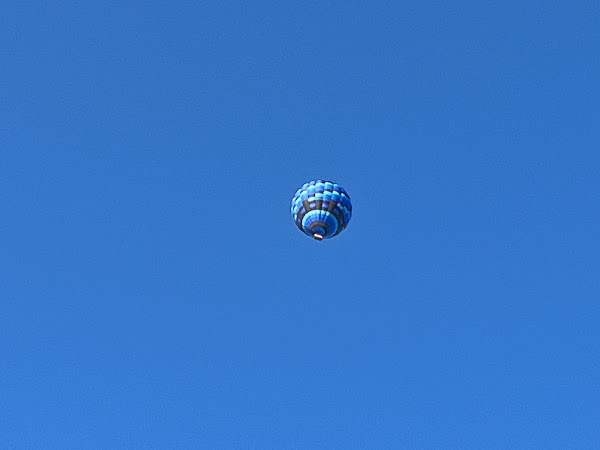
First Overhead Balloon of the Season
Another season turning: better weather, a bit of rain, lingering hot days (but cooler nights). It's a few days past the equinox, a few days short of the full Harvest moon, and I'm getting ready for eye surgery which will put me out of commission for a week or so, but should preserve the sight in my left eye.  In preparation, I've been taking it easy, pottering about the garden, and trying to ignore the news. Molly has taken to spending time with me on the backyard table when I go out to drink my morning tea, so I get a dose of companionship and cuteness before the mozzies figure out that I haven't bathed in repellant. 

Sunday in the Garden with Molly

Nylah is usually over behind the garage, keeping watch for errant dogs or babies who might stroll by. Although basically quite intelligent, her Great Pyrenees genes tend to keep her in "big dumb mop"* mode, more ornamental than useful. She is pretty to watch, but seldom photogenic enough to capture. The last photo I took was in June:

Nylah Lounging in Woody's Garden

In terms of holidays, the Celts celebrated the transition from summer to fall at the equinox, and through to Samhain (which marks the midpoint between the autumnal equinox and the winter solstice, and coincides with Halloween)--when cattle were brought down from summer pastures. I'm wondering just how long it will take the current weather patterns to complete the change, given all of the climatic upheavals we seem to be "enjoying." 

One of the seasonal markers that occur fairly regularly here in the northern part of Occupied Mexico is the Plano Balloon Festival, which takes place about ten miles south of here, near where we lived while my kids were growing up. This year it coincided with the equinox (September 21-24), and the opening photo for this post (taken on September 18) probably represents someone practicing before the event. I'm not sure how much ballooning actually got done because of high winds and other kinds of threatening weather, but we haven't attended the event since The Beloved Spouse began tennis coaching, because by then the whole thing had become a circus and the team got wrangled into participating. 

Celebrations of all kinds seem to have run amok in the last few decades, in part because they've become huge cash cows for businesses. The market-capitalism greed machine has overtaken the communitarian aspect of seasonal goings on, and now they all appear to run together, and the hype begins earlier and earlier each year. 

A couple of days ago, while I was looking through old posts for a family recipe, I revisited the first year of this blog. The November 27th, 2007 entry (entitled "Enough") ruminated on greed--so it's clear that things haven't improved much. 

Nevertheless, I keep finding small indications that some shifts might be taking place. An article in the New York Times on young Luddites (from December of 2022) suggests that technology may not have quite the grip that some of us fear, at least among Gen Z. These kids actually remind me a bit of a group of rather pretentious intellectuals from the local boys' Catholic high school and the public school I attended. We all got grounded around graduation time because we stayed out all night at one guy's house reading T. S. Eliot, discussing The Little Prince, and listening to a couple of them playing Chopin etudes--and there weren't even flip phones for us to call home with.

An article in this week's New Yorker, Sam Knight's "A Young Architect's Designs for the Climate Apocalypse"  quoted from an essay by architect Anthony Dunne in the journal, Reading Design: "A Larger Reality," wherein he quotes from Ursula K. Le Guin's acceptance speech for the National Book Foundation Medal for Distinguished Contribution to American Letters in 2014, where she enjoined science fiction and fantasy, and other "writers of the imagination" to challenge the profiteers of the written word who dictate what should be written and rewarded:

Hard times are coming, when we’ll be wanting the voices of writers who can see alternatives to how we live now, can see through our fear-stricken society and its obsessive technologies to other ways of being, and even imagine real grounds for hope. We’ll need writers who can remember freedom — poets, visionaries — realists of a larger reality. (Copyright © 2014 Ursula K. Le Guin)

With this in mind, I'd like to recommend two small books that provide us with a glimpse of a possible future that avoids Armageddon and turns away from climate apocalypse: Becky Chambers's A Psalm for the Wild-Built and A Prayer for the Crown-Shy (Macmillan 2021 and 2022). For a nice essay that shows why I might be recommending these books, see Molly Templeton's "The Refreshing Hopefulness of Becky Chambers' Monk and Robot Books."

See you on the other side. Or, as Capt. Mal Reynolds would say, "Y'all gonna be here when I wake up?"**


*Not an entirely coincidental reference, because I just finished my second reading of A Prayer for the Crown-Shy last night, I found this passage describing Sibling Dex's family dogs to be a particularly appropriate description of Nylah's lineage and demeanor: "There were three of them, all shaggy herders painted in soft swirls of brown and black, smart as hell when they were at work and big dumb mops every other hour of the day" (113). It's also appropriate that the photo of Nylah I included was taken in the little garden dedicated to one of her two predecessors, Woody--of Woody and Arlo fame. Both were border collie mixes, of which breed Nylah is about half, all of these three also big dumb mops when they're not busy being herders.

**False alarm. My retina surgery has been postponed. But thanks for any concern.