Showing posts with label gardening. Show all posts

Saturday, June 4, 2022

Sanctuary

Spring had been toddling along, with repairs to the plumbing having been effected, and maintenance of our forest canopy having been attended to (see above), and various garden entities having budded, bloomed, hatched, fledged, hopped, and flown. The process is continuing apace.

But two weeks ago the unspeakable happened again, and I have (for me, at least) been rendered speechless. On May 25, The Dallas Morning News reported the killings in Uvalde with a one-word headline: "AGAIN." This week's New Yorker's cover (by Eric Drooker) says it all, wordlessly.

I grew up in a war-threatened world, but never had to worry that anyone would ever take a war-weapon and kill children, Black people, old people, religious people--anyone who got in the shooter's way. But it has happened here--in the country my father, brother, and both grandfathers had spent significant years of their lives defending--again, and again, and again. And it won't stop because our country lacks the moral fortitude to do what needs to be done, and our populace--in absurdly and frighteningly large numbers--lacks the interpretive skills to understand the very Constitution they insist they're "protecting." And Texas is at the epicenter of the madness.

I cannot do anything about it. Godless folk like me don't see prayer as helping anything, and I'm pretty sure any "thoughts" I might be able to "send" to the catastrophically bereaved families would amount to a teardrop in an ocean of sadness. I can send a little money where it's needed, and I can vote. Which I will do--to agencies that support children's welfare,  and for people who will try to rectify the damage done by intellectually and ethically challenged public "servants." But unless enough people are as angry as I am, these efforts may be for nought. We'll see in November.

In the meantime, with temperatures oddly low and rain uncharacteristically abundant at the right times, the seasons move along. My tomatoes are about to be turned into jam, and roasted, and eaten out of hand. In a week they'll be gone, and I'll spend the next three months trying to keep the plants from withering on their stems in hopes of a fall crop. 

And since I have little to add to any conversation at the moment, here are some photos of our little oasis--our sanctuary amidst the madness. These are the reason and the means for our survival.

Flora

Blue-eyed Grass

Yarrow

Alliums

Rain Lilies

Rose of Sharon

Late Wisteria
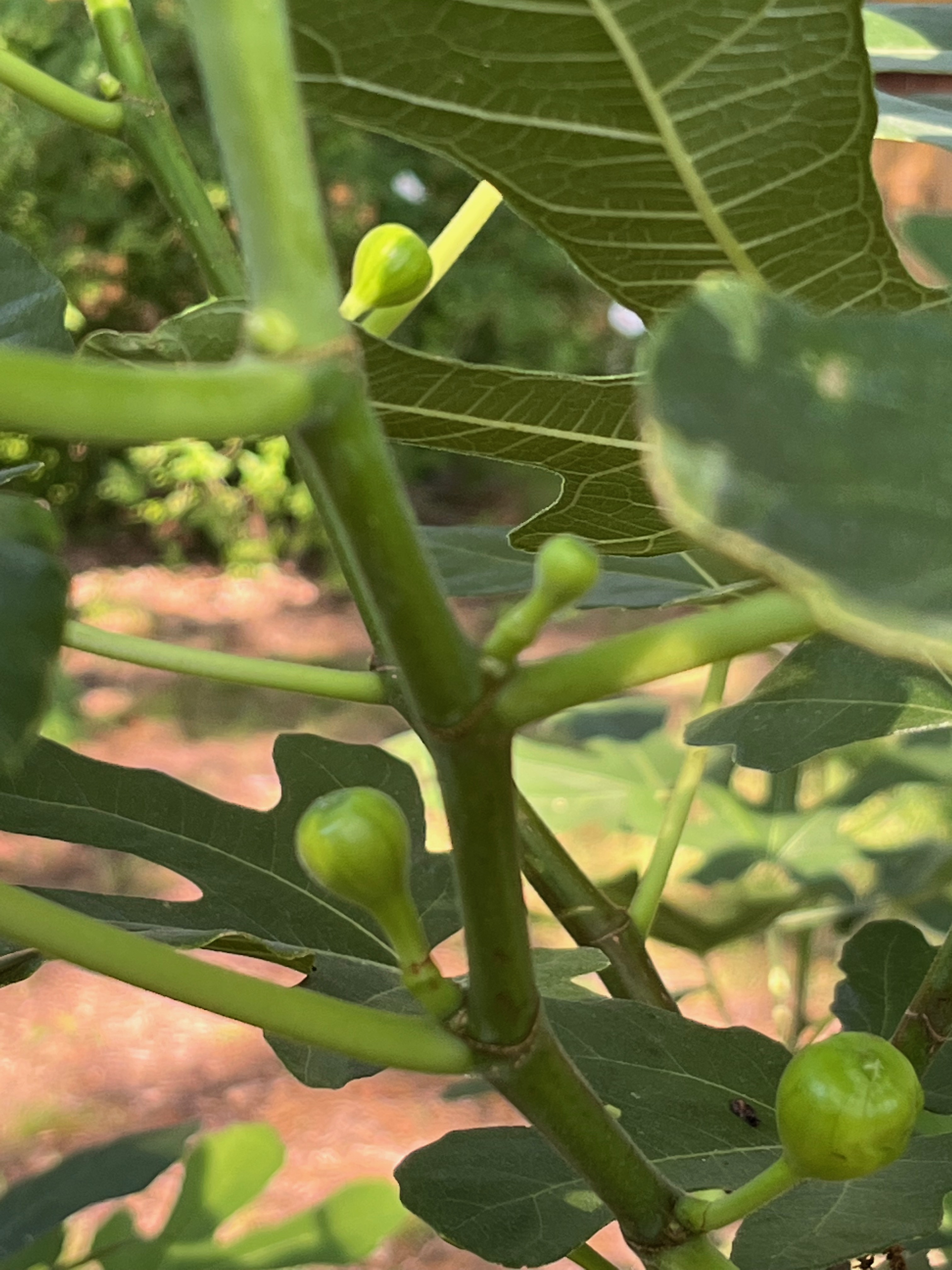
Baby figs

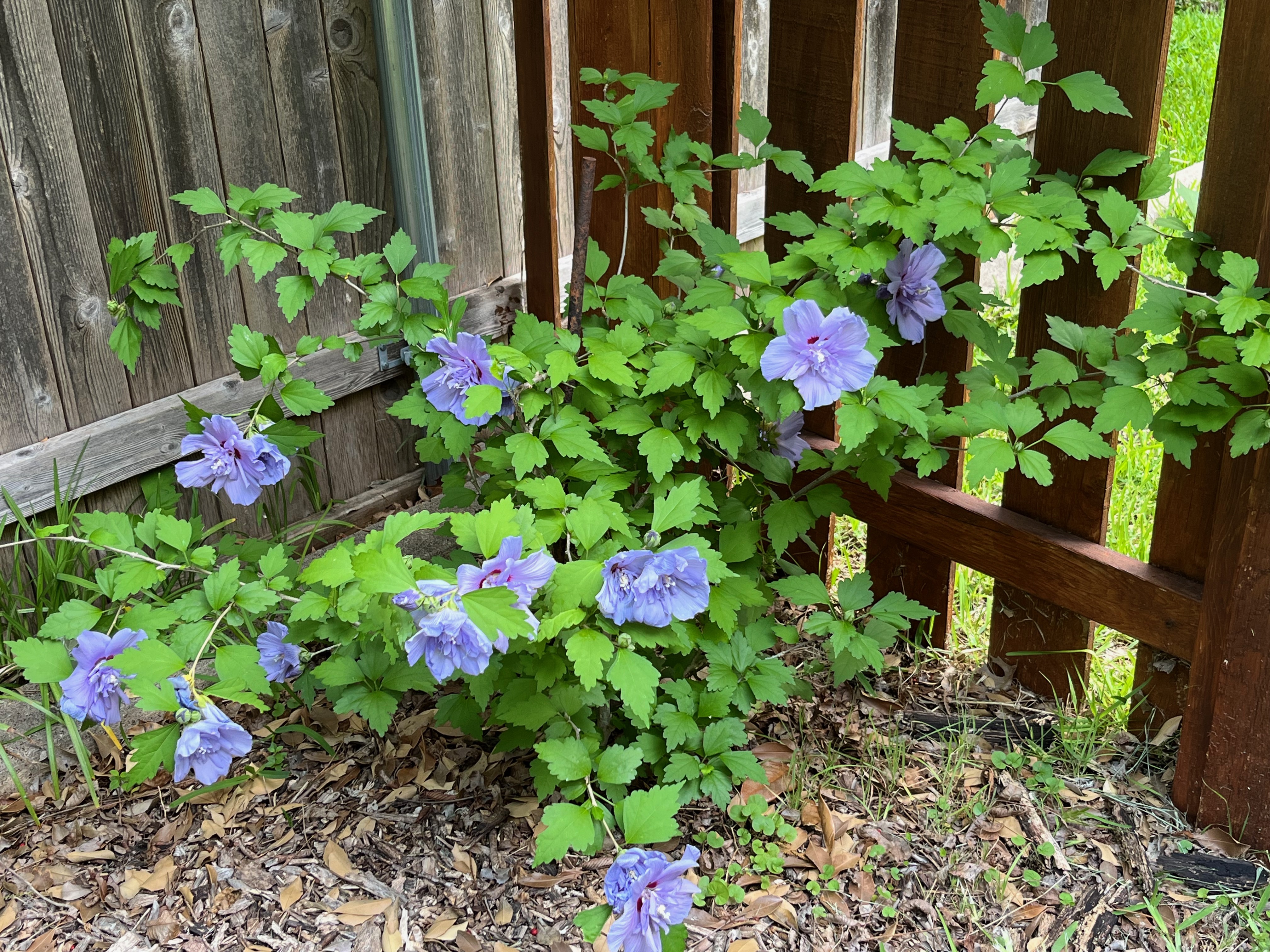
Rose of Sharon (double, blue)


Fauna, wild and domestic

Green and Brown Anoles

Lady Bird Beetle, developing (on oregano)

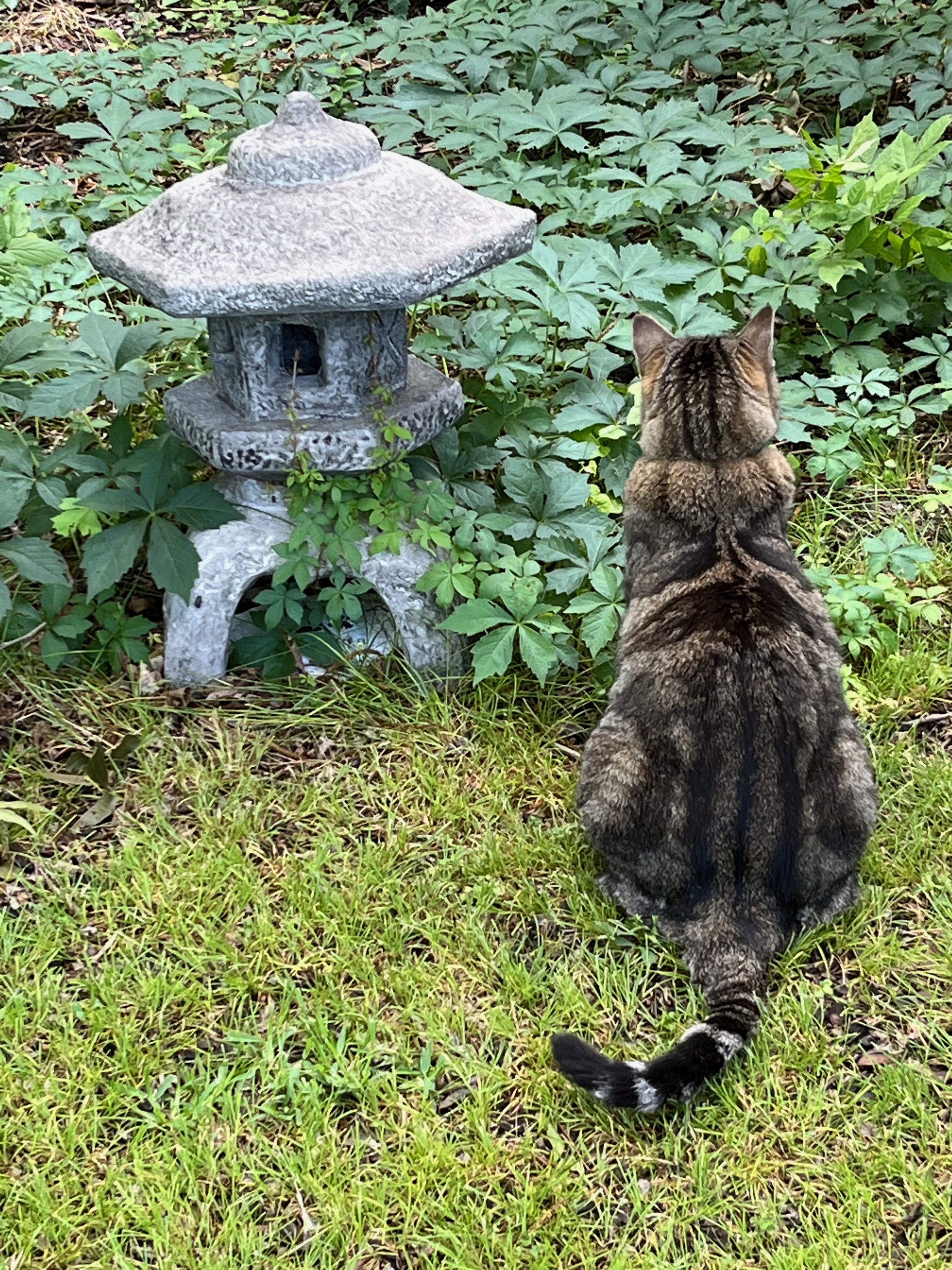
Molly, meditating next to Emma's grave

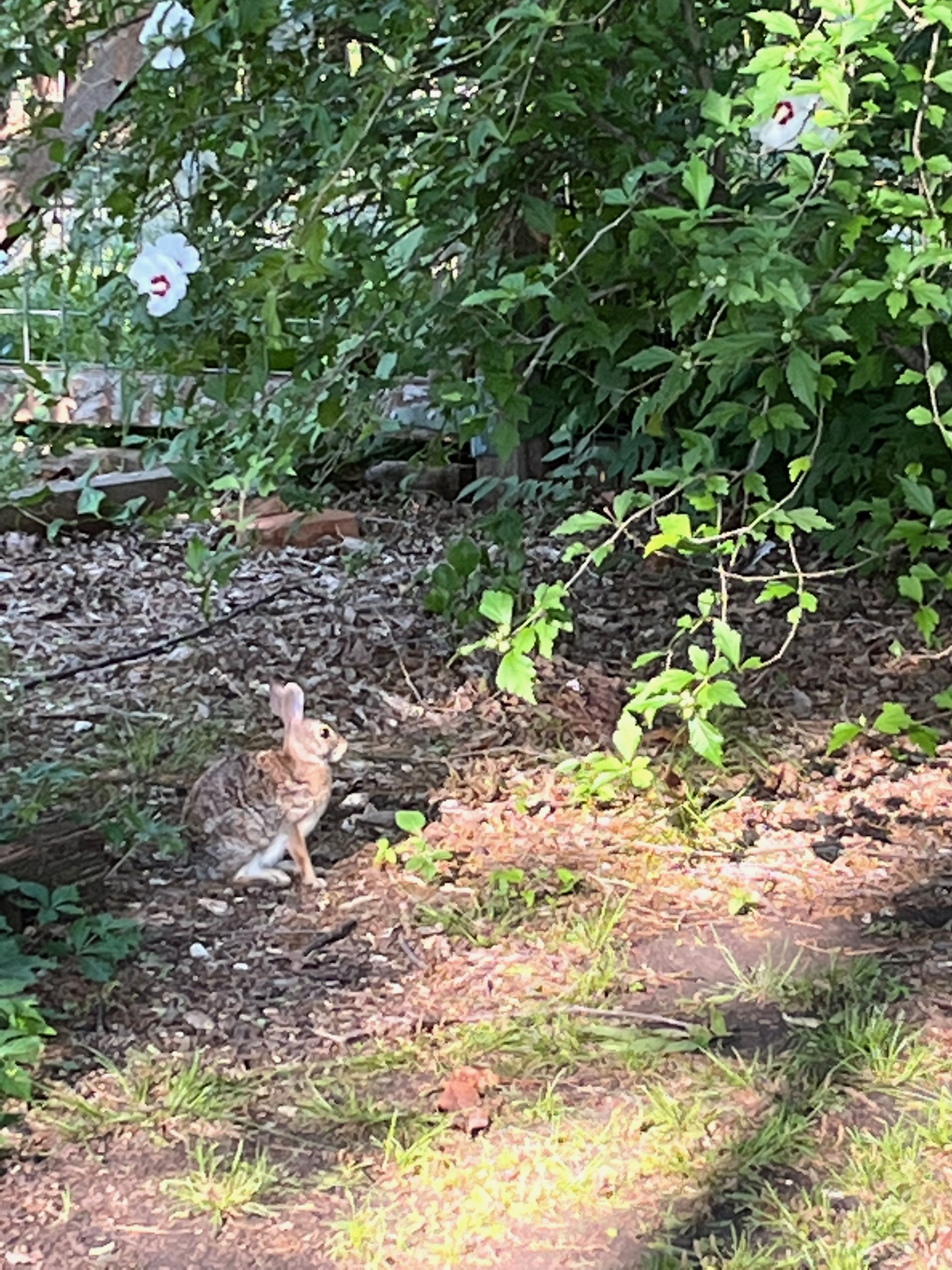
Bunny (near the hogwire fence, avenue of escape)

Molly, being lectured by a squirrel

Nylah, keeping watch nearby

As long as the weather holds, it's easy to find solace in our little patch. Word from our families is generally good, although my 99 year-old cousin, Willma Gore, died recently only weeks away from her hundredth birthday (which is today). That makes me one of the oldest surviving Chrysler-Tate women; time to get my part of the story set down in prose, which I should be able to do thanks to Willma's efforts to record my Grandmother's memories of nineteenth-century pioneering in Nevada and California.

The Beloved Spouse has taken over some of the burden of researching our house for historical registry purposes, so we're hoping to get that completed by the end of the year: a nice hundredth birthday present to the house we love--and in which hope to finish up our time on the planet. Meanwhile, we'll keep taking care of the house and garden, and I'll keep writing about it when I have something that might be worth putting down. 

My father's dying instructions to me were to "write at the end of your stint." He came from a family of historians (his mother Clarice Tate Uhlmeyer, his aunt Myrtle Tate Myles, and his cousin Willma Willis Gore, were all history buffs and also wrote about the family in many contexts), and he often wrote about family and Owens Valley stories for local outlets. My mother was a journalist, but her focus was on Taiwan, where she spent much of her adult life. Nevertheless, my genes have made it difficult for me to keep my mouth shut, which is why I've managed to keep this blog going for this long (fifteen years this month). Thanks to encouragement from some of my former students and occasional readers, I guess I'll keep going for another fair while.

Writing, as it turns out, is way of pursuing sanctuary: by imagining better times and better ways of living, we keep hope alive. Meanwhile, I guess I can just follow the advice of the old comedians, Bob and Ray (my Dad's favorites), who used to say, "Meanwhile, hang by your thumbs." Or at least by harnesses appropriate for preserving the welfare of trees.

Image notes: most of the photos were taken by iPhones, including my new mini; for the larger format ones I used the Canon Eos. Thanks to the guys from Preservation Tree, who have been taking care of our little forest for about fifteen years, for letting me snap shots of them doing their sometimes scary work.

Sunday, March 21, 2021

Spring At Last--More Or Less

I meant to get this up yesterday, on the actual date of the equinox, but I became sidetracked by revisiting old spring posts and comparing notes with myself. For a different spring celebration, peek back to last year's post with its better photos and better outcome: Finding Things to Celebrate: The Vernal Equinox.

This year, everything's late, with the exception of one lone iris; these usually appear toward the middle of April, but this one was apparently confused by the unusual weather. Wisteria, which should be in full feather at this point, is only just beginning to bloom. I can smell a  bit of holly blossom, but the flowers are still almost invisible. Daffodils are pretty much gone, but it does look like the paperwhites will survive, since their stems are back. Meager bits of redbuds are showing, but it's clear that we've lost a major trunk. I may give up and plant a more robust version in its corner, now that I've moved the compost bins (to keep Molly from using them to vault up to next-door's fence). I do enjoy encouraging the volunteers, however.

There should be better sun in that corner this year, due to the severe pruning we did of the privets last fall. Speaking of which, there's still no sign of life on those. But one I planted on the back fence two years ago is leafing out nicely, although it won't be of much use as a screening plant for a while, because it's still quite small.


By this time last year, the figs were promising; big leaves had emerged and a couple of tiny figlets were popping up. This year: nothing. It may have frozen down to the ground this year (as it has in the past), which means we'll have no figs until quite late, if at all. Sigh.

What this all adds up to is that every day brings a small adventure. As soon as I can get to a nursery, I'll fill in some gaps with perennials. I'll get baby veg from Whole foods, and maybe a couple of well-started tomatoes from Costco, but I'm a little less ambitious than I have been.  Now that the greenhouse is in, the soil needs building up, which means assembling compost and well-rotted goodies from behind the garage. This is the site of an attempt at hugulkultur, but has mostly been forgotten, so it's probably time to do something with whatever has come of it. What we need to be doing now is planning for the future that involves mostly things that come back without our help. Now that I have access to a local farmers' co-op, growing an abundance of my own food is less compelling.

The Beloved Spouse and I recently came to a rather sudden realization that moving west permanently is so impractical as to be impossible. (It involves clearing out the garage.) So we've begun to focus on making our place as habitable as we can, and as tolerable as is practicable. This involves putting up a well-insulated tool shed to block the pool pump noise from next door, creating more seclusion by judicious planting along the back and side fences, and rewilding major swaths of the property--while still maintaining spaces for pet-entertainment, human conviviality, and post-pandemic social engagement. 

To address our continuing malaise about where we live, we've vowed to take Porco and the pets and just get out on the road, frequently. In early April, we're taking a trip to Lake Mineral Wells, one of my old hiking haunts from about forty years back. A longer trip much further west is in early planning stages, and exactly when will depend on traffic. RV travel has been quite popular during the Plague, so we're unsure about when we should go. At the moment it looks like late spring or early fall, to avoid as many crowds as possible. The popularity of Nomadland and YouTube RV vlogs makes us a bit leery of gigantic fifth-wheels taking over the desert in mobs. But we will be able to boondock, so that promises to open up some options.

By April 2 we'll both have been fully vaccinated, and so will most of our family. Things are thus looking up, and we should have a fair-weather respite before warm-weather storm conditions begin factoring into our travel ambitions. 

I've written before about my efforts at learning to love the prairie, but hadn't realized at the time that it would become so difficult. Noise, politics, greed, and concrete are only a few of the components that make retirement much tougher than we had anticipated. Some of that has been ameliorated by the regime change in DC, but it will be some time before this part of the world gets over its antipathy toward intelligence, wisdom, and expertise. [Revisiting the linked post (to 9 May 2017) has provided a bit of perspective (we were also contemplating permanence at the time); the current condition of my memory makes it difficult to recall all of the many attempts I've made to reconcile myself to exile in Texas.]

Unfortunately, time is what we have less and less of. But spring does make it easier to ease our anxieties and make better use of that time, by ushering a welcome breath of optimism. 

If anyone who reads this is wondering (as my students used to, constantly) why anyone would want to maintain a blog (let alone more than one), philosophizing and fostering memory both provide compelling excuses. Not many folks frequent my posts, but in the absence of friends and family to keep memory alive, writing is its own reward. I recommend it to young and old alike, because time itself is so very fleeting. 

The last year, as problematic as it has been, is gone. Already. Although far too many people have suffered far to grievously,  it will not be long now before what becomes normality (I'm not sure we can actually return to it) overcomes the recollection of at least a few of the trials.

So, if you haven't already, I urge you to at least begin to keep a journal. Think about shifting from daily snippets on Facebook to longer, more thoughtful posts directed at your family and its collective memory. I have only recently discovered how very fortunate I have been to acquire a repository of family letters, and to have kept numerous journals and several blogs. I rejected Facebook and Twitter from the beginning, and will have more to say about what Jenny Odell calls the Attention Economy in my next post. In the meantime, I'm going out to lay in my hammock with Odell's book, and enjoy the first full day of spring.

Be well, stay safe, and get vaccinated!!


Thursday, January 19, 2017

Sunrise, Sunset

Although I'm not terribly happy about this photo (I generally avoid power lines and try to frame photographs without stray house bits, like the corner of the gable on the upper right), it and its companion below represent this post rather nicely, and were taken on the same day about a week ago. The "Sunrise" shot (above) was taken from the front porch with my new iPhone 7.


The "sunset" shot, taken in the back yard, also includes power lines, so there's an additional aspect of symmetry; I usually stand atop chairs and other furniture to try and avoid them. However, I wanted to submit something to Skywatch Friday for the first time in ages [as usual, thanks to the crew--and do go see what folks from all over have posted], so here we are; what you see is what I got, and I'm making do.

As I am with all manner of things these days. I will not be viewing any of the inaugural festivities tomorrow, and since the weather should be warmer, will instead be doing some early garden prep, reading some Wendell Berry and Joseph Wood Krutch, and watching a couple of episodes of Netflix's wonderful adaptation of Lemony Snicket's A Series of Unfortunate Events. I can't imagine anything more appropriate, given the state of the Union. Thus, the photos seem to hold out a little promise for a not completely bleak future, but I won't be holding my breath.

Despite my usual less-than-optimistic view of things, I've decided to find ways to muddle through the next four years. I'll be rethinking and redesigning my website (and changing the name from Owldroppings to Owl's Farm; this blog will be linked to it), clearing out the detritus in the garage and attic (in case we decide we just can't abide Texas any longer), and finding more ways to live more sustainable lives.

Inspiration for all this has come from several places, including my new subscription to Australia's Slow magazine, ecopoets like Krutch and Berry, and even the latest issue of American Craft. The editor, Monica Moses, has written a wonderful little essay on the role of craft in keeping one's sanity in uncertain times: "The Tough Make Art," in which she describes her own plan:
 
Like a lot of us, I’m looking for ways to cope with the discord, to feel hopeful again. I’m returning to the basics: eating well, exercising, trying to sleep, spending time with loved ones. But I’m also doubling down (as the pundits would say) on art. (American Craft, Feb/Mar 17, p. 10)

My own map of the next few months includes efforts to accomplish much the same sorts of things, including the art part. Her sentiments are in tune with much of what I read among the thoughtful writers whose works I frequent, now that I find myself sticking to the Arts & Life section and the funnies in the Daily Poop,  and the Books and Trilobites sections of the New York Times. Never have I felt more grateful for the library we've amassed, because it should prove most valuable over the next four years, reminding me that sanity might well prevail.

So, for what it's worth, here's what I have in mind:

Eat Real Food. I stole this designation from my Whole Foods Market newsletter, which offered its customers meal plans in several categories. But it's really what I've been trying to do for years, with the help of Michael Pollan and Mark Bittman and others. I've become rather more serious about it since my retirement awarded me with more time for contemplating and planning. We also recently invested in a smaller refrigerator, which facilitates consciousness of how much we buy and where we have to store it. It's also a terrific deterrent to food waste. The Beloved Spouse gave me Lidia Bastianich's new book, Mastering the Art of Italian Cuisine, and The Big Book of Kombucha for the holidays (plus Cooking With Loula, a lovely Greek cookbook I noticed while shopping for other people's gifts). I have always loved cookbooks that are more about history, philosophy, and culture than technique, and these are all inspirational additions to the "food" segment of our aforementioned library. Over the last two weeks I've spent more time planning meals and enjoying the process than I'd been able to do for several years.

Get Real Exercise. The realization that the new, pricey drug I'm taking is likely to prolong my life significantly (and my favorite cardiologist's reminding me that exercise won't do squat for my cholesterol but will do massive amounts of good for my brain and overall well being) has made me more conscious than ever of movement. What finally got me perambulating the neighborhood was the death of our sweet dog Woody last summer. His brother Arlo no longer had a reliable source of exercise, so I started walking him, dropping him off at the house when he got tired, and then continued on my own several times a week. TBS would join me on weekends and holidays, and we've gotten to know the topography of the neighborhood better than we had in the previous sixteen years. Over his winter break from teaching we kept up the dog walking, but neighborhood exploration slacked off due to weather and family obligations.  But a movement-tracking app on my phone has helped keep me from being completely sedentary, and as the weather warms up and I get into the garden more (as I plan to this afternoon), I should hit the "active" category much more frequently (now "lightly active" rescues me from couch potatohood). The goal is to use my body better, get stronger, and get out much more.

Make Stuff.  Some time ago I bought a lovely journal with a William Morris design on it (actually, a sketch for a wallpaper design) in which I've been writing down and sketching out ideas for art books and other little projects. I'll try to get some of these done--including the redesign of my web pages. But I've been wanting to go back to painting and "making" things,  which I haven't done since my children were small. This includes working on the house and garden--painting and plastering and staining and the like, along with general homekeeping, mending, knitting, and quilting. Using one's creative juices seems to be a particularly satisfying way to make it through trying times.

Write More. Having received my first rejection slip (for a story in a science fiction anthology), you'd think I'd have sworn off any desire to publish more than for myself  (and my one or two faithful readers). But I've decided to do what I used to urge my students to do: take the criticism to heart, and use it well. I'm not sure I agree with all of the comments, but I'll have them in mind when I revise the story and submit it somewhere else. I also need to work on More News From Nowhere, and to go back to the old-bats-in-space novel I started working on a couple of years ago. I actually posted on the Cabinet recently, and have lots of ideas for more entries. Letters to friends are on the list, too.

Read Even More. I probably read more than I do anything else, but now that I've made it through the entire run of Midsomer Murders twice on Netflix, I've got no afternoon distractions from the telly. TBS and I have stuff we watch when he gets home (because he's too brain dead after teaching to accomplish anything more impressive), but when I'm not out moving and growing things, I have a huge stack of books to begin or to finish. And then there's always Cat-watching time in the garden, which will need to be extended as the weather improves. Emma likes company when she's out, and I can't leave her entirely unsupervised. In  addition, there's nothing quite as peaceful as watching a cat and a dog snoozing away in the afternoon sun.

This is all very ambitious, I know. But since I'm too old and tired to be politically active any more, if I get even a little of it done, I'll have accomplished something. And so, Dear Reader(s), may the future be better than we have any right, at this moment, to expect.

Saturday, April 20, 2013

Earth Day 2013: Small Steps

Over the past five years I've managed to post on or about Earth Day (last year there were two essays), in an effort to recognize a significant moment in U.S. environmental history, and to reflect on themes that prompted me to create Owl's Farm in the first place. In my current state of time-deprivation, it's difficult for me to post more than a few times a year, but this seems as good a time as any to think about change in general, as well as particular changes over the last twelve months. 

The first celebration I actually remember took place in Philadelphia in 1970, and I still have the poster I bought during those festivities. Today it happily adorns my kitchen wall and reminds me that in this little corner of the universe, every day is, in some way, Earth Day.

If I've learned anything over the years, it's that we can't really afford to lose our focus on what needs to be done, and I'm occasionally heartened by the fact that celebrants are no longer just cranky old folks like myself, but a include a much broader spectrum of citizens.  I don't actually go out and march or dance in the street anymore, but I do spend time out on the property, taking inventory, and reflecting over the past year.  This time, the view from the back yard toward the house is far more pleasant than it used to be, thanks to some major renovations last summer.  New paint, a new bathroom and work on the old one (including new, very low-flow toilets), R50 cotton insulation in the attic, and solar screening will make the coming summer more livable.  Plans for a geothermal heating and cooling system had to be abandoned because the cost would have made the rest impossible. But our energy bills are fairly low anyway, and we bought a portable air conditioner that works more efficiently than our old window unit. The attic fans have been repaired, which will double the air flow through the house, so our bills will probably be even lower, and our power use reduced even more.

Over the last few months, as I've talked with students and colleagues about what we've been doing with the house, I've realized that there are some fairly simple strategies involved with lightening one's impact on the planet that most people never really think about.  None of them require much cash outlay, they do some significant good, and they confer a bit of peace and satisfaction upon their practitioners.

Shorter showers  A couple of years ago a conversation on Orion's forum took this one on, and many writers saw it as purely symbolic.  Real activism, they suggested, needed much more significant action.  But think about it.  If most people take daily ten- or twenty-minute showers, and then cut those in half, common sense (plus a bit of math) tells us that it all adds up. I'm talking water-savings here, in a drought-stricken region, rather than money, because monetary savings are small ($9/year or so).  A four-person family can make a bigger dent if everyone's on board.  Subtract the cost of a cute kitchen timer, and you're still saving water even if the timer costs a tenner.

Even better, take fewer showers.  In her terrific 2010 book, Green Barbarians, Ellen Sandbeck (her blog is here) noted many ways in which our overly sanitized society wastes water and money on all manner of stuff designed to eradicate every possible germ (good or bad) and make us not smell like human beings. But we don't actually need to shower every day in order to be civilized or even healthy.  It's thus quite possible to forgo a shower without contaminating the earth. 

Rain Barrels We bought four (we had one) when we had new gutters installed last summer, and the only problem we foresee is keeping them from becoming mosquito breeding farms when they're over-filled after a rain.  But BT mosquito dunks take care of that problem (as does a judicious lowering of the water level), and there's enough water in each one to take care of gardening needs quite easily.  They won't help much with the lawn, but I'm also working on minimizing the amount of non-productive farmland.  We do need romp space for the dogs, but over the next year or so I'll be replacing as much St. Augustine as I can with fruiting shrubs and low-maintenance ground covers.  Since the non-productive area still provides ground-water recharge,  I won't feel guilty if every square inch isn't edible.  But many herbs make good ground covers anyway, and I can always give extras away to needy culinary students.

Compost Anything edible can be composted and turned into soil and/or fertilizer.  For about a hundred bucks last year I snagged two bins for making Bokashi compost--a Japanese technique that essentially ferments your food waste, including protein sources like bits of meat and cheese.  The ongoing investment in the probiotic granules needed in the process is the only expense after the bins.  I bought two, and rotate them. When one is "done" it sits for a couple of weeks, and the contents then buried in the garden.  If, like us, you've vastly reduced your food waste,  the process can be rather leisurely.  It might take a month or more to fill up a bin (even when spent flowers and other non-food plant materials are added). In the meantime, you also drain off liquid that can be diluted with water to use as a liquid fertilizer.  The areas in the garden where the first two batches were buried are now lushly verdant.  Some stuff still ends up in the big compost bins (weeds, mostly), and most of our coffee grounds are used on the roses, but we end up with about four Bokashi "crops" a year. We're also considering a method called hugelkultur, which involves burying our brush pile and covering it with the excavated dirt to form raised beds.  This would solve the problem of having to use the chipper-shredder (the only gas-powered yard appliance we own). We get a large amount of brush from the trees on the property (rain + wind = downed limbs), and seldom have the time or energy to deal with it.  Some gets used for firewood, but the rest is just sitting there. Being a brush-pile.

Note: This week's explosion in West reminds us all too painfully of the price we pay for depending on chemical fertilizers.  This world really needs to find ways to feed its population without relying on toxic and potentially disastrous combinations of chemicals.

Growth Even folks who don't have large sunny spaces suitable for food crops can grow herbs.  Many herbs are perennials, and also flower, so they can take the place of ornamental annuals.  I now have a large, expanding crop of Greek oregano growing in the front border, and have started taking bits of it to plant in obscure corners of the property.  I'm also thinking very seriously of planting the parkway with peppermint, which is otherwise pretty invasive and has to be grown in isolation or in pots.  But a few strategically placed mint transplants next to the street will look better than the weeds that grow there now, and will smell nice when dogs walk on them, and when their owners clean up after their poopy pooches.

The abundance of shade from our 18 trees (not counting the ones growing along the back alley, which have been planted by birds and squirrels and left to flourish by us, since they mask the houses behind us and offer some considerable privacy) means that our veg-growing success is mixed.  I'm hopeful about the tomatoes, peppers, and tomatillos I have planted, and will try beans and radishes as well.  Now that we have some sunny space in the side yard (which was fenced by a cranky new neighbor last summer), I may try something there--especially since that's where one of the Bokashi batches was buried, and where the next one will be as well.

Anything green we grow lowers our carbon footprint, and if we're smart it will also lower our food bills without contributing to Big Agriculture.  People with kids can accomplish even more, because growing things provides all manner of lesson-material and connects children with the planet in ways they'll never forget.  As I'm fond of mentioning, all the talk about the financial deficit we're leaving them ignores the environmental mess they're inheriting if we don't radically alter our habits, soon. Financial deficits and surpluses are ephemeral; they can be eradicated as fast as they're incurred or accumulated. Environmental deficits, on the other hand, can take millions of years to correct.  And that's if we get started today.

Image note: The photo was taken a couple of years ago in what was once called "the accidental garden" in the southwest corner of our half-acre property. It later turned into our own personal carbon sink, after years of purposeful neglect turned it semi-wild.  It will regain some of its garden-ness when we reclaim some of it as cropland after attempting to establish a hugelkultur patch this summer.

Thursday, May 6, 2010

Skywatch Friday: Hiding in the Garden

This has been such a bad week for the environment that I've found myself spending every spare moment in the garden. What was once the Accidental Garden and then the Carbon Sink is on its way to becoming a full-fledged, small-scale forest--although we will probably manage it in somewhat the same way that the Germans do theirs. We bought a scythe (not the curvey kind, but the back-and-forth swinging kind that isn't built for short folk and requires the wielder to wear long pants and sturdy boots) for dealing with tall weeds, and will continue to pick up fallen branches. But mostly we'll let it go. At least until we find an old Shasta Airflyte trailer to tuck in there for a guest house.

The true reward is in the air. All the smelly stuff is in bloom: honeysuckle, privet, jasmine, roses, Chinaberry, catalpa. The scent is absolutely intoxicating, and I'm not a great lover of perfume. I cannot abide women (or men, for that matter) who marinate themselves in cologne and then make me breathe it. But when it's a natural component of spring air, I'm a devotee.

Even with all the sources around me, though, nothing overwhelms. One has to breathe deeply to really get it in the lungs; otherwise it simply wafts by, begging noses to follow. And even though the mozzies are already out in full force, it's well worth sitting out with a glass of wine. When the temperature rises just a bit (as it promises to do by the weekend), the night-garden will also light up with fireflies as soon as sunset begins, and the combination is simply magical.

The only way to improve things would be to add lilacs to the mix, but (alas) they don't grow well here, and I'll have to do with the jasmine on the front porch for heavy-duty fragrance.

Yesterday morning I went out to do some veg-drenching (putting Garrett Juice on the cucumbers and tomatoes), and caught the mist on the wild gladiolus plot (they're naturalizing like crazy and are taller this year from all the rain) as the sun rose over the fence.

The first crop of baby sparrows has completely fledged and been kicked out of the nest, but even though they're as big as their parents, you can tell who they are because they raise a ruckus, fighting over food that mum and dad are still catching for them. I saw one mother get tired of it all and enjoy a nice fat caterpillar herself when she couldn't figure out which one of her noisy little brats to feed.

The little Shasta Airflyte bird house my daughter bought me for last Mother's Day is occupied (despite its new location adjacent to the recently-planted heirloom tomatoes, and thus next to a great deal of activity), but there are no signs of squawking babies from its interior yet. I'll actually be surprised if anything hatches, but it's still fun to watch the potential parents stuffing the interior (the hole is on the other side) with bits of straw and fluff.

One of the first apps I bought for the new iPad (yes, we did succumb) was a bird ID with sound clips to help me figure out who's who when I can't see the singers of the songs. But I'm also looking forward to sitting out with the new machine and our portable WiFi unit to use some of my bookmarks out "in the field." I'll have to check to see if a compatible e-book of Peterson's or the Audubon guide are available, too--so I can build a virtual bird education unit to carry about.

Last evening the Beloved Spouse and I were sitting out with iPad and binoculars, trying to figure out what I'd been watching high in the trees lately. Thanks to the yard bird app, we were able to determine that it's probably a Phoebe, particularly notable by its habit of flying out and back to the same branch. This time it was the behavior, rather than its looks, that helped us out.

The backyard life and death drama continues, too. This morning, whilst romping with the pups, I discovered a dead fledgling Cedar Waxwing--about the only way you can catch them up close. Its lower parts were still a bit spotty, but it was pretty much full grown. Since they don't feed on the ground (so the dogs didn't get this one), I wonder if our marauding hawk had dropped his dinner.

This week's Skywatch Friday entries are all scented trees against the sky, except for the one shot of the morning mist. I haven't posted for a while, and will get back to the dismal news at the weekend, but for now, I'll enjoy my day of working at home, sitting in the garden, and hiding away from the world--and visiting other peoples' skies vicariously.

Happy Skywatch Friday, and thanks again to the team for running the show.

Image notes: the opening shot is of the volunteer catalpa tree growing next to the driveway, with the moon in the background. The other sky/tree encounter features the Chinaberry. Both Chinaberry and catalpa are considered by many to be trash trees, but I love them. My grandmother and her mother both nurtured volunteers in their yards, and I'm carrying on the tradition. The Chinaberry reminds me both of Italy and Taiwan, so it's a permanent member of my little forest.

Sunday, May 17, 2009

Nature and/as Nurture

One reason I don't like watching much television is not just because of advertisements, but because an increasingly large number of these ads seem to concern drugs. It seems that every other male (particularly the ones who watch evening news programs and sports events) in the country suffers from "ED." Cholesterol medications even start messing with language (according the the Crestor people, "athero" is an acceptable alternative to "atherosclerosis." Never mind that "athero" by itself only refers to half the equation: the fatty deposits alone, not the hardening thereof). The assumption that people are becoming too stupid or lazy to pronounce the disease properly may not be far off the mark, but should advertisers be pandering to them? An unnerving number of ads refer to sleep inducers or antidepressants, suggesting that things are getting to be just too much for us, to the extent that we're willing (or should be, according to the ads) to put up with all manner of horrific-sounding side effects in order to regain our equanimity.

But all this makes me wonder how much our modern ailments depend on our technologically mediated lives. The human species evolved with much simpler tools that required active participation to manipulate, so I suspect that we weren't particularly fat 100,000 years ago. A certain girth, in fact, probably indicated fertility in women, since we now know that when body fat falls below 10% ovulation and menses can cease. The earliest portable artworks, such as the Woman from Willendorf and the recently discovered ivory carving from Hohle Fels cave in Germany, may well have been fertility talismans (instead of Paleolithic porn as the news wonks seem to prefer. For anyone interested on my take regarding persistent sexism in art interpretation, I'm working on a related post for The Owl of Athena).

Of course, our distant ancestors were always in danger of being offed by some preditor, or by other mishaps, but people didn't settle into habitats without a reliable supply of food sources, so unless climates shifted too quickly, early hunter-gatherers might have well have been lean, and they almost certainly weren't plagued by the scourges of obesity. Women who successfully bear children, however, tend to have large breasts, stomachs, and thighs, so it shouldn't be surprising that evidence of fertility should prove to be an admirable quality. And after a hard day of gathering and felling game, people probably didn't have much trouble getting to sleep--even if they might have been a bit anxious about the size of that mammoth herd down the valley.

I'm not saying that lives in the past were necessarily healthier than those we live now, but it's hard not to come to the conclusion that certain aspects of those lives might indeed have generated fewer of the lifestyle illnesses to which we are now prey. Although genes for high cholesterol and diabetes were undoubtedly floating around, if you don't have the luxury of getting fat from inactivity and indulge in a diet heavy on the Big Macs and soda pop, those genes may not have a chance to kill off the carriers. Other perils may have contributed to shorter life spans (things like new strains of flu and plague, not to mention infections and the like), but these would have been accidents of nature rather than the consequences of excess.

Some of us, because of peculiar combinations of nature and nurture, are doomed to require life-long medication with potentially dangerous drugs in order to live out our artificially lengthened lifespans. I for one am immeasurably grateful to the folks who invented statins and especially to those who discovered that a substance originally used as rat poison could actually help keep people with certain heart conditions manage the clotting rate of their blood. I'm also really glad that human beings are smart enough be able to replace defective body parts or functions with mechanical substitutes. I'm on my second round of not being dead because of advances (not miracles, mind you, because they were invented by brilliant people who know exactly why they work) made in medical science that, if I start behaving more like our distant ancestors, may well extend my life significantly.

The bottom line is that we have choices, and we should be making better ones. No one is forcing us to eat fatty hamburgers or guzzle high-fructose corn syrup or pull carcinogen-laden smoke into our lungs. If we have functioning arms and legs and half a brain, we can get our butts moving, get a lot more exercise, learn to eat more healthfully, and obviate the need for most of the drugs that are causing me to wear out the mute button on my remote control.

Come to think of it, I kind of miss the exercise I used to get from getting up off the couch to turn down the volume. So maybe the real answer is, like the song goes, to blow up the TV. Spend all that time out in the garden, growing our own food, taking care of our own land, calming our own anxieties, relieving our own stress, building useful muscle mass and reducing our body mass indices without the need of pills or the advertising designed to sell them. Who knows. Maybe watching all those birds going at the business of making baby birds might inspire solutions to other problems as well. (The illustration is of the cunning birdhouse my daughter bought me for Mother's Day; it's roughly fashioned after the Shasta Airflyte trailer I dream of securing to use as a guest house in the back of my garden.)

For the record, I spent a couple of hours this morning pulling weeds, transplanting escaped violets, cat mint, and chamomile, sweeping pecan catkins off the patio and onto the compost heap, and admiring the nasturtiums I've finally been able to grow, thanks to all the wet, dank weather. Now, having probably over-reached my capabilities (I'm just six weeks post-op), I'll retire to a lawn chair with a good book and work on the inside of my skull for a while. The day is lovely, and this weather won't last for long, so I'll let nature nurture me while I can.

Monday, February 9, 2009

The Reader in the Garden

There's currently something of a stew about the future of newspapers (and see this article in The Economist), but this morning I realized just what I would miss if even our local rag were to disappear.

Due to other preoccupations yesterday, I failed to read the "Points" section of the Sunday Dallas Morning News. But since I actually remembered that I'd forgotten to read it, I pulled it out of the recycle bin this morning to catch up, and took it out with me to the garden to enjoy in the unusually clement weather apparently caused by global warming. Since I've been blogging, this has been my favorite section of the paper, because it frequently brings me new items about which to get my dander up, and keeps me apprised of both local and national opinions on matters both great and small.

And so it is that I came upon an especially relevant essay, "Hard Compromise for a Rural Jew," and an even more relevant blog: Casaubon's Book. Mind you, I might well have tripped over the blog in my travels around the web, and been attracted by its intriguing title (George Eliot's Middlemarch is one of the books I read young and that literally--in the literary sense--changed my life), not even knowing about its focus: oikos. As its author, Sharon Astyk, notes,

The problem isn't just the economy, or our energy use, or global warming - or rather, they are all part of the same larger problem.

The overall content is focused on some of the same things that get ranted about here on the Farm (and occasionally on the Cabinet), but she's been at it a lot longer (since 2004), and she's a real farmer (in upstate New York), and a real Jew (as opposed to whatever I now am), and an actual published writer. Her aim, like mine, however, is tikkun olam, and she writes about how to do it.

In the article (an adaptation of a blog post) Astyk discusses the difficulties of being an observant Jew who lives in rural New York in order to farm. Now, since Jews are by nature community-bound folk (she points out that Jewish practice requires others--a minyan is needed for almost everything important), the fact that she has to drive thirty minutes on Shabbat to get to a synagogue requires a compromise she's not comfortable with. In fact, this is why it's harder to be Jewish than it is to be Amish, because the Amish are still a farming people, whereas Jews (who were once a farming people) have all moved to cities and suburbs. Over millennia, in fact, Jews have systematically been deprived of farms, making them especially leery of investing their wealth in land--either that or it has driven them to see owning land in Palestine as a divine right and causing a rather ironic set of problems.

Astyk's blog is erudite, wide-ranging, literate, and funny. The article reprinted in the News doesn't let on that she's also a Peak Oil activist--which might lead some readers to think she's some kind of apocalyptic nut. But she's no nuttier than Mormons who keep a year's supply of food in their pantries, or than anyone who wants to be as self-sufficient as possible, and her advice on gardening and storing food is fun to read and highly instructive. In fact, I plan on reading her garden design posts rather seriously to help me overcome some of the problems I've been wrestling with over the years. I don't have a farm, but I would really like to make the part of my garden that isn't consciously accidental (is that an oxymoron?) more productive than it has been in the past.

The trouble with reading the newspaper in the first place (and watching the increasingly pessimistic economic news on the telly) is that the Peak Oil people make more sense every day, especially as some of their predictions begin to pan out. I've been aware of oil reserve depletion since I heard King Hubbert speak to geology students at Penn back in the seventies, and have never been convinced that he was being overly pessimistic. Regardless of whether these folks are right or wrong, however, Astyk's discussions on how to preserve and store food, how to grow it in the first place, and how to preserve community at the very least offer an anodyne during times of economic confusion and discomfort. Her practical advice also makes a great deal more sense than the "ten things you can do to save the earth" remedies.

To top it off, she also considers the conundrum faced by print news, especially papers that also host free online editions: Why Buy the Cow When I’m Giving Milk Away for Free? The Problem of Newspapers (and includes in her consideration those of us who publish online for free).

In parting, I'll add to the problem by posting a link to the list of 2008's ten best online newspapers, according to the Bivings Report. The Dallas Morning News wasn't on the list (with good reason, since the Points section and the funnies are its best parts even in print, and the online version is difficult to navigate, to put it kindly)--but my other morning (online) paper was #1: The New York Times.

Saturday, April 19, 2008

The Idea of Order in East McKinney


She was the single artificer of the world
in which she sang.
--Wallace Stevens, "The Idea of Order in Key West"

Every now and then I'm bothered by my apparent inability to create any kind of truly ordered environment. My house, my yard, my desk, my "office" (it's actually called a "workroom" because it's a room where about a dozen instructors attempt to get work done)--none of the spaces within I live are particularly ordered. That is, there's no real regularity about them, other than their physical boundaries (walls, a fence--of sorts, sidewalks, alleys). Patterns, especially in the back half of the house property, are difficult to distinguish, and there doesn't seem to be much of anything that's actually planned.

I did think I was going to dig up a nice neat rectangle in which to grow veg, and that I would also create a more or less formal herb garden in a square outlined by a concrete sidewalk. Last year we used brick from an existing path (which had once led to a now-dismantled, corrugated fiberglass-enclosed compost bin, but over which a Rose of Sharon bush had grown, so that only short dogs could actually walk on it to the bin) to create a patio space for a fire pit and/or table and chairs. But at the moment, the only real structure is that patio and the concrete walk. The herbs have gone in rather haphazardly, and a couple of tomato cages (made from recycled grid-wire) stand at the ready (in case I actually acquire tomato plants to place in them). Two supports from the old summer house stand in the eastern corners, one for a squash plant, another for who knows what. Later in the season, assuming that I eventually get most of the space planted with something, it'll probably look really nice; at the moment, it's pretty much just bare and scraggly. The "before" picture is featured in my last post. I'll update it when I've got this week's herbs installed.

When I first moved into this house, eight years ago, the southwest corner of the property was bordered by luscious blackberry bushes and some grapes, but the entire area was otherwise bare, except for poles and grid wire that had been used for growing beans. The earth had been nuked with every pesticide imaginable, it seems, because there were no bugs that summer, save for a few mosquitoes. No butterflies visited, no fireflies, and there were no earthworms for several years. I planted herbs, and a few flowers, but nature pretty much had her way--planting wild primroses, sunflowers, pokeweed, Texas dandelions, and even a basketflower or two. Every year more wildness happened, and I kept planning to till an open space for planting. Tomatoes went in back there, and peppers, and more herbs, but few of those survive today: oregano, one patch of chives, germander, and Mexican mint marigold. The rest is wild grass and baby trees, with honeysuckle growing up them. No order. Perhaps pattern--but indiscernible to me.

Just this week it occurred to me that what I have growing in that little .25 acre plot is my own personal carbon sink! By letting nature take its course, I'm actually helping to offset my own carbon expenses by growing a carbon-dioxide-sucking area that will consume more C02 than it emits--and perhaps absorb some of the hot air that gets spewed on this blog . . .

So the Accidental Garden is turning out to have a purpose, if not a pattern--and has inspired me to let it develop into its own little wildlife habitat, by interfering as little as possible (I do have to trim the wild grapes out of the burr oak if I want it to survive--and it's a great tree), by letting things take their course, and relegating path-building to the dogs. Over the summer, I'll try to produce a species map on which to log what's happening, but gradually, I think, I'll move out all of the purpose-planted flora and just see what happens. I will probably leave a chair or two in there, for sitting and contemplating what I (and Mom Nature) have wrought, because it has the makings of a sanctuary. At least until some bureaucrat from the city comes by and makes me chop everything down because I'm violating some bloody code of civilized behavior.

My lack of order, it seems, is also being visually rewarded. The wild gladiolus "forest" is in bloom, and just yesterday afternoon I discovered a patch of blue-eyed grass in the front yard, tucked in under a pecan tree. New mullein florets are springing up in gangs near the irises (which have bloomed profusely despite my efforts to let them die off). Iris species, except for the wild flags one finds in mountain meadows and other wilderness areas, are the bulldogs of the flower world. They're presently so completely engineered that no matter how charming (and both bulldogs and irises are charming), one feels guilty about having them. I'm not particularly fond of mine (irises, that is; I've loved my bulldogs) because they're a constant reminder of the previous property owner, who had no particular love for anything wild--except for the maniac squirrels that populate the neighborhood. And they're about as wild as the iris garden: completely fostered by human existence. But now even the front border, which has been neglected almost completely since last spring, is putting forth blossoms of the hot colors (reds, yellows, oranges) planted there. If it weren't for all the peeling paint and the unmown lawn (to be remedied tomorrow), the place would look practically civilized.

But my real goal seems to be to mitigate the effects of civilization, not to propagate them, so what goes in front this year will be as many native plants and odd-ball, water-thrifty additions as I can locate. This should help throw a bit of disorder into the mix, and help balance the porch-rail painting operation that began this morning, when I started scraping off the three layers of previous colors (including turquoise, of all things) in preparation for sanding and priming. I hope that's not too orderly of me, but it's really designed to keep entropy at bay, and keep the house from falling down around our ears.

My apologies to Wallace Stevens for my cavalier modification of his title. I am, alas, far from the sea, and don't sing all that well any more. But I'm frequently reminded of this poem when I'm out there, in my world--the one over which I have little control, and little ability to bend to my will, but which seems, nonetheless, to be the product of my own making.

Top photo: My grandmother's metate, with yesterday's rain reflecting a leafing-out pecan tree.

Tuesday, April 8, 2008

Spring Miscellany

One thing about Spring: it’s busy. I have to make choices I normally wouldn’t have to, because everything’s so demanding. Get out there and plant stuff! Clear out the weeds! Pull the wild grapes out of the bur oak! And do your normal stuff—clean house, cook, read, prep for classes. What’s an old gal to do?

I did manage to spend the better part of Friday and Saturday working on the sodden plot for the potager, and I got some yellow squash and a tomato in. I’m not sure how either will do, because I’m not sure about the amount of sun, but I’ll put in a couple more tomatoes in test plots elsewhere, and some beans. The rest will pretty much be herbs, all of which are still sitting on the table out back, waiting to be transplanted.

Two observations: color in my garden works on a complimentary schedule. It happens elsewhere, too, such as when the bluebonnets and the Indian paintbrush bloom together. In my yard the yellows and purples come out in tandem: Carolina Jessamine, mullein, yellow oxalis (or sorrel, I think), dandelions together with grape hyacinth, ajuga, henbit, and some little purply lily-like things that come and go so quickly (and there are so few of them) that I never remember to look them up or get a picture. In Chicago I could always count on the violets to be first up (the season starts much later up there), but then the pattern would be similar.

The other thing I noticed this weekend is that accidental gardens promote accidents. Before the heavy rains of last week, my husband had started tilling (with a “garden weasel”) the plot I’m using for the new herb garden. He was stopped by the deluge, which turns out to be a good thing, because (in the meantime) I picked up a copy of the latest Mother Earth News, with a nifty article about low-maintenance gardens. Lee Reich offers eleven tips for starting a new garden, and the very first one is “Minimize soil disturbance; always try to preserve the natural layering of the soil.” Hot dog! A really good reason not to till up the whole area—just what needs disturbing to allow planting. The rest can be covered with mulch to make pathways. Another idea was to plant the food garden as close as possible to the house. Well, now I'll be able to step out of the back door and practically fall into my dinner.

I then proceeded to use two of the corners from the old “summerhouse” to support the yellow squash and tomato plants I’d bought from Whole Foods last week. I put the one for the squash in the corner of the potager, and the other outside of it, open to the late afternoon sun (I hope; the pecans haven’t leafed out yet, so it’s hard to tell). There goes the plan for a veg garden outside the concrete sidewalk area. I can’t seem to get away from wanting to sit there in comfy lawn chairs, instead of tearing it up to plant things in neat little rows. Pots of herbs surround that support, which (again, I hope) will sport a nice big patio tomato plant as time goes on. Photos will be posted as soon as everything settles in.

So the new plan is to visit a couple of nurseries this week and pick out stuff on a whim. And then to plant it where it “wants” to get planted. We’ll see. Beginning-of-quarter planning interferes, but if Spring Fever proceeds apace (and if the weather holds), I’ll be getting up earlier and gardening before I go down to Dallas to teach.

One more thing: I’m developing some “rules” for aging (modeled on the “rules” for technological development with which I regale my students). The first of Uhlmeyer’s Rules For Becoming an Old Bat is “Old people shouldn’t get sunburned.”

Idiot that I am, I forgot to use sunscreen on my shins. I usually cover up pretty well otherwise, with a long-sleeved shirt, hat, socks, shoes, and gloves. But I had on pedal pushers (Capri pants, I suppose, is the more up-to-date term), and my shins got too much sun. Now, Rafael Nadal (how's that for a cheap plug for the U. S. Open?) wears these pants to play tennis in (“pirate pants” my tennis-coach husband calls them), and he looks pretty good. But old folks don’t tan like that. As a result, I have splotchy red shins between my white sock line and the equally white line where my pants stopped. Next time, longer pants.

Finally, in my never-ending search for blog fodder, I picked up a couple of books during Border’s educator appreciation weekend (25% off almost everything). Book-shopping is another reason I didn’t get as much done in the garden as I wanted. Anyway, look forward to ruminations involving Kurt Vonnegut’s Armageddon In Retrospect (a collection of unpublished stuff, gathered by his son Mark), Lee Siegal’s Against the Machine: Being Human in the Age of the Electronic Mob, Jeffrey D. Sach’s Common Wealth: Economics for a Crowded Planet, Margaret Atwood’s Penelopiad, and Kim Stanley Robinson’s global warming trilogy.

It’s going to be an interesting Spring.

Photos: Yellow Carolina Jessamine and purple wisteria; the bare potager.