Showing posts sorted by relevance for query endangered alphabets. Sort by date Show all posts

Saturday, September 29, 2018

Atlas of Endangered Alphabets

NEW ATLAS OF ENDANGERED ALPHABETS FEATURES PIONEERING WORK ...

O
ver the last several years I've been supporting various Kickstarter campaigns designed to preserve languages and writing systems from around the world that are in danger of disappearing. These projects have involved quite a few extremely enjoyable efforts aimed at teaching the scripts associated with indigenous languages or mother tongues in countries often dominated by cultures not necessarily in sympathy with native folk. I'll list these with links later, but wanted to take time this morning to alert you all to the latest campaign, described in the above video.

We're about half way to the goal at this point, with not much time left to meet it; so, if you're so inclined and have a bit of spare cash available for an enormously important good cause, please watch the video and go to the Atlas of Endangered Alphabets home page to support the Atlas. As always, there are some nice rewards, although this time I opted just to support the project without snagging any loot. Even if you're not familiar with many of the cultures involved, keep in mind that a number of these endangered scripts are associated with Native American languages.

As Tim Brookes, the founder of the Endangered Alphabets project, mentions in the video, this is an ambitious and expensive project--but I think it's particularly timely in today's fragile political climates.

Addendum (30 September): Here are the Kickstarter pages for the previous campaigns:

Endangered Alphabets

Endangered Alphabets II: Saving Languages in Bangladesh

Mother Tongues

The Right To Read, The Right To Write 
100 Words for a Children's Endangered Language Dictionary
And here are my posts about some of the projects:

The Right To Read, The Right To Write

Revisiting Endangered Alphabets and Languages

International Mother Language Day

Endangered Languages, Revisited

Independence and the Right to Read and Write: A Word from Tim Brookes

Losing Languages

As many of us who have taught in the past well know, language is fragile. If not nurtured, and used well, speakers tend to lose fluency, vocabularies decrease, and the ability to read the great literature of one's own tongue diminishes. The downward spiral can be slow, but often seems inexorable. I urge folks to spend some time on these pages (particularly the Kickstarter efforts) to get an idea of just how important this work really is.


Tonight the Beloved Spouse and I will be attending a Gala in honor of the 40th anniversary of the Center for Translation Studies at UT Dallas, where we were both students. One of the most significant influences on my pedagogical career was the idea of teaching humanities using the translation process as a model--which I learned under the tutelage of Dr. Rainer Schulte, who founded the program in 1978. It seems fitting that this milestone be celebrated at a time when cultural understanding has become so vitally important to political interaction around the world.


The Atlas of Endangered Languages provides an important tool to facilitate that understanding, and I hope that anybody still reading this blog who is interested in its language-related components can help make the Atlas a reality.

Tuesday, June 21, 2016

The Right To Read, The Right To Write


I'm devoting this post to an ongoing concern, and one you've seen me discuss numerous times on The Farm: the importance of language, and the danger represented both by the decline of linguistic richness and the disappearance of language systems.

Some years ago I participated in Tim Brookes's Endangered Alphabets Kickstarter campaign, and later joined his advisory board. Both the original project and its sequels, Endangered Alphabets II: Saving Languages in Bangladesh, and Mother Tongues succeeded in helping to raise awareness about the disappearance of indigenous languages by creating astonishingly beautiful carvings in a wide variety of endangered scripts.

The latest effort, The Right To Read, The Right To Write has been launched this week to enable Tim to "create a major exhibition of carvings for International Mother Language Day 2017 to celebrate and support endangered cultures." The goal is larger than the previous ones, $15,000 in thirty days, but its aims are equally lofty:

My goal is to create the most ambitious and significant set of Endangered Alphabets carvings yet—20 separate carvings of the phrase “mother tongue” in the traditional written languages of those cultures, carved in woods native to those cultures. These will make up a major exhibition to open on International Mother Language Day, February 21st, 2017, the largest and most high-profile display of the Alphabets so far. My aim is to spur public discussion and awareness of the importance of inter-cultural respect, and the dangers of language loss.

Keep in mind that these carvings are hand-crafted on gorgeous wood, and have to be carefully packed and mailed to their destinations. The Kickstarter page goes into more detail--and also features the goodies that come with donations--including the newest edition of Tim's book, and an Endangered Alphabets wall clock--which I just may get for myself as a retirement present.

If you were in any doubt about how important the whole question of the disappearance of languages and alphabets actually is, consider the following:

As my students have heard me claim innumerable times, writing is the most important technology ever invented by human beings. Period. We didn't invent fire; we found it. We didn't really invent stone tools; we simply modified found objects. Even weaving (which I consider far more important than stone weapon making as a measure of human achievement) was probably suggested by observations of plants and insects. Other primates can sign, but writing is purely human. No other species does it.

If it weren't for writing,  there is no possible way we would be where we are today. We've been creating and keeping cultural records since Cuneiform, Indus Valley script, Linear B, Egyptian Hieroglyphs, and other Bronze Age inventions took us far beyond the simple mark-making we'd been doing since the Paleolithic. Without these records we would have no idea of our history on this planet, no way to record what we discover, no way to transmit ideas.

Even as human culture creates new technologies to communicate, these technologies are themselves language-based. Not all of these are natural (think HTML and other codes), but all are vital. And what's really scary to me is that some of the digital technologies we're becoming so reliant upon are actually diminishing the quality of natural language. Vocabularies are diminishing among the young, and while our visual skills may be improving, critical thinking and analytical skills (language-based) appear to be declining. I wonder if some of this stems from the fact that hand writing (and handwriting) has become less important than producing words on a keyboard. But simply recognizing the potential loss of languages and scripts is an important step toward their survival.

Just this morning the New York Times mentioned a podcast from the New York Public Library on vanishing mother tongues, From Ainu to Zaza (tonight at 6:30 pm; register at the link). The live taping is sponsored by The Endangered Language Alliance and World In Words (PRI).

It's fairly clear that concern over the loss of languages and writing systems is growing. Only recently I discovered The Rosetta Project, "a global collaboration of language specialists and native speakers working to build a publicly accessible digital library of human languages."  The Rosetta Disk is a palm-sized digital collection of information on over 1500 languages, and promotes the long-term preservation of world languages by building the "largest open, publicly accessible collection of resources on the world's languages."

One of the best ways we can help to preserve these languages, though, is to foster their use among the people who developed them in the first place. This is where I think the Endangered Alphabets projects are especially important. They tie the beauty of the scripts to tangible art objects that can be displayed publicly to promote their preservation.

Even a few bucks will help, Folks. And if you pony up some serious change, you could snag yourself a work of art and help save a culture. 

Related posts: Losing Languages (2011); Endangered Languages Revisited (2013); Revisiting Endangered Alphabets and Languages and International Mother Language Day (2016)

Monday, January 22, 2024

World Endangered Writing Day: 23 January 2024


As regular visitors to this blog may remember, I've been supporting the Endangered Alphabets Project since its inception in 2011 or so, when I read an article about its originator, Tim Brookes, in the New York Times.

The first Kickstarter project I ever supported was designed to gain the Alphabets a wider audience and to fund an exhibition of Tim's beautiful carvings of passages from languages whose writing systems are in danger of disappearing. I describe this effort in some detail, and my reasons for getting behind it in this post from November 15, 2011: Losing Languages. That campaign was highly successful, and ever since then I've been happy to back every campaign Tim has launched. My favorite has been The Atlas of Endangered Alphabets, but the range of projects has included games (like ULUS: Legends of the Nomads), teaching and learning materials, and even a Sudoku puzzle book.

World Endangered Writing Day represents an international holiday devoted to the projects and results of all these efforts (and many more). At this main link you can find the rationale behind the holiday, the events that will ensue, and ways to support the continuing work to save these remarkable expressions of human intelligence, creativity, and community. 

Except for encouraging folks to participate in various Endangered Alphabets Kickstarter campaigns, I don't usually solicit monetary contributions. But I do urge you to visit the WEWD sites linked to the main page, and consider contributing, even in a small way. The primary purpose of this whole, long, worthwhile endeavor is to preserve the art of writing (and thus help stem the tide of losing traditional languages) and in doing so to keep the histories of these people from disappearing.

In addition, if you're at all interested in the history of writing and its associated technologies, as many of my former graphic design and humanities students have been, please consider purchasing this latest book by Tim Brookes, Writing Beyond Writing: Lessons from Endangered Alphabets. It's available for sale in multiple formats at the link. World Endangered Writing Day coincides with the book's official publication date.

This whole topic becomes all the more important as literacy in general appears to be declining in this particular political and technological landscape. Try to contribute if you can, but even by looking through the linked materials you should be able to enrich your understanding of the critical nature of writing as a vehicle of cultural survival.

Thursday, February 2, 2017

100 Words for a Children's Endangered-Language Dictionary


Once again I’d like to remind readers that language and education have both long been preoccupations here on the Farm. In an era of political unrest brought on in part by cultural differences intensified by lack of understanding one another’ languages, it seems particularly important to endorse projects designed to demonstrate the power of language as a vehicle for identity and knowledge.

To this end, I’d like to draw your attention to another Kickstarter campaign to create a 100-word illustrated children’s dictionary in the endangered languages of the Chittagong Hills Tracts of Bangladesh. The goal is relatively modest (10,000 USD), and the funds will go toward the design, illustration, and publication of a dictionary of one hundred basic, important words in four indigenous  languages (Mro, Marma, Chakma, Tripura) as well as the official national language of Bangladesh (Bangla) and English.

I’ll let Tim Brookes (creator of the Endangered Alphabets and related campaigns) tell the basic story:
As you probably know, in countries all over the world members of indigenous cultures have their own spoken and written languages—languages they have developed to express their own beliefs, their own experiences, their understanding of their world. What they have collectively written in those languages is the record of their cultural identity: spiritual texts, historical documents, letters between family members, knowledge about medicinal plants, poems.  
In scores of countries, though, even in the West, those minority languages are unofficial, suppressed, ignored, even illegal. Children sit through classes listening to teachers they can barely understand; adults have to speak a second or even a third language to get social services or deal with the law.  
Denying members of a minority culture the right to read, write and speak in their mother tongue defines them as inferior and unimportant, and leaves them vulnerable, marginalized, and open to abuse. The extent and quality of education go down, while levels of homelessness and incarceration, and even suicide go up. 
On the far side of the world from me is the nation of Bangladesh, and in the southeast of Bangladesh is a region called the Chittagong Hill Tracts. This upland, forested area is home to 13 different indigenous peoples, each of which has its own genetic identity, its history and cultural traditions, and its own language. Some even have their own alphabets.  
All these languages and scripts are endangered. Government schools mandate the use of Bangla, the official national language, so entire generations are growing up without any sense of their own cultural history and identity—very much the kind of situation that has led to the endangerment or eradication of hundreds of Aboriginal languages in Australia and Native American languages in the U.S.  
We want to give those kids their own dictionary, in their own languages. Decades of research show that children learn best when they start in the language they speak at home.
I urge you to go to the Kickstarter page for a complete description and for a list of nifty rewards for various levels of pledges. Since its launch on January 27, the project has raised 2,758 USD, but there’s still a long way to go to ensure success (the deadline is February 26). If you’re looking for something to help you feel a little better about this world, the 100 Word Dictionary might help.

For a list of previous posts on related topics, use the "Search This Blog" feature at the top of the side bar, using "endangered alphabets" as key terms. As you'll be able to tell, I think that preventing the demise of the world's endangered languages and alphabets is vitally important to the survival of human knowledge.

Image credit: this is the sample page from the Kickstarter site; the actual dictionary will feature six languages rather than the three depicted.

Monday, October 14, 2019

A Few More Words About Language

As most of you know, one of my ongoing concerns involves the loss of languages in the world: both in their spoken and written forms. So it shouldn't surprise anyone that the appearance on my radar of three separate projects within the last couple of weeks has sparked a post.

The first of these is another Kickstarter project created by Tim Brookes, who founded the Endangered Alphabets Project, with which I've been involved almost from the beginning. The last one, The Atlas of Endangered Alphabets (this is my post, with further links to posts about other projects), has been a rousing success, and has prompted Tim to launch a campaign to enable and promote his new Thank You All exhibition.

This latest effort was inspired by a type designer, Ananda K. Maharjan, who created a poster featuring an almost extinct Nepalese script, Ranjana, that says "Thank You All."


This project isn't progressing as quickly as it might, so if you're at all interested in helping, please go to the page and check out the (as always) lovely rewards. I've got several of Tim's carvings exhibited in my home and they always draw enthusiastic comments. But the main reason to support this project is to foster the survival of the scripts that are disappearing on an almost daily basis.

In the New York Times (wherein I first read about Tim's book Endangered Alphabets) this morning, I happened on another project involving linguistic extinction: languages themselves.

Lena Herzog, a photographer with broad interests and talents, has developed a multimedia exhibition called Last Whispers (an "Oratorio for Vanishing Voices, Collapsing Universes, and a Falling Tree"), which explores visually and aurally several of the 3,000 languages that are in danger of extinction. The presentation was created with the help of producer and composer Mark Capalbo, and sound designer Mark Mangini, who won an Oscar for Mad Max: Fury Road. The audio samples on the website are haunting, and the trailer is stunningly beautiful. Public screenings of the Oratorio will take place at Montclair State University October 16-20, with discussions and other events--so if you happen to live in New Jersey, it would be worth your while to check it out. Those of stranded in Texas can only hope there will be a Netflix production or an expansion of venues.

Reading Zachary Woolfe's Times article on Herzog also made me aware of a 2017 video by the artist/anthropologist Susan Hiller, called Lost and Found. This work, commissioned by the Pérez Art Museum in Miami, consists of an "audio collage" of voices speaking about the political and cultural importance of native languages--in twenty three of those that are extinct or endangered, and some of which are being revived. The visual component of the film features text translations of the material, and images of "a shifting oscilloscopic line" accompany the subtitles. A YouTube video of an hour-long discussion between PAMM's curator, René Morales and Hiller is available at the link. Slides from the video augment the conversation. It was actually somewhat heartening to hear that a few languages and dialects are enjoying revivals--such as Cornish and Welsh.

While I was still teaching, I was fond of reminding my students (many of whom were graphic designers) that writing is the graphic representation of language. Although there are many languages in the world that lack--or have until recently lacked--written alphabets or syllabaries, we know about some extinct languages only because they have, in the past, been represented by written symbols that correspond to the sounds of words. My students were always fascinated by Egyptian hieroglyphs, which wasn't deciphered until the turn of the eighteenth century, but opened up an entire universe of much more accurate information on ancient Egyptian life than had ever been available before. Much of my early interest in archaeology was sparked by my having read about Michael Ventris's decipherment of Mycenaean Linear B as an early form of Greek (and its mysterious relative, Minoan Linear A, which is still undeciphered), which I discovered during my initial forays into Attic Greek--which led me to the Homeric dialect I work on sporadically to this day.

The efforts of artists and designers, as well as linguists, to preserve languages and scripts offers some hope to those of us who lament the loss of language in any of its forms. I hope that the projects I've mentioned generate new interest in the ways we communicate, both visually and orally, because these cultural foundations are far more important than most people seem to realize. Being able to see the beautiful scripts and hear the haunting voices of people speaking languages some of us have never even heard of deepens our understanding of the world. It might even make us grateful that our own language and its almost infinite variety of forms is still alive and well.

As Tim Brookes reminds us with his Thank You All project,  "This is what the world needs right now: not suspicion and divisiveness and bigotry but gratitude and openness to everyone, everywhere." Language and literacy provide connections over time and space, and the more access we have to others' stories, the more able we might be to appreciate the world as a whole.

Then, perhaps, we might not be so complacent about its destruction.

Sunday, February 7, 2016

Revisiting Endangered Alphabets and Languages


Once again, the confluence of coincidences has evoked a post; this time it all involves a new Kickstarter effort (The Mother Tongues Campaign) on behalf of Tim Brookes's Endangered Alphabets, New Scientist's cover story this week on "The Eloquent Ape" and related commentary, and the growing chagrin experienced by my Beloved Spouse, my colleagues, and myself about the demise of language skills among college students.

I've written about the Endangered Alphabets Project a couple of times before (Losing Languages in 2011 and Endangered Languages Revisited in 2013--partly about BASAbali), and so will try not to repeat myself this time. But if you've got the wherewithal to support a worthwhile project, please visit the links above, or see the Kickstarter page (the small campaign has been funded, but more donations will result in its enrichment).

What makes this kind of project all the more meaningful is watching less endangered languages (English and the major European languages, for example) suffer from the onslaught of technologies based on reflexive, instantaneous responses that require neither linguistic acumen nor simple thoughtfulness.  I've frequently railed against the twitter-machine (although not by name) and gave up a gig as a community voices volunteer for the Daily Poop because they wanted me to feed them occasional one-paragraph comments on things that really need more than soundbites.  And while I much prefer text-messaging to telephone calls because texting allows me the possibility of passing ideas through my brain-filters before they exit my mouth, I rue the effects of texting on the general public. This doesn't make me a Luddite computer-hater, however. I'm a great lover of e-mail because it allows me to respond to messages and engage in long discussions over time about important topics.  I've made more than a few on-line friends through the blogs and through MOOC fora, and these have led to rich and enjoyable conversations that I probably would not have been able to participate in if handwritten letters were still required.

Nevertheless, the Beloved Spouse and I spend part of each morning's newspaper-reading session grousing about the demise of vocabulary and the inappropriate use of prepositions. Our students constantly seek to "base off of" rather than "base on," or to "center around" rather than "center on." And while these might seem insignificant (after all, language changes), they indicate a growing lack of precision and subtlety in common parlance. What might it mean to base an essay "off of" a poem? How does a question "center around" a particular event?  As George Lakoff and Mark Johnson once noted (in Metaphors We Live By), prepositions often indicate orientational metaphors (waking up) that have to do with spatial relationships. So what could it possibly mean to center around something, or base something off of something else?

Of course, some prepositions are variable enough that regional differences arise (New Yorkers stand on line, while Californians stand in line; Brits use "difference to" where we say "different from"),  and arguments can be made that the implied orientations in these cases make some sense. But if we lose appropriate prepositions, or rich, varied vocabularies, how can we retain any level of literary or other communicative sophistication?

Another observation, somewhat related to the loss of vocabulary, is the loss of second language acquisition in the US. A not-so-recent, but still useful article from Forbes (August 2012) explores "America's Foreign Language Deficit." The upshot is that our kids are missing out on learning other languages and this isn't without consequences:

We should care – a lot – about our foreign language deficit.  We need diplomats, intelligence and foreign policy experts, politicians, military leaders, business leaders, scientists, physicians, entrepreneurs, managers, technicians, historians, artists, and writers who are proficient in languages other than English.  And we need them to read and speak less commonly taught languages (for which funding has recently been cut by the federal government) that are essential to our strategic and economic interests, such as Farsi, Bengali, Vietnamese, Burmese and Indonesian.

My periodic queries in my classes about who speaks a language other than English reveal a few Spanish-speakers whose parents came from Mexico or Central America, or an occasional Vietnamese, Chinese, or South Asian child of immigrant parents. A few Anglo kids have taken French or German in high school, and over the years I've found that some animation students or martial arts devotees have studied some Japanese. But hardly anyone who is not him- or herself an immigrant can speak anything but English fluently. 

In the end, what this means for real fluency in English is that too many speakers lack the depth of training necessary to really understand how language works. They develop only a superficial notion of how nouns and verbs work together, or how prepositions indicate the underlying cases of nouns. Adverbs dangle all over the place, introducing sentences in which they are completely unrelated to any verb or adjective that follows. This may sound nit-picky, but "Hopefully, the aliens won't attack" suggests that the aliens won't attack hoping to kick our collective fannies; I'm pretty sure they would. This kind of subtlety is, unfortunately, lost on most of the writing students I've taught in recent years.

The linguistic pleasures experienced in this house stem from long association with other cultures or wide-ranging literary and philosophical interests.  My early encounter with Japanese makes watching Studio Ghibli films in Japanese enormously fun; familiarity with Classical and modern European languages has widened the range of literary treats available to us--not only because we can read some of them in the original tongues, but because we can understand allusions in the works of the far more adept English-speaking writers of the past. 

It saddens me that so many of my students will never enjoy the richness of language, and they won't even know what they're missing. But I do wonder what will happen in a generation or two, when we old fanatics and nit-pickers are gone, and very few American college graduates really understand what they're reading. Even if the second language the 53% of Europeans are speaking according to the Forbes article (in contrast to the 18% of Americans speaking another language) is English, I wonder if in the end they'll actually speak it better than Americans do.

But as Tim Brookes, Alissa Stern, and others who work so tirelessly to foster the survival of truly endangered languages and writing systems have reminded us, some cultures are in imminent danger of losing their linguistic heritages altogether.  We can help them by contributing to their efforts; but we can also do so by reminding ourselves and others that language is a fundamentally human accomplishment. By ignoring its gifts, we diminish ourselves, and the potential impact on our future is problematic--and certainly not promising.

Image credit: Tim Brookes carved the above plaque, which spells out the word for "owl" in Balinese. It was my reward for backing the original Endangered Alphabets Kickstarter campaign. The plaque was photographed in the Burr Oak tree in my back yard, and illustrated the original post on the Farm.

Tuesday, February 16, 2016

International Mother Language Day

As an addendum to my last post, I'd like to note that February 21 is the United Nations' International Mother Language Day, which this year emphasizes the importance of appropriate languages of instruction, usually mother tongues, in early years of schooling. It facilitates access to education – while promoting fairness – for population groups that speak minority and indigenous languages, in particular girls and women; it raises the quality of education and learning achievement by laying emphasis on understanding and creativity, rather than on rote and memorisation. 

This event was the focus of the Kickstarter campaign initiated by Tim Brookes to create the carving featured on the poster above, and send it to Bangladesh where it will be displayed at Bistaar (the arts complex in Chittagong) as part of the Mother Language Day festivities. The effort almost doubled its goal (originally $1000), and the excess will be used to foster other goals related to Endangered Alphabets.

I initially became involved with these efforts because of my general interest in language and writing systems. In fact, a major component of anything I teach revolves around the importance of the visual communication of stories, ideas, and the human experience in general. This week's topic in Art History 1, for example, focuses on illuminated manuscripts, some of the most beautiful objects ever created by human beings.

But we often forget that without language, and without a code in which to communicate that language on a readable surface, many aspects of human experience and history would be lost to us.

I'm frequently reminded that I'm not alone in my interest and concern, even though the linguistic desert in which I live makes me feel that way sometimes. My news feeds in the last week or so were full of information on Genevieve von Petzinger's research in caves around the world. She has recorded geometric signs found at 146 rock art sites, and categorized them  according to shape in order to begin to understand what they might mean. A handy chart of these is available on the Bradshaw Foundation pages that describe her work. The variety of signs and their contexts may eventually lead to better understandings of why people have made these marks over such a long period (from the Paleolithic on) and over such an immense space. And even though controversy exists (and will most likely persist), it seems clear that early human populations "meant" something by them. They don't have to be a form of writing in order to communicate something to their "readers." But in essence, because we'll probably never really understand them ourselves, that something is lost to us.

Megaloceros with a line of dots at Lascaux Cave

English speakers in general, and Americans in particular, seem to be confident that our own mother tongue is so pervasive that it won't suffer meet its demise in the foreseeable future. It's precisely because of its ubiquity that it will no doubt remain one of the most-spoken and most-read languages in the world. But the history of language is abrim with examples of languages and/or writing systems that have been lost to one extent or another--from Cuneiform, Egyptian hieroglyphs, Mycenaean Linear B, and now Mayan (pretty well entirely deciphered) to Etruscan and Minoan Linear A (either only partially understood or completely undeciphered except for sound values). 
  
Decipherment of not-yet-understood scripts is a tricky business. One must have a large enough collection of samples in order to establish a frequency of signs, and the underlying language must be recognizable. So with the Rosetta Stone,  Jean-François Champollion and Thomas Young had a “crib” via Greek, and when Champollion realized that the third script must be Demotic (related to modern Coptic), the code could be broken. (The BBC article on the decipherment provides a nice summary of the  process.) After Mayanists such as David Stuart, Linda Schele, Yuri Knorozov, and Tatiana Proskouriakoff (among many others) had collected various bits and pieces of how the Mayan language worked from many different discoveries, Mayan was fairly rapidly deciphered. And when Michael Ventris realized that Linear B might be Greek (a notion dismissed by most at the time), he was able to figure out that the script did indeed record an early dialect of Greek.

But what we lose sight of today is the fact that, as David Crystal notes in his introduction to Tim Brookes's Endangered Alphabets, 

Over the past twenty years, the plight of the world's endangered languages has attracted increased academic and political attention. The figures are sobering. At least half of the world's more than 6,000 languages are so seriously endangered that they are likely to die out in the course of the present century. (Brookes 7)  

Even more troubling, as Crystal goes on to note, 

Around a third of the world's languages have never been written down, and when one of those dies, it leaves no evidence of its existence behind. (Brookes 8)

Efforts like the Endangered Alphabets project and the Endangered Languages Project, and organizations like BASAbali@ARMA, UNESCO, The National Geographic Society, the Endangered Language Alliance in New York City, Living Tongues, and others provide education, language training and/or research into preserving and reviving dying languages.

For an eloquent appraisal of the problem, and more background, see Judith Thurman's March 30, 2015 article in the New Yorker, "A Loss For Words: Can a Dying Language be Saved?"

As a parting shot, I would like to remind folks that language is one of the major components of being human. It enables us to think and to participate fully in our cultures, as well as to communicate with one another. It's also our birthright. So if we dismiss the language in which we were educated, and treat it as if it were some throwaway commodity, we will ultimately diminish ourselves. English may be in no immediate danger of disappearing, but its depth and the craft of expressing it are suffering under the weight of modernity.

To celebrate International Mother Language Day, here are some suggestions: visit some of the links above to discover the breadth of the problem and learn about some of the solutions people are developing. And for English speakers who are not yet concerned about diminishing language skills, here are two articles, one I found only recently and that describes the consequences of diminished vocabulary ("The Limits of Our Vocabulary Reflect the Limits of Our World," by Anna Brix Thomsen for The Hampton Institute), and the other a classic that I've used in every critical thinking class I've ever taught (George Orwell's 1946 essay, "Politics and the English Language").

Then go out and write something beautiful.

Image credits: The Mother Language poster was designed by Alec Julien, and photographed by Tom Way. Tim Brookes carved the text in the four languages of Bangladesh: Bangla, Marma, Chakma, and Mro. The Megaloceros image is from Wikipedia.
 

Saturday, November 28, 2020

Gaming For A Purpose

Sorghaghtani Beki
The latest Endangered Alphabets Kickstarter campaign launched on November 12, and was funded at its initial level (USD 20,000) on November 22. This is a record for us (I say "us" because I'm proud to have been involved with Tim Brookes's several projects almost since their beginning) and has prompted a "stretch goal" of USD 30,000 to be raised in the next twelve days.

For a complete description, see the page "ULUS: A Game to Save a Culture" on Kickstarter, watch Tim's video, and do please pledge if you can. And if you're interested in the history of the Endangered Alphabets projects, see these posts here on the Farm: The Thank You All Exhibition; The Atlas of Endangered Alphabets; 100 Words for a Children's Endangered-Language Dictionary;  The Right to Read, The Right to Write.

I'm particularly excited about ULUS: Legends of the Nomads, a game designed to help promote the survival of the Mongolian language,  script,  and culture--not only because I am the proud mother of a professional game designer (both table top and digital), but because games are so useful in helping people understand other people. This is not true, of course, of all games, which is why I continue to have conversations about the nature and content of modern, especially video, gaming with MSGG (my son the game guy)--as I have with former students during my days teaching game designers in my former life. One of the first posts on the Farm, back in 2007 (Virtual Unreality) contained a critique and a discussion with a gamer of a game called Bioshock, which seemed horrific to me at the time--but after the conversation I came around. A little.

At any rate, my affection for tabletop games is problematic, since I don't play them very often. I love the idea of them, but I'm such a terrible loser that nobody will play with me. Nevertheless, I've backed half a dozen Kickstarter campaigns for games that I took to my humanities classes for a quarterly game day to show students how learning about art and culture made really cool games possible. The students always enjoyed the wide variety of games based on Egyptians or the Maya or archaeology or even art historical topics and games adapted from ancient versions. Early art work and design images for ULUS promise to blow most of these out of the water in terms of graphics alone. I'm actually looking forward to engaging The Beloved Spouse in a few rounds of ULUS, because I suspect that I might actually enjoy playing something this thoughtfully produced.


I can't help but think that ULUS would have provided a much-needed look into stories and images based not on The Usual Suspects, and it will certainly provide an initial point of contact for most of us in the West with Mongolian history, folklore, and language through which a further, deeper understanding can be begin. For a description of the importance of this project to Mongolian cultural survival, see "Why Is Mongolian Script and Calligraphy so Important to the Mongolian Identity?"

Tim Brookes's creative energy and devotion to the very important causes he has supported offers me some real hope that a better, more inclusive, and more historically conscious future is possible. 


Image credits: both of these examples of the artwork for ULUS came from Tim Brookes. Sorghagtani Beki was known as "The directing spirit of the House of Tolui" for helping to establish the Mongol line under her son.


Monday, February 7, 2022

Dodging Dystopia

As I was thinking about how to put together a post about Tim Brookes's new Endangered Alphabets-related Kickstarter campaign (The Right to Speak, The Right to Read, The Right to Write), I was in the middle of pondering current efforts in Texas and elsewhere in the US to (once again) to ban books that certain factions don't like. This happens all too often, so much so that the American Library Association sponsors a website called Banned and Challenged Books and promotes an annual Banned Books Week to celebrate the freedom to read.

Still, English- (and other first-world language) speakers largely take reading, writing, and speaking for granted so much that our collective knickers get all knotted up when those rights are threatened (even if we don't quite understand what the Freedom of Speech amendment to the Constitution really means). But as contentious as things tend to get, nobody is threatening to ban our alphabet or eradicate our language. Here, at least.

Elsewhere, however, these irreplaceable components of culture are so threatened that for many years now, Tim Brookes has been working to save as many endangered alphabets (the graphic representation of languages) as possible possible. (See a list of posts on the Farm about the Kickstarter campaigns and my efforts to support his various campaigns here.) The success of these projects has resulted in a wide variety of resources from The Atlas of Endangered Alphabets to the recent launching of Ulus: Legends of the Nomads, a tabletop game designed to foster the imperiled Mongolian language, writing system, and culture.


The newest project involves a large-scale carving in three scripts: 

Osage, from the Great Plains of North America

Bamun, from Cameroon

Meitei Mayek, from Manipur, northwest India


These will be inscribed, by Brookes himself, using his remarkable skill (with which I'm familiar first-hand, because I own several that were obtained as rewards for previous project backings) on a large, spectacular piece of wood that emphasizes both the beauty of the scripts and their importance to the cultures that use them.

All three of these scripts have been rescued from total loss by community efforts to revive them. Two of them, Bamum and Osage, had to be invented in order to help preserve the languages because of political efforts to obliterate the cultures that spoke them. We may not think that this sort of thing can happen to us, but I spent a good deal of time today thinking about how much simpler it is to assimilate and repress indigenous cultures if you make it impossible for them to maintain their historical identity and memory.

Please take a little time to check out the links I've included above, and to imagine how much poorer our own lives would be without the written records we've inherited from our ancestors. Without writing and the documents they produce, rights as we understand them would not exist.

If you've ever wondered why dystopias and post-apocalyptic scenarios are so popular in today's literature and films, think about how much political and cultural angst lies at the heart of stories like Brave New World, 1984, The Handmaid's Tale, Fahrenheit 451, The Man in the High Castle, or A Canticle for Liebowitz. And think about how the abridgment of fundamental rights like reading, writing, and speaking would impact people who've never really had them threatened before.

Only two years ago, pandemics were the stuff of bad dreams and old SF stories like The Andromeda Strain or Earth Abides.  But impossibly large numbers of people have become ill and died from COVID-19. So, if, on top of the disruption of day-to-day life and public health, the destruction of cultural and historical memory is even imaginable to us-- perhaps it's worth contributing to the celebration of fundamental rights to remind us of how fragile they really are--in an increasingly uncertain world. 

I keep trying to find ways to stay positive these days, and this campaign has come along at just the right time. A few bucks toward supporting such an important vision seems like a pretty simple way to lift one's spirits.

Thursday, May 2, 2013

Endangered Languages, Revisited

A while back, I posted some ramblings on the loss of language, after having become involved with a couple of Kickstarter projects: Tim Brookes's Endangered Alphabets, and Alissa Stern's effort to develop multimedia tools for teaching Balinese, an endangered language with an endangered script, to English speakers.

I'm happy to report that both projects were funded, and the Endangered Alphabets will be making an appearance in the Smithsonian in June.

The Balinese effort is also going strong, and Alissa has initiated a new campaign on Kickstarter designed to extend the software to include Balinese-Indonesian teaching materials.


As I bear witness daily to the loss of richness in English, and the loss of linguistic understanding in general among my students, I can't help but hope that somewhere, some languages will survive, with all their embedded culture and poetic possibility.

If you're looking for somewhere to invest a few bucks, this just might be the place; and certain levels are even tax-deductible. I just hope that someone won't have to do this for English at some point in the not-too-distant future.

Tuesday, November 15, 2011

Losing Languages

As I've posted elsewhere, I recently joined in a campaign through Kickstarter to help Tim Brookes realize his plan to display texts from endangered alphabets at libraries and museums in order to raise our consciousness(es) about impending losses. As a reward for my contribution, Tim carved the above plaque, which spells out the word for "owl" in one of those alphabets--Balinese. As many of my students already know, I'm something of a champion of language, writing systems, and the importance of translation as a model for how human beings think and create. Tim's project, therefore, afforded me the opportunity to participate in what I think is one of the more worthwhile creative projects I've come across in recent years, and the Kickstarter campaign turned out to be enormously successful. His book, Endangered Alphabets, is a treasure, and I've been sharing it with colleagues and students alike; if you haven't already done so, I highly recommend that you visit the companion website and its blog.

At Tim's prompting I looked into another Kickstarter effort, this one designed to help preserve the Balinese language itself: Balinese--A Language at a Crossroads with Endangered Script. The project is aimed at developing

the first multi-media materials for the Balinese language. Balinese script is already endangered and the spoken language is dramatically changing. These materials, which will be donated to nonprofit organizations, will provide a record of where the spoken and written language is now and will encourage the use of Balinese for the future.

The project was initiated by Alissa Stern, the Executive Director of BasaBali.org, which promotes the preservation of the Balinese language. Like many of the world's indigenous languages, Balinese is at risk of either being transformed irrevocably, or of disappearing altogether. Its script is arguably one of the most beautiful writing systems ever created. It was actually Alissa who translated "owl" for Tim to carve for me. I thought it especially suitable to photograph the plaque in one of the trees (our Bur Oak) the neighborhood owls frequent.

If you're one of those folks who's stopped buying holiday gifts from the Large Mart and have started donating to worthy causes instead, I highly recommend visiting the Balinese language project page; donation levels start at a buck, and there are only about five days left in the campaign.

One of the reasons I find this stuff so compelling right now is the growing evidence that our own language is rapidly evolving into something almost unrecognizable. More than once this quarter I've had to stop in the middle of a lecture or discussion to explain a word I was using: affable, contiguous, nefarious, wend. Good grief! I'm used to parsing words like Gesamptkunstwerk or pareidolia, not to mention more common words used in discussing art history (chiaroscuro, tenebrism, entasis--and the editor in Blogger didn't recognize any of those except chiaroscuro). But what I would consider ordinary parlance is increasingly being seen as elitist or (at best) just plain obscure.

Although colleagues indicate that they're noticing the same thing, the problem doesn't seem to be much on the minds of the country at large (perhaps because other issues loom larger). The only substantial article I could find on a quick search was one by Ian Brown in the Toronto Globe and Mail (Are we losing our lexicon?) from 2007. I thought it rather amusing that the same search ("losing vocabulary") brought me several hits about a French hip hop composer named Keor Meteor, with an album called "Losing Vocabulary." There does seem to be a hint of irony attached to that one.

But losing language actually presents some serious problems to public life. One of my big beefs about the Tea Party, for example, has to do with its collective insistence that it knows what the Founding Fathers meant in the Constitution. However, it seems unlikely that a substantial number of TP members possess the linguistic background (in eighteenth-century English, let alone Latin and/or Greek), or the contextual understanding of Enlightenment philosophy to wrestle effectively with the multiplicity of possible meanings contained in that one document. Nevertheless, we frequently hear people holding forth on how simple it all is: just read the Constitution.

I'm pretty well convinced that one reason my students don't read the same things I did is because some of the "classics" are not only "too long" (for increasingly shorter attention spans), but that they have "too many words." That is, they have too many words that students would have to look up in order to understand what's going on. It's difficult to imagine that many of today's young adults would spend an entire summer, as I once did, reading Thomas Hardy's corpus--or even take a stab at something like George Eliot's Middlemarch. I admit to having struggled through the first 250 pages of the latter--only to be rewarded many times over for my effort as I proceeded through the book.

Yesterday marked the 150th anniversary of one of the longest books I ever read: Moby Dick. Melville's opus still fascinates, as we see by Nathanial Philbrick's new book, Why Read Moby Dick?, and Sena Jeter Naslund's 1999 riff, Ahab's Wife.

Do many of us remember how funny Melville's actual novel is, beginning as it does with a tongue-in-cheek etymology of the word, whale? Even the first paragraph--containing, perhaps, the most famous three words in literature--is wryly humorous:

Call me Ishmael. Some years ago—never mind how long precisely—having little or no money in my purse, and nothing particular to interest me on shore, I thought I would sail about a little and see the watery part of the world. It is a way I have of driving off the spleen and regulating the circulation. Whenever I find myself growing grim about the mouth; whenever it is a damp, drizzly November in my soul; whenever I find myself involuntarily pausing before coffin warehouses, and bringing up the rear of every funeral I meet; and especially whenever my hypos get such an upper hand of me, that it requires a strong moral principle to prevent me from deliberately stepping into the street, and methodically knocking people's hats off—then, I account it high time to get to sea as soon as I can. This is my substitute for pistol and ball. With a philosophical flourish Cato throws himself upon his sword; I quietly take to the ship. There is nothing surprising in this. If they but knew it, almost all men in their degree, some time or other, cherish very nearly the same feelings towards the ocean with me.

Mind you, I think sailing about the watery parts of the world would indeed solve a number of problems--so long as one didn't become obsessed with a whale in the process. But it seems unlikely that many young folk today will even embark on an effort to read the book.

Language, I like to remember, encompasses the essence of human being: it enables thought, speech, all manner of communication, understanding. Of course it changes--I'm not one of those who constantly laments over shifts in grammar (although I will admit that misplaced apostrophes annoy me). But losing perfectly good words and substituting irritating neologisms indicates a kind of linguistic laziness that impoverishes rather than enriches speech.

We're lucky, I suppose, that English isn't in any immediate danger of annihilation (even though it could one day be supplanted as the primary language of international discourse). Nor is our alphabet tilting on the brink. Instead, its pure simplicity enables it to be written in a seemingly endless multitude of styles--some of them quite beautiful.

Preserving the past, even if it's only for the purpose of not forgetting its mistakes, requires us to pay attention when we're losing cultural artifacts. Languages and writing systems should not be allowed to get lost in the shuffle of modernity precisely because they both mark significant moments in humanity's cultural and biological evolution: from becoming human in the first place, to becoming "civilized" when the very first syllabaries and alphabets were produced.

Saturday, July 2, 2016

Independence and the Right to Read and Write: A Word from Tim Brookes


Pahauh Hmong
In a recent update to the Kickstarter campaign mentioned in my previous post, Tim Brookes wrote the following and asked me to share it; I do so gladly:

As those of us in the United States head into the long weekend that celebrates the country's independence from colonial authority (yes, as a Brit I have to accept my birth country's history!), the Endangered Alphabets' Mother Tongue initiative is especially significant.

Take a look at the attached photo, for example. The Hmong were, and to some extent still are, a disadvantaged minority in many of the countries of their native southeast Asia. The fact that they did not have their own written language was seen as a sign of how uncivilized they were. When Shong Lue Yang, an unlettered farmer, created this script for his people it gave them such a strong sense of identity that the majority cultures of the region were disturbed--so much so that soldiers were sent to assassinate him.

I'd like to suggest we think of Independence Day not just in terms of nations but in terms of people and cultures, and the right of all peoples to their own culture, history, identity and language. That's what our Mother Tongue exhibition will be all about.

Please take a moment to back our Kickstarter this weekend--and then go back to celebrating independence.

Some many years ago (perhaps ten), when I was still asking Humanities and art history students to look up the meaning of their given names and interpret them visually--both with images and in writing systems different than ours, the son of Hmong immigrants from Viet Nam used this alphabet to write his name. It was my first encounter with this very new system (invented only in 1959), and my student (whose name, alas, I cannot remember) told me the story of the script and that its inventor had been assassinated. For a bit more on the story, and for a transcription of the alphabet, see the Omniglot page. This script is so much more lovely and appropriate than the Romanized alphabet popularly used for other dialects that it urgently needs preserving.

One of the saddest elements of my experience is that more recently I had to abandon what had been a creative and thought-provoking assignment because my students knew so little about language in general, and cared so little about their own linguistic heritage, that they couldn't complete it effectively.

To anyone who still reads this blog, I urge you to go to the Right to Read/Right to Write page and make at least a small contribution to help Tim complete this project and to further the Endangered Alphabets goals--for all of us who value languages and writing systems and who fear what their loss would mean to civilization as a whole.

An addendum: for an interesting and extensive commentary on the importance of Tim's work, see this post on Ever Widening Circles. There are also some lovely images of the carvings.

Tuesday, February 22, 2022

Fragile Paths to Better Times

Update: The Endangered Alphabets Kickstarter campaign, The Right To Speak, The Right to Read, The Right to Write has been funded. Happy International Mother Language Day, and a gazillion thanks to anyone who supported the project!


The sparkly aftermath of the last ice storm


After a balmy last few days, it's again cold, windy, and rather bleak this morning, so I'm finding it a little difficult to get up the steam to begin an effort to look at the world more optimistically. But we made it through last night's massive hail storm with nothing obviously damaged (TBS had wisely parked the truck under cover), so maybe that's enough. People on the next-door neighborhood site have started praying for snow tonight (instead of ice and sleet). But it looks like cold weather will rule over the next week before it starts feeling like Texas again.

My several news sources (in particular The New York Times and the Washington Post, but even The New Yorkerf) seem compelled to offer up "good news" with nearly every issue. The WaPo's "The Optimist" generally gets tossed in the trash bin automatically because I'm almost never in the mood for cheeriness first thing in the morning. Occasionally I'll be tempted to take a peek, but I really just want to see what's going on so I can bitch about it for the rest of the day. TNYT and TNY are more subtle, and thus more successful at luring me in. 


It's not that I relish being a pessimist, but as I often remind people who question my lack of sanguinity, "pessimists are seldom disappointed; and when they are, it's a good thing." I'm also not fond of the pabulum some folks seem to think of as good news (no, winning umpteen gold medals in the Olympics is not the most important thing in our collective public life and is not a measure of our national wellbeing). Although I do relish watching Nathan Chen demonstrating his prowess on ice, was not glued to the set for things I don't understand: "big air" and "half pipe," for example. And in order to keep my blood pressure at a reasonable level, I'm avoiding most television in general so as not to be exposed to the idiocy going on at the northern border.


Still, I do not want to spend the rest of my life being pissed off at everything, and so consumed with negativity that I can't hope that things could change.


I'm helped in this regard by a few writers I admire, especially Kim Stanley Robinson. Since Ursula K. Le Guin's death, he's taken up the top slot in my SF pantheon, because he's by far the best writer and the most thoughtful prognosticator of the future available--at least that I know of. After I finished The Ministry For The Future, I went back to his earlier book, Aurora, which I'd abandoned for some reason, and have just completed that as well. What I especially admire about his work, besides his fidelity to science, his depth of research, and his enormous imagination, is his ability to cast a reasonably optimistic eye toward the possibility that human beings can stop being stupid.


So, even though a large part of Aurora is about human arrogance and the failure of big, ill-conceived dreams about space travel, generation ships, and colonization of earth-like planets, its ultimate message is that we can learn to be better people. We can, instead of looking for other places to live by terraforming them, spend our intellectual and economic resources on terraforming earth instead. And although Ministry For The Future begins with a terrifying event (a monster heat wave in India), described so compellingly that it haunts my dreams to this day, it's also about how people can learn to begin to fix what we've screwed up so far.


Le Guin's oeuvre is steeped in similar considerations, both philosophical and environmental, and I'm thus happy to find someone whose work carries on some of her major themes. But it's especially gratifying to see that Robinson (like Le Guin) doesn't just talk about the future, he actively participates in its making.


Now, I'm not easily inspired to do anything. All of my endeavors, however minute, require long-term thinking through, much dawdling, lots of second-guessing, and increasingly small amounts of available energy. But in acknowledgement of the Year of the Tiger I've decided to dedicate an occasional essay on The Farm to locating resources that can help us forge a path, even a narrow one, toward something better than what we've got now.


One paving stone on that path for me is the ability to use wisely technologies with potential to do harm. The obvious culprits are social media of all sorts, but particularly the easiest ones to abuse: Facebook and Twitter, plus platforms like Reddit and Quora. I'll talk about these in more depth at some point, but for now it helps just to be selective about how we use them, and to be aware of the extent to which they dominate our lives. For some insights, see Jaron Lanier's Ten Arguments for Deleting Your Social Media Accounts Right Now, and Jenny Odell's How to Do Nothing: Resisting the Attention Economy.


We should already be able to recognize the technologies we've been depending on long enough to bring us to critical masses and tipping points in the near future: nukes, fossil fuels, internal combustion. But the danger list also includes our dependence on processes that have driven us to unprecedented amounts of consumption and waste and the economic habits that foster it all. 


The rest of the path can be built with much larger amounts of effort of kinds that are already going on. One exemplar is the rise of "Slow" movements: food, fashion, design--and even slow philosophy (as an antidote to fast politics), which arise from notions of sustainability and associated ideas about permaculture and regenerative farming and ranching practices. These are all ideas I'd like to explore in future on this blog, but for the moment I urge anyone who's interested to begin by looking through the interwebs (making good use of this problematic technology) for more information and to see what's being talked about. Another good source is the realm of digital publications and zines that focus on these issues. My last post on Owl's Cabinet featured little reviews of some of my favorites, and I've since located more. I'll be listing all of them on the sidebar of this blog (under "Media"), along with the sources already there under "Education of Desire."


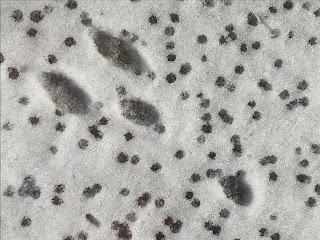
It's not easy to combat the naysayers, or to avoid getting caught up in the deep negativity that's been engendered by the events of the last couple of years. I can't say that my assessment of our ability to work things out for the better is any more firmly grounded than it was in January of 2017 (or January of 2021, for that matter). But hope abides. Especially when the sun's out and the weather is fine. Or even when the ice-clad trees sparkle after a February snow storm that doesn't cause widespread power failures and frozen pipes. Or when bunnies leave their footprints behind in the snowy garden, with polka dots of melting ice as a backdrop.


And then there's the promise of the new year. I've been fond of the lunar new year since I was a child. In both Japan and Taiwan, it was celebrated with delicious sweets, colorful ceremonies and dancing, fireworks, puppetry, and (even for children) introspection. I returned to the United States in 1962, another Year of the Tiger, and my Chinese and Taiwanese friends thought that it was an auspicious time to do so, assuring my mother that the courage and bravery associated with tigers would help me make the necessary adjustments. I'm not sure how brave I was (I ended up staying in the States instead of joining my father in England), but maybe that's what was involved in my choice to remain with my grandmother, in my home town, for the next year. I certainly developed a strong attachment to place during that time, and it took hold fiercely. Much as it has here, in my little hundred year-old bungalow on its little half acre of small-scale utopia.


The future seems more uncertain to me now than it ever has--even after having lived through some major crises in the past. With another Russian conflict building in Ukraine, things don't seem particularly promising. But I do like to think that there's always hope, and so will be spending more my time learning from those who are practicing ways to build it.