Tuesday, February 7, 2012

Happy Bicentennial, Mr. Dickens

This is quite the year for anniversaries, so I thought I'd start acknowledging them both on the Farm (when appropriate) and on the Cabinet--beginning with Charles Dickens's 200th birthday. Dickens worked and wrote tirelessly about the appalling social conditions in nineteenth-century England, and many of the causes he championed were the same ones William Morris embraced.

If I needed any prompting to remember the date, Google's Doodle for today provides a cute reminder, along with a linked Google search on Dickens (coming up with the Wikipedia article first, of course, followed by Google Books editions of his works; you can get a better list using "Charles Dickens"). But since I try to encourage inquiry beyond the obvious, I thought I'd link a few choice bits here for anyone inclined to celebrate.

During my otherwise largely misspent youth, I binged for some time on nineteenth-century English novels, especially those of Thomas Hardy, George Eliot, and Dickens. My interest paid off, because when a grad student in the English department at Penn needed someone to type his dissertation on Dickens's serial techniques, I got the gig, and gave him a deal: 50 cents a page. I loved doing it, and took away a much deeper understanding of the man and his work.

The Dickens oeuvre is massive (online versions of his works abound, but go to Project Gutenberg for a list that includes audiobooks (the link is to the "D" page; scroll down). Folks like me, who prefer hard copy, can find numerous editions at Half Price Books, and occasionally snag nice old copies with pretty covers, like my People's Editions from 1883. Marks inside the covers show I spent between 50 cents and a dollar for each. I bought a good acid-free copy of Our Mutual Friend in London, and should probably begin again to remedy lapses in my library.

This week's news outlets are packed with stories, and many tout his social views: against slavery, supportive of "fallen women," and especially his identification with the poor and downtrodden: The Guardian (on literacy), The Christian Science Monitor (on the 19th century 99%), but not, alas, the Daily Poop, which has noted only what others are doing. My favorite bit is from The Guardian: A Fiendishly Difficult Birthday Quiz, for the true aficionados. And no, I haven't taken it, nor would I do all that well if I did, having not read the man's work for forty years. But that copy of Our Mutual Friend I bought in 1971 is next on my list of bedtime reading.

Some of the absolute best sources on Dickens can be found on the web. My favorite is the official Dickens Museum site, and the Dickens Birthplace Museum in Portsmouth (a late, dear friend of mine was also born in Portsmouth, and loved this museum). The Morgan Library and Museum's online exhibit, Charles Dickens at 200, is spectacular. If you're in New York, you can visit it yourself--although it closes February 12.

Huge numbers of films have been made of the books, most of which I have refused to see because Dickens's plots and characters are far too complex for Hollywood not to mangle. The 1946 David Lean version of Great Expectations is the only exception I can think of (mainly because I saw it when I was young and, as yet, untutored in things Dickensian; the link is to the Criterion Collection edition, which is beautiful)--although my husband swears by the 1977 serial television production of Nicholas Nickleby. Perhaps on some dark and stormy night I'll relent and start collecting selected DVDs.

There was also a PBS biographical series on Dickens back in 2003. It's probably time to see if that's available, since his own life story is every bit as interesting as his fiction. Speaking of biographies, there's a relatively new one out by Michael Slater (2009), Charles Dickens: A Life Defined By Writing (Yale UP, 2009), which I haven't read but intend to get. Last November, David Gates reviewed two more in The New York Times (by Claire Tomalin and Robert Douglas-Fairhurst).

There are a number of good Dickens portraits available online (my favorite is the George Herbert Watkins photo that opens this post), in many media. A quick image search can locate dozens. But because Dickens was such an outspoken figure, he was frequently lampooned. The best of the caricatures is probably this one, by André Gill ("Dickens crosses the English Channel, carrying books from London to Paris" from the cover of the French newspaper, L'Eclipse. Gill was a prolific caricaturist, and many public figures relished being portrayed by him.

Not far from where I lived in Philadelphia, in one of the vest-pocket parks the city has sprinkled all over the urban environment, is this statue of Dickens and Little Nell, the heroine of The Old Curiosity Shop. I remember a lit prof once telling the class that ships passing one another while crossing the Atlantic as the book was appearing in serial form would call to one another, "Does Little Nell still live?" My, how things have changed.

I'll have to think of an appropriately Dickensian brew for the Beloved Spouse this evening, and raise a glass to a superb novelist with an admirable social conscience. He ought to be assigned reading for people running for political office.

Image credits: Photograph of Charles Dickens by George Herbert Watkins; albumen print, 1858. (National Portrait Gallery; also available on Wikipedia and Wikimedia Commons). The photo of Clark Park's Dickens and Little Nell statue is by Bruce Anderson, via Wikimedia Commons. The Gill cartoon is from the Wikipedia Article on L'Eclipse.

Tuesday, January 31, 2012

Vindicating Introversion

Vindication seems to be rolling into my life, little wavelets at a time. For example, the art history textbook I use, the venerable Gardner’s Art Through the Ages, has started acknowledging 1628 BCE as the date for the eruption of the volcano on the Aegean island of Thera—and thus confirming my contention that it could not have been the cause of the decline of Minoan civilization in the mid-sixteenth century BCE. I’ve been complaining to my students for over ten years about the persistent ignoring of the geological evidence by art historians and edutainment profiteers, and now I can crow about it.

Just this last weekend, an article in the Daily Poop mentioned the probability that there’s not nearly as much natural gas out there to be fracked as oil & gas profiteers are constantly claiming to justify their gawdawful practices. (The article seems to have disappeared from the local archives, but it originally came from the New York Times: “New Report by Agency Lowers Estimates of Natural Gas in U.S.” by Ian Urbina.)

This is not news to those of us who keep up with the latest info on peak oil and gas, but it was rather nice to read about it in the local rag, even if they did have to pinch it from the Times. In all fairness, I should mention Bloomberg Businessweek’s assurance (“Everything You Know About Peak Oil is Wrong”) that we’re not running out of anything (although the article does point out the rather significant cost of extracting all those abundant “natural resources”). But my fellow skeptics can only chortle when the possibility that the “experts” might be wrong actually becomes news.

I've also been bugged for eons by the increasing levels of noise in the world, especially noise imposed on people who are trying to learn stuff. I've tried mightily not to require collaborative efforts on the parts of students, except occasionally in select classes, despite constant insistence by folks trying to assert the latest educational fad.

So imagine my glee when splashed all over the Poop this weekend were articles about Susan Cain’s new book, Quiet: The Power of Introverts in a World That Can’t Stop Talking. Not only was there a piece on the front page of the Points section by Cain herself (“When collaboration kills creativity”), but a review in the Books section as well (“Introvert, to thine own self be true”—by MiChelle Jones, to which I cannot find a link anywhere).

Cain’s own website, The Power of Introverts, notes that since her book launched on January 24th, she’s been inundated with requests for interviews (21 on one day—some of which are linked on the blog). For an avowed introvert, that’s got to chafe (and she admits this is so). I’m pretty sure that one reason I’ve never sought to publish on a wider scale is that the very thought of interviews or book tours makes me quail. Fame and/or notoriety are not on my menu of desires. (No, blabbing in a blog to a limited audience does not count.)

The vindication aspect is this: I have long preached that thinking (of any variety) requires solitude. In fact, I can only infrequently avoid making snarky remarks about the current fad of walking around plugged into background music. How can one think at all with a sound track? My victims, however, tend to be people in elevators who can't hear me anyway, so I don't usually blow my introvert cred.

I’m one of those folks who listens to music for enjoyment, and when I do so, it’s without other distractions. I listen without other stuff going on. I require a good sound system and decent recordings. So I rarely have the radio dial tuned to the local Classical station (except for pledge time on public radio; I’ve already given, thanks), preferring to hear commentary and news on the road. When I want to think in the car, the radio goes off. I abhor second-hand music—other peoples’ choices that drift through the air toward me from a car parked across the street or some other venue. Woe betide the innocent who tries to play music in my office, because I will assert myself and ask him or her to turn it the hell off.

I also really like to work alone. And this is where Susan Cain’s book comes in and makes my case. I’ve been having a great deal of trouble getting work done in the bullpen I have to use as an “office” at school. People want to play music, discuss politics, and generally schmooze, when I need to be getting prep done. I’ve argued for years that faculty members need offices in which to work and conduct conferences with students—to no avail, because the corporate model is for everyone to be stuffed in together so we can more easily collaborate. As Nero Wolfe would say, “pfui!

Consequently, I laughed out loud when I read this in Cain’s article: “ . . . The New Groupthink has overtaken or workplaces, our schools and our religious institutions. Anyone who has ever needed noise-cancelling headphones in her own office . . . knows what I’m talking about.” At the beginning of this quarter I brought my Bose headphones, purchased at an airport years ago to escape from airplane noise, to my office, and cleared out a space in my overhead bin (we have carrels, not cubicles) to give them pride of place. They’ve twice so far kept me from wanting to throttle someone.

Perhaps the moral of this story is that one of the advantages of age is the vindication factor: live long enough, and someone might well appear in some public sphere to tell you you’ve been right all along.

Image credit: my apologies to the two people who took the photos I mashed together for this cartoon, and donated them to Wikimedia Commons. The Thinker, by CJ, and Gili Meno West Coast by Davenbelle.

Sunday, January 29, 2012

Genderism


Maybe it’s because I recently finished rereading the late Octavia Butler’s xenogenesis series. Or maybe it’s because I’m just getting really tired of hearing hypocrites like Newt Gingrich ranting about how gay marriage stands to destroy the structure of family values and lead America down the path to rack and ruin.

But when I read Frank Bruni’s article in today’s Times, Genetic or Not, Gay Won’t Go Away I couldn’t stop thinking about the way gender has been treated through most of history on this planet: there are only two (male and female), male is inherently superior, and females are primarily baby-making machines.

Butler’s wonderful books, Dawn, Adulthood Rights, and Imago (later reissued in a single volume as Lilith's Brood), consider the impact of introducing a third gender into the mix, but it’s really rather more complicated than that. Hers is a post-apocalyptic earth visited and rescued by a race of traders in genetic material who provide humankind with a path toward survival after they’ve damned near blown themselves to smithereens. But human beliefs about gender specificity (and proper roles for women and men) hinder the evolutionary possibilities available to the survivors.

In our present-day, so far pre-apocalyptic world, we seem so bent on making sure everyone follows the traditional paths—especially those codified in religious texts—that we end up falling into camps that don’t do much to expand possibilities. We either support gay rights because we think they have no choice (i.e. it's all in their genes), or we condemn all varieties of sexual difference because some Bible or other says it’s an abomination (whether or not the text of that Bible actually says so).

Bruni points out that whether or not someone is genetically programmed toward a particular gender doesn’t matter. Gay people just aren’t inclined to change, and there’s no real reason for them to do so.

It occurred to me while reading Butler’s novels that we really don’t have just two genders anyway. There are homosexuals, bisexuals, transsexuals, heterosexuals and asexuals; some people may be more than one over the period of a lifetime. And trying to fit everybody into two convenient categories doesn’t really seem to do anyone any good.

Pronouncements about the sanctity of marriage based on ignorance don’t make things any better. If family values (loving parents taking care of well-loved and guided children; familial loyalty and affection; extended families) are so important, it seems to me that we should be allowing them to spread wherever they can sprout. In my own experience, some of the most engaging, respectful, creative, and clearly loved children I’ve ever met have been raised by gay people who may or may not be their biological parents. And one of the best consequences I can think of is that none of these children feels compelled to fit into any particular role just because he or she is a he or a she.

Even when I'm talking about art history, I find myself pointing out gender disparity in that vast span of human experience between the Paleolithic (when men may not have understood their role in procreation) and the development of agriculture (when they seem to have decided that they had everything to do with making babies). What anthropologist Elizabeth Fisher once called “the pernicious analogy” (semen = seed) developed during the Neolithic beginnings of farming (which seems to have suggested “planting” the “seed” in the womb, where it would be nurtured as in fertile soil), and was followed by the notion that women were merely empty vessels just waiting to host a little homunculus. Inexplicably, however, if the woman didn't bear sons it was her fault. Sigh.

Things are only now beginning to look up. When I was a fourth-grader, I wasn’t skipped to a higher grade, despite evidence of some intellectual talent, because we hadn’t covered fractions yet and girls weren’t “good in math.” But my male classmate was skipped because boys were supposed to be innately much better at quantitative skills. Nowadays, girls are much more frequently encouraged to excel in whatever they can, but that glass ceiling persists, and true gender equality still seems to be a long way off.

So we shouldn’t be surprised that consideration of multiple genders isn’t really even on the radar at the moment. Human beings seem to be really good at partitioning out “otherness” in terms of color, religion, culture, and/or political economy. Of course, we still use mere otherness as a reason to discriminate, and that’s not likely to change soon, either.

Being able to label someone as a deviant from the norm used to be the purview of despots (witness the concept of Degeneration popular in the 1930s, which became one of the excuses for annihilating Jews, Gypsies, and homosexuals). If we were to expand the concept of "normal" to include not only all races, colors, creeds, and politics, but multiple genders as well, who would the bigots be able to pick on?

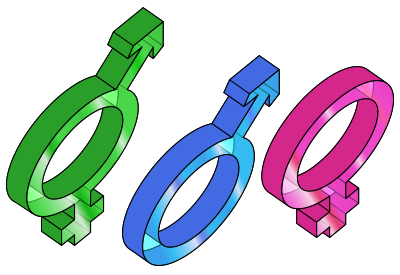
Image credit: 3D expanded gender symbols modified and uploaded to Wikimedia Commons by Ju gatsu mikka.