Tuesday, June 20, 2023

June Daze: Sumer Is Icumin in*

Morning sky, last day of Spring 2023

'Tis really only the last day of spring, and although it's in my nature to celebrate seasonal changes--like tomorrow's solstice--most of what's worth anticipating is a (probably short) respite from the week's long Excessive Heat Warnings we've been living through for much of the month. That and quarter-sized hail and a scary, noisy night last week.

In fact, it hasn't really been all that bad; we've managed to avoid turning on an air conditioner until about 10 am each morning, and we have time to spend out of doors before shutting all the windows and drawing all the blinds and curtains. Even this morning, which required air-con to dispel the absurd humidity in the house at 6 am, gave us cool enough outdoor temperatures to get a few garden chores done. The Beloved Spouse mowed the back green patch, and I got a bit of bronze fennel transplanted into a pot to help keep our one black swallowtail caterpillar alive until he's ready to build his chrysalis. More on that in a bit.

At any rate, it's 90 F ("feels like" 100) now at noon, and we may actually be heading out of the worst of the heat. At least until the week-end, when we'll probably hit a genuine 100-102. So I plan to get out and frolic tomorrow morning when it's only 77; or maybe wait a day until it's down to 73.

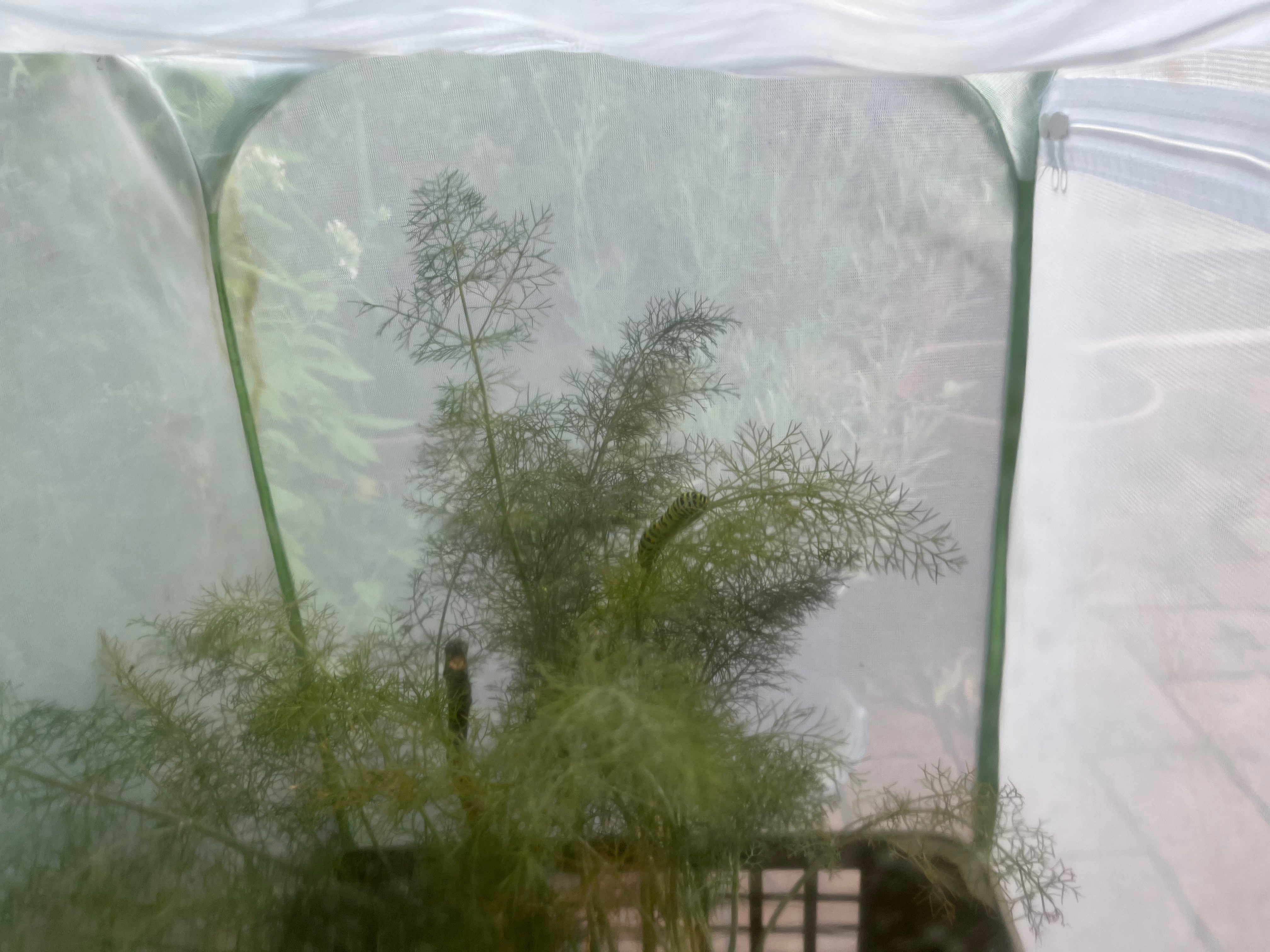
So far, for most of the week, I've managed to get out with animals at breakfast and do the crossword, TBS has had some tennis practice, and my one wee beastie of a caterpillar has managed to fatten up on my now-depleted fennel plant without having been lunched upon by cardinals or anoles. This morning I managed to move him onto the newly potted fennel now housed in the butterfly haven I bought a few years ago but haven't yet used. A couple of days previously I had enveloped him in a mesh bag, but his new quarters are portable and there's much more food:

Black Swallowtail caterpillar in mesh bag shelter

New digs; note eggs above stick

Stick on left, caterpillar on right; not sure where the eggs are

What I didn't know until a few minutes ago, was that before I'd made off with the bronze fennel planted in another part of the garden, eggs had been laid on it! They look like more black swallowtail ova, and as a species they are fond of fennel, so we'll see. This does mean that if they hatch, I'll need to find some more fennel. 

The Canadian wildfire haze did get down to us, but blew away quickly. Still, those ominous photos of orange skies in New York City were rather too close to those depicted in the Apple+ series I mentioned last month (Extrapolations). An article in the New York Times this morning by Paul Bogard, "We're Watching the Sky as We Know It Disappear," noted the recent wildfire smoke in the Minnesota Lake Country, lamented the changes we're all beginning to notice. Bogart edited Solastalgia: An Anthology of Emotion in a Disappearing World, which is high on my reading list. I first learned the term, "solastalgia" from an entry in Climate Words. Coined by Aussie philosopher Glenn Albrecht, it's used "to describe the feelings of anxiety and sorrow that follow immediate impacts to our environments." "Algia" comes from the Greek for "pain" (algos). Although we use it today mostly to refer to body-related pain (e. g. neuralgia), to Homer it was more akin to suffering, as in grief. The "solas" part is from Latin: solacium (comfort, as in solace). The etymology of most neologisms can be problematic, but this one seems to offer hope in context. But the notion of being unsettled, sad, even angry about climate change--especially if we're aware of it and seem to be pretty powerless to stem the rate of change or to mitigate it, is hard to live with.

Maybe that's why I derive such satisfaction from figuring out how to save a (potential) butterfly, or re-wild some of my little yard. The bunnies and the 'possums may not all make it, but maybe some of them will. And even though the cardinals and anoles may be deprived of a fat larval form of butterfly (or more!), there are plenty of mosquitoes and other varieties of bird and reptile noshes available.

And maybe that's why I've been so heartened in the last couple of days to see articles in the Daily Poop* about regenerative farming and family farms in general. Today's front page featured an article on agritourism and soil replenishment: "Farmers market of agritourism? One is 'like buying local on steroids,' farmer says; reducing tillage and increasing soil organic matter are part of regenerative agriculture." On Friday, along with my delivery from Profound Foods, I found the latest issue of Edible: Dallas Fort Worth. In addition to its usual fare (ahem), there is a lovely article about Sister Grove Farm. The owners, Sarah and Rodney Macias, bought a plot of historic Texas farmland in 2016 and have turned it into a working farm and a retreat that fosters responsible living on the land. She quotes people I already love (Robin Wall Kimmerer and Wendell Berry), and the way of life they've made for themselves near Van Alstyne is truly inspiring. 

It does seem that every time I get all grumpy and pessimistic, a few items pop up here and there that lift me up a little, and give me time to reflect on the fact that 1) I'm not dead yet (again; I'll write about that later) and 2) I have a pretty damned good life, all things considered.

Like nostalgia--the combination of sweetness and sadness about home enmeshed in memory--perhaps learning to understand how solastalgia fits into this new world can help us negotiate new ways of approaching modern problems that promise some hope for what comes next.

Happy summer, People. Lhude sing cuccu!***


Notes: 

*On the Canon quoted in my title (Sumer is icumen in): this is a lovely Medieval English song for several voices to be sung in a round. The author(s) are unknown, but may be either W. de Wycombe or John of Fornsete. For an image of the manuscript, its history, the words (both original Middle English and in translation), see the Wikipedia page linked. This is a wonderful poem to read, or song to listen to, on the Summer solstice.

**My irreverent nickname for The Dallas Morning News, to which we subscribe and which we read daily.

***"Sumer is icumen in, Lhude sing cuccu! (Summer has come in, Loudly sing, Cuckoo!)


Saturday, April 22, 2023

Earth Day 2023: Being In Time

Our resident anole, Harry, and friend celebrating Earth Day
Ever since the first April of this blog (which began in June of 2007, so my first Earth Day post didn't happen until the following year), I've made sure to acknowledge the only holiday I'm particularly religious about. I'm tardy getting at it this year, having been distracted by all manner of converging events, so I don't have anything prepared, mused over, and edited in advance. Given the longish passage of time, I though it might be interesting to look back at some of my older posts to see what I've managed so far.

My very first actual Earth Day post in 2008 focused on an increasingly worrying aspect of US political economy: Plutocracy, or rule by and for the wealthy--and the dystopian effects that stem from it. The post was called "Surviving Plutopia," and touches on a topic near and dear to those of us who survived "Snowmageddon" in 2021:

Only by adjusting our own perceptions of "need" vs. "want" can we begin to understand the true nature of poverty. And I am getting sick to death of pundits who describe anyone who lacks electricity as "living in abject poverty." (For my perspective on the larger questions, see "Rethinking What it Means to be Wealthy" and "Rethinking What It Means to be Poor.") The line usually runs something like "They're so poor they don't even have electricity"--as if this particular technology is necessary to the very notion of civilization. But it's not. It's perfectly possible for people to work the land, provide sufficient food and clothing for themselves, and dwell in thriving communities without ever having seen a light bulb!

Of course it was naive (and actually rather cruel) of me to negate the necessity of something so foundational to our concept of civilization, and this became painfully apparent when we found ourselves bundling into the upstairs bedroom where we had access to a gas heater, and a portable power station to which we could hook up a fan to blow the heat in. The fireplace worked well enough downstairs, but after the disaster was over, we had it cleaned out (it was probably on the verge of burning the place down) and replaced by a log-burner that's far more efficient and uses up the voluminous trimmings from our many trees. What I began to understand then was that if you think it's possible to live without electricity, you have to design an economy that can function without it. If everything depends on it, no one can afford to lose it. This has led to a radical re-thinking of More News From Nowhere (which is being revised and is no longer linked). But, my concept of utopia starts with leaving the electricity out--not cutting it off because of bad design and corporate greed.

From "Nature Red In Beak and Claw" (2010): 

Over the next decade, and ten more Earth Days, we'll inevitably be visited with typhoons, hurricanes, earthquakes and tsunamis, tornadoes, volcanoes--everything Mom can throw at us while her internal processes are at work. How these "disasters" affect the denizens of this planet will increasingly depend on how human beings manage what's actually within our power.

Thirteen years later, we've been visited by more, and more lethal natural phenomena--most of which Kim Stanley Robinson has dealt with so eloquently in his The Ministry For The Future (2020). The first chapter haunted me for weeks--especially during the reportage about atmospheric rivers along the west coast of the United States, and heat waves on the Indian subcontinent. More recently, we've been watching Apple+ TV's streaming series, Extrapolations. It's terribly sad, in many ways--and we won't be watching the final episode until tonight--but just as Robinson's book offers a slightly optimistic prospect, each of the episodes so far has ended with a tiny hint that something better might happen. Someday.

In 2013 we had begun rehabbing the house, taking stock, and making plans. I didn't know it then, but retirement (for me) wasn't that far off; even then, though, we were already resigning ourselves to staying put, and taking "Small Steps."

If I've learned anything over the years, it's that we can't really afford to lose our focus on what needs to be done, and I'm occasionally heartened by the fact that [Earth Day] celebrants are no longer just cranky old folks like myself, but a include a much broader spectrum of citizens.  I don't actually go out and march or dance in the street anymore, but I do spend time out on the property, taking inventory, and reflecting over the past year.  This time, the view from the back yard toward the house is far more pleasant than it used to be, thanks to some major renovations last summer.  New paint, a new bathroom and work on the old one (including new, very low-flow toilets), R50 cotton insulation in the attic, and solar screening will make the coming summer more livable.  Plans for a geothermal heating and cooling system had to be abandoned because the cost would have made the rest impossible. But our energy bills are fairly low anyway, and we bought a portable air conditioner that works more efficiently than our old window unit. The attic fans have been repaired, which will double the air flow through the house, so our bills will probably be even lower, and our power use reduced even more.

The following decade has seen us weaning ourselves away from the academic life, becoming occasional caravaners to the west (first in our little imitation Shasta Airflyte, Lola, and later in our more substantial Whitewater Retro, Porco Rosso), and downsizing our load of life's detritus. We've established habits much more in tune with lowering impact--such buying only what new stuff we need to further our transition toward far less dependency on fossil fuels. A newer, bigger Bluetti power station enhances what we already had, and will get us through the next stupid Texas power grid failure--as well as make it possible to camp off grid on our trips west, as well as to the few remote public campsites available in Texas. In 2018 I posted on "Doing More, And Less":

Our best effort this year has been to eliminate food waste. The smaller fridge has been wonderful for keeping us both aware of what needs using up, and we've had little except pits, skins, seeds, and coffee grounds to pitch into the compost bin. Even the skins and coffee grounds we often use for augmenting garden plantings. In the last year, only one or two things in the fridge have gone off before they were eaten, and at some point I'm wondering where our compost is going to come from, since we mulch our grass and rake leaves into litter piles to make soil.

On March 13, 2020, the world closed down for COVID, just as I was having one of my original bypasses (from the CABG I had in 1995) stented. On that Friday the 13th I had the procedure, and I was back in the blogosphere reflecting on a recent camping trip and musing about the future a week later in "A Different World": 

Celebrating Earth Day this year is fraught with all of the political, economic, and cultural ramifications of a pandemic that few people seem to understand fully, and too many seem to be unable to accept as real and really problematic. We've only been hunkered down for about six weeks, the total number of infected people is largely unknown, the means to combat the virus itself are not imminent, and this country is flying blind into the future. 

Oddly enough, the environment is faring better as we become sicker. Air pollution is down, water is cleaner in some areas, and fewer animals are dying on highways. Not coincidentally, fewer humans are being maimed and killed in automobile accidents. I'm hesitant to call this a "silver lining" because so very many people are suffering so badly. But as I think through the possibilities of long-term effects, I can't help but wonder how our modern, technological, "efficient," wasteful, cruel (to the animals whose "products" we consume, and all too often to other people), growth-obsessed, and greedy culture might change as a result of being locked down.
Might we learn to do with less stuff, eat more nutritious food from more local sources, live more kindly, drive less, find ways to live without fossil fuels, and take better care of ourselves, our children, and our neighbors?

I almost have to laugh in retrospect, at further evidence of my naivete. Since that post, way too many people have become crazier, stupider, and meaner. Who among us relatively sane people could have imagined the bizarre backlash against life-saving vaccines? Small signs of normality seem to emerge occasionally, but not nearly as many as we need. Because of this, our little farm has become more and more of a sanctuary.

I've been in the garden more regularly, and since Spring hasn't managed to morph into summer as quickly as it has in the last couple of years, there are tomatoes (large Costco transplants, not from seed) getting ready to ripen, peppers flowering, and herbs abundantly proliferating. I've been rooting ends of celery and lettuce, planting sprouted onions, and pulling wild onion/garlic scapes from the iris bed to put into salsa and salads. One of the most impactful consequences of the Plague is that we've been getting a good portion of our food delivered from a co-op that either grows its own or obtains its products from local farms and ranches. The upshot is that we're able to eat much more sustainably, and even though we're eating much less meat, we're getting it from humanely raised animals. We've cut our deliveries down to every two weeks, but still buy about as much food and have the opportunity to donate to a project for single mothers and their kids, and to support our local farms--many of which are starting to use permaculture and regenerative grazing. 

In the past couple of years we've also managed to build up a wildlife habitat behind the garage, where we hope bunnies and such can find refuge. They'll need it, because a fox has moved into a vacant lot across the back alley, and has already reduced the rabbit population by at least one. We've seen a mother 'possum carrying joeys across the front yard, so the wee beasties seem to be finding some places to shelter themselves. 

The weather's still cool, we've been spared most of the nasty storms that have moved east to demolish parts of Arkansas and Alabama, and it's rained enough so that the drought has been staved off for a bit. And so, it seems, we actually have an Earth Day to celebrate. We'll be watching the last episode of Extrapolations, having not been put off by critics who call it "ponderous" and "slow" and whatever adjectives folks are using these days to describe anything that's not mindless, action-packed and involving car chases. I'm waiting for that little hint of hope that occasionally shows up in stories that project our future, however long that turns out to be. Time is the medium in which we live, and it frames everything. The projections of the not-too-distant future that Scott Z. Burns shows us are not inevitable. "Spending" the time we have more wisely could offer at least some of the possibilities Kim Stanley Robinson imagines for us.

And yes, I fervently hope that Ukraine survives, that ways to solve problems amicably emerge, and that we figure out how not to destroy this rather lovely and possibly truly unique spot in the vastness of the universe. In my lifetime? Maybe by next year? 


Tuesday, February 21, 2023

Attending to the Garden: Musings on the Coming of Spring

Yesterday morning I spent rather a long time doing something I had wanted to get at for years: transplanting a clump of wild gladiolus--the scions of a single plant I found under the nandina shrubs on the north side of the property in the first spring after we moved into the house.

I don't think I actually planted them in this spot, but thanks to our furry denizens (some of whom later nearly destroyed the entire patch after developing a taste for the bulbs) some ended up next to the sidewalk that extends from our back door to form a large square area within which a brick patio and our greenhouse have been erected. After said near-extinction, I thought I'd lost them again after the deep freeze in February of 2021, but they're incredibly hardy and keep coming back no matter what happens.

The wild gladioli in May of 2021(lower right)--after Snowmageddon 

Unfortunately, their growth had been so exuberant that they had obscured a large part of the sidewalk. I had thought for several years that they needed to be dug up and transplanted, and some lower-growing replacement needed to be found.

On a whim, I got out my garden/archaeology tools (my old Marshalltown mason's trowel and a soil screener), as well as my spading fork, a couple of nippers, a large rusty iron nail, a little Japanese twig saw, and a foam pad for kneeling), and went to work. This was probably not a great idea, given my current age-related joint problems, but the weather is warming up and I wanted to take advantage of the temperatures (in the high 60s yesterday, and 80s today). Indeed, I was rather sore by the time I had enough of the job done to quit for the day, but enjoyed the work--even though it turned out to be more arduous than I had expected. And I broke my spading fork. After that, I had to use a regular spade--pictured below, along with some of the other tools and my assistant, Molly.


It turns out that the bulbs had multiplied and bunched up right next to the concrete sidewalk, some even burrowing a bit under the three-inch slabs. I ended up using the trowel not so much as a digging tool, but as an excavator--taking me back to my days in the Long Island Pine Barrens, working on a site where some "Pineys" (itinerant travelers) had camped. A paint brush would have helped, but I was down on all fours and I was saving the effort of getting up until I was finished. In the end, some three hours after I'd started, I had unearthed the clump's components, laid them in the soil screen, piled leaves on top of them, and dowsed them with water to keep them from drying out overnight.This morning I performed bulb-triage, and divided the crop into bulbs-only, bulbs-with-short-leaves, large-bulbs-with-long-leaves, and little-tiny-bulbs-with-iffy-stems-and-leaves, and bits to be composted. I found places to plant all but the LBWLL group, and they'll have to be protected again tonight. They'll go into the front border and a little swath of border next to the porte-cochere, where a few canna lilies and volunteer wild onions have found a home. But that's for tomorrow.

The weather, after some very cold spurts, quite a bit of rain, an ice storm (which affected us very little), is now tempering out. The skies have been lovely, with evidence of the winds that we have grown to expect as we head to spring (now only a month away).


These days, when not scruffing about in the clay, I spend time musing on mortality, as one does when confronted with the brevity of existence. We've lost two close friends within the last couple of months, and I came into the house yesterday to the news of President Carter's entering into hospice, and President Biden's trip to Kiev on the first anniversary of that needless, wasteful war in Ukraine. The recent earthquake in Turkey brings back memories of much less violent events in my childhood, but stories that have emerged from that catastrophe are both horrifying and heartening.

I'm especially moved by Jimmy Carter's choice to forego further hospitalization and to end his long and inspiring life at home. This was a choice my own father made, when his thyroid cancer could no longer be treated effectively. I have been grateful ever since that my children and I got to see him in his own den, next to his ham radio setup, surrounded by books he loved and the family that cherished him. I wish everyone could come to the end of their lives in peace and relative comfort. For those who face war and disaster, there's little any of us can do but to support efforts to relieve some of the anguish. It feels incredibly inadequate, but it is something. And so is remembering them, and finding ways to end political violence and to mitigate natural disasters by building better and safer places to live.

As we move from one season to another, my natural pessimism fades a bit. Things really could be worse, and attending to the accidental garden provides some equilibrium, at least for a time. But now I think I'll go and enjoy the company of The Beloved Spouse and our "daemons" (in Philip Pullman's usage). The rest of the transplanting can wait until tomorrow. 

End note: The Marshalltown trowel link included above is to a post on Owl's Cabinet of Wonders, from my MOOC period of existence, nearly a decade ago. I truly enjoyed the online courses offered through Coursera and other venues, and am glad I had the foresight to include some of the materials in the blogs.