Showing posts with label Luna Moth. Show all posts

Saturday, June 18, 2022

It's Not Easy Being Green

For the last several years I've let the Virginia creeper take over large swaths of space in the garden, and it's become a tradition to let it overflow the decrepit, mangled (from branch that fell from the elm overhead) Adirondack chairs and an old sawed-off patio table. After the elm branch fell, I thought I'd just have to get rid of them, but now, more than a year later, they're still there, swathed in viney decorations that now include wild grapes (descendants of vines that grew on the south fence and once provided fruit for some really bad wine we found under the house) and English ivy from next door--as well as the creeper. It won't be long before wisteria and trumpet vine gain a foothold, since I've no plans to eradicate any of it.

An article in the New York Times (Yes, You Can Do Better Than the Great American Lawn) prompted me to muse on the unorthodox nature of our own "lawn," and to offer an alternative to the tidy, suburban, pesticide-laden, water-hungry model that presides around here. There is some attendant irony in that the city motto of McKinney, Texas, is "Unique By Nature." But the fact that there are no other houses on our block with fireflies may suggest the duplicity in that coinage. I'm clearly not the only one mindful of these problems (see especially Margaret Renkl's May 16 article for The New York Times, "One Way to Do More for the Environment: Do Less with Your Lawn," which I only just got around to reading), but the older I get, the louder and judgier I become.

This morning, whilst potting up a rescued plant from the back (one I'd tried to kill earlier in the spring, but that proved amazingly hardy), I watched the neighbor across the street mowing his smallish patch with a large, loud gas thing with a grass catcher. He dumped the clippings into a large paper bag for the city to pick up next Friday. He then brought out his new, also loud, also gas trimmer, tidied up, and then use a blower (also loud, also gas) to blow the stray bits out onto the street. Weenie that I am, I said nothing, because I have to live here, and most of my neighbors already think I'm a tree-hugging commie.

But we don't do that. We use our electric (battery-powered) utensils to mow and mulch, trim, and blow the bits back onto the "lawn." Such as it is. A large section of the front yard is composed of mulch from various trimmings of the eighteen Very Large Trees within the property boundaries. We've got another pile sitting in the driveway, waiting for The Beloved Spouse to distribute it appropriately after the most recent care-taking (see last week's post). 

We have in place a few rules that have endured for many years, beginning long before we moved to McKinney, and that have served us well:

If it's green, let it grow--at least until you know what it is (and if it's in a place you might want lawn, mow it).

We do have some hardy St. Augustine grass growing, but where it doesn't, we let anything grow that wants to. Our yard is also replete with edibles (henbit, purslane, dandelion, plantain, chickweed, cleavers, wood sorrel, onionweed, pigweed, mullein) that periodically get added to salads. I'm hoping to add lambs quarters to the list, if I can get some to root out of what I bought from Profound Microfarms. It used to grow wild, but I haven't seen any in some time. Were I to spend more time at it, I'd probably discover more, but it's getting harder to spend that kind of time out in the heat.

When we first moved in, everything was very tidy, with the southwestern section of the property set aside for growing veg. There were the grapes, too, and blackberries galore. Those kept up for a few years, but eventually got shaded out from all the squirrel- and bird-planted trees that now line the back part of the lot. After trying a more formal herb garden, I eventually gave up and let a copse grow, which (much later) was mostly cleared for a caravan driveway/parking area when we bought our little Shasta. 

Before we began the house renovations, the garage was painted white, and most of what grew around it was what most folk would call weeds. As below, to the left, where the garage peeks out from behind a stand of cow parsley. We don't grow much of that now, though, because it turns into burrs that love dogs' tails. So it only grows outside of the fence. Occasionally I pick it for wildflower bouquets, which I like to keep on my writing table on the screened porch. 
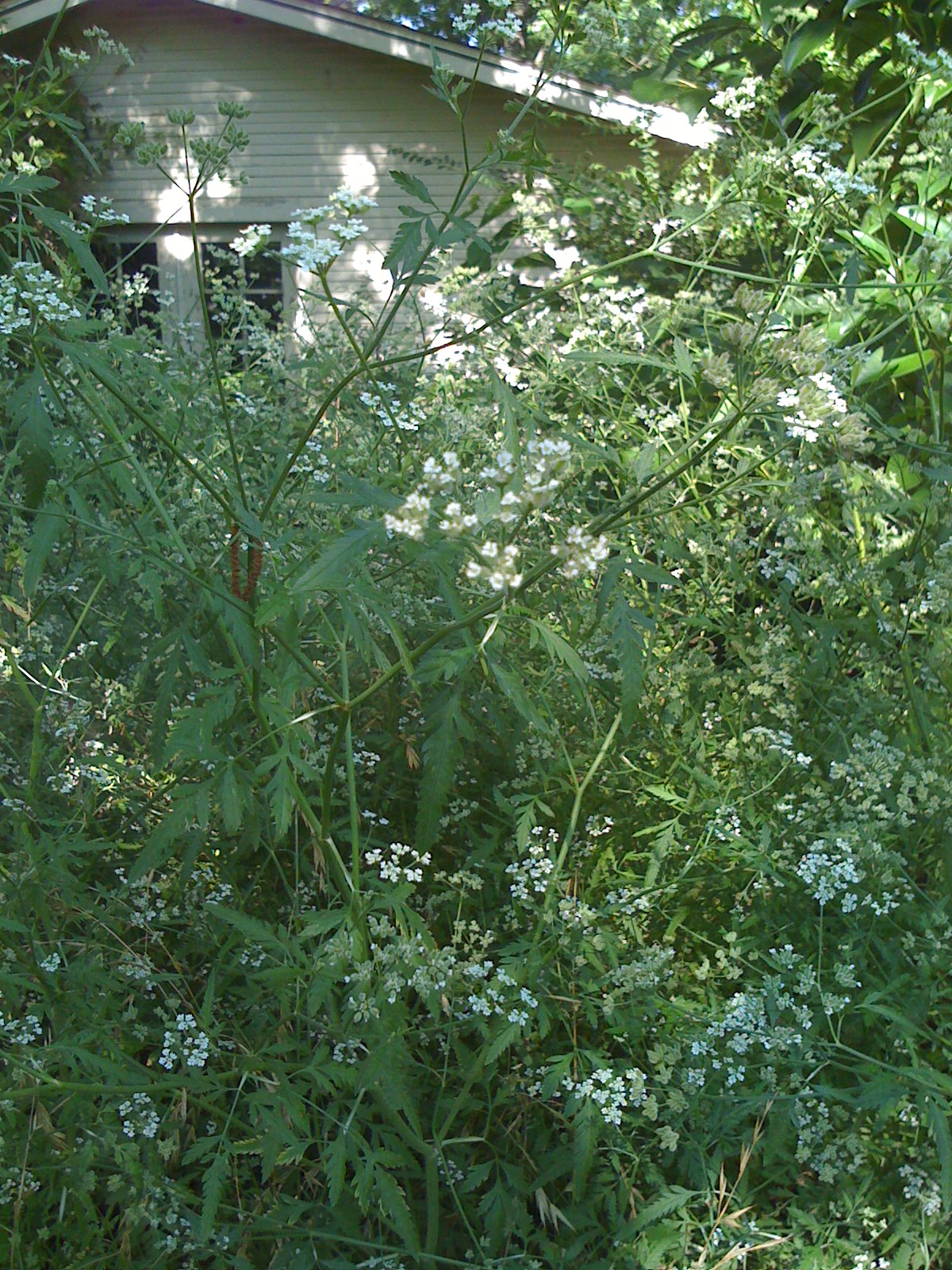
Above the back door to the garage (which you can barely see at left) we installed a miniature pergola (below) to support a heavy branch of wisteria.  It was so successful that the growth extended onto the roof--until one of this spring's storms knocked the whole plant over and off the support. Reluctantly, we cut it down and are now training stray shoots back up the structure, but it will take another year or two for it to offer much decorative cover. I'm trying to root some more, but am not having much success because the heat keeps drying out my twiglets. It will clearly be a while before it regains some of its flamboyancy.

But perhaps not as long as I thought, because just this morning I noticed that the  stump of the big vine we'd had to cut off was (as TBS had suggested it might) sprouting anew. Vigorously. So, we may have some well-established beginnings of a refreshed tangle of wisteria by the end of the summer. 

With humidity at tropical levels, things will continue to grow lushly until the summer drought takes over and I have to spend time judiciously watering to keep it all from dying off. 

All this has illustrated the lesson of letting things be: that it's not always easy to maintain any kind of order, even if one doesn't demand much. I'm not a total anarchist in the garden; I do decide where I want things to grow, and often move them about from place to place. Mostly, I'm successful--but then I have to ride herd on what I change. 

At some point during one of our evening animal outings, I realized that Woody's garden (a circular planting area ringed by tree stumps from previous prunings) really needs to be a butterfly haven. I've already got some attractors planted in there, so realized that a few more might help support the few visitors we see once or twice a day: Tiger and Black Swallowtails, an occasional Monarch, and various smaller and less regal types. This leads me to another rule: 

Focus on supporting wildlife, not people.

This morning I transferred some yarrow (suggested in an article I'd read only yesterday, but can't remember where) into Woody's garden, and will find some salvia to move as well. Because the summer heat is already here, I won't get more ambitious until next spring, but this will fill in some bare spots, and provide more food for the abundant number of pollinators who already visit. Unlike most of our neighbors, we don't try to get rid of most bugs (the main exceptions are the mozzies that see me as food dispenser), and thus provide haven for bees, wasps, fireflies, dragonflies, ladybird beetles, spiders, and others generally seen as beneficial. But we also harbor all manner of less well appreciated critters, like assassin bugs. As annoying as all the "baddies" can be, they still provide food for all the birds we capture on our Merlin sound-identification app and for the bats that whiz past us overhead in the evenings.

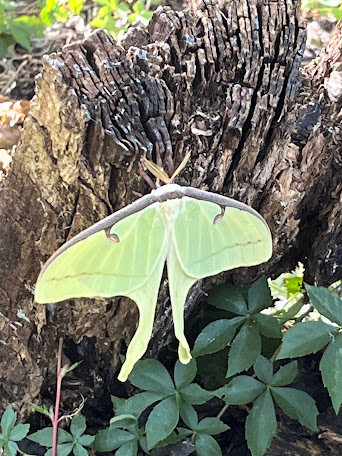
Occasionally we're rewarded with something especially nice, and late yesterday afternoon this beauty showed up on one of the repurposed logs:


I saw it from across the yard, and proceeded to sneak up on it--after having run into the house for my phone. Although it's not the first Luna Moth to show up in the yard, it came in earlier and stayed longer than the only other one I'd seen in the garden. One showed up on the front screen door several years ago, but this is the first one I've seen taking advantage of the habitat. 
 

Habitat lounging is common in this kind of a garden. The arborist who came to assess the recent tree job was very impressed with the number of places critters could comfortably occupy. Even the structures provided for plants can offer a perch for an anole on the hunt:


This one is lazing on the support frame for the fennel we use to harbor swallowtail larvae--not a good sign for this summer's prospects. But I'm hoping to harvest at least a few baby butterflies to host in my mesh hatchery, where I can keep them safely away from this guy. Although chances are that Molly will already have had his tail by then, and he might not be so spry. She's separated at least four other anoles from theirs already.

Many years ago, Kermit the Frog lamented the difficulty of greenness, which can still be seen as a metaphor for current problems in the human world. On several levels. But this gives rise to one more rule worth considering:

It may not be easy being green, but it's our only hope.

This week's events in Yellowstone are bringing home more of the reality of climate change. If we don't start making efforts to restore the environment immediately, precious habitats everywhere will just be washed away. Or suffer from another of the myriad plagues our species is inflicting on the planet.

Earth Island Institute's piece from last year,  "It's Not Easy Being Green: What if we were mutually accountable not only to the environment, but to each other?" takes this a step further, and challenges us to to embrace the whole: humanity and environment, persons of every color, all beings, the whole planet. Everything we do has impact. Responsible choices, meaningful gestures--anything we can do to acknowledge the fact that no matter what color or gender we are, we are all part of the natural world. It could all go away as quickly as a road can be washed into a raging river. 

I'll be celebrating Juneteenth with both the brown and green anoles in the garden tomorrow. I'll be remembering my father, who taught me that race was a human invention, and that color had nothing to do with being human. And I'll be grateful for every person I've known who has reinforced that understanding throughout my life. 

Recognizing that the earth belongs to us all and that we all depend on its survival for our own should be a universal goal. But starting small, in the garden, and keeping safe what we can is easier than it might seem.


Wednesday, April 14, 2010

Nature in Sub-Urbia

Skywatch Friday addendum, 16 April: If I don't cheat and use this as my SWF entry for this week I won't have time for one at all--so here's an update. The evening after I posted what appears below, the moth was still on the screen. But as soon as I switched on the porch light, he fluttered off. I guess I was sort of hoping he was dead, so I could "collect" him--but now I'm just as happy he was just resting for the day. The birds, however, seem to have moved in permanently.

A couple of days ago I was slaving away at the computer, and glanced out the window in front of me to see a gang of Cedar Waxwings frolicking in my birdbath. I say "gang" rather than "flock" because these birds are ruffians. They attack any unwary bush with anything resembling a berry on it, and completely denude it in moments. One day last week, they were busy stripping my pear trees of blossoms. No pears this year.

Right around equinox time they were at the holly, and I can imagine that it's only a matter of time before the pyracantha berries are ripe enough to gobble up.

After their group bathing experience (I only managed to catch three at it, and I had to shoot from inside the house), they gathered to sun themselves in a neighboring tree (see below). As I've mentioned in an earlier post, these birds once used to fly through, eat berries, and leave--after depositing the remainder of their meals on unsuspecting lawn furniture and laundry. Somehow they managed not to poop on the pillowcases drying on the line behind the pecan tree.

Nowadays they seem to treat this place like a cafeteria, especially since the establishment of the Carbon Sink on the southwest corner of the property. There's a lot of privet there, some of it probably contributed by these very birds, as well as the volunteer Chinaberry that grew from seed about six years ago and is now over twenty feet tall. This tree is, of course, thought by many to be a weed, but to me its a link to my Asian childhood, and also to Italy, where I saw it growing as well.

At any rate, when they're through feeding or bathing, they congregate for a nice long squawk, yellow breasts gleaming in the sun. I think I can put up with a bit of bird lime (the color varies with the meal) in exchange for tree ornaments and a concert every now and then. If you'd like to see what they look like in action, YouTube has a whole page of videos.

The latest oddity is the appearance of a Luna moth on the rusty screen door at the entry to the house. Beloved Spouse noticed it last night when he was shutting down the house at bedtime, and I snapped a couple of shots, assuming that the moth would be gone by morning.

But he was still there at sunrise, and so I photographed him from both inside the house and out. I love the shot with the shadow with the grids created by the screen and door muntins, but was especially pleased with the one backlit by the sunrise that opens this post.

I think this is the only time I've seen one of these beauties alive (if, in fact, he is still alive, and didn't just choose to die on my screen door; I didn't poke him for fear that he'd fly away). I knew they were in the neighborhood because I found a wing once when I was cleaning up the garden.

I'm heartened by the continued appearance of evolution's incredibly varied results, because in moments when I think we might be getting stupider and stupider as a species, something might survive our (ahem) lunacy. I guess it's just time to stop reading the op/ed pages of the Daily Poop, and certainly stop watching really bad doomsday movies (we caught the train wreck called Armageddon a couple of nights ago; very messy, stupid science, but a tear-jerker nonetheless).

Every time I drive by a manicured lawn (in the very economical and ecologically correct Vera, who has already rewarded me with four leaves for good driving) I can't help but feel slightly morally superior, knowing that my ratty, 100% organic yard has become a haven for all manner of flora and fauna. The Carbon Sink is now a jungle, full of edible goose grass, which is great in salads and cures all manner of ailments. Last year it was cow parsley, but this year the late winter rains seem to have drowned out some of that, and what the kids used to call "sticky weed" has replaced it.

The Beloved Spouse mowed on Sunday, and although back quarter-acre doesn't exactly look like Augusta National (many of the plants for which various holes on the course are named actually grow in my yard, too), it's rather more civilized now that it's been shorn; at least the clumps of assorted wild grassy stuff are all relatively the same height. I do wonder, when I'm sitting out enjoying it all, whether our lack of a chemical lawn service is going to make it more difficult for my neighbor to sell her manse (asking price is $519K). But I'm thinkin' that the kind of folk who don't like my yard will do one of two things: not buy the house, or put up a fence (saving me the trouble of repairing mine, and giving me something to hang bird feeders on). I live in hope that people will love the house (it looks rather like Morris's Kelmscott Manor), and think having scruffy, farmer-wannabe neighbors with a suburban wildlife sanctuary is a good thing.

Images: all taken with the Nikon D80, with minimal adjustments in PhotoShop.