Showing posts with label Wisteria. Show all posts

Saturday, June 18, 2022

It's Not Easy Being Green

For the last several years I've let the Virginia creeper take over large swaths of space in the garden, and it's become a tradition to let it overflow the decrepit, mangled (from branch that fell from the elm overhead) Adirondack chairs and an old sawed-off patio table. After the elm branch fell, I thought I'd just have to get rid of them, but now, more than a year later, they're still there, swathed in viney decorations that now include wild grapes (descendants of vines that grew on the south fence and once provided fruit for some really bad wine we found under the house) and English ivy from next door--as well as the creeper. It won't be long before wisteria and trumpet vine gain a foothold, since I've no plans to eradicate any of it.

An article in the New York Times (Yes, You Can Do Better Than the Great American Lawn) prompted me to muse on the unorthodox nature of our own "lawn," and to offer an alternative to the tidy, suburban, pesticide-laden, water-hungry model that presides around here. There is some attendant irony in that the city motto of McKinney, Texas, is "Unique By Nature." But the fact that there are no other houses on our block with fireflies may suggest the duplicity in that coinage. I'm clearly not the only one mindful of these problems (see especially Margaret Renkl's May 16 article for The New York Times, "One Way to Do More for the Environment: Do Less with Your Lawn," which I only just got around to reading), but the older I get, the louder and judgier I become.

This morning, whilst potting up a rescued plant from the back (one I'd tried to kill earlier in the spring, but that proved amazingly hardy), I watched the neighbor across the street mowing his smallish patch with a large, loud gas thing with a grass catcher. He dumped the clippings into a large paper bag for the city to pick up next Friday. He then brought out his new, also loud, also gas trimmer, tidied up, and then use a blower (also loud, also gas) to blow the stray bits out onto the street. Weenie that I am, I said nothing, because I have to live here, and most of my neighbors already think I'm a tree-hugging commie.

But we don't do that. We use our electric (battery-powered) utensils to mow and mulch, trim, and blow the bits back onto the "lawn." Such as it is. A large section of the front yard is composed of mulch from various trimmings of the eighteen Very Large Trees within the property boundaries. We've got another pile sitting in the driveway, waiting for The Beloved Spouse to distribute it appropriately after the most recent care-taking (see last week's post). 

We have in place a few rules that have endured for many years, beginning long before we moved to McKinney, and that have served us well:

If it's green, let it grow--at least until you know what it is (and if it's in a place you might want lawn, mow it).

We do have some hardy St. Augustine grass growing, but where it doesn't, we let anything grow that wants to. Our yard is also replete with edibles (henbit, purslane, dandelion, plantain, chickweed, cleavers, wood sorrel, onionweed, pigweed, mullein) that periodically get added to salads. I'm hoping to add lambs quarters to the list, if I can get some to root out of what I bought from Profound Microfarms. It used to grow wild, but I haven't seen any in some time. Were I to spend more time at it, I'd probably discover more, but it's getting harder to spend that kind of time out in the heat.

When we first moved in, everything was very tidy, with the southwestern section of the property set aside for growing veg. There were the grapes, too, and blackberries galore. Those kept up for a few years, but eventually got shaded out from all the squirrel- and bird-planted trees that now line the back part of the lot. After trying a more formal herb garden, I eventually gave up and let a copse grow, which (much later) was mostly cleared for a caravan driveway/parking area when we bought our little Shasta. 

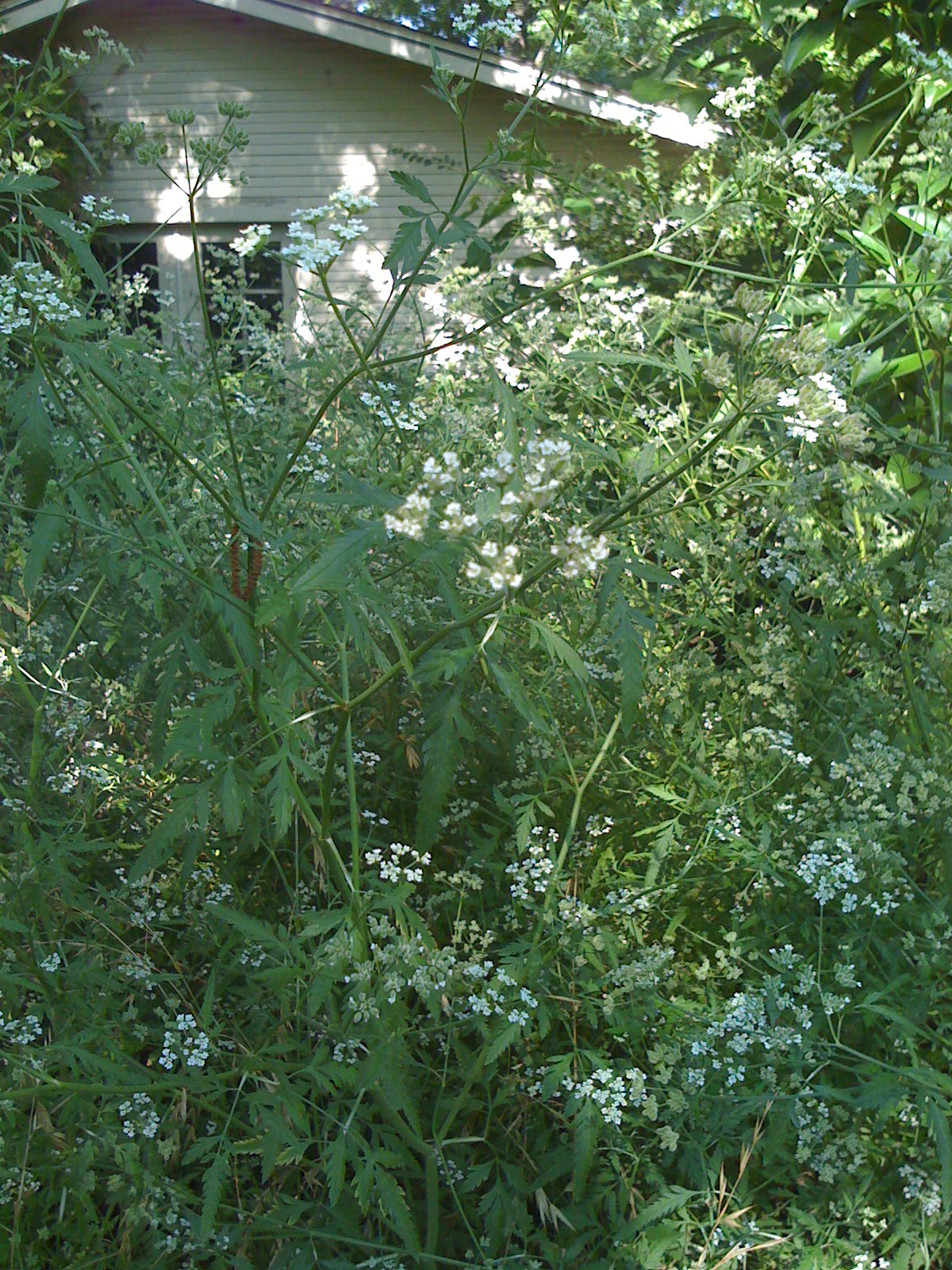
Before we began the house renovations, the garage was painted white, and most of what grew around it was what most folk would call weeds. As below, to the left, where the garage peeks out from behind a stand of cow parsley. We don't grow much of that now, though, because it turns into burrs that love dogs' tails. So it only grows outside of the fence. Occasionally I pick it for wildflower bouquets, which I like to keep on my writing table on the screened porch. 
Above the back door to the garage (which you can barely see at left) we installed a miniature pergola (below) to support a heavy branch of wisteria.  It was so successful that the growth extended onto the roof--until one of this spring's storms knocked the whole plant over and off the support. Reluctantly, we cut it down and are now training stray shoots back up the structure, but it will take another year or two for it to offer much decorative cover. I'm trying to root some more, but am not having much success because the heat keeps drying out my twiglets. It will clearly be a while before it regains some of its flamboyancy.

But perhaps not as long as I thought, because just this morning I noticed that the  stump of the big vine we'd had to cut off was (as TBS had suggested it might) sprouting anew. Vigorously. So, we may have some well-established beginnings of a refreshed tangle of wisteria by the end of the summer. 

With humidity at tropical levels, things will continue to grow lushly until the summer drought takes over and I have to spend time judiciously watering to keep it all from dying off. 

All this has illustrated the lesson of letting things be: that it's not always easy to maintain any kind of order, even if one doesn't demand much. I'm not a total anarchist in the garden; I do decide where I want things to grow, and often move them about from place to place. Mostly, I'm successful--but then I have to ride herd on what I change. 

At some point during one of our evening animal outings, I realized that Woody's garden (a circular planting area ringed by tree stumps from previous prunings) really needs to be a butterfly haven. I've already got some attractors planted in there, so realized that a few more might help support the few visitors we see once or twice a day: Tiger and Black Swallowtails, an occasional Monarch, and various smaller and less regal types. This leads me to another rule: 

Focus on supporting wildlife, not people.

This morning I transferred some yarrow (suggested in an article I'd read only yesterday, but can't remember where) into Woody's garden, and will find some salvia to move as well. Because the summer heat is already here, I won't get more ambitious until next spring, but this will fill in some bare spots, and provide more food for the abundant number of pollinators who already visit. Unlike most of our neighbors, we don't try to get rid of most bugs (the main exceptions are the mozzies that see me as food dispenser), and thus provide haven for bees, wasps, fireflies, dragonflies, ladybird beetles, spiders, and others generally seen as beneficial. But we also harbor all manner of less well appreciated critters, like assassin bugs. As annoying as all the "baddies" can be, they still provide food for all the birds we capture on our Merlin sound-identification app and for the bats that whiz past us overhead in the evenings.

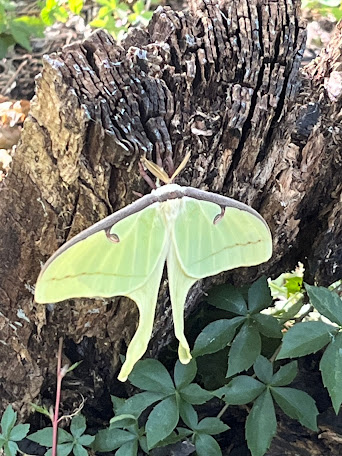
Occasionally we're rewarded with something especially nice, and late yesterday afternoon this beauty showed up on one of the repurposed logs:


I saw it from across the yard, and proceeded to sneak up on it--after having run into the house for my phone. Although it's not the first Luna Moth to show up in the yard, it came in earlier and stayed longer than the only other one I'd seen in the garden. One showed up on the front screen door several years ago, but this is the first one I've seen taking advantage of the habitat. 
 

Habitat lounging is common in this kind of a garden. The arborist who came to assess the recent tree job was very impressed with the number of places critters could comfortably occupy. Even the structures provided for plants can offer a perch for an anole on the hunt:


This one is lazing on the support frame for the fennel we use to harbor swallowtail larvae--not a good sign for this summer's prospects. But I'm hoping to harvest at least a few baby butterflies to host in my mesh hatchery, where I can keep them safely away from this guy. Although chances are that Molly will already have had his tail by then, and he might not be so spry. She's separated at least four other anoles from theirs already.

Many years ago, Kermit the Frog lamented the difficulty of greenness, which can still be seen as a metaphor for current problems in the human world. On several levels. But this gives rise to one more rule worth considering:

It may not be easy being green, but it's our only hope.

This week's events in Yellowstone are bringing home more of the reality of climate change. If we don't start making efforts to restore the environment immediately, precious habitats everywhere will just be washed away. Or suffer from another of the myriad plagues our species is inflicting on the planet.

Earth Island Institute's piece from last year,  "It's Not Easy Being Green: What if we were mutually accountable not only to the environment, but to each other?" takes this a step further, and challenges us to to embrace the whole: humanity and environment, persons of every color, all beings, the whole planet. Everything we do has impact. Responsible choices, meaningful gestures--anything we can do to acknowledge the fact that no matter what color or gender we are, we are all part of the natural world. It could all go away as quickly as a road can be washed into a raging river. 

I'll be celebrating Juneteenth with both the brown and green anoles in the garden tomorrow. I'll be remembering my father, who taught me that race was a human invention, and that color had nothing to do with being human. And I'll be grateful for every person I've known who has reinforced that understanding throughout my life. 

Recognizing that the earth belongs to us all and that we all depend on its survival for our own should be a universal goal. But starting small, in the garden, and keeping safe what we can is easier than it might seem.


Saturday, June 19, 2021

On the Cusp of Summer in the Anarchist's Garden


This weekend has become both nationally and cosmically momentous, what with our first federally official Juneteenth celebrated today, and the occurrence of the Summer Solstice tomorrow.  Fathers' Day doesn't much come into the equation, since we are both now fatherless, but the children usually send greetings and often bring up a nice beer; if they do so this year, we'll have even more to celebrate. 

As the early onset of summer heat has settled into our daily lives, we've already begun to take mitigation steps. Those who live in drafty old houses without central air conditioning probably understand better than anyone that cooling is an especially expensive enterprise around here. We are, however, fortunate to have a two-level attic fan that draws air both in and out of the house, forty windows to help direct that flow, and numerous large shade trees. 

The garden is so shady, in fact, that finding a place in which to deploy our solar collectors to juice up the Bluetti portable power station isn't easy. It turns out that the best spot is on the north side of the house, next to our already-sagging veggie garden, where a strip of lawn gets sun most of the day. Elsewhere, nothing stays sunny for long, which in summer is mostly a good thing. I discovered this morning, however, that the solar panels are killing the grass, so we'll have to figure out how to elevate them. The power companies are predicting grid problems, and it will be up to consumers to deal with blackout periods in August. This being Texas, there are no plans for actually correcting the problems. So the solar collecting effort is designed to give us a couple of off-grid air con when we need it.

Our habit now is to open up the house in the early morning, for as long as it's cool enough to get by with just the fans. As things warm up, we vacate the living room for the snug and/or the study, where we can turn on a room air conditioner. The real challenge is cooking, since the kitchen has no A/C, but the ceiling fan usually does the job for as long as it takes me to prep for the main meal. We're keen on salads or casseroles for supper, the latter being fairly simple to deal with in the "pizza oven" in the range. So I try to cook what needs to be cooked while it's still cool, and then chuck the results into the fridge until time to assemble.

My early childhood experience without any real air conditioning in both tropical and desert conditions has made me fairly tolerant of heat, but the combination of high temperatures and humidity is more difficult to accommodate than desert conditions.

These days, Molly and I have begun a new routine of walking in the garden early, where she can lurk and pounce on unsuspecting insects and reptiles while it's still somewhat cool, and I can practice what I'm calling Mao Qigong (cat Qigong). This involves following her around to make sure she doesn't 1) reduce our already endangered bird population or 2) leap to the top of the fence in pursuit of squirrels. Yesterday I managed to complete an entire Ba Duan Jin (the Eight Brocades) while she explored her usual haunts. I don't get to concentrate much, but I do get to practice out of doors which is supposed to be good for my Chi (Qi). I'm not a believer, but I respect the discipline, and the exercises have helped me to not turn into a blob. The neighbors who walk their dogs past our yard have long since decided that I'm a complete nutter, so I'm no longer bothered by being spotted. 

The garden itself, after being totally sodden for so long, is baking out, and I've had to water the tender herbs. Mosquitos are rife, despite the fact that I've used Bt granules everywhere water stands for more than a few minutes, so I have to spray myself down as soon as I get out. Because my warfarin-laced blood is so attractive to the mozzies, I must rely on a low-level DEET spray, but it's the only deterrent I've been able to find that actually works. When bitten I welt up and itch for days.

My efforts to attract bees seem to be successful again this year, even if butterflies haven't discovered the non-toxic pleasures of my abundance of parsley and fennel plants. I even have a butterfly shelter to help save larvae from the anoles and cardinals that have had their way with caterpillars and chrysalises in the past. As soon as I notice a caterpillar, I'll tie a mesh bag around its feeding area (courtesy of a local farm from whom I buy seasonal veg and which packages them in these rather than in plastic), and when it's big enough, I'll transfer it to a pot of food in the shelter until it pupates and then hatches. Or so the plan goes. Last year my one successful chrysalis rescue in October ended when the butterfly froze after it hatched during Snowmageddon last February. I hadn't thought it would overwinter and hatch, and left it unattended in the greenhouse, only to discover its beautiful corpse after the storm.

The Accidental Garden invariably becomes the Anarchist's Garden as I let nature take its course after spring efforts to get things established.  Except for mowing and occasional weed-yanking, disorder reigns. Of necessity, we do little out of doors after about ten or eleven in the morning, unless the humidity drops below 50%. The critters like to get out later, though, so I bought a collapsible swimming pool for them, hoping to engender some frolics in the evenings. Both Molly and Nylah are fond of water, but I'm not sure how eager they'll be to hop in and wade about. They both examined it when I unfurled it next to the greenhouse, in an especially chaotic corner of the garden that gets swamped when it rains and has thus been shamelessly neglected. But they quickly lost interest when Molly noticed something moving in the sea oats. We shall see. This morning she stuck her front feet in the scantily filled pool and took a drink, but withdrew before too long. We'll find a better place for a more formal test later.


Our mychorrizal habitats (large amounts of dead wood) continue to fruit, with both the usual culprits and some interesting newcomers. I've recently found some "dog barf" fungus (slime mold, in a rather lovely orangey color) in the copse next to where we park Porco. And our long-dead hackberry stump keeps feeding a colony of some variety of inkcaps; these commonly arise after rainy periods. They look very pretty for a day or two, and then collapse into goo.
 

The weatherborne energy of nature is also expressing itself in aggressive growth and abundant flowering. As I showed in my last post, the Virginia Creeper and our neighbor's ivy are taking over wherever I let them. The Creeper is sending out tendrils everywhere, and I've had to trim it back when I notice it. But the extraordinarily long flowering season for Wisteria is particularly welcome, and I've been documenting the development of new blooms on a daily basis. One of the spaces for Mao Qigong includes our "secret garden" behind the garage, where a mass of Wisteria grows unsupported and unconstrained, and it's just lovely to breathe in the heady scent as I move through a practice.


It was by this very blossom that I watched a veritable orgy of Cardinal sex the other day, and wondered what would result. Today I got my answer, since one pair (of the three involved) is reestablishing its home in the cedar tree outside my study window. Two nests have already been built there, and several eggs lain, but only one bit of fluff ever seems to have emerged, and I'm not even sure that it survived to fledge. The weather was so stormy and wet for so long that even in the dense cedar needles I doubt that the mother could have protected any babies for very long. Three pairs have built nests in various parts of the garden, but only this couple has persisted. Shepherding Molly past the tree every morning will once again become part of our daily routine.

I'm not sure what to think of the coming three months. There's little chance that we'll be able to travel anywhere, since state parks are booked up forever. We do plan to head west to visit family after children are back in school and the roads less traveled, but things have changed over the duration of the Plague so much that this summer should be somewhat different than what we've experienced over the two decades we've spent on this little plot of land, and certainly in the last year. 

I guess we'll just have to wait and see.

Image notes: The photo of the sun rising over Stonehenge on the morning of the Summer Solstice (21st June 2005) was taken by Andrew Dunn and used with a Creative Commons license. All the others are iPhone 7 snaps.

Wednesday, May 6, 2009

Skywatch Friday: 13 Ways of Looking at Spring Skies

Wallace Stevens's iconic poem "Thirteen Ways of Looking at a Blackbird" was one of the first texts I studied in a graduate course on translation. The concept that understanding involves multiple perspectives wasn't all that new to me, but this poem drew me to Stevens and his other works, and has frequently prompted visual "thought experiments" that involve looking at familiar things in different ways.

Since many of the photos I take are of my little half-acre in north Texas, I'm frequently inspired to shoot the same object(s) over and over again, at different moments throughout the year. Now, midway through a rainy spring, and before the premature summer weather sets in, I thought it would be a good time to visit and revisit some of this year's subjects.

The opening photo is one I took just after I started posting on Skywatch Friday, and just as the trees in front of the house started budding. The one that follows is of a gloomier moment, as storm clouds began to gather in a spot nearby, about two weeks later:

Just before the official entrance of Spring (phenologically, it arrives early in Texas), I accidentally caught a flock of Cedar Waxwings on film, although I didn't realize what they were until I was choosing photos for this post. I wasn't sure even when I enlarged the image, because their little cockades didn't show up; but the tails and the yellow-grey vests give them away:

And here's a closeup:

Today, as soon as the sun arrived (after several soggy, cloudy, dismal days) I went out a'shootin' and to my surprise, there they were again, this time filching the mulberries that grow next to my front door (the mulberry overlaps with the enormous pecan that grows in the southeast part of the property):

And a closer view:

Concurrent with the first Waxwing photo, I snapped a pleasant surprise--a volunteer redbud that had settled in long enough to be bud (although the buds are really pink), and not far away from that the wisteria had also started to bloom,

to be followed in another ten days by voluptuous, frowsy vines all over the fence, perfuming the entire yard:

Some of the flora aren't quite as dramatic, but still contribute to the suggestion of heavy vegetation to come, such as my well-loved Bur Oak. Its acorns are majestic, as big as hens' eggs, and its rough bark forms a nice backdrop to its large crenelated leaves--here only just budding out, dripping catkins:

Most of the photographs featured so far have shamelessly used the sky as a backdrop; but in these last three, it provides most of the content. The first is of a fairly typical evening in March, just as baby leaves have started to obscure the sky. The skeletal branches of winter have been replaced by fuzz, and clouds move in on a regular basis, but in this shot there's still a bit of blue in the corner, and darkness hasn't quite won out. Within a month there would be little sky at all to see through the canopy.

The second was taken as I was getting ready to enter the hospital, knowing that this month (April) would end my quest to capture all the full moons of the year. As it turned out, on the night of the Full Pink Moon I was still in ICU, and it was the proverbial dark and stormy night (I remember the rain beating against the big windows in my room), so I wouldn't have caught it anyway. Still, this shot of the waxing gibbous moon (although a little fuzzy; I didn't even think to get out the telephoto lens) got fairly close to the proper date.

April showers were in full force for most of the month, and on the 28th I awoke to a mist-drenched back yard. The sky had fallen into my garden, and we got a bit of a respite from the rain.

As much as I complain about being exiled from the land of my birth, there are many things to love about what's left of the prairie. My little carbon sink and my accidental garden remind me that it wouldn't take too long for signs of human habitation to disappear, at least on this small piece of land. I'm trying to strike a balance between too much "civilization" and too little, and I'm frequently rewarded by the variety and density of nature, and the role the sky plays in bringing it to my attention.

Happy Skywatch Friday, People--and many thanks to the crew that put this meme together and keeps it thriving.

All photos taken with a Nikon D80, using either Nikkor 18-135 mm or Sigma DL Macro Super 70-300 mm lenses.