Sunday, December 31, 2023

(Can There Be) Too Many Trees?

Note: I wrote most of this a month ago, but got distracted by the holiday season and some dismal weather. It was originally meant to be the first in a two-part series (but don't hold your breath), this one subtitled "A Nostalgic, Mostly Random, Catalogue of a Life's Worth of Trees." It has morphed into a grateful farewell to 2023.


Brief glimpses of the sky in late summer

The most important difference between desert rats, like me and my father, and the rest of humanity, is that we easily become oppressed by voluminous masses of trees.

For the tree-shy among us, vast volumes of sky are preferable to endless forests. It seems somewhat ironic, therefore, that most of my life has been spent in subtropical forests (Taiwan) and blackland prairie (north central Texas) that's been transformed into suburbs with tree-lined boulevards and back yards full of native hackberry, pecan, and burr oak, as well as bird-planted mulberry, chinaberry, catalpa, and privet--in addition to developer-planted Callery and Bradford pears. The gradual overtaking of native grasslands by Eastern red cedar trees is another kind of problem, because these cedars are native to Oklahoma, but are becoming a plague across Nebraska and other prairie states.

Finding open sky over our little half-acre is almost impossible for three quarters of the year. One of the most enjoyable aspects of autumn is the gradual opening of our rather dense canopy (especially after having had the Tree-saver people out for some serious pruning to prevent winter damage due to dropped branches), and the welcome expanses of sun that spill in with the also-welcome cooler weather. 

The back yard is populated by five very large pecans, one of which dropped an enormous branch after a wet spell that had followed a longer dry one. This is what prompted the latest thinning, because our lot also harbors four more pecans, four oak varieties, a sweet gum, and a few stray bird-planted specimens of catalpa, cedar, redbud, and a large tree-bush that looks like a viburnum in bloom but has leathery, serrated leaves like a holly (I've lately found out that it's an English Holly). And then there are the yaupon holly shrubs that hide a good deal of the house from the street, and shade the living room from the eastern morning sun in summer. A ten-year old chinaberry had to be cut down this year (leaving lots of lumber for various uses), as did a Callery pear and a mulberry. I'm hoping to use the newly vacant space to plant a fruit tree near the compost bins, but haven't decided whether battling the pear-eating squirrels would be worth the effort. There are two pears on the southern border of the property, but we haven't had a crop in years because the squirrels denude them almost as soon as they flower. Maybe something pretty, like a vitex chaste tree, which always do well around here, and are natives.


The broken pecan branch before The Beloved Spouse felled it.

The aftermath.

After recently reading Kendra Atleework's moving memoir of growing up in the Owens Valley, Miracle Country, I realized that there is a small connection between there and here: the Liquidambar styraciflua  growing in front of my house, the sweet gum, is the same species as one that grows in Atleework's yard in Bishop. 

When my son was two years old, my father and stepmother visited us on Long Island, where we lived in a lakeside cabin on Long Pond (better known as Lake Panamoka). It was there that I first hear the "too many trees" remark as a reason why my dad hadn't ever been interested in living in the east. After a final Air Force stint in Hawaii, he had retired to an acre or so in Porterville, California (on the other side of the Sierras from where we both were born), which sported a couple of fruit trees and a pollarded mulberry, but not much else. A magnificent oak sheltered grazing cows on the other side of the back fence, but it was far enough away to not count as too many.

I do remember that when I was a small child, visiting my father's parents in the Owens River Valley,  there were a few fruit trees and a gorgeous (and prolific) walnut tree in the back yard of the house provided by the Los Angeles Department of Water and Power electrical plant at Cottonwood.  The infamous aqueduct across from the desiccating bed of Owens Lake snaked by the house and the plant, where my grandfather worked until the end of his life. After he died, though, my grandmother moved to town (Lone Pine, where I was born). There her tiny back yard was graced with a honey locust and a catalpa. Her mother had loved the big, fragrant, orchidy flowers of catalpas, which is what prompted me to let one grow next to my driveway in McKinney. It had to be cut down during the recent trimming because it was dying, but its replacement is already about six feet tall, standing in the middle of an iris bed. In the front yard of my grandmother's house  two very large cottonwoods grew, but eventually died as the city of Los Angeles got stingier and stingier with the water it was diverting from the Owens River. 

During the five years my father was stationed in Taiwan, we lived in five different houses, three of which were located on Yang Ming Shan (Grass Mountain), and, if they survived the inexorable and exponential growth  of Taipei city in the '60s and '70s, are now part of the National Park. The first and last houses were in Taipei proper, but I only remember the Jacaranda tree that grew inside the stuccoed brick wall that surrounded the first house. It was huge, and bloomed luxuriantly with purple blossoms the first spring/summer we were there. It was also great for climbing. The Yang Ming Shan houses, however, were mostly nestled into clearings in the jungle, and overlooked terraced rice paddies all the way down into the valley below, or a waterfall into a sulphur river. The last mountain house had a pomelo tree at the top of the entry steps. Although one has to work at it, peeling the one-inch rind off the fruit is well worth the time and effort it takes to reach the slices of mild grape-fruity sweetness. Sadly, the quality of pomelo one can get here in the States doesn't begin to approach that childhood memory. 

It's probably the case that my ambivalent relationship with trees developed only after I'd spent my early adult life in palm tree dominated Southern California, and began to see my home town as my real home--even after I had moved permanently to Texas, finally met a compatible husband, and finished raising my kids. Now when we travel, it's always west, through the deserts and mountains of the Basin and Range. So far we've hauled several dogs and a cat back and forth three different times, pulling a caravan (first an imitation Shasta Airflyte, and then a larger, more animal-compatible retro style canned ham) behind our Jeeps, spending as much time as we can trying to soak up the atmosphere of sand and sky and clear air before we head back to a place we're finding really difficult to imagine leaving permanently.

We've been here in north Texas together for over thirty-five years, but often muse about moving west for good. At best, however, we'll probably manage at least one more caravan trip back. We've lavished an enormous amount of labor and love on the house, the garden, and--yes--the trees. Whether or not there are too many of them. They do help me mark the seasons, though, and here are some early winter shots of skeletal trees and the surprising skies they occasionally frame (the large magnolia on the left of the first photo belongs to my neighbor):

Moonrise just before the Full Wolf Moon, 25 December.

Facing west this morning, toward the Wolf Moon's waning gibbous remains. 

Sunrise on New Year's Eve.

A bit of year-end sky drama from the north, just after sunrise this morning.

One of the reasons I enjoy Skywatch Friday is that it inspires me focus on what's overhead, which often presents surprisingly beautiful photo opportunities. And the sheer number of possible dramatic meteorological displays available to me serves to remind me of why we continue to live here and why we probably will never leave. The property may measure only a half acre, but it's our little bit of refuge in a world now tormented by yet another war and ever more destruction.

Shalom to all of you who still wander by the Farm, and to all of us inhabitants of a problematic age. I am often quite pessimistic, but I do harbor some hope that the new year will bring us a less bellicose political landscape, climatic news could improve, and that relief from the many economic plagues that ravage the less prosperous who share this amazing planet with us may come about.

Tuesday, September 26, 2023

Into Autumn

First Overhead Balloon of the Season
Another season turning: better weather, a bit of rain, lingering hot days (but cooler nights). It's a few days past the equinox, a few days short of the full Harvest moon, and I'm getting ready for eye surgery which will put me out of commission for a week or so, but should preserve the sight in my left eye.  In preparation, I've been taking it easy, pottering about the garden, and trying to ignore the news. Molly has taken to spending time with me on the backyard table when I go out to drink my morning tea, so I get a dose of companionship and cuteness before the mozzies figure out that I haven't bathed in repellant. 

Sunday in the Garden with Molly

Nylah is usually over behind the garage, keeping watch for errant dogs or babies who might stroll by. Although basically quite intelligent, her Great Pyrenees genes tend to keep her in "big dumb mop"* mode, more ornamental than useful. She is pretty to watch, but seldom photogenic enough to capture. The last photo I took was in June:

Nylah Lounging in Woody's Garden

In terms of holidays, the Celts celebrated the transition from summer to fall at the equinox, and through to Samhain (which marks the midpoint between the autumnal equinox and the winter solstice, and coincides with Halloween)--when cattle were brought down from summer pastures. I'm wondering just how long it will take the current weather patterns to complete the change, given all of the climatic upheavals we seem to be "enjoying." 

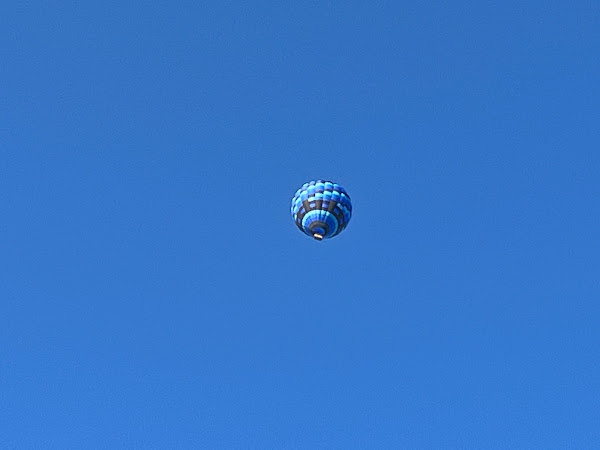
One of the seasonal markers that occur fairly regularly here in the northern part of Occupied Mexico is the Plano Balloon Festival, which takes place about ten miles south of here, near where we lived while my kids were growing up. This year it coincided with the equinox (September 21-24), and the opening photo for this post (taken on September 18) probably represents someone practicing before the event. I'm not sure how much ballooning actually got done because of high winds and other kinds of threatening weather, but we haven't attended the event since The Beloved Spouse began tennis coaching, because by then the whole thing had become a circus and the team got wrangled into participating. 

Celebrations of all kinds seem to have run amok in the last few decades, in part because they've become huge cash cows for businesses. The market-capitalism greed machine has overtaken the communitarian aspect of seasonal goings on, and now they all appear to run together, and the hype begins earlier and earlier each year. 

A couple of days ago, while I was looking through old posts for a family recipe, I revisited the first year of this blog. The November 27th, 2007 entry (entitled "Enough") ruminated on greed--so it's clear that things haven't improved much. 

Nevertheless, I keep finding small indications that some shifts might be taking place. An article in the New York Times on young Luddites (from December of 2022) suggests that technology may not have quite the grip that some of us fear, at least among Gen Z. These kids actually remind me a bit of a group of rather pretentious intellectuals from the local boys' Catholic high school and the public school I attended. We all got grounded around graduation time because we stayed out all night at one guy's house reading T. S. Eliot, discussing The Little Prince, and listening to a couple of them playing Chopin etudes--and there weren't even flip phones for us to call home with.

An article in this week's New Yorker, Sam Knight's "A Young Architect's Designs for the Climate Apocalypse"  quoted from an essay by architect Anthony Dunne in the journal, Reading Design: "A Larger Reality," wherein he quotes from Ursula K. Le Guin's acceptance speech for the National Book Foundation Medal for Distinguished Contribution to American Letters in 2014, where she enjoined science fiction and fantasy, and other "writers of the imagination" to challenge the profiteers of the written word who dictate what should be written and rewarded:

Hard times are coming, when we’ll be wanting the voices of writers who can see alternatives to how we live now, can see through our fear-stricken society and its obsessive technologies to other ways of being, and even imagine real grounds for hope. We’ll need writers who can remember freedom — poets, visionaries — realists of a larger reality. (Copyright © 2014 Ursula K. Le Guin)

With this in mind, I'd like to recommend two small books that provide us with a glimpse of a possible future that avoids Armageddon and turns away from climate apocalypse: Becky Chambers's A Psalm for the Wild-Built and A Prayer for the Crown-Shy (Macmillan 2021 and 2022). For a nice essay that shows why I might be recommending these books, see Molly Templeton's "The Refreshing Hopefulness of Becky Chambers' Monk and Robot Books."

See you on the other side. Or, as Capt. Mal Reynolds would say, "Y'all gonna be here when I wake up?"**


*Not an entirely coincidental reference, because I just finished my second reading of A Prayer for the Crown-Shy last night, I found this passage describing Sibling Dex's family dogs to be a particularly appropriate description of Nylah's lineage and demeanor: "There were three of them, all shaggy herders painted in soft swirls of brown and black, smart as hell when they were at work and big dumb mops every other hour of the day" (113). It's also appropriate that the photo of Nylah I included was taken in the little garden dedicated to one of her two predecessors, Woody--of Woody and Arlo fame. Both were border collie mixes, of which breed Nylah is about half, all of these three also big dumb mops when they're not busy being herders.

**False alarm. My retina surgery has been postponed. But thanks for any concern.


Monday, September 4, 2023

How Much Is Enough?

Note: This post was actually written about a week ago, but life got in the way, the weather's since been up and down, and we're at the beginning of another heat wave. The musings, however, still hold.

Late August morning in McKinney; First clouds in weeks!

The Beloved Spouse and I were enjoying the cool, breezy morning--after weeks of blistering temperatures with only one, short, previous break. This is beginning to look like a harbinger of Fall, but we're not celebrating extended good fortune quite yet. Still, even a short-lived respite is welcome, and recognizing good fortune often results in good conversation.

As often happens among the philosophically inclined, we were discussing the conditions that have created the current socio-political situation: climate change, energy consumption, consumption in general, the kind of materialism that convinces people that they need more and more stuff (instead of the kind of materialism that focuses on what exists rather than what people imagine might be out there), greed, The Future. In other words, Life, the Universe, and Everything. As we often do.

After we had mused about what we could do to ameliorate things (acquire an electric car, increase our solar production/battery capabilities), I wondered out loud about how much of what we already do makes even a dent in the overall condition of the planet: cut unnecessary consumption of consumer goods rather drastically, eliminate food waste, conserve power, reduce reliance on natural gas, minimize water use, eliminate single-use plastics, rely as much as possible on locally sourced food (sustainably grown and humanely raised),  minimize car use--all of which we're already pretty good at.

But to what end? If as few people actually make these efforts as seems to be the case, are we really accomplishing anything? 

We also live in an area of the country that's experiencing monstrous growth with the accompanying environmental degradation, increased pollution, massive addition of concrete and other problematic infrastructure materials, and demand for (and ultimate shortage of) water resources. The influx of population is bringing with it not only more people, more jobs, increasing property values, and a larger tax base (which are all considered Good Things in Texas), but is also exacerbating all of the problems conscientious people are trying to deal with.

A few signs of hope occasionally appear, like the increasing presence of local farms practicing regenerative agriculture (even as land gets snatched up by developers), urban farmlets cropping (sorry) up in South Dallas's food desert, cooperative enterprises that involve farmers, artisans, restaurateurs, food purveyors, and other socially and environmentally responsible entrepreneurs. But can they keep up with the "progress as growth" ethos built into the kind of consumer capitalism that dominates the current economy?

Another hopeful sign is the increasing number of "slow" movements sneaking into the existing economic forecast. Backlashes against destructive consumerism, especially in food and fashion, are appearing in the news, online, and in shelter magazines. The permaculture movement, most visibly evident in Australia, but catching on in Great Britain, the US, and Canada fairly conspicuously, is becoming a "thing." I've become an avid reader of Tom Hodgkinson's The Idler, which advocates slowing down and smelling flowers, but also a slower, more engaged, less frenetic economy. I only subscribed after it became available digitally because of my problematic relationship with print publications. (Digital subscriptions are also less expensive.) It is, however, highly entertaining, and often quite instructive.

Oddly enough, given my technologically skeptical bent, social media platforms like Pinterest and YouTube are helpful in promulgating practices that lead to slowing down and less active forms of consumption. For example, TBS and I have become followers of a few travel vlogs that allow us to enjoy activities out of our financial reach (such as sailing, or wandering around Scotland, or boating on the British canal system, or living in a Japanese satoyama and restoring a rice farm) vicariously. Every day we can learn something about the latest astrophysics news, watch Italian nonnas make pasta, or clever chefs show us how to make dishes from recipes published in the New York Times food section. Pinterest allows me to collect and curate inspiring photos and articles like those I used to cut out of the shelter magazines I subscribed to and save in notebooks. Now I can do much more with the interesting ideas I come across. At least until the EMP comes and fries the Cloud.

And so, while we still have pipe dreams about buying an electric truck and pulling an electric caravan, it's more likely that we'll keep plugging away at doing what we can to lower our planetary impact. I may not be able to maintain a completely waste-free household (the kind of effort that frequently appears in the newspaper and magazine articles I consume), over the last decade we have managed to reduce our trash output to a single green bin per month (stuff headed for the tip), and our recycle bin goes out every month or so. New clothing purchases are primarily confined to tennis shoes (TBS's avocation requires properly supportive foot ware) and underwear, neither of which are suitably acquired at charity shops.  I'm also hoping to solve some of our energy-consumption challenges by creating insulated portieres to help us isolate single rooms when we need an air conditioner to escape the heat, or a heated room to withstand the cold. We're currently recycling old woven serapes, but they're not as efficient as they could be. Over the years, however, I've collected large bins of fabrics--from worn clothing, bed linens, remnants from old projects, and thrift-store finds, all of which will allow me to make use of my antique-looking sewing machine or (if I'm feeling especially frugal) my grandmother's treadle machine, on which I learned to sew in the first place.

In fact, ruminating on the conditions in which my grandmother grew up (isolated Nevada ranch with no running water, indoor plumbing, nor electricity), and remembering the little two-room cottage with a single water spigot in the kitchen and outdoor toilet where my family spent a year in Japan, provides a reality check when I feel a bit picked on by the cosmos.

All of this navel gazing has come about in part because of the 100-degree (F) exterior heat that's characterized the last two months, and that seeps into a wood-frame house with brick cladding and little insulation (and not much we can really do about it). Upgrading heating and cooling sources, and otherwise improving a century-old house built to withstand nineteenth-century temperatures, requires more money (and in some cases, physical effort) than we can expend. So we make do, as inventively as we can, because we chose this house, and love it enough to keep living in it. 

We are deeply aware that there are unimaginable numbers of people in this world, and even in this very state, who are far worse off than we are. And if our meager efforts to make a difference aren't any where near enough, at least they're not nothing.

And maybe, at least for now, that has to be enough.