Showing posts with label Ursula K. Le Guin. Show all posts

Saturday, February 15, 2025

Perhaps Resistance Isn't Really Futile

A North Texas winter sky

Since my last post, I've been experiencing what many like-minded folk have, when practical solutions to current political chaos seem, well, futile. I've often joked that with all of the artificial gadgets that now occupy my body (chief among them an artificial aortic valve--but also stents in old bypass grafts and interocular lenses in both eyes) I'm well on my way to Borghood. The Collective's warning upon meeting any new species is that resistance to assimilation is futile. Try as one might, becoming a fellow cyborg is inescapable. 

Now that this country is in the process of being overwhelmed by the Collective-like apparatus of the fomenters of Project 2025 (including our current president and his minion-in-chief--or is it the other way around?), finding ways to escape the doomsday scenarios that emerge daily seems unlikely, if not (yet) a completely futile effort.

And so, rather than give in to the probably-inevitable cultural and political emergence of true dystopia, and given that most of us (especially fixed-income retirees with ties to hearth, home, and animals) aren't well fitted to actual Revolution, I thought I'd share some of the strategies I've been pursuing to combat utter depression and ease unavoidable anxiety. If you are in a position to actively Do Something (or, as Revrunner advised in a comment after reading my last post, to follow Nancy Pelosi's advice to stop agonizing and start organizing), please do. Please do. Alas, my days of protesting, marching, and sitting in are long behind me, so I have to content myself with sending a few bucks to worthy causes. And--as a few of my loyal readers have advised--keep blogging.

It's probably a very good idea to keep reading, as well, since there are so many wonderful writers and websites and newsletters out there that I keep running across during my weekly exercises in rabbitholery. In terms of actual strategy, here's an idea that's working wonders with my attitude and with keeping my brain from shriveling up and crawling somewhere dark and dank: Re-read the people whose work got you where you are today, intellectually, politically, religiously, or whereverly. For example, I'm currently in the midst of rereading Ursula K. Le Guin's Earthsea works.  Shortly after her death in 2018, I was given the collection of her stories (in the volume at the link). It's a heavy tome, and so I've taken to reading it downstairs in my living-room comfy chair, then continuing with individual volumes upstairs when I go to bed. The troubled universe she describes in the books is disturbingly like ours in its current configuration, minus the mages and magic. But her astonishingly wise take on human frailty--race, gender, economics, art, craft, and the nature of wisdom itself--is both frighteningly prescient and reassuring at the same time. Even though I generally prefer science fiction over fantasy, I have long enjoyed these books and stories. But the science fiction segment of her work explores many of the same themes, which novels such as The Left Hand of Darkness, The Dispossessed, and The Telling consider in equal depth. [Even though I haven't joined their affiliate program, I would urge anyone who wants to buy these books to order from Bookshop.org, or directly from the publishers, rather than to enrich Mr. Bezos more than we have to. Another option: buy them used from a local bookshop.]

I also plan to revisit Octavia Butler's Parable of the Sower, which begins in what was then the "near future" of 2024 (the book was first published in 1993) and in the very LA neighborhoods (Altadena and Pasadena) that have been devastated by the recent fires. Although Butler died in 2006, her legacy has survived in part because of her own prophetic vision--and the diligence with which her readers preserve her work and its messages

In addition to reading, I urge folks to write--to blog, to start a Substack, to send letters to the editors of local newspapers, and to avoid the attention-culture as much as possible. Although I do have an Instagram account, I only use it to follow a few writers and a local prairie gardener. I use Pinterest only as a curatorial tool for myself; I don't engage with anyone on it. I visit Quora less and less, and usually just to answer questions about cookery and being old. I've avoided twitterhood entirely, and see no reason to subscribe even to Bluesky--although if you find such a platform necessary, it's probably the best available choice at the moment. I try to subscribe to media populated only by folks who think and write about what they're thinking, but when I do, I resist requests to follow platform "recommendations." I will shortly be going through my own blog roll to make sure any links are active, relevant, and worthwhile. If you're interested in the cultural can of worms the Attention Economy has dumped on us, try reading Jenny Odell's How to Do Nothing [a web search will turn up videos, workshops, and discussions on the book] or Chris Hayes's The Sirens' Call: How Attention Became the World's Most Endangered Resource. [Again, there's a great deal online about this book, including interviews and Hayse's own podcast.] 

The benefits one can derive from keeping a journal in dark times seem, at the moment, immeasurable. In part because of what I often describe as "sleep-related marble-leaking" I tend to forget things quickly. It does, therefore, help considerably to spend an hour or so several times a week trying to record things that might be needed at some point in the future. My father's deathbed advice to my children was to "write at the end of your stint," which I've taken in earnest during the last decade or so. But don't wait! Do it now! My son will be fifty next year, and although I can plainly remember the jollity with which he posted a sign on my office door (during his brief studenthood at the Art Institute) announcing my own fiftieth birthday, that's just another indication of how quickly it all goes by. And keeping journals (I now have several, on reading/thinking, cookery, gardening, and design ideas) helps organize the brain, provides a creative outlet, and gives you something to do with all the free time you have if you give up futzing around on Tik Tok or Instagram or Facebook. If you need to keep in touch with people, write them letters in email and keep a record of the correspondence. I still have the letters my father and I wrote to each other via email from about 1997 to 2004. I copied them, printed them out, and cherish them to this day. They're like journals, only with more dimensions.

Finally, try a bit of Tikkun Olam--the Jewish practice of finding ways to heal the world. The link is to a page on the Orthodox understanding of the term, and it provides some useful ways to think about taking care of an increasingly endangered planet.  Every little thing we do, especially if multiplied by others, helps to stem the tide of of demise. Keeping even a little garden, providing even a tiny bit of habitat for wild critters, home-keeping, spending time in the out-of-doors, helping neighbors, buying less stuff, driving less, using less energy,  paying attention to the planet--even simply sky-watching. 

We really do need to enjoy what we have while we have it--and to do what we can to keep from losing it. 

Monday, July 22, 2024

Slouching Toward Gilead


Because nearly every day recently has contained elements that seem to portend the beginning of the end of rational life on earth, I've been reading more than my usual quota of science fiction. So, while I was looking for something to use as a banner for this post, I came across this wonderful diagram of The History of Science Fiction by Steve Jurvetson on Wikimedia Commons*, and I think I've managed to link to a high-res version (which is the only possible way to use it without getting a headache). Although as an infographic it's a bit difficult to follow, Jurvetson's connections among different genres and media throughout history (from Gilgamesh to now) offer a really useful way of following what I've come to think of as the literary genre with the longest history of all. 

Imagining different worlds and universes seems to characterize major shifts in historical events, ways of thinking, and--eventually--life, the universe, and everything.** Among the stories I've always loved best, even though I've been pretty much a free-range reader, have been those attempts to imagine what we could become at moments where what are becoming seems to be particularly problematic. Only recently I'd plowed through all three of Cixin Liu's Three Body Problem novels (and watched both television renditions) and was left longing for something that would restore my persistent suspicion that things might just turn out okay in the end.

I often return to Ursula K. Le Guin's early stories that feature striking contrasts between fairly simple economies (like the Kesh in Always Coming Home, or Falk's rescuers in City of Illusions) and their antagonists (the Condor People and the Shing), or that follow emerging connections during contacts between indigenous peoples and explorers (such as natives and ethnologists or colonists; I think the best of these, and the most relevant to the present is The Telling). But Le Guin tempers utopian leanings with realistic assessments of the things that get in the way: greed, power-hunger, fear/hatred of the other.

Living through the current election cycle seems more and more like being ensnared in an ill-conceived saga about people who yearn for a past that never really existed, others who have a better idea of what is actually going on but are powerless to effect any kind of meaningful change, and a much larger population of those who would rather not think about it at all.

So, I keep reading. Rather recently I discovered Robin Sloan's Mr. Penumbra's 24 Hour Bookstore and its companion (within the Penumbraverse) Sourdough. As often happens to me, at just about the time I'd finished both, Sloan's newest entry into his 'verse came out: Moonbound. I pre-ordered it and devoured it upon arrival. None of these books is actually science fiction as usually defined or experienced by folks like me. Instead they're variations on a magical-realistic view of the present (the first two), and a fantasy adventure that riffs off most of the stories/tropes that belong to boomers, gen-exers, and their descendants: C. S. Lewis, Tolkien, Harry Potter, Dungeons and Dragons, and a lot more I'm not even tangentially familiar with. Sloan's worlds are amusing, smart, with-it (I think; since I'm not, I'm not really sure what that means--but they seem particularly attuned to my children's generation), and engaging, even for old Luddite farts like me who fell out of the gaming world when she couldn't make it through Myst. [Note: I'm leaving the sourcing up to interested readers, since everyone seems to harbor preferences as to booksellers and critical resources. Searches can lead to beneficial excursions through accidental rabbit holes, so have fun.]

Another new favorite is Becky Chambers, whose Robot and Monk books, A Psalm for the Wild-Built and A Prayer for the Crown-Shy are much better, and far more healthful, than drinking too much wine in order to make it through the current epoch. They're both gentle, sanguine, philosophically sound, and way too short (not really; each one is exactly as long as it needs to be--but I want more). Her niche in contemporary SF has been called "hope punk" which seems rather appropriate.  I can't remember how I found out about them, but will search back through last year's journal to see where they first come up so I can thank whoever's responsible. When I'd finished them (twice), I read her earlier Wayfarer series (A Long Way to a Small, Angry Planet, A Closed and Common Orbit, Record of a Spaceborn Few, and The Galaxy, and the Ground Within), and a stand-alone novella, To Be Taught, if Fortunate.  Twice, each. In the Robot and Monk books, dystopia has been bypassed (the robots give up on humanity and left town for the wilderness). In the Wayfarer series, dystopia still beckons among some species, but the crew of Wayfarer and their friends are making their way(s) toward a more harmonious universe. If this intrigues you at all, see this essay in Wired by Jason Kehe: "Is Becky Chambers the Ultimate Hope for Science Fiction?"

So, while this country seems bent on making at least some aspects of contemporary dystopic film and fiction (like The Handmaid's Tale, Mad Max, and various warnings about the coming Singularity) come into being, I'm revisiting William Morris and Le Guin

But in case you haven't had enough of dystopia (or if you're bingeing the stuff I never read or watched, like The Hunger Games and such) here's a classic, which everybody needs to read: 

In 1909, E. M. Forster published his short story, "The Machine Stops" in the Oxford and Cambridge Review. It's available at the link in .pdf  (thanks to retiring U. C. Davis professor Phillip Rogaway; I'm not sure how long this text or his web page will be available after the end of the month). I used this story in my Technology And Utopia classes both at UTD and the Art Institute, and my students found its prescience striking--even before the F-book and its ilk had taken over our own world. 

But I'm not going to end on a completely sour note. My bedtime reading (after my third time through Le Guin's The Telling) is currently Andy Weir's latest novel, Project Hail Mary. . . .

[Several days later]

I started working on this post on or about the Ides of July, when things had started looking quite ominous. Since then, and since my last little bit of input, things have changed and a modicum of sanguinity has returned (that's "sanguine" in the sense of "optimistic" rather than "bloody"). We'll still have to wait to see how things turn out, but the prognosis is somewhat more promising than in recent weeks.

That said, I've now finished Project Hail Mary, and I don't remember having quite so much fun reading a book about the probable demise of Mother Earth. A mild spoiler: Earth seems to have survived, thanks to the efforts of Ryland Grace and his buddy Rocky. Weir once again has his characters "science the shit out of" every problem that erupts (actually, many, many problems) just as Mark Watney does in The Martian. I'm sure the biophysicists (?) and other sciency types who read the book (or see the film, due out next year, with Ryan Gosling as Grace) will find numerous flaws, but I'm more than willing to suspend whatever disbelief arises because the whole thing is poignant, smart, quirky, amusing, and very much fun. I can't wait to see how the film crew manages to pull this one off!

Good science fiction is really no different from good fiction of any other genre, as long as the writer can build an engaging world, create believable and compelling characters, and deal with issues important to human being-in-the-world. Once upon a time, in a world long past, I was asked "where have all the philosophers gone?" I rather flippantly answered that they'd all run off to write science fiction. As it turns out, though, the tendency of SF writers to engage questions of philosophical importance, deal with cultural conundrums, and explore the meaning(s) of sentience and consciousness by posing interesting questions and conducting thought experiments along the way makes my answer from about 1980 practically spot-on today. 

Any of the writers I've mentioned in this post are well worth reading. So, if you're looking for a beach read, or just something smart to take your mind off current events, have a go. As I mentioned above, I haven't linked everything, but using the google machine can often lead you along interesting paths, so I decided to leave the door open for serendipity.

Enjoy the rest of the summer, and try to stay cool.


*Steve Jurvetson's Flickr page is here. My finding this image also led me down a rabbit hole--this guy is really interesting.
**Thanks, of course, to Douglas Adams. 

Tuesday, September 26, 2023

Into Autumn

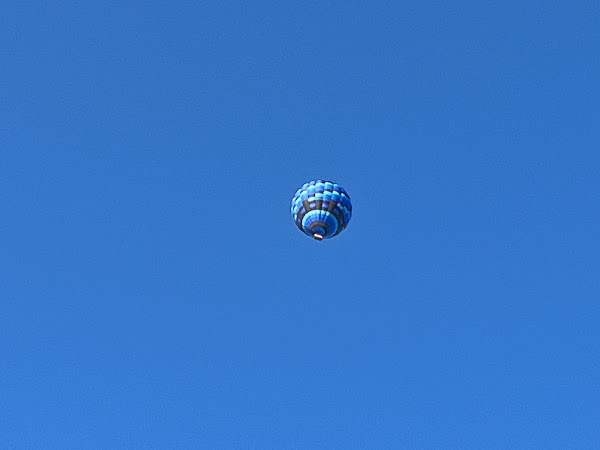
First Overhead Balloon of the Season
Another season turning: better weather, a bit of rain, lingering hot days (but cooler nights). It's a few days past the equinox, a few days short of the full Harvest moon, and I'm getting ready for eye surgery which will put me out of commission for a week or so, but should preserve the sight in my left eye.  In preparation, I've been taking it easy, pottering about the garden, and trying to ignore the news. Molly has taken to spending time with me on the backyard table when I go out to drink my morning tea, so I get a dose of companionship and cuteness before the mozzies figure out that I haven't bathed in repellant. 

Sunday in the Garden with Molly

Nylah is usually over behind the garage, keeping watch for errant dogs or babies who might stroll by. Although basically quite intelligent, her Great Pyrenees genes tend to keep her in "big dumb mop"* mode, more ornamental than useful. She is pretty to watch, but seldom photogenic enough to capture. The last photo I took was in June:

Nylah Lounging in Woody's Garden

In terms of holidays, the Celts celebrated the transition from summer to fall at the equinox, and through to Samhain (which marks the midpoint between the autumnal equinox and the winter solstice, and coincides with Halloween)--when cattle were brought down from summer pastures. I'm wondering just how long it will take the current weather patterns to complete the change, given all of the climatic upheavals we seem to be "enjoying." 

One of the seasonal markers that occur fairly regularly here in the northern part of Occupied Mexico is the Plano Balloon Festival, which takes place about ten miles south of here, near where we lived while my kids were growing up. This year it coincided with the equinox (September 21-24), and the opening photo for this post (taken on September 18) probably represents someone practicing before the event. I'm not sure how much ballooning actually got done because of high winds and other kinds of threatening weather, but we haven't attended the event since The Beloved Spouse began tennis coaching, because by then the whole thing had become a circus and the team got wrangled into participating. 

Celebrations of all kinds seem to have run amok in the last few decades, in part because they've become huge cash cows for businesses. The market-capitalism greed machine has overtaken the communitarian aspect of seasonal goings on, and now they all appear to run together, and the hype begins earlier and earlier each year. 

A couple of days ago, while I was looking through old posts for a family recipe, I revisited the first year of this blog. The November 27th, 2007 entry (entitled "Enough") ruminated on greed--so it's clear that things haven't improved much. 

Nevertheless, I keep finding small indications that some shifts might be taking place. An article in the New York Times on young Luddites (from December of 2022) suggests that technology may not have quite the grip that some of us fear, at least among Gen Z. These kids actually remind me a bit of a group of rather pretentious intellectuals from the local boys' Catholic high school and the public school I attended. We all got grounded around graduation time because we stayed out all night at one guy's house reading T. S. Eliot, discussing The Little Prince, and listening to a couple of them playing Chopin etudes--and there weren't even flip phones for us to call home with.

An article in this week's New Yorker, Sam Knight's "A Young Architect's Designs for the Climate Apocalypse"  quoted from an essay by architect Anthony Dunne in the journal, Reading Design: "A Larger Reality," wherein he quotes from Ursula K. Le Guin's acceptance speech for the National Book Foundation Medal for Distinguished Contribution to American Letters in 2014, where she enjoined science fiction and fantasy, and other "writers of the imagination" to challenge the profiteers of the written word who dictate what should be written and rewarded:

Hard times are coming, when we’ll be wanting the voices of writers who can see alternatives to how we live now, can see through our fear-stricken society and its obsessive technologies to other ways of being, and even imagine real grounds for hope. We’ll need writers who can remember freedom — poets, visionaries — realists of a larger reality. (Copyright © 2014 Ursula K. Le Guin)

With this in mind, I'd like to recommend two small books that provide us with a glimpse of a possible future that avoids Armageddon and turns away from climate apocalypse: Becky Chambers's A Psalm for the Wild-Built and A Prayer for the Crown-Shy (Macmillan 2021 and 2022). For a nice essay that shows why I might be recommending these books, see Molly Templeton's "The Refreshing Hopefulness of Becky Chambers' Monk and Robot Books."

See you on the other side. Or, as Capt. Mal Reynolds would say, "Y'all gonna be here when I wake up?"**


*Not an entirely coincidental reference, because I just finished my second reading of A Prayer for the Crown-Shy last night, I found this passage describing Sibling Dex's family dogs to be a particularly appropriate description of Nylah's lineage and demeanor: "There were three of them, all shaggy herders painted in soft swirls of brown and black, smart as hell when they were at work and big dumb mops every other hour of the day" (113). It's also appropriate that the photo of Nylah I included was taken in the little garden dedicated to one of her two predecessors, Woody--of Woody and Arlo fame. Both were border collie mixes, of which breed Nylah is about half, all of these three also big dumb mops when they're not busy being herders.

**False alarm. My retina surgery has been postponed. But thanks for any concern.


Tuesday, February 22, 2022

Fragile Paths to Better Times

Update: The Endangered Alphabets Kickstarter campaign, The Right To Speak, The Right to Read, The Right to Write has been funded. Happy International Mother Language Day, and a gazillion thanks to anyone who supported the project!


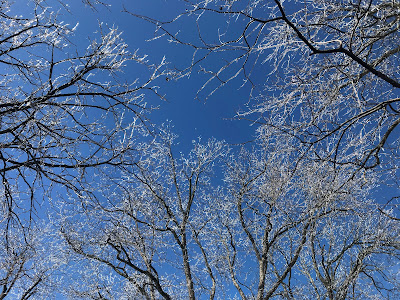
The sparkly aftermath of the last ice storm


After a balmy last few days, it's again cold, windy, and rather bleak this morning, so I'm finding it a little difficult to get up the steam to begin an effort to look at the world more optimistically. But we made it through last night's massive hail storm with nothing obviously damaged (TBS had wisely parked the truck under cover), so maybe that's enough. People on the next-door neighborhood site have started praying for snow tonight (instead of ice and sleet). But it looks like cold weather will rule over the next week before it starts feeling like Texas again.

My several news sources (in particular The New York Times and the Washington Post, but even The New Yorkerf) seem compelled to offer up "good news" with nearly every issue. The WaPo's "The Optimist" generally gets tossed in the trash bin automatically because I'm almost never in the mood for cheeriness first thing in the morning. Occasionally I'll be tempted to take a peek, but I really just want to see what's going on so I can bitch about it for the rest of the day. TNYT and TNY are more subtle, and thus more successful at luring me in. 


It's not that I relish being a pessimist, but as I often remind people who question my lack of sanguinity, "pessimists are seldom disappointed; and when they are, it's a good thing." I'm also not fond of the pabulum some folks seem to think of as good news (no, winning umpteen gold medals in the Olympics is not the most important thing in our collective public life and is not a measure of our national wellbeing). Although I do relish watching Nathan Chen demonstrating his prowess on ice, was not glued to the set for things I don't understand: "big air" and "half pipe," for example. And in order to keep my blood pressure at a reasonable level, I'm avoiding most television in general so as not to be exposed to the idiocy going on at the northern border.


Still, I do not want to spend the rest of my life being pissed off at everything, and so consumed with negativity that I can't hope that things could change.


I'm helped in this regard by a few writers I admire, especially Kim Stanley Robinson. Since Ursula K. Le Guin's death, he's taken up the top slot in my SF pantheon, because he's by far the best writer and the most thoughtful prognosticator of the future available--at least that I know of. After I finished The Ministry For The Future, I went back to his earlier book, Aurora, which I'd abandoned for some reason, and have just completed that as well. What I especially admire about his work, besides his fidelity to science, his depth of research, and his enormous imagination, is his ability to cast a reasonably optimistic eye toward the possibility that human beings can stop being stupid.


So, even though a large part of Aurora is about human arrogance and the failure of big, ill-conceived dreams about space travel, generation ships, and colonization of earth-like planets, its ultimate message is that we can learn to be better people. We can, instead of looking for other places to live by terraforming them, spend our intellectual and economic resources on terraforming earth instead. And although Ministry For The Future begins with a terrifying event (a monster heat wave in India), described so compellingly that it haunts my dreams to this day, it's also about how people can learn to begin to fix what we've screwed up so far.


Le Guin's oeuvre is steeped in similar considerations, both philosophical and environmental, and I'm thus happy to find someone whose work carries on some of her major themes. But it's especially gratifying to see that Robinson (like Le Guin) doesn't just talk about the future, he actively participates in its making.


Now, I'm not easily inspired to do anything. All of my endeavors, however minute, require long-term thinking through, much dawdling, lots of second-guessing, and increasingly small amounts of available energy. But in acknowledgement of the Year of the Tiger I've decided to dedicate an occasional essay on The Farm to locating resources that can help us forge a path, even a narrow one, toward something better than what we've got now.


One paving stone on that path for me is the ability to use wisely technologies with potential to do harm. The obvious culprits are social media of all sorts, but particularly the easiest ones to abuse: Facebook and Twitter, plus platforms like Reddit and Quora. I'll talk about these in more depth at some point, but for now it helps just to be selective about how we use them, and to be aware of the extent to which they dominate our lives. For some insights, see Jaron Lanier's Ten Arguments for Deleting Your Social Media Accounts Right Now, and Jenny Odell's How to Do Nothing: Resisting the Attention Economy.


We should already be able to recognize the technologies we've been depending on long enough to bring us to critical masses and tipping points in the near future: nukes, fossil fuels, internal combustion. But the danger list also includes our dependence on processes that have driven us to unprecedented amounts of consumption and waste and the economic habits that foster it all. 


The rest of the path can be built with much larger amounts of effort of kinds that are already going on. One exemplar is the rise of "Slow" movements: food, fashion, design--and even slow philosophy (as an antidote to fast politics), which arise from notions of sustainability and associated ideas about permaculture and regenerative farming and ranching practices. These are all ideas I'd like to explore in future on this blog, but for the moment I urge anyone who's interested to begin by looking through the interwebs (making good use of this problematic technology) for more information and to see what's being talked about. Another good source is the realm of digital publications and zines that focus on these issues. My last post on Owl's Cabinet featured little reviews of some of my favorites, and I've since located more. I'll be listing all of them on the sidebar of this blog (under "Media"), along with the sources already there under "Education of Desire."


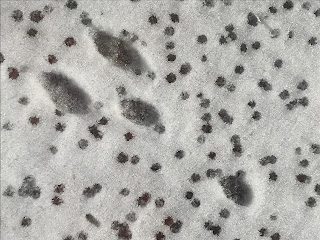
It's not easy to combat the naysayers, or to avoid getting caught up in the deep negativity that's been engendered by the events of the last couple of years. I can't say that my assessment of our ability to work things out for the better is any more firmly grounded than it was in January of 2017 (or January of 2021, for that matter). But hope abides. Especially when the sun's out and the weather is fine. Or even when the ice-clad trees sparkle after a February snow storm that doesn't cause widespread power failures and frozen pipes. Or when bunnies leave their footprints behind in the snowy garden, with polka dots of melting ice as a backdrop.


And then there's the promise of the new year. I've been fond of the lunar new year since I was a child. In both Japan and Taiwan, it was celebrated with delicious sweets, colorful ceremonies and dancing, fireworks, puppetry, and (even for children) introspection. I returned to the United States in 1962, another Year of the Tiger, and my Chinese and Taiwanese friends thought that it was an auspicious time to do so, assuring my mother that the courage and bravery associated with tigers would help me make the necessary adjustments. I'm not sure how brave I was (I ended up staying in the States instead of joining my father in England), but maybe that's what was involved in my choice to remain with my grandmother, in my home town, for the next year. I certainly developed a strong attachment to place during that time, and it took hold fiercely. Much as it has here, in my little hundred year-old bungalow on its little half acre of small-scale utopia.


The future seems more uncertain to me now than it ever has--even after having lived through some major crises in the past. With another Russian conflict building in Ukraine, things don't seem particularly promising. But I do like to think that there's always hope, and so will be spending more my time learning from those who are practicing ways to build it.

Wednesday, October 1, 2014

Coming of Age in the Twenty-first Century


Early on, in my misspent youth, I aspired to be both good-looking and smart. So I read Vogue magazine when I could afford it, looking for interesting ways to dress on my embarrassingly meager salary, so as to attract interesting men. I didn’t get very far with this ambition, but I was apparently attractive enough so that after my first divorce I dated highly intelligent men with Good Prospects.  As it turns out, though, it might have been the other aspiration that attracted them, rather than my questionable gorgeosity.

To foster the “smart” end of the equation, I pretentiously read The New Yorker (again, when I could afford it), and made sure I picked up the latest issue whenever I found myself flying home for a holiday.  This act was only partly a sham, because I really did enjoy many of the articles, and actually appreciated their length.  I read prose by Ursula LeGuin, Pauline Kael, and others whose work I admired, while seatmates on the plane read Time (articles in which were already getting shorter and shorter). If I wanted a news magazine, I chose U. S. News and World Report, because it seemed more heady—but also because the articles were more thorough than those of its competitors.

Although my motives may not have been entirely pure, I did learn a great deal, and was pointed toward interesting writers, topics, and points of view.  By shamming intellectualism, I actually became an intellectual.  I continued to pursue my part-time Ivy League degree, and have enjoyed an intellectually challenging and rewarding life ever since.

And so it was with some amusement that I added The New Yorker to my Newsstand subscriptions on my iPad a couple of weeks ago.  My one regret now, however, is that I’ll probably never have the time to read everything I’d like to, now that my interests are so much broader and deeper than they were during my callow years.  I’ll probably have to cancel it when I finally retire, because it’s awfully pricey—although its digital features are quite wonderful—but for now I’ll use part of my Social Security check to keep it going.

What brought all this to mind was an article by A. O. Scott in the New York Times magazine (to which I also subscribe online), called “The Death of Adulthood in American Culture” (September 11, 2014). In it Scott bemoans the deaths of “the last of the patriarchs” (in television shows like The Sopranos, Breaking Bad, and Mad Men, none of which I have seen, although I kind of wish I had watched Mad Men, and may yet someday).  He doesn’t miss the sexist aspect of patriarchal authority, but notes that in progressing beyond patriarchy “we have also, perhaps unwittingly, killed off all the grownups.” He goes on to note the popularity of “Young Adult” fiction among so-called grownups, between the ages of 30 and 44. (Oddly enough, though, anything labeled "adult" fiction tends to be pornographic).

Now, while I’ll admit to being geekily fond of comic book movies, I haven’t been able to bring myself to pick up copies of the Divergent or Hunger Games books. I never did get into Harry Potter, either, beyond the first chapter of the first book.  The plots and characters of all of these franchises are so familiar and so borrowed from older, wiser works that I read while I was earning the aforesaid degree, that I can only see reading them as an effort to get inside the heads of my “young adult” students.  And to them I always recommend Ursula LeGuin's books written for younger audiences, because she's pretty egalitarian in her treatment of her readers.

It took me eight years to get my B.A., and during much of that time I was also working as an admin around scholars at Penn—many of whom are now dead, but from whom I learned how to become (eventually) an adult. So I find myself trying somewhat desperately (and perhaps pathetically) to find ways to lead my own students toward at least a few more worthy literary endeavors.  They will probably never read War and Peace.  But how about a bit of Dickens?

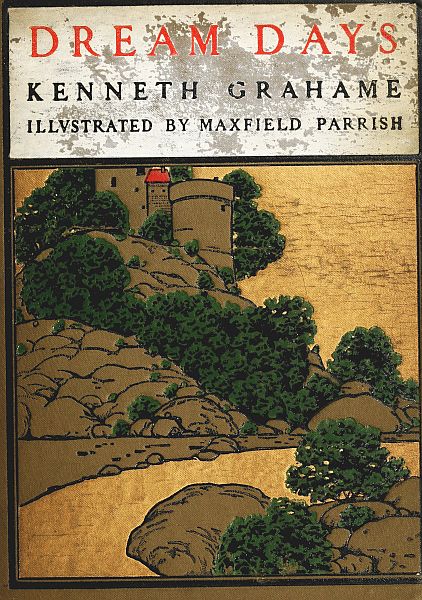
The Beloved Spouse and I watched David Suchet’s tribute to Agatha Christie the other night on PBS and wondered at Christie’s ability to write lucid, careful prose as a very young child.  It shouldn’t be all that surprising, once one is familiar with what children read in those days: Lewis Carroll’s Alice stories, J. M. Barrie’s Peter and Wendy, Kenneth Grahame’s Dream Days. The prose in these “children’s” books is so rich, complex, and erudite that they’re well worth reading by adults today—rather like some of the cartoons we watched as kids (Rocky and Bullwinkle, anyone?) that amused both children and parents. 

It seems a bit ironic to me that some of the animated films out today offer more intellectual stimulation than do novels aimed at teenagers. But The Box Trolls, which is amazingly animated and richly written, is far less juvenile than what I’ve seen of the Harry Potter movies. I’m not talking here about the Disney princess movies (however engaging they might be) that make me happy I don’t have a small daughter today and don’t have to deal with the princess phase. Rather, it’s Lemony Snicket and Despicable Me that seem to harken back to Kenneth Grahame’s hilarious, luminous story, “Its Walls Were Made of Jasper.” I tried reading the latter to my Art History students when I was teaching about manuscript illumination. But they didn’t get it: too many unfamiliar words.

Scott reminds us in his essay that Huckleberry Finn is commonly relegated to the children’s section of libraries, and that’s about as close as most of today’s students get to literary depth.  Numerous attempts to ban it suggest its potential power to do just what Socrates died for: corrupt the minds of the young by teaching them how to think. I’m pretty sure they don’t read Moby Dick anymore, and if they get any Shakespeare at all, it’s Romeo and Juliet.

Another irony exists in all this, and it has to do with J. M. Barrie.  Peter Pan didn’t want to grow up. The Disneyfied Peter Pan never did, and he lives on in popular culture’s reluctance to offer few if any grownup models.  In the end, Scott’s essay has explained to me why I watch so few television series today, and perhaps why most of the contemporary literature I read is science fiction or works about science.  I’ve long held that some of the most compelling prose comes wrapped in covers that depict galaxies far away.  One of the first science fiction novels I ever read was Wilmar Shiras’s Children of the Atom, which sparked an interest in science and speculative fiction that hasn’t left me even in my dotage.  That particular novel probably inspired the X-men comics and characters, and although aimed at the young, treated its readers as if they were—at least potentially—adults.   

Image credit: The cover of Kenneth Grahame's Dream Days, illustrated by Maxfield Parrish, via Wikimedia Commons.

Thursday, February 24, 2011

Winter Weirding

Deep winter now feels like spring, and our recent spate of very cold weather makes the current respite all the more pleasurable. It's 64 F now, with a light rain, and the weekend temperature is expected to reach the high 70s. The cold-weather cleanup has begun in earnest.

Our eight-year-old chest freezer went to its eternal rest (it was in an unheated shed), so we went shopping last Sunday for a small (12.1 cu. ft.) upright that's now in the laundry room on the back porch. We want to be able to stock up on pastured meat when the farmers markets reopen, and this one's half again as big as the old one. It does block part of a window, but we moved a bookshelf in front of another window--which will allow me to spy less obtrusively on birds bathing just outside. Yesterday I caught a flock of cedar waxwings having a grand old time splashing out all the water, but had to shoot through the window and the screen in front of my desk.

Waxwings après le bain

I can't refill the birdbath with the hose yet, because the cold also did a number on the water line. Beloved Spouse came home one day to a spraying fountain behind the washer, and had to spend a fair amount of time cleaning up the wet after he'd shut off the valve. Fortunately, the broken pipe seems to be just the one leading out, so we haven't had to stop doing laundry. Our favorite plumber will be called in soon to check out the lines under the house and to effect repairs as necessary. I'm particularly fond of these folks because they do one of the dirtiest jobs there is, but they do it efficiently and with good humor. I've never understood why people complain about how much it costs to have that sort of work done, when none of them would be willing to do it themselves, even if they knew how.

The plumbing issue is rather timely, actually, because we're about to start talking about poop in my utopia class. I was inspired to include the discussion by an article in the Penn Gazette last month about this year's summer reading project for incoming freshmen, Rose George's The Big Necessity: The Unmentionable World of Human Waste and Why It Matters (Metropolitan Books, 2008).

Utopians, after all, seldom talk about the nasty bits associated with human life, so I made sure to include composting toilets in More News From Nowhere. But discussing these matters gets to the heart of issues that need to be addressed in the real world: use of water, treatment of waste, who has to take care of it all, etc. Excrement is also a dandy metaphor for all manner of human excess, as Ursula LeGuin uses it in her "ambiguous utopia," The Dispossessed.

The discussion in a couple of weeks should be interesting, and I'll probably have more to spout on the subject then. For now, however, I've sorted through the various winter sky shots I've managed to take over the last couple of weeks. These could be the last of the leafless-tree-against-the-sky photos I get until next winter, because the elm next door is already budding. Pear blossoms, pecan catkins, and wisteria blooms can't be far behind.

The opening shot gets the moon just before full. The other two are evening and morning images carefully framed to miss the ubiquitous power lines. Happy Skywatch Friday, all.

Saturday, April 12, 2008

Ned Ludd's Bad Rap

Back when I was seriously formulating a dissertation, before I got tired (finally, at about 45 years of age) of being a graduate student, I was trying very hard to be a philosopher of technology. This, to me, provided a focus that made sense of the enormous variety of courses I'd taken (in both the social and natural sciences, as well as in the humanities) over some (then) 25 years of higher education.

It made sense to me that if one of the things that helped us define ourselves was our use of tools (for everything from hunting and preparing our food to expressing ourselves in art and music), then we ought to be able to examine critically the uses we make of these tools, and to assess their impact not only on ourselves, but on our fellow beings--animal, vegetable, and even mineral. When I first started looking around at the developing fields of technology assessment, environmental ethics (now more broadly characterized as environmental philosophy), and other branches of philosophy (mostly pragmatism and the Continental tradition), I wondered why there wasn't a more coordinated effort to study questions that seemed to be on everyone's minds: what are we doing to ourselves?

Some folks were, in fact, writing about this very question, and I discovered them when I started thinking seriously about what human beings were up to. Continental philosophy had, in fact, produced one of the most enduring critiques in 1954, when Martin Heidegger published his essay "The Question Concerning Technology." Even earlier, Karl Marx, John Dewey, Lewis Mumford, and William Morris (among many others) had written about technology in philosophical terms. The idea of questioning technology, I discovered, had been around since the Greeks. I wasn't exactly on to something new.

Nonetheless, pursuing the subject led me deeply into Morris and his work on the technologies of art and design, and on the social and political aspects of active critique. Some folks, it seemed, hadn't just written about this stuff--they went out and tried to whack people on the side of the head to try to get them to think about where all these new machines (steam engines, power looms) were leading us. Hence the notion of sabotage (and the rather odd choice of image to illustrate this post), perhaps related to the development of the Luddite movement during the Industrial Revolution.

Of course, terms like "sabotage" and "Luddite" carry primarily negative connotations these days, but their origins lay in the act of criticizing technologies--not in terrorism or the refusal to immediately adopt every damned toy that comes on the market. My question is this: How much different might the world be today if we actually stopped to think about new tools, and took a bit of time to imagine where they might lead?

I'm absolutely convinced that the manifold problems associated with the internet, for example, would not have arisen if we hadn't all jumped higgeldy piggeldy onto the bandwagon, brandishing our cherished American gospel of individualism and waving our technical superiority, trying to convince the rest of the world that if it wants to join the future, it had better become like us. Only it's not just us--it's the entire West (trying to be like us--or perhaps trying to convince themselves that they were like us before we were). The impact of computer technology alone, from manufacture to use, on the rest of the world has created such rapid and rampant change that nobody has a choice about it any more. Traditional tribal peoples all over the globe are (thanks to Nicholas Negroponte's One Laptop Per Child initiative) being introduced to the internet, and their children are being seduced by technology in the name of "progress" and "modernity" and the inevitability of globalization. The real crime here is that nobody asked them if they wanted it. We in the West are all for freedom of choice (walk down the supermarket cereal aisle to see where that's led us), but only when it comes to "choosing" which brand of computer to buy--not choosing whether or not to buy them in the first place.

The irony of the market, of course, is that choice exists only in the beginning. The "winning" technology eventually takes over (VHS beats out Betamax; DVDs beat out VHS; Blue Ray beats out HD DVD), and then those of us who bought into the "wrong" technology are left with stacks of obsolete, expensive crap that the conscientious person has to agonize over what to do with, and those who don't give a damn simply dump into the landfill.

I held out on using a cellular telephone for much longer than most (although I did own one briefly, about ten years ago, while my mother was still alive and under my care). It was only my daughter's emergency surgery a couple of months ago, and the ensuing difficulty of trying to contact me, that I finally acquiesced. And I didn't just buy a little pay-as-you-go model as I had originally planned. I bought an iPhone, because this way I could convince myself that I wasn't buying a phone--I was buying a little tiny laptop. In fact, most of what I use it for is checking e-mail, so it doesn't seem quite so much like selling out.

But of course I have sold out. I became a techno-whore when I bought that Commodore 64 back in the eighties and stopped writing my essays out by hand and then typing them on an electric typewriter. I was convinced, like Stewart Brand and Kevin Kelly, and the rest of the Whole Earth crowd on The Well (which I never did join, however) that the internet was going to bind people together and make the world a better place. Our optimism was a bit over-frought, as Lee Siegel has rather succinctly pointed out in his new book, Against the Machine: Being Human in the Age of the Electronic Mob. If only we had thought it through a bit more carefully.

Now, I have to admit that there are things about the internet that I love. I truly enjoy writing this blog, and doing so actually forces me to think more carefully about the world and what's going on in it. It allowed me to publish my book without having to sell myself or pander to the whims of the book trade. I've also made some good friends that I'd never have even come in contact with without the rapid development of internet communication devices and programs. Best of all, I enjoyed a long and lively correspondence with my father in the years before he died, which would certainly never have happened otherwise because I'm so lousy with the phone and so bad at getting around to writing letters.

But this is only one technology, really, as all-encompassing and pervasive as it is. We don't tend to think seriously about the consequences of anything we do: cloning, genetic engineering, nanotechnology, nuclear power (well, that does cause some contemplation, thanks to Chernobyl). Unless we endure some whacking great disaster related to one or all of the above, we're not even likely to discuss potential problems before they're already out of our hands entirely. Anyone who does ask questions is an alarmist, or worse: a Luddite.

In her sort-of utopian novel, Always Coming Home, Ursula K. Leguin describes technology as "morally dangerous." The computers are all located somewhere in a city, most people live in low-impact rural enclaves, and even solar-powered electricity is looked upon with suspicion. As she explains in an appendix on practices, the "arts of the uses of the energies of sun, wind, water, electricity, and the combinations of things to make other things are all practices of exchange. They want vigilance and clarity of mind, a bright imagination, modesty, attention to detail and to implication, strength, and courage" (479). Imagine how different the world would be if we became equally mindful about the technologies we now so thoughtlessly pursue, oblivious as we are to the varieties of potential--not just the prophesied advantages.

Thanks to the wonders of technology, I'm still alive and able to wallow in my low-fi Luddism. I'm fully aware that were I to move to the valley in my own utopia, I'd last a couple of years at best, because I'm so dependent on the drugs that mitigate my unfortunate combination of genes (and my sedentary way of life, pounding away at a computer keyboard rather than charging around the garden as I should be doing). But that doesn't mean that it's a useless exercise, and it doesn't mean we shouldn't be doing much more thinking about technological consequences, much more frequently.

To some extent, we are. The back-to-the-land movement that came out of the sixties has become more sophisticated and has begun to focus on permaculture and sustainability. "Green" blogs and websites abound (some are noted in my sidebar entries). People are more interested in the quality of their food, and the market is responding, at least on a small scale. But I did discover, while conducting a bit of background research for this blog, one ominous sign. The U. S. Government office of technology assessment has closed. I'm not sure whether it ever accomplished anything anyway, but if we're officially closing up shop in this regard, it makes one wonder whether Our Guys in Washington have permanently given up thinking about consequences, or whether it's just a temporary blip. It'll be interesting to see what happens after November.

We should not, however, need a government agency to do our thinking for us. We really need to be asking questions ourselves, every time we make a purchase, especially of the latest high-tech gadget. What went into its making? Did any being or environment suffer or die as a result of its manufacture? Will this object (or complex of objects) truly enhance my life? How will it affect my relationships with my family and friends? My ecological footprint? How long will it last? Does it have the potential to cause social or environmental harm? Do I really need it? It wouldn't hurt to treat any technology we adopt as if it were potentially dangerous not only to our physical selves, but to our moral being.

Heidegger himself put it best, at the end of "The Question Concerning Technology": "The closer we come to the danger, the more brightly do the ways into the saving power begin to shine and the more questioning we become. For questioning is the piety of thought."

Photo: Panthouse's own clogs (modified), from Wikimedia Commons.
Citation: Ursula K. Leguin, Always Coming Home. New York: Harper & Row, 1985.

Monday, March 10, 2008

Going backward, looking forward

The utopian impulse seems to have occupied human consciousness at least since the Bronze Age, when biblical stories of a perfect world (the Garden of Eden) describe the past before human beings learned how to screw things up (in this case by seeking knowledge). The Greeks also imagined a long-gone golden age, and the idea developed further through the imaginations of Plato (Atlantis) and Francis Bacon (The New Atlantis) and myriad others—including William Morris and yours truly. But there’s another phenomenon that seems to spring from the same yearnings: a kind of short-sightedness about the more recent past that makes us look back at our childhoods or some previous historical moment as—if not actually perfect—better than now. In trying times, this seems to make some sense, and it might actually explain my own interest in utopian ideas.

But the idea of utopia seems to elicit both forward- and backward-looking responses. In her 1982 essay “A Non-Euclidian View of California as a Cold Place to Be” Ursula K. Le Guin writes about the utopian impulse as being fundamentally progressive:

I am not proposing a return to the Stone Age. My intent is not reactionary, nor even conservative, but simply subversive. It seems that the utopian imagination is trapped, like capitalism and industrialism and the human population, in a one-way future consisting only of growth (85).

In the same essay, Le Guin mentions that some people actually think of North Texas as a kind of utopia (specifically, Arlington—p. 88; it’s a story told by Prof. Kenneth Roemer, who teaches at UT Arlington), and it’s clearly the case that many American citizens think of the United States itself in utopian terms: the best of all possible worlds, if not still, then in the past. This has got me to thinking about the kind of historical blindness that seems to spring up when things aren’t going well, as they haven’t been in recent years, and ties in with Susan Jacoby's article in the Sunday Dallas Morning News on the rise of anti-intellectualism in the US (
An incredibly incurious America). It’s also related to an anonymously authored e-mail that’s been circulating (I’ve been sent copies by two people).


I hadn’t really noticed it before, but folks who live in north Texas suburbs actually seem to be pretty happy about doing so. After all, they’ve got nice big houses, clean streets, and shopping close by. Fast food is plentiful, uniform, and predictable, so there aren’t any surprises. Chances are no one’s going to run across anything unique, but hey—that’s why the suburbs are attractive: nothing to upset the equilibrium. Things may be getting a teensy bit unsettling with the spate of foreclosures and rising gas prices, but area ‘burbs aren’t nearly as affected as in the rest of the country, and, well, one can always downsize the Hummer to a standard SUV if gas gets to be uncomfortably expensive. So the notion of Arlington (or Frisco, or the west side of McKinney) as utopia doesn’t seem that far-fetched, if one envisions comfort and placidity as the ideal.

But many older folks (my generation and my parents’) seem to be looking back on an unlikely utopia: the years surrounding World War II, when (as the e-mail puts it), “they had just come out of a vicious depression. The country was steeled by the hardship of that depression but they still believed fervently in this country. They knew that the people had elected their leaders so it was the people’s duty to back those leaders.” Furthermore, “Often there were more casualties in one day in WWI than we have had in the entire Iraq war. But that did not matter. The people stuck with the President because it was their patriotic duty. Americans put aside their differences in WWII and worked together to win that war.”

Today, however, we’re “a cross between Sodom and Gomorra and the land of Oz” and are “subjected to a constant bombardment of pornography, perversion, and pornography” and “have legions of crack heads, dope pushers, and armed gangs roaming our streets.” (One does wonder where the author of this piece actually lives—since it’s clearly not around here!) Then was good; now is bad. As a reminder to those who bought into this message wholesale, I offer this list from Al Devito’s blog, Vineyard News: What a Difference 60 Years Makes.

Now, I’ll admit to giving my students the occasional speech in which I wax nostalgic about my rather rich education, imposed in part by the stern Dominican nuns who must have learned a thing or two from the Inquisition. But I also know that current problems in education are in large measure our own fault—the fault of my generation, for buying into “progress” for its own sake, and for embracing without question the technologies that we blame today for everything from short attention spans to sexual license. The kids, to be sure, whined endlessly, begging for the newest electronic gizmo, but most of us went along with it, upgrading from Atari to Commodore 64 to Xbox to whatever. They learned from this that whining is a winning strategy.

But nostalgia for the war years seems equally misplaced, as does the unquestioning acceptance of “patriotic duty” (the people of Germany, after all, felt it their patriotic duty to follow their elected chancellor and to ignore what the SS was doing to guarantee German sovereignty). Having lived in Japan shortly after that same war ended, I clearly remember weekly air raid drills that scared the bejeezis out of me, and duck-and-cover practice sessions that haunted my dreams for decades. During that same war, we also deprived thousands of American citizens of their rights, simply because of their ethnic origins, and transported them to “relocation” camps like the one outside of my home town—Manzanarwhile also depending on many of them to help fight the war for us. We were not perfect then, any more than we are perfect today.

I see no reason to disagree with Susan Jacoby’s fundamental premise that Americans are becoming increasingly ignorant of history and decreasingly curious about anything that will help remedy that ignorance. But we could start by looking back honestly at what has happened, and using the knowledge we gain to help us build paths toward a more viable future. In her essay, Le Guin quotes Howard A. Norman (from his book on Cree folk tales) describing a kind of porcupine philosophy: “He goes backward, looks forward” in order to back safely into a rock crevice. She goes on to interpret this in terms of thinking about what lies ahead for us:

In order to speculate safely on an inhabitable future, perhaps we would do well to find a rock crevice and go backward. In order to find our roots, perhaps we should look for them where roots are usually found . . . With all our self-consciousness, we have very little sense of where we live, where we are right here right now. If we did, we wouldn’t muck it up the way we do (84-85).

We might, in other words, learn to get alonglearn to beby being conscious of where we are and where we’ve been. Ignorance of history is a dangerous indulgence, and lack of curiosity is even more deadly. The human imagination requires both in order to thrive. We owe our kids the inspiration to learn from the past without holding it up as some glorious utopian moment, and we sure as hell have no place moaning helplessly about the present, when our generation helped to create it. Nevertheless, when we vote for a nebulous idea like “change,” we also need to understand exactly what we mean; the only way we can do that is to fully understand what we’re changing from.

Quoted material: Ursula K. Le Guin, “A Non-Euclidian View of California as a Cold Place to Be” in Dancing At the Edge of the World: Thoughts on Words, Women, Places. New York: Harper Perennial, 1989. The link is to the 1997 edition from Grove Books.

Photo Credit: Cemetery shrine, Manzanar, Japanese internment camp, photo taken on 2002-03-24 by Daniel Mayer © 2002. Wikimedia Commons.