Sunday, May 15, 2011

Inspiration Nation

It all started with a romp through my blog roll, trying to catch up on what other folks were doing. I tried to go through the list again this morning, to find out where I'd gotten the link, but couldn't find it. So the credit ends up going to Stan Cox himself, whose book Losing Our Cool: Uncomfortable Truths About Our Air-Conditioned World (and Finding New Ways to Get Through the Summer) opened up yet another path of inquiry for The Farm.

I've actually dealt, obliquely, with the topic of air conditioning (or the lack thereof) on this blog in the past (there are some eleven posts that mention it; use the search field if you're interested). Always interested in folks who share my concerns, I bought the book for the iPad. Before I'd finished the first chapter, I'd decided on a new series of posts about civilization and its discontents, roughly organized around the four ancient elements: air, earth, fire, and water.

Before I begin the musings, however, I wanted to acknowledge the many bloggers and other writers whose work continues to fuel my own, and who provide me with philosophical support. Some of these, like Wendell Berry and Herrick Kimball are grounded in the Christian agrarian traditions associated so closely these days--accurately or not--with our Founding Fathers (only some of whom were farmers). I've been reading Berry for twenty-five years and make sure I buy his books in hard cover as much as possible because they get re-read frequently. He's decidedly not fond of digital technologies, so eschews the blogosphere--but that's fine with me. Kimball, however, whom I've only recently discovered, has a whole slew of blogs. My favorites of these are The Deliberate Agrarian and Agrarian Nation (which inspired the title of this post).

Reading Kimball's most recent articles on Agrarian Nation sent me back to the iPad, because one of the first things I did when I got it was to download all the old-timey cookery books and home-keeping volumes offered in the Free section (through Project Gutenberg). These include luscious stuff like Things Mother Used to Make: A Collection of Old Time Recipes, Some Nearly One Hundred Years Old and Never Published Before (1914); The Healthy Life Cook Book (second edition) by Florence Daniel (1915); Culture and Cooking, or Art in the Kitchen by Catherine Owen (1881)--and more. No doubt I'll be able to scare up even more on Free Books, but haven't yet taken the time, probably because I'm too busy reading interesting blogs where other people introduce me to even more old stuff.

I also read a considerable amount of material on Peak Oil (The Oil Drum, ASPO), including Sharon Astyk's blogs (Casaubon's Book and The Chatelaine's Keys) and books (Depletion and Abundance, A Nation of Farmers). The combination of technical discussion on what I really think is going to happen at some point in the not-too-distant, perhaps-even-before-I-die future, and Astyk's comments and advice (as well as the stuff she links to) is almost enough to keep me busy all of my waking life. Unlike Berry and Kimball (as much as I admire their work), Astyk's perspective resonates with me because she's Jewish, a woman, and unerringly practical.

While I'm on the topic of practical advice, I would be grievously remiss were I not to mention Ruth Stout (just Google her), and Helen and Scott Nearing. They are all, alas, dead now, but their legacies live on thanks to the digital universe--at least until the grid goes down.

No paean to self-reliant agrarianism would be complete without mention of The Mother Earth News and the Whole Earth Catalog, both mainstays of my early leanings in this direction. You can now get almost the entire run of TMEN on CD (1970-2010), cheap (60 bucks). Somebody on eBay probably has the whole thing in paper. In an unpublished short story I wrote a few months ago, an entire community manages to survive after an EMP because somebody had squirreled away all her back issues.

Many years ago, in a graduate class called (I think) "The Future As Present," we were asked to give an oral "book report" on a publication we considered essential. One of my fellow students almost caused our instructor to enter a monastery (or at least to retire early) when she reviewed David Macauley's Motel of the Mysteries. I didn't help matters when I chose the Whole Earth Catalog. The inspiration of this particular choice was a sort of vision of having a copy of the WEC on hand when the apocalypse came. See? I was thinking ahead even twenty some-odd years ago.

I'm looking forward to looking outward for a while. I've been so internally focused on my own discontent for far too long. And the weather has been great, my garden is beginning to flourish, and I'm getting way too comfortable. The first essay, on Air, will show up as soon as I finish Stan Cox's book and get my notes organized. Meanwhile, I heartily recommend his book, and the stuff I've linked above.

Image credit: I couldn't resist a bit of artistic nostalgia here. After searching on the Commons for historic agriculture photos, I found one of Carl Larson's sweet paintings of farming in Sweden.

Thursday, May 12, 2011

Nostoi: Journeys Home

Well, just because I've started a concerted effort to become a prairie-loving homesteader in north Texas doesn't mean I've stopped longing for eastern California. In fact, a double-whammy caught me off guard a few weeks ago, when my humanities class focused on Homer's Odyssey and I received a group of photos from my uncle. The latter were taken on his recent trip with my aunt, my cousin, and her new husband to the Owens Valley. They hit many of our old haunts, including the Department of Water and Power plant at Cottonwood, and the photos included shots of the plant and of the old house that had served as home ground for travelling children and grandchildren until my grandfather died in 1959.

The house, alas, has been severely remodeled and no longer looks anything like what I remember. In the old days, several families lived in the vicinity, in city-owned bungalows, with access to horse pasture, an orchard, walnut trees, and blackberries. My grandparents' house had a pantry and a back sleeping porch, an old wind-up telephone, and a screened-in front porch with an army cot under which a box of toys was stashed awaiting whatever visiting child wanted to play with them.

I still bear a scar in my eyebrow from tearing through the house from the front porch to the kitchen, where I ran headlong into the open oven door and got a gash that probably earned me a helping of my grandmother's Little Horse cookies (made with a press that I've since inherited).

All that's gone now: no horses, no orchard, no porch. No workshop where my grandfather kept his tools and puttered around. He had the infamous Marilyn Monroe-on-red-silk pin-up calendar, but since we weren't allowed in the workshop, we could only see it by peeking into the window. I do, however, still have the cookie recipe, and will make an effort to reproduce it for Owl's Cabinet when I've got a free moment.

I've often wanted to make this trip myself, but have always lacked the nerve; and now I'm glad I didn't cross the aqueduct and brave the short drive up to the house. I'd probably have cried for days. I'm also glad that my uncle actually visited the spot and did the dirty work--so I won't wonder about it any more, and can just hang on to a child's charmed memory.

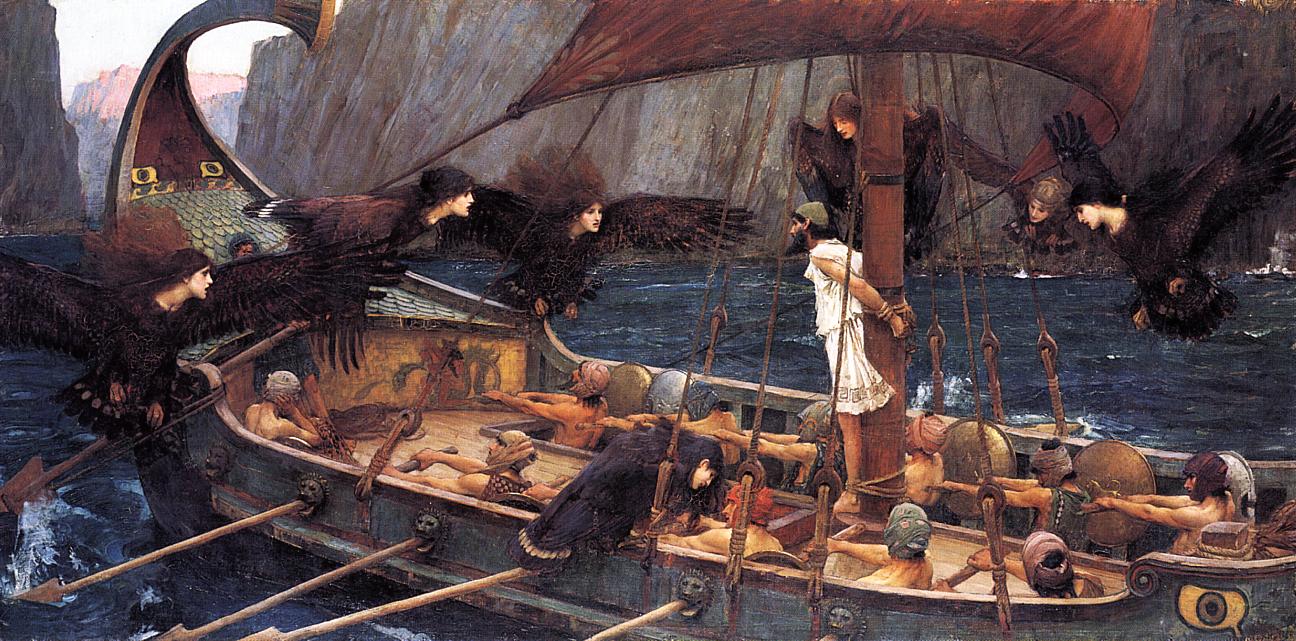
As if the photos weren't enough, my class session on the Aegean cultures of the Bronze Age featured some consideration of the homecoming theme in the Odyssey--the nostos, or journey home. When I checked my Liddel and Scott for some elaboration (from nosteo, to come home or return), I discovered that it also means, when applied to food, abundant, nutritious, wholesome.

So nostalgia, the ailment to which I have become so prone, unites nostos with algos (pain), to create a word that, according to the Oxford English Dictionary, connotes not just longing, but a "form of melancholia caused by prolonged absence from one's home or country." The literal translation would be home-sickness, but I tend not to see the condition quite so negatively. Because it encourages memory (and is often generated by memory), nostalgia can be somewhat energizing. More than once, after musing over old photographs, or re-reading letters from my parents or grandparents, I've sat down to write, often taking up projects I'd abandoned for some time. Since much of what I write comes from or is set in the old turf, the act of recovering memory can transport me there and reignite creative embers.

I often remark about the serendipitous nature of research, and simply looking up the Greek origins of nostos led me to a connection I'd never made before, but is really foundational to notions of home and comfort: food. Many of my childhood memories are grounded, as I'm sure I've mentioned before, in kitchen aromas and favorite meals. The aforementioned "Little Horse" cookies were frequently included in care packages, lovingly tucked into old coffee tins by my grandmother, and sent to Taiwan for Christmases and birthdays. Pies, made from blackberries freshly picked from the brambles behind the Cottonwood house, and applesauce cake (with its "secret" ingredient of chocolate powder; the original recipe is here) were staples of family gatherings and perennial choices for comfort food among several generations of children. The connection between fragrance and memory is never as clear as when it's churned up in the kitchen.

True melancholia, the debilitating depression that seems to plague so many (if we can believe the pharmaceutical ads), is undoubtedly not at all productive. But I have found that missing someplace meaningful, while saddening in some sense, is also therapeutic because it juxtaposes past with present and can remind us of those parts of the past that have made us who we are. I don't mean to belittle true depression or make light of those who do suffer; but I often wonder if we're so conditioned to seek happiness (whatever that is!) at all costs, and to feel like failures if we're not "up" and "positive" all the time.

It's not that we should wallow in occasional home-sickness, but I do think that we might well benefit from letting our minds wander along old paths more frequently--perhaps to explore both senses of nostos: of returning, but also of nourishing and sustaining. Home, even when we can return only in memory (and even if it takes us ten years to get there), is still restorative, as long as we don't choose to get lost on a path and forget where we are now.

Not long ago, I came across a book by Norman Fischer, Sailing Home: Using the Wisdom of Homer's Odyssey to Navigate Life's Perils and Pitfalls (New York: Free Press, 2008). It's a Zen-ish take on the idea of the homeward journey and, although I am decidedly not a fan of self-help books, I found his essays interesting. I've used some of his comments in my discussions with students of the relationships between ancient literature and modern life, and the notion of coming home to oneself seems to resonate with them.

Another recent acquisition, Robin Lane Fox's Travelling Heroes in the Epic Age of Homer (New York: Vintage Books, 2008) demonstrates how potent and how prevalent the heroic journey is, not just in the West, but in the East as well. Journeys, and especially nostoi, seem to be part of the literary landscape of most cultures. But in an era when "travelling" seems to connote pleasure cruises on gigantic floating hotels or trips to theme parks, voyages of discovery like those undertaken in antiquity appear to be diminishing.

Our so-called "globalization" far more closely resembles a kind of entropy, where the world is blurring into a homogenous blob of sameness. Fewer and fewer of my students travel anywhere (some have never been out of town, much less out of state), and the curiosity that used to drive adventure seems to be dwindling by the second. I'm not sure what all this means, but one possible outcome is that few of this generation's survivors will every have to make a journey home, because they'll never have left.

Image credit: One of many Victorian paintings dealing with Odysseus and his long voyage: John William Waterhouse's Odysseus and the Sirens (1891), via Wikimedia Commons.

Friday, April 22, 2011

Skywatch Friday: Learning to Love the Prairie

I spend far too much on this blog whingeing about my "exile" in north Texas, and longing for the desert. At my age, and having made choices earlier in my life that brought me here, you'd think I'd have resigned myself to my fate and begun to make peace with the place in which I will probably breathe my last--even if that happens (as I hope) some distance into the future.

Years ago, when I was involved to some small extent in the local environmental movement, and volunteering regularly at the Heard Museum down the road from where I now live, I was somewhat more enamored of blackland prairie. Since those days, now a quarter of a century past, I've lived at the upper end of the prairie (in Chicago) where I got a taste of city life on a really big natural lake, and then lived in a more politically energizing part of the Dallas area before being chased north by the advancement of mega-houses and the destruction of the tolerable parts of the city that I could afford to live in.

We settled in McKinney over ten years ago, attracted by the historic district covenants that prohibit tearing down old houses to build new monstrosities. We found an old prairie-craftsman on a bit of land, where we've managed to build a little organic sanctuary in the midst of a pesticide-loving populace. The city tries to foster green-ness, but the neighbors all use loud gas-spewing mowers and leaf blowers, and dowse their lawns with chemicals. I think things might be getting better, but I'm too busy hiding out to notice.

My Earth Day resolution this year is to start doing what I can to preserve this wonderful old house and its half acre, and in doing so to renew my earlier efforts to come to terms with living here. I'm going to go back to the Heard, with an eye toward once again volunteering there when I reduce my course load in a few years, and begin my emeritus career. I have a feeling that it'll be considerably easier to recover my affection when I'm not driving through rush-hour traffic and dealing with folks who don't like my adherence to the speed limit.

It's time, after spending thirty years in the Midwest, to develop a bit of topophilia for the place I chose (at least in part) for child-rearing. The children themselves probably won't end up with as much love for their auld sod as I did for mine (they, in fact, harbor the same affection for the Eastern California desert as I do). But if I have to live here, it's about time I stopped regretting that fact and started to embrace the job of home-keeping in earnest.

Last week, after I'd mowed the back lawn (which was by then practically a meadow), I sat back to enjoy my handiwork and noticed how beautiful it all looked: no uniformly green monoculture in this yard. Instead, I'd trimmed down a variety of grass and "weeds" that formed small variegated mounds, closely-spaced enough to serve as an aromatic carpet just the right size for romping dogs. The color variations reminded me of the subtle hues one can see in the desert, that only a true lover can spot. My eyes, it seems, have adjusted to the "new" locale--much as the children do in Ursula Le Guin's short story about adaptation in place, "The Eye Altering."

Chairs under a tree in front of the Carbon Sink

When I'd finished mowing, I placed a couple of chairs under one of the pecan trees next to the Carbon Sink, and added a small table for holding coffee, after I'd been chased away from my usual spot by a gaggle of pooping Cedar Waxwings. The new seating area offered me an entirely different perspective, from where I enjoyed the chiaroscuro effect of sun alternating with shadow, emphasizing one area, then another. The wild gladioli, which I've let naturalize and cover more of the yard every year, are just past their prime, but still lovely to look at with their vibrant fuchsia blossoms. They form a short wall, beyond which lies the potager. In another month I'll mow them down to extend the produce-garden, salvaging the disturbed bulbs and replanting them in borders and in other spots where they might do well and add some welcome color next spring.

Wild gladiolus wall in front of the herb and veg garden

As I type this today I'm reminded of an episode of Star Trek: The Next Generation, "The Survivors," in which an alien being and the re-creation of his dead wife live on a green patch of ground on an otherwise-devastated planet. There are times when I feel a bit like that, living on my own little island of sanity in a world that seems to be going a bit mad. I lack the energy to fight the good fight any more, but do find some solace in being able to keep this place a little wild, with small reminders of what used to be here--the occasional basketflower, a few native grasses, and a number of gifts from birds who propagate all manner of seeds--sometimes in the middle of the book I'm reading.

The birdbath in the potager, at sunrise

This week the air is redolent of sultry privet, sweet catalpa, pervasive honeysuckle, and even some of the irises left in bloom. The nandina will follow, along with roses, lavender, and rosemary as they begin to blossom. The promise is all here, with burgeoning vegetables and ripening figs. We're occasionally reminded, though, that we enjoy our bounty at nature's whim; along with all this fortune come the wildfires in the west, and the ever-present, more local threat of tornadoes.

I'll try to remember to revisit this post in another year, to see if I've been at all successful in fulfilling any part of my resolution. In the meantime I can certainly enjoy the good weather, the blooming garden, the approaching figs, and the promise of a decent harvest. At least I managed to get the garden in early this year, so it stands some chance of settling in and producing before the relentless north Texas heat replaces the balmy mornings we're enjoying for this year's Earth Week. But today, in the still-cool morning, I find it easier to love the prairie. Sometimes, I guess, all it takes is a bit of reflection on one's good fortune to make the cranky world go away for a while.

Image notes: all photos were taken in the garden with the Nikon D80. This year's Earth Day/Skywatch Friday shot was taken under the pecan tree, fortunately (for these purposes) empty of Cedar Waxwings--else there'd have probably been a blob in the middle of the picture.