Showing posts with label agriculture. Show all posts

Sunday, September 7, 2014

Celebrating--and Questioning--Wilderness

On September 3, the Beloved Spouse and I celebrated (or at least acknowledged) our twenty third anniversary. As it turns out, the Wilderness Act marked its fiftieth anniversary on the same date--unbeknownst to me until I read a message from Orion Magazine, which is my main source of environmental commentary these days.

My mention of the occasion, however, won't rank up there with the joyous celebrations of tree huggers everywhere, because I'm rather skeptical about the whole notion of wilderness in the first place. I'm pretty sure it doesn't really exist in the present day, because there is almost no place on earth that isn't (as Wilhelm Dilthey would put it) human affected (with the possible exception of volcanoes in the remote hinterlands of Iceland).

More true now even than it was in the nineteenth century (Dilthey's Introduction to the Human Sciences was published in 1883), there isn't even a tiny corner of this planet that doesn't bear at least a chemical imprint of human activity. Not only that, it's difficult for many people to even imagine what real wilderness, truly unaffected by so-called homo sapiens sapiens (the wise wise human species), would look like.  In my first-level art history class I ask my students to choose a photograph of an object (animal, vegetable, or mineral) as untouched by humans as possible, and I have to warn them that a picture of an elephant in a zoo, or a trail through a forest, or a field with a fence, or even a single rose is not a good choice. But there's an obvious irony connected with the task, because a photograph in itself is evidence of human interference.

In the midst of my pondering the notion of the wild, this morning I read Rob Nixon's review in the New York Times of Diane Ackerman's new book, The Human Age. The book seems to be both potentially fascinating and terrifying, and I'll probably buy it for the iPad--but I'm not sure I really want to be reminded just how much we're interfering with the future of the world.  Looking up Nixon's recent Slow Violence and the Environmentalism of the Poor led me to a June 2011 article in the Chronicle of Higher Education, "Slow Violence: Literary and postcolonial studies have ignored the environmentalism that often only the poor can see" which advocates moving the locally-focused understanding of environmentalism away from Thoreau and other members of our national canon (including those like Wendell Berry who are often invoked in this blog) outward: toward the rest of the world, far less cushioned from the ravages of human power than we are here.

As Nixon points in the article, there are other voices to be heard:
Figures like Wangari Maathai, Indra Sinha, Ken Saro-Wiwa, Abdul Rahman Munif, Njabulo S. Ndebele, Nadine Gordimer, Jamaica Kincaid, Arundhati Roy, and June Jordan have recorded the long-term inhabited impact of corrosive transnational forces, including petro-imperialism, the megadam industry, the practice of shipping rich nations' toxins (like e-waste) to poor nations' dumping grounds, tourism that threatens indigenous peoples, conservation practices that drive people off their historic lands, environmental deregulation for commercial or military demands, and much more.
While some of those enshrined in the American pantheon are now dead, none risked the fate of those like Ken Saro-Wiwa, who was executed by the Nigerian regime of General Sani Abacha for defending his people not against some marauding heard of infidel-purging jihadis (which might have garnered some coverage on CNN), but by us: big oil in America and Europe.

Earlier in the week I'd been reading about the current discussion on GMOs and whether or not they're "safe" and whether or not people have a right to know if they're in our food or not.  As the general controversy involving GMOs has developed, I've frequently thought that we might not be asking the right questions when it comes to allowing their use in the first place.  Just as I think that the question about preferring organically- vs. conventionally-grown food isn't whether or not it's "healthier," but rather if it's culturally better for us (more sustainable, economically more equitable, etc.), I wonder if the real question behind gene-manipulation in our food crops isn't more about whether it's ethically defensible and environmentally sustainable than whether it's going to poison us or cause birth defects or some such.

The question up for debate at the moment is really about labeling. Science seems to be bolstering the notion that modified foods do not pose a danger to our health. One long-time opponent of GMOs, Mark Lynas, has recently switched sides in the argument against their safety (as did Neil deGrasse Tyson), and is now advocating that we embrace them in order to stave off the looming cloud of hunger related to population growth. As both of these guys point out, the science backs the safety claim; not only that, if we're going to blast the climate-change deniers and the creationists for ignoring scientific evidence, we out not to base opposition to GMOs on unfounded skepticism.

For my part, I'm not particularly bothered by crops like Bt cotton--because we don't ingest it (and it's one of the most pesticide-dependent crops human beings grow, so that spraying chemicals significant harm both to the environment and to those who harvest it), but I'm also not so sanguine about our ability to ensure that food crops will never develop consequences down the line.  The people who develop and test the modifications are, after all, human. And we can be utterly blind at times, unable to foresee potential outcomes. Two words: atomic bomb. Or maybe one: thalidomide. Or an acronym: DDT.

Simply labeling products so we can make choices doesn't seem like it should be such a big problem, but "folks" (corporations are people, after all) like Monsanto, Bayer, and Dow are afraid that labeling will imply lack of safety and discourage people from buying their RoundUp-ready products.  Well, I already don't buy them for economic and ethical reasons; I don't like the fact that altered genes are escaping the plants they've been manipulated into the environment and generating unforeseen consequences (see this 2012 Mother Jones article). I don't buy milk with hormones in it because I identify too closely with those poor engorged cows I've seen in feedlot dairies.

In the end, though, it seems a bit luxurious to even be able to question our food sources, and to make choices at all because so many people in the world have to take what they get--some of which may be imposed upon them by the denizens of rich, still-imperialistic countries like our own. And while environmental consciousness seems to have risen here over time (as people become more aware of how what we do to the planet is hurting them), we don't seem to hold the same regard or concern when it comes to developing countries with resources we want to exploit.  So any benefits GMO foods might produce may come with cultural and economic costs in other realms.  And even with science currently able to proclaim the safety of genetic modifications, our track record isn't stellar when it comes to predicting future consequences.

Although humanfolk have been using artificial selection to manipulate crops since the beginning of agriculture (the very word implies manipulation), as Tyson points out, we're now messing with Mother Nature in ways that go far beyond simply mixing pollen from different species to increase the food supply.  And even though some GMO crops (like golden rice) might well help keep some people in Asia from debilitating malnutrition, the encroachment of Big Agriculture, like Big Oil, and the like isn't exactly sustaining human cultural traditions. It sure as hell doesn't bode well for the preservation of the wild.

I'm just not at all sure that we're actually capable, as a species, of making particularly wise decisions about the future. Wilderness as an idea is still with us, but as an actual, existing phenomenon I'm pretty sure there will be little left in another fifty years.

Image credit: The Bardarbunga volcano erupting in Iceland on September 4, 2014. The coincidence of this eruption and the idea that volcanoes are one of the few truly wild, non human-affected natural phenomena in existence was too much to resist. The image originally came from the Wikipedia article on the volcano--where you can also learn how to pronounce it. Blogger didn't like the coding, so I couldn't post a link.

Wednesday, October 5, 2011

Good Growth

Our local Whole Foods Market is decked out with pumpkins (some pretty big ones--that a person could sit on--for $50), and the seasonal squashes and other goodies are in, if not as plentiful as last year. The summer's heat blasted many local farms, with the result that Fall menus will likely feature veg from Mexico and Chile rather than from around here as many of us would like.

I had planned to have acorn squash at least, but that gave up the ghost long before Halloween decorations even made it into the stores. So I've got a few peppers coming in, and maybe some late eggplant, but aside from the herbs, that'll be it.

What this post is really about, though, is work. Real work: the stuff that needs to get done in order for people to survive. And the work of the season is harvesting. With the U. S. economy in the doldrums, and anti-immigrant fervor at a peak, one would think that farmers would have their pick (ahem) of potential hands to pull up the onions and pop the corn off the stalk.

Not according to this morning's New York Times, however--and this isn't the first I've heard of this problem. The upshot is that although America is a far fatter and less healthy nation than it should be, and even though the unemployment rate is embarrassingly high, farmers can't find nearly enough local workers to get the job done. I've heard more than one report of people signing on to harvest crops, and leaving after a few hours because they thought the work was just too hard.

I know I tend to romanticize farming; I even have the temerity to use the term "farm" metaphorically in the title of this blog. But farming lives somewhere at the center of our American identity (think of our pastoralist forefathers, amber waves of grain, and all that). Many of our ancestors farmed this land, or the land from whence they came. My own name even contains "farmer" in German (although we still haven't figured out how one could farm owls). But farming seems to have evolved into something different in recent decades.

The growth of agriculture has meant not an increase in the number of people who farm. Rather, it has morphed into fewer, larger farms owned by conglomerates. The idyllic-sounding "family farm" has become a memory to many, because small farms now find it so difficult to compete with Big Ag: Bigger machines, more oil (including fuel manufactured from corn, which--if I remember correctly--used to be a food crop), larger spreads of monocultures, genetically engineered species. Everything's designed to be more efficient and cheaper to produce, and then we hear complaints about how hard it is for mega-farms to make a profit. Heaven help the small farmer, unless she happens to live near a city where she can sell her fresh harvest to a restaurant or at a farmers' market.

I'm always amazed at the small-government advocates who don't seem to give a hoot about small anything else, because they'd rather buy their genetically-engineered corn at WalMart for pennies, rather than pay more for better food from more sustainable sources. Yes, I know the Large Marts all over the place are touting their local sources and organic produce--but all that's a piddle in a puddle when we look at the big picture.

The picture isn't pretty. After reading about farmers' trying to hire unemployed workers to fill in gaps from lower numbers of immigrant workers, and the unwillingness of the new hires to do the work after only a few hours on the job, I couldn't help but wonder about what we've become. Fat and lazy? Disconnected from the earth that sustains us? Softened by electronic toys and digital media that distort the very idea of farming ("Farmville," anyone)? Do any of these people really care about where our food comes from--what they put in their own bodies? It seems that most folks these days would rather work at Micky D for minimum wage than get out into the open air and get some exercise for the same amount of money per hour.

At my rapidly advancing age and stage of decripitude, I can't quite afford to give up my own job--despite the increasing stress afforded me and my colleagues as we watch beloved co-workers laid off, our own work-loads increase, and as we face the challenge of teaching students whose preparation levels seem to drop every quarter. But don't think for a minute that if the axe fell on me I wouldn't be looking for seasonal work in the field to supplement my meager retirement prospects. I'd certainly be a great deal healthier, sturdier, thinner, and freer of stress-induced belly fat than I am today.

But this is a philosophical as well as a practical concern. What have we become? Why is farm work, the foundation upon which civilization itself was built, held in esteem so low that so few people think it worth doing? When we talk about culture (that ineffable essence that describes what it means to be human) and cultivation (how we educate, nurture, and exercise our vast intellectual possibilities), we're using the language of farming. (Agriculture: ager = field, cultura = tending, tilling.) Even traditional American teaching cycles are arranged around the agricultural needs of our ancestors; kids get off in the summer because at one time they were needed in the fields. And shall I also mention all those seasonal festivals that arise at planting, tilling, and harvest times?

I'm going to be talking about the origins of agriculture in my first-level art history classes next week, because when we began to farm, we also began to create the monumental works that mark a culture and provide it with a physical identity. Turkey, Egypt, Mesopotamia, Bronze Age Greece--the makers of temples and tombs were all farmers first, and only later warriors. It was to help account for crops that writing was invented among some people. Some of the most enduring painted and sculpted images from antiquity depict farming or honor agricultural products and nurturing deities.

Lately I've also been thinking about growth. And although that's a post for another time, about the only really beneficial growth I can think of these days has to do with crops and kids. Most of the other senses of the word we're currently using are essentially unsustainable. But growing crops--and growing children both provide us with hopeful metaphors. It's not coincidental that some of the first formal schooling our offspring get is in kindergarten--a garden for children.

But schooling has little to do with gardens these days. Except in a few schools that actually cultivate garden classrooms (about which I've written elsewhere), we've taken our kids out of the fields and plopped them down into over-crowded classrooms, tempted them away from the out-of-doors with myriad electronic gizmos, and taught them to eat Happy Meals that will end up making them fat, unhealthy, and reluctant to do the real physical work it takes to harvest real food.

That Mad Farmer, Wendell Berry, has the right idea. We need to re-ground ourselves in the metaphors that arose from our nation when it was young. Before we became enamored of constant growth, upward mobility, and efficiency, we knew something about the cycles of things. I just hope we can remember them before it's too late.

Ask the questions that have no answers.
Invest in the millenium. Plant sequoias.

Say that your main crop is the forest

that you did not plant,

that you will not live to harvest.

Say that the leaves are harvested

when they have rotted into the mold.

Call that profit. Prophesy such returns.
Put your faith in the two inches of humus
that will build under the trees

every thousand years.

--Wendell Berry
"Manifesto: The Mad Farmer Liberation Front"
From The Country of Marriage, 1971

Image credit: Ansel Adams, Farm Workers and Mt. Williamson, 1943. This is a rather idyllic photo taken at the Manzanar "relocation" camp outside of Lone Pine, California during the second World War. Despite their forced internment at the camp, the incarcerated Japanese occupants contributed to the U. S. economy by farming. A woman I met in Philadelphia, who had been at Manzanar as a child, told me that farming helped the internees maintain their dignity because it was honorable work. The photo is available through Wikimedia Commons, from the Library of Congress collection of Adams's photos of Manzanar.

Sunday, May 15, 2011

Inspiration Nation

It all started with a romp through my blog roll, trying to catch up on what other folks were doing. I tried to go through the list again this morning, to find out where I'd gotten the link, but couldn't find it. So the credit ends up going to Stan Cox himself, whose book Losing Our Cool: Uncomfortable Truths About Our Air-Conditioned World (and Finding New Ways to Get Through the Summer) opened up yet another path of inquiry for The Farm.

I've actually dealt, obliquely, with the topic of air conditioning (or the lack thereof) on this blog in the past (there are some eleven posts that mention it; use the search field if you're interested). Always interested in folks who share my concerns, I bought the book for the iPad. Before I'd finished the first chapter, I'd decided on a new series of posts about civilization and its discontents, roughly organized around the four ancient elements: air, earth, fire, and water.

Before I begin the musings, however, I wanted to acknowledge the many bloggers and other writers whose work continues to fuel my own, and who provide me with philosophical support. Some of these, like Wendell Berry and Herrick Kimball are grounded in the Christian agrarian traditions associated so closely these days--accurately or not--with our Founding Fathers (only some of whom were farmers). I've been reading Berry for twenty-five years and make sure I buy his books in hard cover as much as possible because they get re-read frequently. He's decidedly not fond of digital technologies, so eschews the blogosphere--but that's fine with me. Kimball, however, whom I've only recently discovered, has a whole slew of blogs. My favorites of these are The Deliberate Agrarian and Agrarian Nation (which inspired the title of this post).

Reading Kimball's most recent articles on Agrarian Nation sent me back to the iPad, because one of the first things I did when I got it was to download all the old-timey cookery books and home-keeping volumes offered in the Free section (through Project Gutenberg). These include luscious stuff like Things Mother Used to Make: A Collection of Old Time Recipes, Some Nearly One Hundred Years Old and Never Published Before (1914); The Healthy Life Cook Book (second edition) by Florence Daniel (1915); Culture and Cooking, or Art in the Kitchen by Catherine Owen (1881)--and more. No doubt I'll be able to scare up even more on Free Books, but haven't yet taken the time, probably because I'm too busy reading interesting blogs where other people introduce me to even more old stuff.

I also read a considerable amount of material on Peak Oil (The Oil Drum, ASPO), including Sharon Astyk's blogs (Casaubon's Book and The Chatelaine's Keys) and books (Depletion and Abundance, A Nation of Farmers). The combination of technical discussion on what I really think is going to happen at some point in the not-too-distant, perhaps-even-before-I-die future, and Astyk's comments and advice (as well as the stuff she links to) is almost enough to keep me busy all of my waking life. Unlike Berry and Kimball (as much as I admire their work), Astyk's perspective resonates with me because she's Jewish, a woman, and unerringly practical.

While I'm on the topic of practical advice, I would be grievously remiss were I not to mention Ruth Stout (just Google her), and Helen and Scott Nearing. They are all, alas, dead now, but their legacies live on thanks to the digital universe--at least until the grid goes down.

No paean to self-reliant agrarianism would be complete without mention of The Mother Earth News and the Whole Earth Catalog, both mainstays of my early leanings in this direction. You can now get almost the entire run of TMEN on CD (1970-2010), cheap (60 bucks). Somebody on eBay probably has the whole thing in paper. In an unpublished short story I wrote a few months ago, an entire community manages to survive after an EMP because somebody had squirreled away all her back issues.

Many years ago, in a graduate class called (I think) "The Future As Present," we were asked to give an oral "book report" on a publication we considered essential. One of my fellow students almost caused our instructor to enter a monastery (or at least to retire early) when she reviewed David Macauley's Motel of the Mysteries. I didn't help matters when I chose the Whole Earth Catalog. The inspiration of this particular choice was a sort of vision of having a copy of the WEC on hand when the apocalypse came. See? I was thinking ahead even twenty some-odd years ago.

I'm looking forward to looking outward for a while. I've been so internally focused on my own discontent for far too long. And the weather has been great, my garden is beginning to flourish, and I'm getting way too comfortable. The first essay, on Air, will show up as soon as I finish Stan Cox's book and get my notes organized. Meanwhile, I heartily recommend his book, and the stuff I've linked above.

Image credit: I couldn't resist a bit of artistic nostalgia here. After searching on the Commons for historic agriculture photos, I found one of Carl Larson's sweet paintings of farming in Sweden.

Wednesday, March 18, 2009

Smaller, Better, Wiser

I watched a News Hour broadcast the other night about some of the things American troops are doing in Afghanistan to help win the war for hearts and minds. And although I do think there is a military role beyond blowing things up (accidentally or not), I was a bit disturbed by the description of some of the aid work U. S. Forces are engaged in.

PBS's Margaret Warner has been reporting from Afghanistan all week, and I appreciate the perspective she's providing. But in her Reporter's Notebook piece for the segment on the Nebraska National Guard "Sodbusters" Agri-business Development initiative, she describes their work as follows:

This is the soft side, the warm face, of the U.S. presence in Afghanistan, an exercise in nation-building (not reconstruction but building anew) designed to help this agrarian society -- among the five poorest on the planet -- leapfrog into the 21st century. It's a tall order, in a country where the literacy rate hovers at about 25 percent. The gameplan is to help the Afghans develop the economic and social wherewithal to withstand the blandishments, ideology and threats of the Taliban and its array of insurgent allies.

For that, the Army and National Guard units have deployed ADTs and PRTs (provincial reconstruction teams), augmented by experts from the State Department and other agencies, to build bridges and roads and help the Afghans develop their skills at earning a living, governing and managing their own affairs.

This sounds well-intentioned and certainly indicates a more productive use of our soldiers. But it's also just too big.

Why are we talking about "leapfrogging" into the twenty-first century when these people have been denied, through both our efforts and those of the Russians, the gradual development of their own ways of life, and a more natural progress toward integration of tradition with new technologies? Why are we even talking "agri-business" here instead of sustainability?

In our own country the family farms that formed the backbone of the Republic are being driven out of existence by the Big Bidness Giant Farm Conglomerate types who worship at the altar of Monsanto and other chemical companies bent on genetic modification and patenting of seeds stolen from traditional farmers in other parts of the world. Why on earth would we want to subject Afghanistan to even more manipulation of their traditional ways of maintaining their land and their livestock than they've put up with since before the Soviet invasion?

For multiple generations, Afghan farming communities withstood drought and meteorological misadventure by using methods that worked for them. Part of what has made the Taliban successful in this region is that they don't threaten these ties to the past. (For a brief history of the bad policies--ours and those of the former Soviet Union--that led to this mess in the first place, see my post about Saving Ariana from a few weeks ago.) I had hoped that we had learned something from our mistakes, but it looks now as if good intentions are getting in the way of good sense. There are programs that show promise, but I can't see that trying to turn a neolithic economy into a post-nuclear agricultural machine overnight is going to win us any long-term allies.

Instead of building infrastructure these folks might not be able to maintain, encouraging wanton growth, and addicting farmers to chemical fertilizers and modern mega-farming techniques, we need to be starting small, and working within traditional parameters. "Infrastructure" should mean wells, low-tech sanitary systems, simple solar technologies (like solar ovens), reliable, renewable energy sources, and food-storage facilities--not fancy paved highways and bridges in seismically unstable areas.

Help these people do what they already know how to do, and protect the aid workers who are trying to build sustainable communities--rather than making them dependent on high-dollar foreign technologies grounded in foreign values. The wise path is not paved with concrete; it's worn by goats and sheep and herdsmen, and maintained by men, women, and children who have worked the land since long before our ancestors left the coasts of Europe have their way with this continent.

The last time I looked, we weren't doing such a great job in our own twenty-first century economy. Maybe we could learn something from the Afghanis.

Image credit: Northwestern Afghanistan, by Koldo Hormaza, via Wikimedia Commmons.

Saturday, February 21, 2009

Saving Ariana: Waging Peace Instead of War in Afghanistan

I have two somewhat silly and very tangential connections to Afghanistan. I was born near the Owens Valley's famous Alabama Hills, now used largely as a setting for SUV commercials and occasional science fiction films (Tremors, various Star Trek movies, etc.--in fact, in the recent Iron Man, the site stood in for Afghanistan). Once upon a time, however, this desert of bizarrely shaped granite boulders was the go-to movie set for some real classics, such as Gunga Din (1939) and King of the Khyber Rifles (1953). The "connection" here involves my uncle Art, who was an extra in the latter, and recognizable only as "the first one over the hill" according to my grandmother.

When I was a little older, during my mother's stint as a reporter in Taiwan, she had a friend (the only other woman among those who hung out at the Foreign Correspondents Club) whose name now escapes me. But she was an exotic and glamorous figure, tall and grey-haired, and held me rapt at her knee with stories about "Samuel the Camuel" and his adventures in Kabul, where she had long been stationed by one of the news gathering agencies. She once brought me a stuffed camel who then traveled with me until he disintegrated.

So except for these minor elements I have no real claim to having thought much about Afghanistan during my entire life, except when I show images of the Friday Mosque in Herat during my lecture on Islamic Art. But during the past ten years, as news of various incidents has hit the wires, this ancient and rather mysterious country has entered my consciousness on an increasingly more immediate level. Not long ago I heard someone discussing the fact that during the Russian invasion in the '80s, one of the most devastating effects had been the destruction of apricot and pistachio trees and their subsequent replacement with fields of opium poppies.

Once known as Ariana, the history of the region we now call Afghanistan reaches back into prehistory, and was almost certainly one of the earliest regions to develop pastoralism and agriculture outside of the Fertile Crescent. Its centrality as a crossroads drew attention from the Medes and Persians, from Alexander the Great, and later from the Mongols--among others. Because it borders on what is now Pakistan, it became important to the British Raj (hence the romance of the Khyber Rifles), and although it became nominally independent in 1919, Afghanistan has been politically battered ever since, except for the relatively stable forty-year reign of King Zahir Shah. Since his overthrow in 1973, the U. S. and Russia have vied for influence, and Afghanistan has become a political volleyball (albeit a very large one).

The Soviet invasion and subsequent ten-year war, as well as U. S. involvement in counter-Soviet groups, succeeded only in politicizing various traditional factions and fomenting the problems that helped lead to 9/11. (For an excellent account of the situation, I recommend Robert D. Kaplan's Soldiers of God.) And now we're getting ready to send even more troops into Afghanistan to help stem the tide that we helped to create.

As Peter Parker suggests on this Reuters film clip, we're on the verge of another Soviet-like debacle. It doesn't appear as if it's going to accomplish much, and so I thought it might be helpful to consider a different strategy: one that many folks are already working on, and that will benefit the Afghans far more than sending more soldiers and robot-bombers into the country.

The most enduring damage inflicted by Russian invaders in the '80s was to the agricultural infrastructure that had traditionally managed to feed the Afghan people despite persistent drought and its paucity of arable land. They bombed fields and irrigation systems, shot livestock, and so completely disrupted the agricultural economy that farmers have since turned to poppy-growing to provide an already over-drugged world with more opium. For a thorough and moving account of the plight of Afghanistan's natural environment, I encourage you to read Afghanistan's Natural Heritage: Problems and Perspectives, by Daud Saba. Given the current situation, the infusion of yet more military traffic into the area seems doomed to failure.

If President Obama wants to shift the hearts and minds of the Afghans away from the Taliban and whatever seems to be attractive about their extreme traditionalism, he must present a more compelling alternative. If we have to send soldiers, it would seem much more profitable (in both a practical and a moral sense) to use them to help protect the people on the ground who stand the best chance of doing the most good: NGOs and aid programs like ICARDA, the Afghanistan Agricultural Initiative, and PEACE who are already working to rebuild irrigation systems, replant trees and traditional crops, reforest hillsides, and enable people to earn their own livings, and take their country back for themselves.

Efforts designed to "bring the Afghan people into the twenty-first century" (whatever that means) need to be put on a back burner, because until these people can feed themselves and have means to a livelihood other than opium-growing, they're going to follow anyone who promises them food and protection from the invader du jour, whether it be Russia, Pakistan, or the U. S.

Even with its history of drought and hardship, Ariana was a land of mountains and deserts interspersed by garden valleys. Nobody would ever claim that it was paradise, but it was, as Daud Saba notes, sustainable. The greatest gift the United States could provide would be to ensure that this ancient land be able to restore itself, and to regain its ability to rely on traditional agriculture, pastoralism, and craft industries to to replace the dessicated valleys, the ruined fields, and the land mines.

Addendum 02/25/09: On the way to school yesterday, I listened to a broadcast of PRI's The World, featuring Marco Werman's interview with Jennifer McCarthy. Her blog, Water Flows, talks about the interview and its aftermath, but it was a nice coincidence to hear this not long after I'd posted the above. She's living in Afghanistan on $1 per day--and it's more than one of those noble social experiments that often end up meaning little. Her experience offers some real insight into the situation in northern Afghanistan.

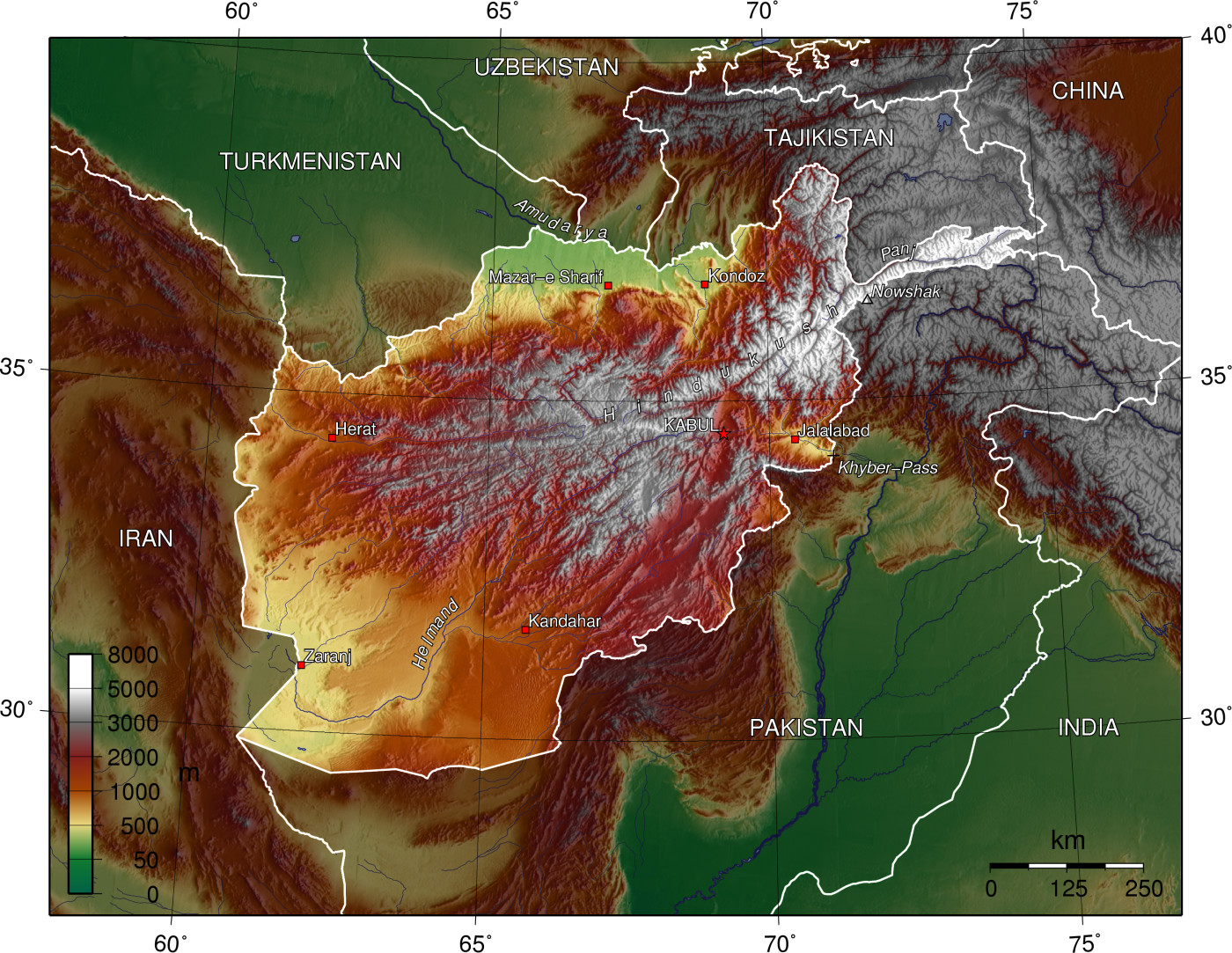
Photo credits: Orchards in Eastern Afghanistan by "Executioner," topographic map of Afghanistan, Irrigated Farm Fields in Afghanistan by Todd Huffman. All from Wikimedia Commons.

Thursday, January 8, 2009

Growing Our Own

As usual, a couple of timely coincidences has prompted another post. This time, we're back to food.

I was grazing through the Orion update I get periodically, where a short piece by Jason Peters about ecological illiteracy points out that ignorance about our almost complete dependence on oil is going to affect us profoundly, and not all that far in the future.

Then, Geoff Isaac on his It Came from the Kitchen blog pointed me to Mark Kinder's article for BBC News, which essentially illustrates the problems that derive from being culturally stupid about how we do things: Food Needs 'Fundamental Rethink.'

The main point Peters makes is that we're so uneducated about the consequences of our oil-addiction that we operate under a quasi-religious faith in the economy, and that "in an increasingly abstract economy we have simply let ourselves live in a kind of blissful ignorance about oil—how it was formed, what we use it for, how we get it, what and whom we destroy in the process."

Kinder's article focuses on City University of London professor, Tim Lang, who notes that (among other problems with the food supply) "We have an entirely oil-based food economy, and yet oil is running out. The impact of that on agriculture is one of the drivers of the volatility in the world food commodity markets."

I think the whole problem is actually even more insidious than oil-dependence, because it seems to be closely related to a kind of blindness about how much we depend on complex energy sources of all varieties for just about everything we do. For example, people concerned about our reliance on fossil fuels (especially those we obtain at great cost from other countries) tout biofuels like ethanol as solutions. But ethanol itself is just one more energy-intensive way of obtaining fuel, and one whose ramifications include reducing the amount of land that can be used for farming foodstuffs. So even when we're not using oil in every aspect of food production, we're using it as a production model even while we try to wean ourselves from it.

Professor Lang advocates a radical rethinking of the way we view our diets, and how we feed ourselves, and he's one among a large and growing number of people who are actively thinking about how we can change both habits and policies to address the ultimate issue: how do we feed a population nearing 9 billions without destroying the planet in the first place?

Britain, according to the article, is beginning to try to answer the question by establishing a Food Council (of which Lang is a member). This is an encouraging step, and one that needs to be taken in the United States. In fact, Rod Dreher (local Christian conservative blogger and author of Crunchy Cons, both the book and the blog) wrote a Thanksgiving piece for NPR in November, after Barack Obama was elected, and noted the need for change here at home: "We have to quit subsidizing agribusiness. We need policies that encourage the building of local food economies, not ones that depend heavily on fossil fuel transport. We need reform of regulatory codes that purport to protect the public's health, but really shield agribusiness from local competition."

Dreher then makes a rather modest, but interesting proposal to the new President:

May I suggest dinner? Let agribusiness lobbyists feed their faces at The Palm. You break bread at the White House with guests like Wendell Berry, Joel Salatin, Michael Pollan and Will Allen, the urban gardener who just won a MacArthur Foundation grant for teaching inner-city folks how to raise their own food. Lend them your sympathetic ear. And by the way, why not set a good example by planting a kitchen garden on the White House lawn?

He goes on to point out that this is one area where social conservatives like himself and tree-huggers like me can work together: "taking care of the land and building traditional food cultures are areas where conservatives and liberals can not only find common ground, but sow seeds in it that will bear good fruit for us all."

What he doesn't mention here is that the more we all become involved in understanding how and where our food is grown, the more quickly we can ameliorate our environmental illiteracy, and educate our communities and our children about ways to break the cycle of high-tech, fuel-greedy technological food production, and replace them with simpler ways of feeding ourselves before we mess things up so completely that choices no longer exist.

In this regard, I tend to be somewhat sanguine, since evidence that a paradigm shift is imminent seem to be popping up every other second or so. Take, for example, movements like Slow Food and the increase in permaculture practices worldwide.

A quick tootle around the internet provided me the following, and there are myriad more where these came from. Signs that things aren't as bad as they might seem:

The Science Barge is a New York effort to educate people about urban agriculture and sustainability.

The Urban Farm: Growing Food, Having Fun Gardening, Connecting with Nature (Phoenix, Arizona)

Jones Valley Urban Farm (Birmingham, Alabama)

Picardo Farm
(Seattle, Washington)

A CBS report on the urban farming movement, linked on City Farmer News.

The MacArthur Foundation page on honoree Will Allen

Urban Habitat Chicago: Demonstrating the viability of sustainable concepts and practices in urban environments through research, education, and hands-on projects.

A Google search on "urban farm" or "urban agriculture" will lift your spirits, because the links I've listed are only a smidgen of a sample.

Photo credit: The victory gardens at Slow Food Nation by David Silver, from Wikimedia Commons.

Wednesday, October 29, 2008

Pastoral Roots and Stewardship


Instead of reading Chairman Mao
I think I'll go and milk my cow.
--Wendell Berry, "The Mad Farmer March"

Back in the day--when I was still leaning rightward regarding economic issues--the main sources for information on what would now be called "sustainability" were to be found only in leftish periodicals, such as Mother Earth News and the Co-Evolution Quarterly (later to be called the Whole Earth Review). Urban-dweller that I was at the time, I still longed for the life of the self-sufficient farmer/rancher whose ethos I'd been fostered into: farms, ranches, victory gardens, home-grown cattle and eggs that could be found in farmers' markets, home-made sausage and cheese, down-to-earth values.

Early on I was also seduced by the ideal of community, and actually partook in a co-operative apartment arrangement that did amazingly well, housing three women (including one who was married and attended Penn three days a week before heading home to husband and hearth in Washington DC for the other four days) and two men, a dog, and two cats. One of the cohort was an Orthodox Jew who managed to maintain Kosherness in a house full of heathens. We did rather well for over a year until she and I both left to marry and one other member bought a chicken farm in upstate New York.

I was reminded of all this by a recent op/ed piece by local pundit Rod Dreher in the Dallas Morning News on Kentucky farmer, poet, and advocate of sustainable living, Wendell Berry. One of the reasons I don't like political labels in general (Liberal, Conservative, Etc.) is because they generally don't do a very good job of describing folks in particular, and because many of us don't fit into tidy little piles. Wendell Berry is one such person, being extremely conservative in regard to land use, responsible stewardship, and the centrality of family and community. He's also a pacifist (for reasons that coincide with his other values), and a proponent of social justice. Likewise, Rod Dreher (author of the Crunchy Cons concept that describes conservatives who hold what otherwise might otherwise be considered tree-hugging Lefties; he also writes a blog for Beliefnet) shares a number of these values (as do I), which led him to write this week's essay.

Praising Wendell Berry gets one in trouble with free-market economists because Berry's model for how to live in the world posits that competition presupposes winners and losers and, thus, if the free market reigns, we foster a class partition into one or the other. A thoughtful critique of this stance (like this one from Taki's Magazine) would note that the "losers" aren't thrown into a pit of alligators or anything (ideally, they find something else to do), but I think that misses the point. Berry's own critique is primarily about values: the very same values that helped found the Republic in the first place: agrarianism, community, co-operation, responsibility, justice. And most critics of this view start talking immediately about personal preference, and ask "what if I don't want to do what Berry thinks I should do?"

So once again we move toward the politics of desire: I don't want to have to pay the high prices that free-range, hormone-free chickens or beef cost, so I shouldn't have to; I should be free to choose. Never mind the multiple long-term benefits of better choices, such as decreasing the amount of meat we eat (thus reducing the cost of our meat bill in the first place), the higher quality of the meat as a product, the welfare of the animals, the reduction of pollutants and chemical use, the livelihood of the farmer, etc. Never mind that people in the habit of considering the entirety of the picture (not just the initial cost) conclude that convenience is pretty far down on the list of reasons for doing anything. Never mind that personal preference (again in the long run) is a pretty lousy reason for doing anything (because, after all, we're not all hermits living alone in the wilderness). That we should only do what we want to do seems to be an awfully childish way of approaching life.

Another criticism I've heard lobbed toward both Dreher and Berry has to do with religion. While most folks would see faith as a good place to begin, those given to questioning its efficacy as a source of reason do have a legitimate complaint. Believing something frequently trumps rationality, and citing a god as the ultimate authority doesn't work in a cogent argument. The skeptics among us (and I include myself here) are always looking for solid evidence.

But this country and most others on this planet are grounded in one religious tradition or another, and faith permeates culture to such a degree that ignoring it isn't going to make it go away. Preferring that it not exist helps no one and alienates many. In addition, faith is usually only one reason for doing something--not the entire ground. So if you think we should be stewards of the earth rather than exploiters of its bounty, it doesn't make a lot of difference whether it's because of faith or simply because it makes good scientific sense. Until god is really dead, we have to take belief into account, and he/she doesn't appear to be expiring any time soon. Some form of religion is part of our history and foundational to more world views than not. And since many of the most reasonable people I know also believe in some form of divine being, I can't see dismissing an argument simply because it arises from a deeply held belief.

That said, we are what we do. So if we say one thing and do another, we're just hypocrites, and no amount of religious doctrine is going to make us anything else. And this is why I admire Wendell Berry; he's deeply Christian, and he lives, breathes, writes, and acts as a steward. And a steward, I think, is a good thing--a caretaker, a holder of the house, a fosterer of the land. Instead of doing something simply because it's convenient, or because it satisfies some immediate desire or preference, Berry thinks broadly about taking care of the earth, of sustaining life and well-being, rather than pursuing some nebulous notion of "happiness" that involves constant acquisition of stuff.

It's unfortunate that, like the words "green," "organic," and "natural," "sustainability" is becoming another buzzword, used as a mantra by some and derisively by others. It's already losing its root notions of upholding, supporting, preserving,--even cherishing, as well as restraining. It's a good word. We shouldn't turn it into jargon, but rather attend to its richness. We need to participate in all of its meanings if we're to temper the rapid, mindless, heedless, and perhaps inexorable destruction of habitat, species, cultures, and the very ways of life that allowed us to emerge into the modern world.

In many religious traditions, even those that arose where there were only two real seasons, this time of year found people celebrating first fruits: the biggest harvest festivals of the year. We commemorate the season in the U. S. after the harvest is in, the jam has been made, the pickles put up, the seeds gathered, and the root cellar stocked to tide us through the winter. We call it Thanksgiving and attribute the holiday to an almost mythical event in American history, but its practice is similar to much earlier celebrations. I'm reminded of my favorite Hebrew prayer, the Shehecheyanu, which is said frequently during the year, notably at the beginnings of festivals and holidays, and has special poignancy at harvest time:

Blessed are You, Lord, our God, King of the world,
Who has kept us in life, sustained us,
and brought us to this moment.


I only hope that the idea of sustainability--creating the ability to sustain ourselves--doesn't get lost in all of the election and economic hoopla playing out on the news these days. It seems that anybody who talks about co-operation and sustenance is being branded a Socialist, and the idea of sacrificing wants in an effort to create an economy that supplies needs is being called Communist (and its clear that only cartoon definitions of either are being evoked), so the rhetoric will have to be tempered if we're to get back to talking about what we're leaving our children and grandchildren.

If we don't begin to talk more seriously about sustainability, and to act accordingly, the opportunity to address looming problems may disappear altogether. Predatory practices in the market seem to have buried whatever benefits might have existed under deregulation, and some serious reconsideration of the nature and scope of Capitalism seems to be occurring (see, for example, John Kenneth Galbraith's new book, The Predator State: How Conservatives Abandoned the Free Market and Why Liberals Should Too).

But economics, because it affects all of us, shouldn't just be the purview of theorists, and the better you and I understand what's going on, the better prepared we will be to make sound decisions in the voting booth over the next decade. Sustainable choices and market economies can actually work, as John Ikerd (an agricultural economist, who wrote Sustainable Capitalism: A Matter of Common Sense) and others have noted, even if they require careful thinking--and rethinking. Just because we're not all farmers doesn't mean we can't embrace agriculture as a metaphor, and see land stewardship as a model for better living. Our national roots reach deeply into this country's soil, and a careful study of those roots seems to be in order. This conversation should not be about who's a "Socialist" and who's a "Real American." It should be about going out and milking that cow.

In his 1980 essay, "Solving for Pattern," Wendell Berry offered some sound advice about how to create human solutions, grounded in specific human virtues. One such virtue is restraint, which he defines as "the ability to accept and live within limits; to resist changes that are merely novel or fashionable; to resist greed and pride; to resist the temptation to 'solve' problems by ignoring them, accepting them as 'trade-offs,' or bequeathing them to posterity."

Restraint is in short supply these days, but I look forward to the day when I don't have to rail constantly against greed and excess. The only way that'll happen, however, is if we can become a more educated electorate, and heed Berry's increasingly timely advice.

Sources for Wendell Berry quotations: "The Mad Farmer March" from A Part, North Point Press, 1980. "Solving For Pattern" was printed in The Gift of Good Land, Further Essays Cultural and Agricultural, North Point Press, 1981.

Photo credits:
Strohräder (Straw bale) by Walter Pilsak; Pumpkins, by Yolan Chériaux. Both from Wikimedia Commons.