Thursday, April 7, 2011

The Precept of the Teacher

The other day, during a Library Committee meeting, one of my colleagues used what's probably an old saw by now (the toilet paper analogy) to characterize the way time works on old folk: the closer you get to the end, the faster it goes. The perceived phenomenon of the increasingly rapid passage of time has been weighing on my mind much of late, because there never seems to be sufficient time for getting done what I'd like to.

So I haven't posted on any blog in nearly a month, and am seriously thinking of bundling everything except the Parliament back under the aegis of the Farm so that I don't feel so much pressure to compartmentalize my musings. I'll probably end up using the others as an archive and--at least until I'm not teaching as much--restrict my efforts to the original focus.

A new quarter has started, with a fresh batch of students (the one class of mostly "old hands" doesn't meet until Friday), along with yet another massive effort to keep them engaged. Oddly enough, my two 8 am classes are, so far, the most enthusiastic and vocal, making it easier for me to muster the energy to embrace the educational cheerleader roll my job requires even when--as is the case on Wednesday mornings--I've only left campus at 10 pm the night before.

For many years my pedagogical philosophy has involved emphasizing common ground as a means of connecting with my students. I use translation as a model for teaching, so finding out what my students know that I know (and vice versa) is part of my engagement strategy. But as I told them yesterday, it's now easier for people of their generation to connect across cultures and continents than it is for my generation to connect with theirs.

The advent of social networking media has created a web of interaction among young adults who share interests in popular culture that transcends national boundaries. But because many in my Boomer cohort find it extremely difficult (if not downright impossible) to embrace various aspects of that culture, the gap can often broaden into an unbridgable crevasse. In my case, unless I've got a class full of science fiction geeks or Miyazaki fans, I have to work really hard to locate areas of common interest and knowledge. They just don't know what I know--and not all that many of them really want to.

It does help that we're at least all designers, and that I know some stuff that they will eventually find helpful. They seem to appreciate my sense of humor, and my acknowledgment of my own shortcomings, but keeping them with me for the entire eleven weeks gets harder and harder every quarter. It seems to me that at this point in my career I shouldn't have to work quite so hard, and I should have more time to just enjoy getting old. Shouldn't I be resting, Buddha-like, on my laurels or something?

And this is probably where the time-perception problem originates. Between every quarter I now spend a considerable amount of time going over old lesson plans and presentations to freshen them up and integrate new material I've discovered that looks promising. Education, as I've often preached, is an ongoing process; so if I keep learning stuff, chances are I'll be able to keep the small parcel of common ground from eroding completely in a world that seems to share my values less and less.

A footnote of sorts: As I was looking for an image to illustrate this post, I typed a few keywords into Wikimedia Commons, starting with "crevasse" but ending up with "teacher." The latter led me on an interesting quest to locate the painter whose work I used. Not realizing initially that "Nicholas Roerich" was the anglicized name of the Russian painter Nikolai Konstantinovich Roreicha, I spent some time transliterating his Russian name from Cyrillic into Roman letters and looking for some information on him. This took longer than it should have, but I was rather well rewarded in the end. Roerich died the year I was born, this was his final painting, and I'd never heard of him. However, the discovery does seem particularly fortuitous, given the focus of this post.

According to the biography on the Nicholas Roerich Museum page, the painter "constantly sought to connect ethical problems with scientific knowledge of the surrounding world. . . It was Roerich's gift that these 'connections' appeared so natural to him and presented themselves in all life's manifestations. And it was this talent for synthesis, which he admired in others and encouraged in the young, that enabled him to correlate the subjective with the objective, the philosophical with the scientific, Eastern wisdom with Western knowledge, and to build bridges of understanding between such apparent contradictions."

On the Wikimedia Commons page from whence I pinched the image, the title of the painting is listed as "The Precept of the Teacher," although the museum page calls it "The Command of the Master." "Command" doesn't make much sense to me, but since I don't know much Russian, I'm not in a position to question either translation. But I like "precept" better than "command," and "teacher" better than "master." By using "precept" in the title of the post, I'm calling on its connotation of a "guiding principle"--in this case, nature. Roerich clearly possessed the same appreciation for montane landscapes that I do, and I find the image of the solitary teacher atop a peak to be especially evocative.

In the end, another lesson emerges. As I continue to lament the evident loss of curiosity among a growing number of students, the process of locating this image, and eventually discovering this artist, reaffirmed my assertion that not only does philosophy begin in wonder, but so does creativity.

Friday, March 25, 2011

Spring At Last

March Madness has nothing to do with basketball in this household. While I relish the beginning of spring and enjoy a brief respite between frigid cold and oppressive heat, my work-life becomes a morass of grading and preparation marked by an even briefer "break" between quarters.

Things are worse this year, because winter's "gift" of snow days has left me with two classes for which I had to arrange an alternative meeting date, and for which some material couldn't be made up. My poor Intro to Humanities class was good humored (especially when I forgot that I'd arranged to meet them at the Dallas Museum of Art last Sunday to make up for the extra snow day), but a bit dazed by our last meeting. I tried to smooth things over with sushi and other nibbles as we performed a modified Popul Vuh and they showed off their projects for the quarter. But now I have to revise the next version of the class to avoid any potential confusion, especially since it's an eight o'clocker on Monday mornings. At least this next class will begin when we're well into Spring's promise, and (barring really weird conditions) won't have to worry about snow.

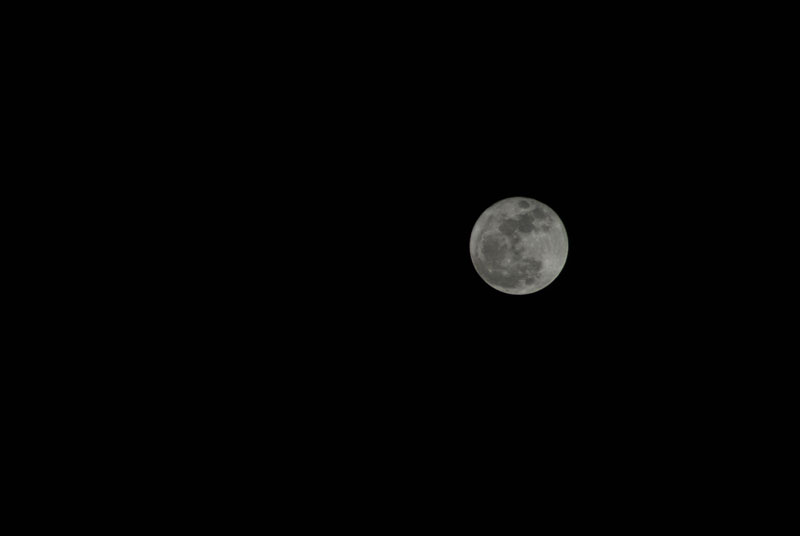
The universe is helping. Once again we got a spectacular heavenly display, this time at the equinox when we enjoyed a "super" perigee moon. Beloved Spouse and I snapped on the telephoto lens and set the tripod up in several locations, hoping to get a decent shot. The next morning (on the equinox itself) the moon was still visible, but it had gone cloudy so I couldn't get a dawn version. The opening shot for this post was one of the first I took, hand-held, and thus rather fuzzy. But I liked the effect of the tree "cradling" the rising moon. By the time we got the one below, the clouds were gone and we had the camera on a tripod. I'm pretty sure the Beloved Spouse took this one.

And then, of course, the House Clock performed on schedule, as the sun rose for the first time this year through the east window of the dining room, spilling sun on everything. A couple of days later I noticed another potential feature tied to the equinox: the possibility that the sun reaches from the front (glass) door to the back of the house for the first time on the first day of Spring. I'll have to wait a year to test it, but on the 22nd I noticed a straight line of sunlight. It may have appeared earlier, but I just didn't notice.

At any rate, the photos provided me with my first Skywatch Friday entry in weeks. And since I'll undoubtedly be out of commission next week, this may be it for another fortnight. I hope everyone has a great weekend.

Saturday, March 12, 2011

Geology Lessons

The enormous, near-apocalyptic temblor off the coast of Honshu would have been surprisingly tame, had it not been for the tsunami. The main reason for the comparative lack of architectural damage from the earthquake itself has to do with lessons the Japanese had learned well from history.

The great Tokyo earthquake of 1923 nearly flattened the city, with a notable exception to the general devastation: Frank Lloyd Wright's Imperial Hotel. It stood intact, surrounded by the debris of neighboring structures.

Since 1995's Great Hanshin earthquake in Kobe, the Japanese have implemented building codes and disaster plans designed to mitigate the inevitable destruction associated with the different kinds of earthquakes to which Japan is subject. The Kobe quake took place near a large population center, under the island itself, rather than offshore, so it didn't have to cope with a tsunami. Still, it wasn't as prepared as it could have been, and the human and economic impact was immense.

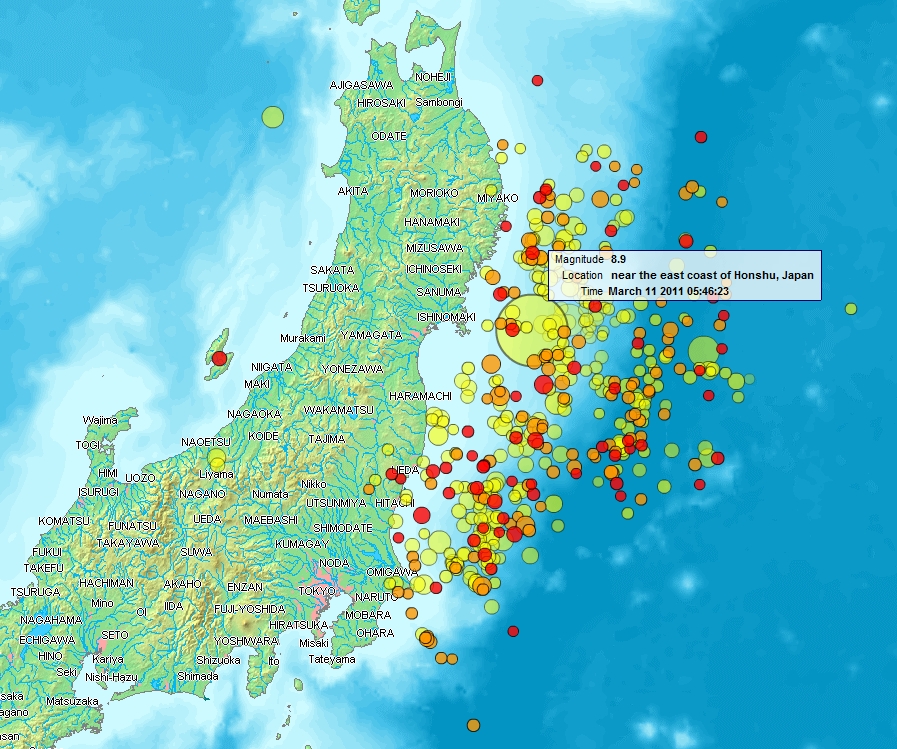
This week's quake was different, and the map below indicates why. It occurred along a subduction zone in relatively shallow water, not far from the coast: a recipe for large-scale tsunami impact. The numerous aftershocks haven't helped. I counted over 30 of magnitude 6 or higher on my iPad earthquake app--so many, in fact, that the big one had already dropped off the list. The pushpins on the map formed a huge, solid blob because the graphics weren't designed to depict hundreds of earthquakes. The map below is clearer, and if you click on it and then enlarge it, you can really see the enormity of an event that really hasn't stopped yet.

Having lived in four major earthquake zones (Japan, Taiwan, the Owens River Valley, and southern California), I'm no stranger to the earthquake experience. Even when small ones occur in unlikely places (such as Pennsylvania and Dallas), I sense them early and seem like a prophet to those around me (or a complete nut; take your pick). My interest in geology may, in fact, have stemmed from wondering about what caused it all.

But the aftermaths are also indicative of how human beings respond to disasters when they live in areas prone to them. There are few places on the planet that aren't subject to some dangerous phenomenon or other. Here in North Texas, we're on the lower fringe of Tornado Alley (which seems to be widening as the climate changes), and always teetering on the brink of drought. Hurricanes, floods, katabatic winds, wildfires, avalanches, and all manner of catastrophic events occur in places that might be safe from earthquakes, volcanoes, and tsunamis--although many are located within areas with a wide variety of potential natural disasters to withstand.

How we live when faced with these consequences is where clear-thinking and lessons from history should prevail when making choices. Sometimes what seems to be a good idea at the time turns out to be problematic, as with Japan's increasing reliance on nuclear power. In order to reduce its dependence on oil, the country has chosen to bet on nukes. Now, to me this sounds absolutely crackers, given the location of the island: at the edge of a plate boundary subject to ten centimeters of movement in a year. Sure enough, the Guardian is reporting today that the Japanese nuclear industry has barely dodged a bullet at the Fukushima Daiichi nuclear reactor, and avoided a meltdown. At least for the time being.

In 1872, what may have been California's worst earthquake in recorded history (around the same magnitude as the one in San Francisco in 1906) occurred along the fault line over which I was born. The valley's population then only numbered about 300, and twenty seven of them died. They're buried in a monument just outside of town. The land slipped down on the eastern segment of the fault, all the way up to Big Pine. On one of my last trips there before my father died, he pointed out the spot on the family's old property where a spring opened up as a result of the quake. (I love the lurid headlines at left; a sign of things to come in the Murdock era of tabloid journalism.)

The adobe structure in the center crumbled, leaving only its roof.

The frame house survived intact, losing only the flimsy shed attached.

The lesson from this rather small-scale local event (when compared, at least, with what Japan is going through today) was that adobe houses don't withstand earthquakes; only the frame houses survived. From then on, frame-built buildings took the place of adobe, which might be fine for fault-free Arizona and New Mexico, but clearly not the material of choice here.

On the other hand, the frame houses in Japan have never done well, probably because the quakes are different, the earthquakes bigger, the populations larger. But the effort to earthquake-proof buildings in Japan is focused on tall structures in business districts. Japan's real success has been in disaster-proofing its citizens, with drills and signs to direct them away from danger when possible. We can probably thank these measures for keeping the death toll down, even though it will probably keep climbing for a while.

I can't help but think that we'll never get it right if we don't stop pretending that our huge footprint on the planet doesn't make disasters worse. If we didn't rely so heavily on oil refineries, nuclear plants, and giant skyscrapers, and if we were spread about more wisely, might we not prevent much of the unnecessary suffering that attends our choices to live where danger is part of the landscape? If we didn't have huge energy grids susceptable to shutdowns due to weather or attack, wouldn't our energy needs be met more efficiently, without the potential for massive impact? If we weren't so very in love with using internal combustion engines to move us around unnecessarily long distances at ridiculous speeds, couldn't we vastly reduce the amount of dirty crap we spew into the air that, in turn, seems to be intensifying natural disasters?

Thinking smaller seems to make much more sense today than ever: more local food and energy sources, fewer commuter miles, more responsive local economies. I don't think for a minute that we'll ever decide to address any of these issues in any meaningful way, but when the latest disaster news takes over the wires, I can't help but long for a more thoughtful populace, and wiser political leadership.

Image credits: An old postcard view of the Imperial Hotel opens the post; it and the photo of the earthquake aftermath are from Wikimedia Commons. The map of what's now being called the Sendai Earthquake also comes from Wikimedia Commons. The shots of damage from the Lone Pine earthquake come from Susan Hough's report report on the event, "Owens Valley: Then and Now" on the USGS Pasadena pages.