Tuesday, February 22, 2022

Fragile Paths to Better Times

Update: The Endangered Alphabets Kickstarter campaign, The Right To Speak, The Right to Read, The Right to Write has been funded. Happy International Mother Language Day, and a gazillion thanks to anyone who supported the project!


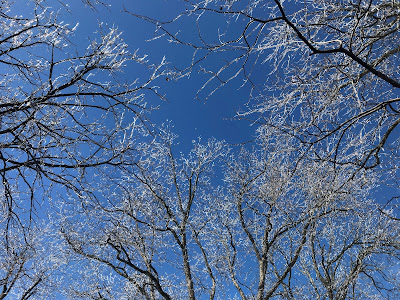
The sparkly aftermath of the last ice storm


After a balmy last few days, it's again cold, windy, and rather bleak this morning, so I'm finding it a little difficult to get up the steam to begin an effort to look at the world more optimistically. But we made it through last night's massive hail storm with nothing obviously damaged (TBS had wisely parked the truck under cover), so maybe that's enough. People on the next-door neighborhood site have started praying for snow tonight (instead of ice and sleet). But it looks like cold weather will rule over the next week before it starts feeling like Texas again.

My several news sources (in particular The New York Times and the Washington Post, but even The New Yorkerf) seem compelled to offer up "good news" with nearly every issue. The WaPo's "The Optimist" generally gets tossed in the trash bin automatically because I'm almost never in the mood for cheeriness first thing in the morning. Occasionally I'll be tempted to take a peek, but I really just want to see what's going on so I can bitch about it for the rest of the day. TNYT and TNY are more subtle, and thus more successful at luring me in. 


It's not that I relish being a pessimist, but as I often remind people who question my lack of sanguinity, "pessimists are seldom disappointed; and when they are, it's a good thing." I'm also not fond of the pabulum some folks seem to think of as good news (no, winning umpteen gold medals in the Olympics is not the most important thing in our collective public life and is not a measure of our national wellbeing). Although I do relish watching Nathan Chen demonstrating his prowess on ice, was not glued to the set for things I don't understand: "big air" and "half pipe," for example. And in order to keep my blood pressure at a reasonable level, I'm avoiding most television in general so as not to be exposed to the idiocy going on at the northern border.


Still, I do not want to spend the rest of my life being pissed off at everything, and so consumed with negativity that I can't hope that things could change.


I'm helped in this regard by a few writers I admire, especially Kim Stanley Robinson. Since Ursula K. Le Guin's death, he's taken up the top slot in my SF pantheon, because he's by far the best writer and the most thoughtful prognosticator of the future available--at least that I know of. After I finished The Ministry For The Future, I went back to his earlier book, Aurora, which I'd abandoned for some reason, and have just completed that as well. What I especially admire about his work, besides his fidelity to science, his depth of research, and his enormous imagination, is his ability to cast a reasonably optimistic eye toward the possibility that human beings can stop being stupid.


So, even though a large part of Aurora is about human arrogance and the failure of big, ill-conceived dreams about space travel, generation ships, and colonization of earth-like planets, its ultimate message is that we can learn to be better people. We can, instead of looking for other places to live by terraforming them, spend our intellectual and economic resources on terraforming earth instead. And although Ministry For The Future begins with a terrifying event (a monster heat wave in India), described so compellingly that it haunts my dreams to this day, it's also about how people can learn to begin to fix what we've screwed up so far.


Le Guin's oeuvre is steeped in similar considerations, both philosophical and environmental, and I'm thus happy to find someone whose work carries on some of her major themes. But it's especially gratifying to see that Robinson (like Le Guin) doesn't just talk about the future, he actively participates in its making.


Now, I'm not easily inspired to do anything. All of my endeavors, however minute, require long-term thinking through, much dawdling, lots of second-guessing, and increasingly small amounts of available energy. But in acknowledgement of the Year of the Tiger I've decided to dedicate an occasional essay on The Farm to locating resources that can help us forge a path, even a narrow one, toward something better than what we've got now.


One paving stone on that path for me is the ability to use wisely technologies with potential to do harm. The obvious culprits are social media of all sorts, but particularly the easiest ones to abuse: Facebook and Twitter, plus platforms like Reddit and Quora. I'll talk about these in more depth at some point, but for now it helps just to be selective about how we use them, and to be aware of the extent to which they dominate our lives. For some insights, see Jaron Lanier's Ten Arguments for Deleting Your Social Media Accounts Right Now, and Jenny Odell's How to Do Nothing: Resisting the Attention Economy.


We should already be able to recognize the technologies we've been depending on long enough to bring us to critical masses and tipping points in the near future: nukes, fossil fuels, internal combustion. But the danger list also includes our dependence on processes that have driven us to unprecedented amounts of consumption and waste and the economic habits that foster it all. 


The rest of the path can be built with much larger amounts of effort of kinds that are already going on. One exemplar is the rise of "Slow" movements: food, fashion, design--and even slow philosophy (as an antidote to fast politics), which arise from notions of sustainability and associated ideas about permaculture and regenerative farming and ranching practices. These are all ideas I'd like to explore in future on this blog, but for the moment I urge anyone who's interested to begin by looking through the interwebs (making good use of this problematic technology) for more information and to see what's being talked about. Another good source is the realm of digital publications and zines that focus on these issues. My last post on Owl's Cabinet featured little reviews of some of my favorites, and I've since located more. I'll be listing all of them on the sidebar of this blog (under "Media"), along with the sources already there under "Education of Desire."


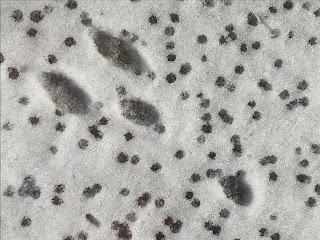
It's not easy to combat the naysayers, or to avoid getting caught up in the deep negativity that's been engendered by the events of the last couple of years. I can't say that my assessment of our ability to work things out for the better is any more firmly grounded than it was in January of 2017 (or January of 2021, for that matter). But hope abides. Especially when the sun's out and the weather is fine. Or even when the ice-clad trees sparkle after a February snow storm that doesn't cause widespread power failures and frozen pipes. Or when bunnies leave their footprints behind in the snowy garden, with polka dots of melting ice as a backdrop.


And then there's the promise of the new year. I've been fond of the lunar new year since I was a child. In both Japan and Taiwan, it was celebrated with delicious sweets, colorful ceremonies and dancing, fireworks, puppetry, and (even for children) introspection. I returned to the United States in 1962, another Year of the Tiger, and my Chinese and Taiwanese friends thought that it was an auspicious time to do so, assuring my mother that the courage and bravery associated with tigers would help me make the necessary adjustments. I'm not sure how brave I was (I ended up staying in the States instead of joining my father in England), but maybe that's what was involved in my choice to remain with my grandmother, in my home town, for the next year. I certainly developed a strong attachment to place during that time, and it took hold fiercely. Much as it has here, in my little hundred year-old bungalow on its little half acre of small-scale utopia.


The future seems more uncertain to me now than it ever has--even after having lived through some major crises in the past. With another Russian conflict building in Ukraine, things don't seem particularly promising. But I do like to think that there's always hope, and so will be spending more my time learning from those who are practicing ways to build it.

Monday, February 7, 2022

Dodging Dystopia

As I was thinking about how to put together a post about Tim Brookes's new Endangered Alphabets-related Kickstarter campaign (The Right to Speak, The Right to Read, The Right to Write), I was in the middle of pondering current efforts in Texas and elsewhere in the US to (once again) to ban books that certain factions don't like. This happens all too often, so much so that the American Library Association sponsors a website called Banned and Challenged Books and promotes an annual Banned Books Week to celebrate the freedom to read.

Still, English- (and other first-world language) speakers largely take reading, writing, and speaking for granted so much that our collective knickers get all knotted up when those rights are threatened (even if we don't quite understand what the Freedom of Speech amendment to the Constitution really means). But as contentious as things tend to get, nobody is threatening to ban our alphabet or eradicate our language. Here, at least.

Elsewhere, however, these irreplaceable components of culture are so threatened that for many years now, Tim Brookes has been working to save as many endangered alphabets (the graphic representation of languages) as possible possible. (See a list of posts on the Farm about the Kickstarter campaigns and my efforts to support his various campaigns here.) The success of these projects has resulted in a wide variety of resources from The Atlas of Endangered Alphabets to the recent launching of Ulus: Legends of the Nomads, a tabletop game designed to foster the imperiled Mongolian language, writing system, and culture.


The newest project involves a large-scale carving in three scripts: 

Osage, from the Great Plains of North America

Bamun, from Cameroon

Meitei Mayek, from Manipur, northwest India


These will be inscribed, by Brookes himself, using his remarkable skill (with which I'm familiar first-hand, because I own several that were obtained as rewards for previous project backings) on a large, spectacular piece of wood that emphasizes both the beauty of the scripts and their importance to the cultures that use them.

All three of these scripts have been rescued from total loss by community efforts to revive them. Two of them, Bamum and Osage, had to be invented in order to help preserve the languages because of political efforts to obliterate the cultures that spoke them. We may not think that this sort of thing can happen to us, but I spent a good deal of time today thinking about how much simpler it is to assimilate and repress indigenous cultures if you make it impossible for them to maintain their historical identity and memory.

Please take a little time to check out the links I've included above, and to imagine how much poorer our own lives would be without the written records we've inherited from our ancestors. Without writing and the documents they produce, rights as we understand them would not exist.

If you've ever wondered why dystopias and post-apocalyptic scenarios are so popular in today's literature and films, think about how much political and cultural angst lies at the heart of stories like Brave New World, 1984, The Handmaid's Tale, Fahrenheit 451, The Man in the High Castle, or A Canticle for Liebowitz. And think about how the abridgment of fundamental rights like reading, writing, and speaking would impact people who've never really had them threatened before.

Only two years ago, pandemics were the stuff of bad dreams and old SF stories like The Andromeda Strain or Earth Abides.  But impossibly large numbers of people have become ill and died from COVID-19. So, if, on top of the disruption of day-to-day life and public health, the destruction of cultural and historical memory is even imaginable to us-- perhaps it's worth contributing to the celebration of fundamental rights to remind us of how fragile they really are--in an increasingly uncertain world. 

I keep trying to find ways to stay positive these days, and this campaign has come along at just the right time. A few bucks toward supporting such an important vision seems like a pretty simple way to lift one's spirits.

Friday, November 5, 2021

There And Back Again, Again

The Inyo Mountains from the secret campsite
Once one begins to list “retired” as one’s “occupation,” the notion of taking a vacation becomes increasingly moot. When The Beloved Spouse and I began to plan a late-fall road-trip out west to see family, it was hard to think of it as a vacation. Fortunately, “road trip” is a “thing” now, so it provides a useful substitute.

Our window of opportunity was somewhat narrow, because we wanted to avoid family crowds in state and national parks (where we prefer to stay), and to leave late enough to avoid remnant summer heat but get home before cold weather started creeping in. Although we did manage to miss almost all the hot weather, we had to change plans several times to avoid encroaching sub-freezing temperatures in many places we wanted to visit. Porco is a great travel trailer, but his underbelly isn’t insulated, so we need to camp in predictably temperate climes. 

After dealing with some mini-disasters related to bad packing and insufficient plumbing expertise, we settled in for a reasonably comfortable couple of "shake down" days at Copper Breaks State Park near Quanah, TX. Our first hint of trouble arrived as we drove into Trinidad Lake State Park, in southern Colorado, and started mapping out our route for the next day. We were rather gob smacked to learn that the predicted weather for the next few days in mountainous central Colorado involved nights dipping below freezing, so we quickly changed plans to head for the Colorado/New Mexico border instead, to Navajo State Park, and stay there for a couple of days in order to re-map the route. We’d have to traverse the fabled Wolf Creek Pass, but the aspens had started changing color and the views were spectacular. 

The stay at Navajo was quite pleasant, even though it offered us the first of many reminders of encroaching drought (very low lake levels), and gave us time to rethink our plans a little. We shifted over to Utah after that, and moved up toward Salt Lake and across to Nevada, where we rejoined our original route and drove up the "most dangerous highway in the US" (93) to Idaho to visit family near Boise. The foretold danger--on an otherwise smooth, well-paved, lovely road--appeared in the form of a nasty multi-vehicle accident that parked us for an hour and a half. We still made it to the Boise area in good time, though, and had a nice visit with my step-family, who had only recently moved up from southern California. From there we drove through a good chunk of eastern Oregon into Washington, over the Cascades, and spent time with my son and his wife in their new-ish rainforest aerie in Redmond, WA, my former student Jane and her husband in Bellevue, and my uncle, aunt, and cousins and family in the Greater Tumwater Area (where we got to see my cousin Jeff's champion pumpkin before it shuffled off to glory in Half Moon Bay, CA). We ended up spending three days in Tumwater, enjoying my aunt Geri and uncle Art's gracious hospitality and amazing food. Molly and Nylah had a great time running around in the house and yard sans leash, for the first time in two weeks. 

Remnants of the Dixie Fire
Things started going south (metaphorically as well as literally) as we drove toward Eugene, OR through a cold rain and had to change plans again because the temperatures were falling along the Oregon/California border, where we had planned to join Highway 395 and follow it south. So, after changing a flat in one of Porco's tires, we kept on I 5 into Redding and then went east to Susanville—through some of the remnants of the recent Dixie Fire (which had not yet been entirely contained) near Lassen Volcano. We had reserved a couple of nights at a funky campground beside the Bridgeport Reservoir, but had no cell service and thus no way to check on the weather. By the morning after we arrived we got enough information to know that the temperatures would not be favorable overnight, so we abandoned the rest of the booking, sacrificed the fee, and got on back on to 395 south. 

The trip down was lovely, with dramatic clouds, a significant dusting of new snow, and gorgeous views down to Mono Lake. We dropped in at a viewing spot near the tufa and snapped a couple of pictures, and then drove to Big Pine where we filled our freshwater tank. Our preferred RV park in Lone Pine was full, so we decided to try one of the BLM areas (not the Alabamas, which have become an RV cult spot). We found a terrific campground that would only cost us USD 2.50 per night thanks to our Geezer Parks Pass. I’ve opted not to name it, because I’m a selfish old bat and just don’t want to share the discovery. But we loved it, the animals loved it, and we had three days of peace with only one “neighbor” for two of them. TBS hooked up the solar array and kept us in electricity, and we got in some hiking and trips to sacred family sites in the valley. 


Bridgeport Reservoir, with geese if you look closely


New snow in Mono Country


Mono Lake from outside of Bridgeport
 

Mono Lake Tufa


View from the campsite with haze from
Sequoia/Kings Canyon fires

Unfortunately, this idyll marked the end of our journey out, and everything that followed focused on getting us back to Texas, which would require more re-routing, a missed opportunity to visit my beloved 99 year-old cousin Willma in Sedona, and some of the scariest driving we’ve ever experienced. We were leaving just in time to avoid a freeze, but also just in time to have to negotiate one of the periodic katabatic wind storms I’ve known since I was a child. 

Owens Valley frequently experiences very high-velocity winds that blow from north to south and west to east (at the same time). The dust kicked up by these storms, especially off of Owens Lake (mostly dry) and the dunes at the southern end of the valley can blind drivers and cause horrific accidents on 395. After attending to some necessities (fixing Porco's flat, dumping our tanks, and visiting the Interagency Visitor Center for Valley swag), we got on the road just as the storm got serious. We probably should have waited it out for another day, but decided to take it slow and easy, and to get off the road if necessary; it was supposed to freeze in Lone Pine that night, so our options were slim. Our rig is relatively short (20’ for Porco, 20’ for the Gladiator), and pretty low-profile, presenting less of a wind target than most RVs. 

We managed to get around one accident blocking the southbound lane by moving over to Old 395, and later saw two semis overturned in the northbound lanes. We got to Pearsonville before we lost visibility, and pulled off. GPS told us that we were near where the highway curved east, so as soon as it was clear enough to see anything, we drove past the junction with CA 14, just as it was being closed, and found out that 395 had been closed both north and southbound. Turning east meant that we had the wind at our tail, were out of the valley, and the most dangerous part was over. 

Coming into Kramer Junction 

After that we got some of the best mileage of the trip. The winds caught up with us as we turned south again, but they weren’t nearly as strong. We ran into another visibility problem as we drove into Kramer Junction (the only photos I got of the storm were through the windshield here), but instead of 0 feet, we could see for 10 or 15. By the time we stopped for gas, the dust was gone, and we were headed east again: to Needles for the night, and then on to a stretch of old Route 66. 

While we were cruising along the next day, reading old Burma Shave signs and stopping at a couple of tourist traps, we learned that the overnight temperatures along I 40 would be well below freezing, resulting in yet another change in plans, and direction. We had to abandon our reservations at Meteor Crater, and our plans to visit Sedona. (We’re now thinking of making that one up with a special trip out to Arizona next spring.) We took a sharp right turn just before Flagstaff, and headed toward Phoenix, where we stayed in an RV park right out of the Twilight Zone. If I ever do a review of the places we stayed, I’ll tell that story. But think Stepford Wives meets Heinlein Mars colony and you’ll get the idea. 

We managed not to have to take an extra day by abandoning all plans to visit interesting places, and sped on back through southern New Mexico (where we stayed at a campground with Great Horned Owls) and into Texas. We spend our last night on the road in Sweetwater, and got home by early afternoon, twenty-five days after we left. 

In the end, it was wonderful to be able to visit most of the folks we had planned to see, and to drive through parts of the country I hadn’t seen since I was a seven year-old on a caravan trip with my grandparents. Future trips, however, will involve many fewer one-night stands at RV parks and more, longer-term stays in more remote places. The unfortunate (for us) boom in recreational travel has meant that many state parks are booked months in advance, the national parks have been over-run, and some of our favorite places (like the Alabama Hills outside of my home town) have become RV Disneylands. I once remarked that if Los Angeles hadn’t taken all that water from Owens Valley, the towns south of Mammoth would have become overpopulated and overcrowded themselves. Although I don’t really see that happening now, the tourists have become far more abundant than I’ve ever seen them. This creates a bit of an economic boom for valley dwellers, but lessens the enjoyment quotient for lovers of peace, quiet, and dark skies. 

As I go through my travel journal to fill in gaps and have a chance to ruminate more deeply on the trip, I’ll probably add posts that expand on this one. But for those of my well-wishers who’ve been waiting to get more than brief text messages, I thought it prudent to get this part out. 

Daylight savings time ends this weekend, the leaves are falling, it’s getting much cooler, and we’ve turned on the furnace in the house. We’re also enjoying a bumper crop of pecans, which require endless shelling, but are welcome nonetheless. We’re both now boostered, and still sport our Ghibli masks when we go out, so feel about as safe as we can in this part of the world. There will be a Thanksgiving this year, again hosted by daughter and her partner, for which I have little to do but enjoy when we get there. 

Now that we’re back, we can get back to work on making the house livable for the foreseeable future, with measures to withstand future, climate-related difficulties. Despite the fact that everybody in Real Estate Land seems to want to buy our house, the trip has provided one more insight. No matter where we travel, this house is where we all—spouses, cat, and dog—feel at home. So no, we won’t be moving west. But we’ll still get out there once in a while.