Wednesday, June 17, 2026

Coming to Terms With Technological Change

Olivetti Lettera 22

For over thirty years I've been wondering how to approach emerging questions introduced by innovations in information technology.  At first (in the '80s) I accepted new-fangled objects like computers and screens almost without question. And then I happily embraced e-mail, primarily because it enabled me to keep in more frequent touch with my father, who had been an eager early-adopter. During the last fifteen or so years of his life (he died at 83 in 2004) we enjoyed a lively correspondence that had been enhanced by the ability to exchange messages much more quickly than we could by post--although we continued using the older tech in order to include family members who hopped on the bandwagon more slowly. 

We were both less receptive toward portable telephones, although I reluctantly bought an early Nokia when my mother was ill and I was teaching, although land-line phones sufficed for everything but emergencies. But borrowing a friend's mobile phone in 1995 for a solo road trip to California (only weeks before I underwent bypass surgery) made portability's uses even clearer. It still took some active persuasion for me to buy my first iPhone, but one of my students convinced me of its efficiency, and I fell under Apple's spell.  I still have that old silverback, which had to be replaced within a year or so, but have reluctantly upgraded only when I had to. It's really too bad that Apple was, from the beginning, so committed to planned obsolescence that it would never develop anything that didn't need to be modified on a frequent schedule. Fast tech was born at the dawn of the era of fast food, fast fashion, and ever-increasing waste.

Oddly enough, my first gig at the Art Institute of Dallas was teaching "Computer Literacy" in 1989. I'm not sure why I was hired, except that I had been a TA at UTD in the computer science lab before a real teaching assistantship opened up. But by the time I became a full-time humanities instructor, I had realized that a course website would help me communicate better with my students and make it possible to provide resources for them that our high-tech multi-media focused college couldn't yet supply. 

So I bought a domain, started learning how to use Adobe PageMill, and created a site that became known as "Owldroppings" (don't ask). I switched over to Adobe Creative Suite when I got a free teaching copy, and that provided me with better tools for design and image manipulation. A couple of students hosted the site over the years, and I eventually learned enough about maintaining it to take over its management. Not long after that, a colleague convinced me that I really needed to start a blog. And so, nearly nineteen years ago, on June 22, 2007, I wrote this: 

I swore I would never do this. Who wants to read my stuff, anyway? But pressures mount in an academic/technical environment, and I was seduced by somebody else's blog.

I grew more enthusiastic about the enterprise as I got into it; then, of course, life got in the way and my output dwindled. But I have kept it up, if intermittently. The websites not so much.

My distaste for other social media, however, has remained steadfast in most ways. I've never had a Facebook or Twitter account, having been pretty ferocious in my opposition to what they and similar platforms were putting out from the day they were launched, despite the fact that my children and many other family members eagerly opened accounts on one or more of them. 

I actually had an Instagram account for a few years because I thought it might be good for putting pictures up on the blog, but only ever used it to follow a few bookstores--and recently got rid of it altogether. There is a Quora account (I joined in 2011 because Ursula K. Le Guin had one; but she left shortly after I arrived), on which I still hold forth very occasionally on topics about which I have some expertise. There's also a Pinterest account because it's still a good curatorial tool and substitutes for collections of magazine clippings--although mine has no social value to me or anyone else. My only regret about using it is that when it gets bought up by some greedy megacorp that decides I don't buy enough stuff from the advertisers, I'm outta there and so are all my beguiling boards and images. My feed is increasingly being populated by AI Slop, however, so perhaps it won't take an EMP to drive me away or obliterate my collections.

Which brings me to my current conundrum, confession, and concession. (Don't smirk; I worked hard on that.) 

Remember that course website ("Owldroppings"), the construction of which convinced me that not all modern technology was a waste of time and effort?  It hung around the interwebs for several years, even after I retired, and a couple of my former students decided it was worth preserving. So they deposited bits of it onto The Internet Archive's wonderful, magical Wayback Machine. In the meantime I had redesigned the home page and renamed it "Owl's Farm (The Website)," considered some ideas about what could happen to it, and then let it sit.

I had also constructed a site for what I had once thought might be my final attempt at a doctoral dissertation: a riff on William Morris's utopian novel, News From Nowhere, complete with resources and other materials related to what I called More News From Nowhere. And because I was teaching both Morris's book and mine in a course called "Technology and Utopia" at AiDallas, I published the first draft online. And there it sat. Until last week.

Since early this year I've been trying to reclaim both sites and bring them back to life. But I kept having technical problems with my software (a pre-cloud version of Dreamweaver), my computers (two old Macs running old operating systems), my understanding of how FTP works, and my host (Go Daddy) with whom I've been doing business for twenty years. I got frustrated a couple of times, and backed off when I couldn't understand what I was doing. This lasted for about six months, but last week I decided to try again and was introduced to a new platform that I automatically said NO A THOUSAND TIMES NO to. But the particular salesman I talked to (they call them "Guides") engaged me in conversation long enough for him to get on the Wayback Machine, scrape my material off, slap it into the Ai program, and produce pages that weren't awfully different from what I would have done.

In essence, the program did--in about a half an hour total--everything I had been trying to do since I retired. I feel a bit like Sibling Dex meeting the robot Mosscap for the first time in A Psalm for the Wild Built (thank you, Becky Chambers)!  "Cheese" (my guide; not his real name, but close) managed to convince me, not by using ad-speak or some tech-salesperson language with which I am inadequately familiar, but by showing me. And it's not AI Slop, either. It's my sensibilities tidied up a bit and translated into a newer, cleaner version of what I had constructed all those many years ago. I can edit everything (even code, although it's not code-based), add my own graphics and images, and pretty it up if I want to. I've since been working on both sites as I think about what I want to happen with them, making changes, publishing them, and getting on with my life.

I still have major problems with the current artificial intelligence obsession. I'll go into those in some depth later. I'll also feature a discussion of some of it in the novel. But for now I'm back to writing and editing, and have built (along with my robot, who's very affable and polite, and probably needs a name) workable update of the originals. If you're curious about the earlier material, you can always visit the Wayback Machine, although accessing More News From Nowhere can be confusing, the text has changed significantly, and will not be uploaded until I'm ready for feedback. I also haven't tried looking at older versions of owlfarmer.com. 

Once again, however, the right person has talked me back from absolutism and stridency to a position of reasonableness. I still deplore the latest trends in visual manipulation, although perhaps charts might be a good outlet for "designers" who simply want to type in a few parameters and push a button. But for those of us who learned from scratch how to design and edit code and were pretty successful at it, and who are now older than dirt and not all that good at it any more, this alternative may provide a path forward.

More News From Nowhere* and "Owl's Farm: The Website" are now linked at the top of this blog. "Owl's Farm (The Blog)" and "Owl's Cabinet of Wonders" will stay on Blogger and undergo only a few modifications and updates.

I hope you folks who are still here will stay with me.  


*Note: I am well aware of Nick Cage's song of the same name; the two works share a source of inspiration (Morris's book) and possible thematic elements (according to the Wikipedia account), but I've never heard the song itself. I began working on the material that led to my story in 1992 when I started conducting research on Morris and his critique of modern technology, so I was way ahead of Cage with that title.

Image credit: My first text-producing machine ever was an Olivetti Lettera 22. The photo is from Wikipedia's page, because the one I still own is a rusty, scruffy mess.  My mother had a friend who was an Olivetti salesman in Taiwan, and he gave her the 1961 script version. She gave it to me, and I typed papers on it in college. One professor wrote on the cover of what was otherwise an excellent paper on John Chadwick's The Decipherment of Linear B, "This typewriter could drive a man to drink." Here's what it looked like:


I think there's a technological message in here. Somewhere.


Tuesday, May 19, 2026

Metaphor and Possibility

McKinney, April 18 2026 (and below)


McKinney, December 30, 2023 (rare winter thunderstorm at sunset)
 
The appearance of mammatus clouds as the weather warms always seems to add a tinge of foreboding to both weather- and news-watching. They're so called because of their resemblance to udders or breasts, and are usually associated with thunderstorms.  I've always been a cloud fan (the atmospheric variety, that is), because of my father's meteorological interests. He had flown over and into Atlantic hurricanes during our time in Bermuda (ca. 1950) and often had a weather station in a back yard wherever we lived. Before I moved to north Texas, however, the most dramatic clouds I was familiar with were the lenticular "Sierra waves" that form regularly over the Owens River Valley. We watched this one develop at sunset during our last visit:

Lone Pine, California, June 2025

My first encounter with mammatus clouds occurred on April 10, 1979, just after I arrived in north Texas, on the day Wichita Falls was hit by an F4 tornado that killed 45 people. Although we were 140 miles away, the local sky was filled with the cloud formations I now always associate with the possibility of really bad storms. I was eight months pregnant with my daughter, and my son and our cats and I spent our first tornado watch in the bathtub, under a mattress. 

What brought all this cloud stuff to mind was an article in this week's New York Times Magazine, "Why Smart Products Have Started to Look Like the Dumb Choice." Nitsuh Abebe writes a column on language for the Magazine, and this one combines two of my particular interests: metaphor and the philosophical assessment of technology. 

Abebe takes us through the evolution of words like "smart" and "dumb" as metaphors, and explains how utterly absurd and problematic the designations have become. Smart phones, homes, TVs, and even kitchen appliances, now demand internet connectivity in order to work. I've been ranting about the notion of planned obsolescence for so long that I can hardly have a conversation with an appliance salesperson without spouting off about why I've had to buy a new refrigerator only ten years after I bought the one I now have to replace. And mine aren't even "smart" because I absolutely refuse to own an electronic object that talks to me. (And no, I do not use Siri.) I live in a hundred year-old house that can't even accommodate an automatic ice maker, so that a fridge that doesn't come with one is actually a selling point. 

Over the past twenty years, I've been working on a bit of speculative fiction that (among other things) imagines a world without electricity. As a thought experiment, this is the perfect exercise for examining our dependence on a now-pervasive technology that was unthinkable only 250 years ago. And the premise isn't built on disaster or dystopia; it's based on choice. The focus of my graduate research was on William Morris and the Arts and Crafts movement, and central to Morris's philosophical approach to art and design was the education of desire. To Morris, human dignity, creativity, comity, and culture were all based on the distinction between need and want. His novel, News From Nowhere, imagined a world where work and art were conjoined rather than opposed. The machines responsible for the polluted air and waters of Victorian Britain were absent from Morris's utopia, and his musings inspired me to think about how the modern, post-industrial, digitally-dictated age might beget something more philosophically satisfying than what we're now experiencing.

Of course, it takes an old Luddite like me to even want to think about a life free of complex machines, but other visions of lower tech, more humane ways of living are emerging as I type. A newish literary genre commonly referred to as "solar punk" has generated a number of novels like Becky Chambers's Monk and Robot books (A Psalm for the Wild Built and A Prayer for the Crown Shy). Many of Ursula K. Le Guin's novels and short stories consider the relationship between need and want and delve deeply into human relationships with technologies. And then, of course, there are the deeply anti-technological and anti-industrial themes of J. R. R. Tolkien's novels. So I don't think it's coincidental that, as Abebe notes in his essay, "more than a quarter of younger Americans are curious about switching to a 'dumbphone.'" I'm also heartened by the growing interest in "retro" tech like vinyl records, portable turntables, and manual typewriters.

The current state of the world, with its various antagonisms--including greed, power hunger, and disregard for the consequences of the technologies we've fostered and embraced--doesn't offer many of us much hope that things will get better any time soon. But perhaps one way to approach the problems is to look for better metaphors: Sibling Dex in A Psalm for the Wild Built goes looking for cricket song. And Mosscap, the Robot, goes looking for what human beings need

I've been thinking lately, as I watch the fairyland of fireflies arise in our garden each evening (they're scarce anywhere else in the neighborhood, but because we don't use pesticides, we offer a sort of firefly utopia), I wonder if maybe fostering fireflies might be a good place to start. Or using the plenitude of cloud formations to represent the multitude of ways we could make things better. Mammatus clouds, for example, might be seen as motherly rather than scary, since they often signal the approach of thunderstorms that bring much-needed rain). 

A bit of silly speculation and wishful thinking, perhaps, but an alternative to spending time thinking along lines that will only make things worse: "The Cloud" as a "storage space" in which to cram all the digital output of the energy- and resource-consuming machines billionaires keep building to feed the coffers of people who don't really need any of it but produce simply because they can. 

I won't deal with this now, but we might start considering very seriously just who is going to benefit from all that stored "data" and all that AI. 


Wednesday, April 22, 2026

Earth Day 2026: Revisiting Earth Days Past

 In an effort not to purger myself, I've spent the last hour or so going through the history of this blog to make sure that I had, indeed, faithfully posted on each Earth Day over the years since its inception. The first year doesn't really count, because I didn't get talked into dipping toes into the blog-pond until June of 2007. But, indeed, there have been posts on April 22 of every year since. One year (2012) there were even two!

Themes are pretty consistent; one might even say repetitive. But then, the same might be said of the tribulations that continue to face this tiny little blue dot of a planet--a point of which we were reminded during this last couple of weeks when we got to join in the latest real-life space adventure when Artemis II made its flyby trip to the moon and back. NASA has put together an endlessly entertaining collection of digital media to document the mission, but my favorite has to be this one of the Earth setting over Ohm crater on the Moon,


the perfect companion to the 1968 Apollo 8 photo, "Earthrise." 

It's not entirely coincidental that my last several months of reading time have been occupied by tales of solar system adventures (Kim Stanley Robinson's Mars Trilogy--Red Mars, Green Mars, and Blue Mars--and Red Moon, as well as Andy Weir's The Martian) and planetary peril (Weir's Project Hail Mary). I tend to prefer scientific fidelity and at least possibility in my SF reading these days, since what's happening on the planet is scary enough, and it's difficult to imagine space aliens who could do worse by us than what our own government seems to be intent on carrying out. I'm also not convinced that space visitors would come to us wearing armor and with guns a-blazing. They're probably nicer, if they've existed long enough to get here.

So I guess my Earth Day contribution this year will be to point out that in the 70s the space programs (not just ours) seemed to offer the best hope that we might not do ourselves in, and that science might just give us a decent chance to overcome our worst impulses. 

Addendum:

As I've mentioned many times on the Earth Day blogposts, I celebrated the very first Earth Day in Philadelphia in 1970, when I purchased this poster by Martin Carey. It hangs in my kitchen and reminds me quite often of the part this kitchen itself plays in my attempts to help save the planet. I keep referring to it, but have only posted it once, so I thought popping it in here might tie these posts back to their origins. Out of curiosity, I checked to see if it's still available, and found it here (for 250 USD). Carey designed it for the Earth Week Committee of Philadelphia.


Image notes: The Artemis II image is from the NASA collection noted above. The Apollo 8 photo was taken by astronaut William Anders on December 24, 1968 and is from Wikipedia's article on the photograph.

Saturday, April 4, 2026

After Long Silence

The Earth with the Moon and the Milky Way by Wladyslaw T. Benda
Produced to illustrate The Future of Earth by Maurice Maeterlinck

I've been absent from this blog for so long, and so preoccupied by events so complex and all-consuming that I don't even know where to start. But since one of my current adventures in rabbit-holery involves multiple space-related literary, visual, and journalistic media, I couldn't scrounge up an appropriate image from my own photo archives--so I turned to The Public Domain Review, looking for old photographs, paintings, or other illustrations that might evoke my current state of mind. The PDR seldom disappoints, and looking through images in the "Astronomy and Space" section of the image archive search engine I found several evocative candidates. I was quite tempted to use one of the illustrations by Henrique Alvin CorrĂȘa of the 1906 french translation of H. G. Wells's The War of the Worlds, for a couple of reasons. One is my recent plunge into Mars-related science fiction (rereading Andy Weir's The Martian, and Kim Stanley Robinson's Mars trilogy and related short stories, and beginning the fifth season of For All Mankind). And then there's my current anxiety about the state of the world as we know it.

But it's the all-encompassing import of this last category, coupled with the current flight of Artemis II to the moon, that led me to choose Wladyslaw Benda's evocative image* created for the publication of Maurice Maeterlinck's piece for the March 1918 issue of Cosmopolitan (!). I found a reprint of the essay in a rather wonderful blog called "Voyages Extraordinaires: Scientific Romances in a Bygone Age" by a Canadian chap named Cory Gross. [His last post was in 2023, so I need to look him up, but his blog seems like a Steampunker's dream site. One more rabbit hole!] The date of Maeterlinck's essay is important to the connection with war and its proximity. And the essay itself is particularly apt.

While I'm explaining myself, I should also mention that this post's title comes from a poem by William Butler Yeats, which relates not to war but to age, which is more constant even than conflict is in my easily distracted mind these days. But the title's path to this post was less authentic than I make it sound. 

Over the last few months, spent recovering from a repair job on my sternum and raising a puppy acquired way too soon after the death of our beloved Nylah, I've felt guilty about not writing here, hoping that my remaining readers hadn't given me up for dead. And then I turned 78 (last December) and my son turned 50 (last month), and I finally twigged to the fact that tempus is fugiting faster than I'd realized, and decided to get serious about rejoining the blog-o-sphere. 

I actually did write a driblet in January, and have saved the draft, but I kept thinking about the title of a Sherri S. Tepper** science fiction novel called After Long Silence. I got it off the shelf and realized that the story had little to do with where my mind wanted to go, but I did decide to look up her title's source. And there it was: Yeats writing about age and speech and conversation, and this: "Bodily decrepitude is wisdom; young/We loved each other and were ignorant."

It's not that I think old people are smarter than young people. In fact, most of the young people I know (now in their thirties, forties, and even early fifties) are much smarter than I was at their ages. I used to joke that I didn't become an adult until I hit forty. But now, almost forty years later, I do feel wiser. And so I'll probably spend most of my future blogtime waxing philosophical about how much fun it is to be able to wander around in those rabbit holes*** making connections, remembering old things and discovering newer ones. Because we are, none of us, getting any younger--and some really ignorant and unwise people are making it less likely that we're going to get much older.

Time to get wiser and relish what time there is left. I'll certainly be curtailing my silences from now on.


Notes

*Maurice Maeterlinck was a Belgian (Flemish, but wrote in French) poet, playwright, essayist--and Nobel Prize laureate (1911, for literature). He wrote a play, The Bluebird (1908), that was translated into English in 1911; I read the kids' version The Blue Bird For Children, which may have been my mother's but is now lost to me. Thanks to Project Gutenberg, however, it's available at the link. 

**I read Tepper's Grass after I'd already become a devotee of Ursula K. Le Guin. At that point my sources for women's perspectives in science fiction broadened significantly. I didn't love everything she wrote, but some of her works are still among my favorites. She died in 2016, and I do miss her.

***If anyone's interested in what a real rabbit "hole" (they're really called "forms") looks like, here is one our puppy Alan found in our garden; we immediately protected the babies and they've since gone off to do adult bunny things. More about that saga next time.

The crown of a baby rabbit's head, framed by two tiny ears,
 is visible just below the top leaf.

Saturday, July 5, 2025

A Spring/Summer Travel Saga, Highly Condensed

Lately I've been so distracted by life that I've felt little like chronicling it beyond a scribble or two a week in my reading journal. So the Farm has been evolving into a quarterly effort to get things down for family, friends, and passers-by who might find any of it interesting. It also reminds me to go through the Blogger list of my subscriptions to see what I've missed (since my subs go to the seldom-visited owlfarmer gmail address, rather than my eponymous version). So I'll be spending some of this sweaty afternoon checking back with folks who probably think I've fallen off the planet since my last post.

Our trip west in May was interrupted by an apparent electrical glitch in Porco Rosso, our travel trailer, which gets lassoed into use every year or to to visit the Owens River Valley and points in between here and there. This year's impetus was a family get-together to bury my step-mother's ashes next to my father's in the family plot. She lived a good life, and was nearly 94, so the occasion was celebratory rather than funereal. I got to see a cousin I hadn't seen in about thirty years, and all of my living siblings--and even, in a way, my late brother, who is also buried in the plot, and for whom we had a similar gathering in 2019.

Palo Duro Canyon from the park store overlook.
Resident burro at Homolovi

Deer behind our campsite at Santa Rosa State Park

The trip out began well, with a two-day stay in Palo Duro Canyon State Park, near Amarillo. Because of recent rains, most of the trails were closed, so we've already vowed to return. But the park itself is gorgeous, the campsites pleasant, and has popped up to the top of our Texas state park list. We stayed for a night at Santa Rosa State Park in New Mexico before moving on to Homolovi State Park in Arizona for two nights--which turned into three because we liked it so much--even though Molly decided to go walkabout in the middle of the first night (squeezing out when TBS went out to check on a flapping noise) and scared us half to death. As is her wont, however, she didn't go far and was easily located. 

Some of the amazing variety of ceramic
remnants at Homolovi I and II

Our goal was to avoid RV parks in favor of state parks, Corps of Engineers campgrounds, and dispersed spots on BLM land, but we also wanted to revisit a segment of Route 66 (where we stayed at a campy tourist spot near Seligman, Arizona) and a favorite RV camp in Lone Pine for the two days set aside for family time.

On the day before we were to de-camp and head for our favorite boondocking site in the Valley, however, our freezer and fridge conked out and we had to ditch plans to head north and then eastward into Nevada to visit old family stomping grounds there. We had wanted to visit the Big Smoky Valley, where my great grandfather ran a stagecoach business in the late nineteenth century, and where my grandmother was born and lived before the family moved across the border to California. But this leg of the trip had to be abandoned because we were relying heavily on the stuff stored in the fridge and freezer. Porco has recently been kitted up with electrical appliances, battery backup, and solar capability--which wasn't much help with defunct cold storeage. Winds had also become a problem (again!), so we just gave up and headed southeast and back to Texas via Death Valley. Further adventures included flat tires caused by bad rims on our new Porco tires, and a night in a sleazy Vegas RV dive, further unwanted stays at questionable locations chosen only because they facilitated our quick trip back to Texas. We spent the last night in a Safety Rest Area near Hedley, which we can recommend because 1) it's free and 2) located in a rather lovely area along the road out of the Panhandle. 

By then, of course, the fridge had somehow reset itself and made that part of the problem go away. But without our half-hour stay at the Discount Tire in Vegas, though, we'd undoubtedly have been stranded in the desert somewhere near Belmont, Nevada, population 38. We'll just have to make a more leisurely trip at the next opportunity, knowing what we now know about caravan refrigerator mechanics and tire rims.

The otherwise really cheesy RV park in Las Vegas
provided some interesting views sky-related subjects.

Well, I've spent so much time wrangling photos and trying to compress our short adventure that I'm out of steam, with more to tell. So I'll post this now and hope to get back to the non-travel-related events I intended to include. Perhaps trying to stuff life into too-small containers makes them even more difficult to narrate than simply trying to keep up with things as they happen. Meanwhile I'll take some time to look at what's going on in my particular blogosphere and enjoy what folks have been posting while I haven't been paying attention.

Tuesday, April 22, 2025

Earth Day 2025: On the cusp of change

An early spring sky in North Texas

It's been so long since I last posted, that it took me several tries just to access this account. My cognitive skills (especially the technology-related ones) take longer and longer to ramp up, so that every effort seems almost Herculean. But I can't remember the last time I didn't post on Earth Day, so it seems like a good time to try and get back into the habit of writing more frequently.

The recent death of my step-mother (who was 93 and had led a pretty admirable life) has prompted a family get-together at the cemetery in Big Pine, California, where most of the ancestral bones and ashes are buried. This means a full-fledged road trip west in Porco Rosso, our little retro-style caravan, giving us a chance to test all the recent earth-friendly(er) modifications The Beloved Spouse has made to it: swapping out the gas hob, oven, furnace, and water heater for solar-supported battery-friendly electric alternatives; a new portable loo that acts as a cassette toilet and rids us of having to use a black tank; substantial upgrade to our solar capacity to keep our Bluetti power stations topped up and the on-board batteries charged. Porco now sports new tires and brakes, which should make towing easier for the new-ish Jeep 4xE we'll be using to haul us all out to the first family gathering on the auld sod we've managed since my brother died in 2019.

Most of the trip will involve staying at state parks and boondocking, which would have been much less feasible without the new solar capability. We'd rather be able to stay at parks and off-grid campgrounds with minimal "amenities," and to reduce our load on park services (which are under duress at the moment due to the vagaries of the federal overseers). And precisely because of the current uncertainties regarding the future of the Republic, it's hard to tell whether or not we'll be able to take another such trip before it's my turn to be gathered around and remembered over beer and pizza.

Uncertainty is a constant source of angst among most of the people I know these days, but it does tend to spark the necessity to enjoy what one has whilst one still has it. So, in the midst of the ongoing Swedish Death Cleaning efforts, we're both finding the time to enjoy the pleasures of our little piece of the planet. We're working on converting most of the formerly lawned areas into a prairie garden, and although we've got a long way to go, we're progressing with the overall design, and have given over a fair amount of the garden to native perennials and naturalized border plants and bulbs. Some years ago, I found a small patch of wild Byzantine gladioli under a Nandina hedge, and the gorgeous fuchsia-colored blooms have since taken over large swaths of the back yard and are creeping around to the front. Although the Nandinas themselves are invasive non-natives from Asia, I'm keeping them for now, but will cut off the berries as soon as they begin forming to keep them from spreading. The berries are reputedly toxic to birds and cats, so I'll go ahead and enjoy the blossoms--but will eliminate the problematic bits.

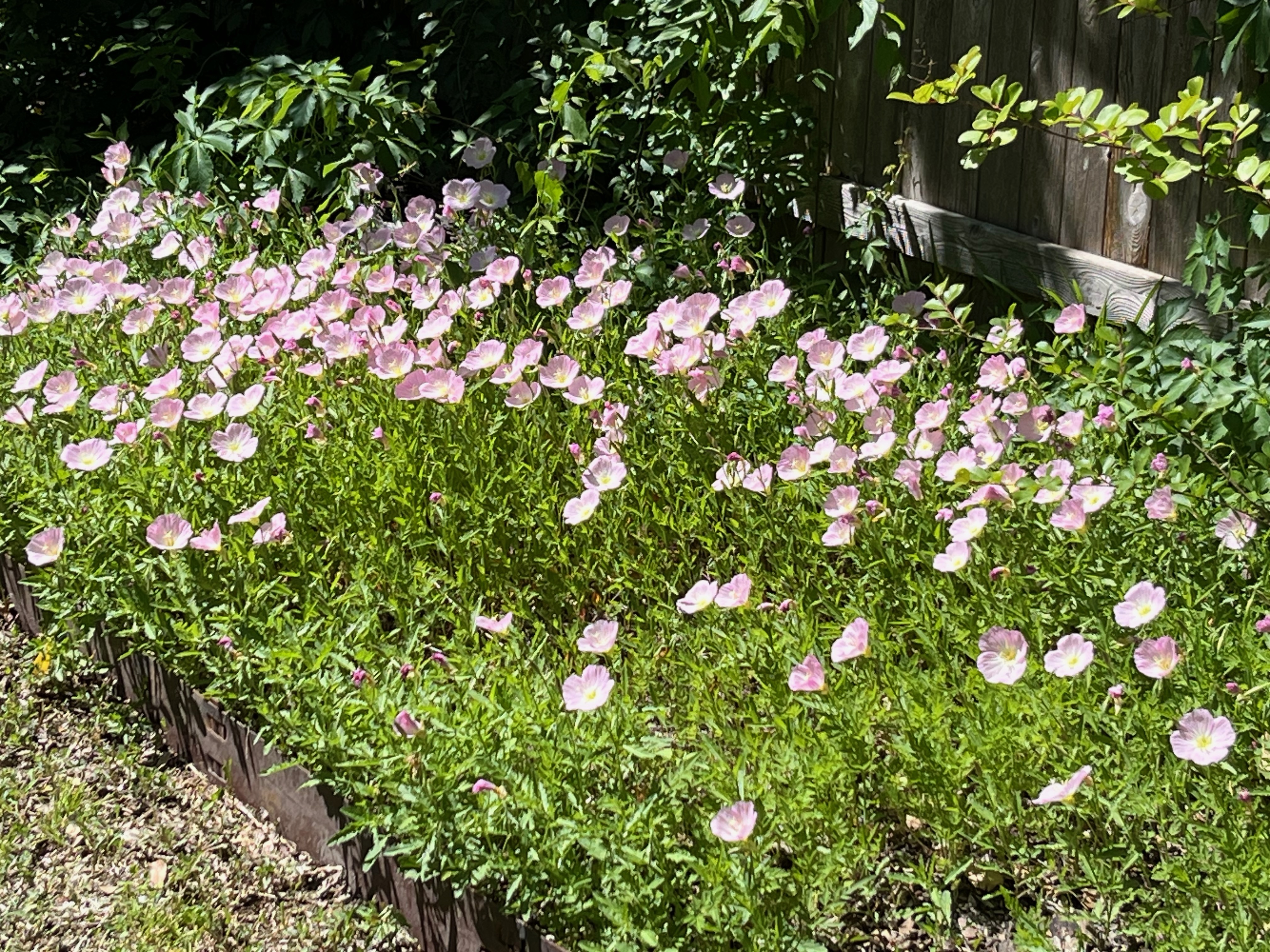
Our greatest success so far is the large patch Texas primroses that has taken over the area on the north side of the house that I used to reserve for tomatoes. Here are a couple of shots that include both (gladioli and primroses--not tomatoes):


I've been nurturing a couple of tiny stands of blue-eyed grass for years, but if I want more, I'm probably going to have to sow seeds, since they're not nearly aggressive enough for my needs. But I do love them. They pop up amidst the myriad "weeds" we foster instead of turf grass, and we mark them before we mow so as to give them a chance to self-sow. 


Visiting wildlife is always welcome here, and we've created many areas that have fostered rabbits and occasional raccoons and opossums. In recent years we've enjoyed regular visits from northern green anoles, which have all been named "Harry" after the lizard in Death In Paradise. Ours are actually Anolis carolinensis, the males of which can change from green to brown, and back again. The photo may be of a female Harry, since I couldn't see a dewlap, but I loved the perch on top of the rebar designed to help support the potted bougainvillea I like to grow each year next to the greenhouse.  (Click to enlarge if you'd like a clearer view.) In past years I've included some of this Harry's ancestors, and caught a couple of his/her progenitors in flagrante delicto--making more little anoles. If I can find the post, I'll link it here; but that's as bawdy as things get here on the Farm--although a past Earth Day post has featured mating kites. Our newest regular visitor is a chubby opossum, who likes the apple cores and other fruit bits we leave out. We've caught her (we think she's the one who once trotted her babies across the front yard hanging onto her rail) on our back-door camera several times.

Which brings me to the best wildlife event of our year so far: the appearance on April 2 of a pair of Yellow Crowned Night Herons in our yard, engaging in artful mating displays and graceful saunterings across pecan the limbs that create a corridor over our yard to next door. The day was cloudy and rather drear, and their features were difficult to capture on our phones (we didn't expect them to be around for long, so we didn't haul out the real camera; lesson now learned). But searches on Cornell's "All About Birds" site (at the link) and Wikipedia gave us a positive identification, so we sat out watching as they moved from tree to tree. They left for a while, but came back later, just before it started getting dark. We never saw them again, and wondered why they were even here, given their preferred diet of crustaceans and coastal locales for year-round living. But we are within their breeding range, and the neighborhood does provide a number of creeks for crawdads and such. Our recently pruned trees may also have offered them room for showing off their pretty crowns and feathers. Sad to say, neither of us could get clear enough shots to use for illustration purposes, and my video-editing skills are abysmal anyway. So it turned out to be one of those occasions for which we will have to rely on our own visual memories to relive.

Speaking of living: News from old friends indicates that we're still managing to survive the current upheaval of democratic institutions around the country. Of course, we're all white, home-owning, educated pensioners with (for now) stable (if not voluminous) incomes. We don't have tattoos that could get us identified as Venezuelan gang members, and I don't think that any of us speak enough Spanish to get us misidentified as border-hopping immigrants. But even if we don't get sent to a Salvadoran prison for what's left of our lives, and even if our woefully inadequate defense department manages not to get us nuked, the equally under-qualified interior department may well land us with an irreparably damaged ecosystem--one that even acquisition of Canada or Greenland would be unable to ameliorate. In all the years of the Cold War spent hiding under desks and practicing air raid drills, it never occurred to me that we might be undone not by hot-war adversaries (although they're still around), but by our own profoundly ignorant, unimaginative, race-obsessed, and  rapacious (in all of its senses) elected leaders: Not with a bang but some kind of "administrative mistake." 

I can't end this without expressing immense sadness at the loss of Pope Francis. As a practicing Cynic/Skeptic, lapsed Catholic, and secular Jew, I appreciate him more than almost any modern leader  because he truly embodied the values he taught, with grace, humor, philosophical rigor, and true charity. As I mentioned to a dear Catholic friend yesterday, we are all richer for his presence, and poorer for his loss. 

So, Folks, have the best Earth Day and spring you can muster, do what you can to protect the planet from the ravages of stupidity, and maybe together we can help stave off apocalypse--at least for now.

Photo notes: As I looked over previous Earth Day posts, I found that the images I have chosen are  often similar--if not downright repetitive. But we've lived on our little half acre for nearly twenty-five years, and it has become a haven of contentment in a problem-infused world. Taking pleasure in small moments provides some respite from all the turmoil underway, and suggests the possibility of better days--kind of like sunlit clouds emerging after a storm, as they did in the opening shot.

Saturday, February 15, 2025

Perhaps Resistance Isn't Really Futile

A North Texas winter sky

Since my last post, I've been experiencing what many like-minded folk have, when practical solutions to current political chaos seem, well, futile. I've often joked that with all of the artificial gadgets that now occupy my body (chief among them an artificial aortic valve--but also stents in old bypass grafts and interocular lenses in both eyes) I'm well on my way to Borghood. The Collective's warning upon meeting any new species is that resistance to assimilation is futile. Try as one might, becoming a fellow cyborg is inescapable. 

Now that this country is in the process of being overwhelmed by the Collective-like apparatus of the fomenters of Project 2025 (including our current president and his minion-in-chief--or is it the other way around?), finding ways to escape the doomsday scenarios that emerge daily seems unlikely, if not (yet) a completely futile effort.

And so, rather than give in to the probably-inevitable cultural and political emergence of true dystopia, and given that most of us (especially fixed-income retirees with ties to hearth, home, and animals) aren't well fitted to actual Revolution, I thought I'd share some of the strategies I've been pursuing to combat utter depression and ease unavoidable anxiety. If you are in a position to actively Do Something (or, as Revrunner advised in a comment after reading my last post, to follow Nancy Pelosi's advice to stop agonizing and start organizing), please do. Please do. Alas, my days of protesting, marching, and sitting in are long behind me, so I have to content myself with sending a few bucks to worthy causes. And--as a few of my loyal readers have advised--keep blogging.

It's probably a very good idea to keep reading, as well, since there are so many wonderful writers and websites and newsletters out there that I keep running across during my weekly exercises in rabbitholery. In terms of actual strategy, here's an idea that's working wonders with my attitude and with keeping my brain from shriveling up and crawling somewhere dark and dank: Re-read the people whose work got you where you are today, intellectually, politically, religiously, or whereverly. For example, I'm currently in the midst of rereading Ursula K. Le Guin's Earthsea works.  Shortly after her death in 2018, I was given the collection of her stories (in the volume at the link). It's a heavy tome, and so I've taken to reading it downstairs in my living-room comfy chair, then continuing with individual volumes upstairs when I go to bed. The troubled universe she describes in the books is disturbingly like ours in its current configuration, minus the mages and magic. But her astonishingly wise take on human frailty--race, gender, economics, art, craft, and the nature of wisdom itself--is both frighteningly prescient and reassuring at the same time. Even though I generally prefer science fiction over fantasy, I have long enjoyed these books and stories. But the science fiction segment of her work explores many of the same themes, which novels such as The Left Hand of Darkness, The Dispossessed, and The Telling consider in equal depth. [Even though I haven't joined their affiliate program, I would urge anyone who wants to buy these books to order from Bookshop.org, or directly from the publishers, rather than to enrich Mr. Bezos more than we have to. Another option: buy them used from a local bookshop.]

I also plan to revisit Octavia Butler's Parable of the Sower, which begins in what was then the "near future" of 2024 (the book was first published in 1993) and in the very LA neighborhoods (Altadena and Pasadena) that have been devastated by the recent fires. Although Butler died in 2006, her legacy has survived in part because of her own prophetic vision--and the diligence with which her readers preserve her work and its messages

In addition to reading, I urge folks to write--to blog, to start a Substack, to send letters to the editors of local newspapers, and to avoid the attention-culture as much as possible. Although I do have an Instagram account, I only use it to follow a few writers and a local prairie gardener. I use Pinterest only as a curatorial tool for myself; I don't engage with anyone on it. I visit Quora less and less, and usually just to answer questions about cookery and being old. I've avoided twitterhood entirely, and see no reason to subscribe even to Bluesky--although if you find such a platform necessary, it's probably the best available choice at the moment. I try to subscribe to media populated only by folks who think and write about what they're thinking, but when I do, I resist requests to follow platform "recommendations." I will shortly be going through my own blog roll to make sure any links are active, relevant, and worthwhile. If you're interested in the cultural can of worms the Attention Economy has dumped on us, try reading Jenny Odell's How to Do Nothing [a web search will turn up videos, workshops, and discussions on the book] or Chris Hayes's The Sirens' Call: How Attention Became the World's Most Endangered Resource. [Again, there's a great deal online about this book, including interviews and Hayse's own podcast.] 

The benefits one can derive from keeping a journal in dark times seem, at the moment, immeasurable. In part because of what I often describe as "sleep-related marble-leaking" I tend to forget things quickly. It does, therefore, help considerably to spend an hour or so several times a week trying to record things that might be needed at some point in the future. My father's deathbed advice to my children was to "write at the end of your stint," which I've taken in earnest during the last decade or so. But don't wait! Do it now! My son will be fifty next year, and although I can plainly remember the jollity with which he posted a sign on my office door (during his brief studenthood at the Art Institute) announcing my own fiftieth birthday, that's just another indication of how quickly it all goes by. And keeping journals (I now have several, on reading/thinking, cookery, gardening, and design ideas) helps organize the brain, provides a creative outlet, and gives you something to do with all the free time you have if you give up futzing around on Tik Tok or Instagram or Facebook. If you need to keep in touch with people, write them letters in email and keep a record of the correspondence. I still have the letters my father and I wrote to each other via email from about 1997 to 2004. I copied them, printed them out, and cherish them to this day. They're like journals, only with more dimensions.

Finally, try a bit of Tikkun Olam--the Jewish practice of finding ways to heal the world. The link is to a page on the Orthodox understanding of the term, and it provides some useful ways to think about taking care of an increasingly endangered planet.  Every little thing we do, especially if multiplied by others, helps to stem the tide of of demise. Keeping even a little garden, providing even a tiny bit of habitat for wild critters, home-keeping, spending time in the out-of-doors, helping neighbors, buying less stuff, driving less, using less energy,  paying attention to the planet--even simply sky-watching. 

We really do need to enjoy what we have while we have it--and to do what we can to keep from losing it. 

Thursday, November 14, 2024

What Now?

Roll clouds over Bad Ass Coffee in McKinney, August 4, 2024
I've been AWOL from The Farm for nearly four months now, trying to figure out what to do if the elections were to go badly for folks of my particular intellectual bent. Since I generally lack optimism and tend to gird myself for the worst in hopes of being pleasantly surprised, I thought I'd be well enough prepared for whatever happened. 

Like most of my fellow travelers, however, I fell into a kind of hopeful state of denial that a large enough plurality of voters could abandon common sense and/or willfully disbelieve the available evidence, and that reason would somehow prevail. And then the reality hit the fan and . . . . well, here we are. The consequences of the cognitively dissonant, counter-intuitive, intellectually and emotionally painful, and, yes, frightening election results are beginning to settle in.

The fact that we have a couple of months of marginally normal life left has numbed this household into a reflective mood, and we are beginning to shore up our inner resources--and a few of our external reserves--into strategies for facing the future in the developing dystopian moment.

So, my question: What now?

Fortunately for me, the gathering gloom brought forth some happy accidents during the last couple of months, and I discovered some interesting newsletters that kept me from doomscrolling through Quora, and gave me some rabbit holes to fall into and explore, and allowed me to enjoy the serendipity of found objects. In this case, the "objects" were really writers whose interests coincided with mine and practically coerced me into beginning to think sideways onto more productive paths. What's best about these folks is that after November 6th, they began channeling their grief and disappointment into productive avenues of creativity and philosophical engagement. So, in hopes that the folks who read this blog will not be surprised at my angst, and will probably commiserate in some measure, I decided to share some of these recent discoveries that might appeal to you as much as they have to me. I should note that everybody listed here offers ad-free content supported by subscriptions; some offer limited free access, but I urge you to subscribe if you can. 

Austin Kleon. Two or three months ago, I was idling through my Pinterest feed and came upon a compelling photo of a notebook that led me to its owner, the author of a book I wish I had known about when I was still teaching: Steal Like An Artist: 10 Things Nobody Told You About Being Creative. As some of you already know (especially if you were one of my students), I am not generally fond of what could be called "self-help" books, but this little (about 6" square, 1/2" thick) tome-ette is a charmer. And it's helpful. Especially if you're in a crappy mood and can't seem to get anything accomplished. I liked it so much that I subscribed to his Substack (see the initial link), and then bought Keep Going: 10 Ways to Stay Creative in Good Times and Bad, which seems consummately appropriate for this moment in world history. I'm now such a fan-girl that I eagerly await the newsletters I get twice a week, and they often set the tone for the morning. Last week's "Don't let your dreams give up on you" collage/post kept me going all day. 

Jason Kottke is a long-time blogger who's really good at connecting folks to other folks via links and commentary on his site. I subscribed to his newsletters, too, and am treated twice a week to intriguing, thought-provoking, beautiful, funny, entertaining, inspiring, and (I could go on, and on) other engaging stuff. He also introduced me to

Matt Pearce, the journalist who got me out of my snit about the Washington Post. When Jeff Bezos prohibited the WaPo's editorial board from endorsing Kamala Harris for President, I cancelled my digital subscription (which would have expired on the 11th anyway). Pearce, however, in a thoughtful essay, "Journalism's fight for survival in a postliterate democracy," convinced me that losing my piddly little 170USD per year subscription wasn't going to hurt Bezos one small bit (especially since I can't really afford to give up Amazon Prime from whence I feed my addiction to French murder procedurals), but the collective effect of losing all those pissed-off readers like me would seriously impact journalists. As the daughter of a foreign correspondent, I know how that could hurt. Anyway, it would also be a good idea to read the essay Alex Wagner interviewed Pearce about on MSNBC, "Lessons on media policy at the slaughter-bench of history: Contemplating the purpose of the press after the Trump revolution." I'm still reading him for free, but only until my Social Security check comes in. One note, though: I am no longer buying books through Amazon, and I urge you to tame your instant gratification urges and start buying from Bookshop.org instead. Yes you pay shipping, and yes it takes a little longer. But some of your money goes to an independent bookstore of your choice, and you'll be a better person.

I've got more of these, and a recent visit from two former students has convinced me that I need to get back to working diligently on the Farm. As Rachel Maddow has said (and Austin Kleon, and many others), it's time to do something. Since this is practically the only something I do, I guess I'd best get to it.

Image note: I thought that an ominous cloud formation might be an appropriate illustration for the topic. I took this photo at the end of a storm after consuming a terrific cup of Kona coffee.

Monday, July 22, 2024

Slouching Toward Gilead


Because nearly every day recently has contained elements that seem to portend the beginning of the end of rational life on earth, I've been reading more than my usual quota of science fiction. So, while I was looking for something to use as a banner for this post, I came across this wonderful diagram of The History of Science Fiction by Steve Jurvetson on Wikimedia Commons*, and I think I've managed to link to a high-res version (which is the only possible way to use it without getting a headache). Although as an infographic it's a bit difficult to follow, Jurvetson's connections among different genres and media throughout history (from Gilgamesh to now) offer a really useful way of following what I've come to think of as the literary genre with the longest history of all. 

Imagining different worlds and universes seems to characterize major shifts in historical events, ways of thinking, and--eventually--life, the universe, and everything.** Among the stories I've always loved best, even though I've been pretty much a free-range reader, have been those attempts to imagine what we could become at moments where what are becoming seems to be particularly problematic. Only recently I'd plowed through all three of Cixin Liu's Three Body Problem novels (and watched both television renditions) and was left longing for something that would restore my persistent suspicion that things might just turn out okay in the end.

I often return to Ursula K. Le Guin's early stories that feature striking contrasts between fairly simple economies (like the Kesh in Always Coming Home, or Falk's rescuers in City of Illusions) and their antagonists (the Condor People and the Shing), or that follow emerging connections during contacts between indigenous peoples and explorers (such as natives and ethnologists or colonists; I think the best of these, and the most relevant to the present is The Telling). But Le Guin tempers utopian leanings with realistic assessments of the things that get in the way: greed, power-hunger, fear/hatred of the other.

Living through the current election cycle seems more and more like being ensnared in an ill-conceived saga about people who yearn for a past that never really existed, others who have a better idea of what is actually going on but are powerless to effect any kind of meaningful change, and a much larger population of those who would rather not think about it at all.

So, I keep reading. Rather recently I discovered Robin Sloan's Mr. Penumbra's 24 Hour Bookstore and its companion (within the Penumbraverse) Sourdough. As often happens to me, at just about the time I'd finished both, Sloan's newest entry into his 'verse came out: Moonbound. I pre-ordered it and devoured it upon arrival. None of these books is actually science fiction as usually defined or experienced by folks like me. Instead they're variations on a magical-realistic view of the present (the first two), and a fantasy adventure that riffs off most of the stories/tropes that belong to boomers, gen-exers, and their descendants: C. S. Lewis, Tolkien, Harry Potter, Dungeons and Dragons, and a lot more I'm not even tangentially familiar with. Sloan's worlds are amusing, smart, with-it (I think; since I'm not, I'm not really sure what that means--but they seem particularly attuned to my children's generation), and engaging, even for old Luddite farts like me who fell out of the gaming world when she couldn't make it through Myst. [Note: I'm leaving the sourcing up to interested readers, since everyone seems to harbor preferences as to booksellers and critical resources. Searches can lead to beneficial excursions through accidental rabbit holes, so have fun.]

Another new favorite is Becky Chambers, whose Robot and Monk books, A Psalm for the Wild-Built and A Prayer for the Crown-Shy are much better, and far more healthful, than drinking too much wine in order to make it through the current epoch. They're both gentle, sanguine, philosophically sound, and way too short (not really; each one is exactly as long as it needs to be--but I want more). Her niche in contemporary SF has been called "hope punk" which seems rather appropriate.  I can't remember how I found out about them, but will search back through last year's journal to see where they first come up so I can thank whoever's responsible. When I'd finished them (twice), I read her earlier Wayfarer series (A Long Way to a Small, Angry Planet, A Closed and Common Orbit, Record of a Spaceborn Few, and The Galaxy, and the Ground Within), and a stand-alone novella, To Be Taught, if Fortunate.  Twice, each. In the Robot and Monk books, dystopia has been bypassed (the robots give up on humanity and left town for the wilderness). In the Wayfarer series, dystopia still beckons among some species, but the crew of Wayfarer and their friends are making their way(s) toward a more harmonious universe. If this intrigues you at all, see this essay in Wired by Jason Kehe: "Is Becky Chambers the Ultimate Hope for Science Fiction?"

So, while this country seems bent on making at least some aspects of contemporary dystopic film and fiction (like The Handmaid's Tale, Mad Max, and various warnings about the coming Singularity) come into being, I'm revisiting William Morris and Le Guin

But in case you haven't had enough of dystopia (or if you're bingeing the stuff I never read or watched, like The Hunger Games and such) here's a classic, which everybody needs to read: 

In 1909, E. M. Forster published his short story, "The Machine Stops" in the Oxford and Cambridge Review. It's available at the link in .pdf  (thanks to retiring U. C. Davis professor Phillip Rogaway; I'm not sure how long this text or his web page will be available after the end of the month). I used this story in my Technology And Utopia classes both at UTD and the Art Institute, and my students found its prescience striking--even before the F-book and its ilk had taken over our own world. 

But I'm not going to end on a completely sour note. My bedtime reading (after my third time through Le Guin's The Telling) is currently Andy Weir's latest novel, Project Hail Mary. . . .

[Several days later]

I started working on this post on or about the Ides of July, when things had started looking quite ominous. Since then, and since my last little bit of input, things have changed and a modicum of sanguinity has returned (that's "sanguine" in the sense of "optimistic" rather than "bloody"). We'll still have to wait to see how things turn out, but the prognosis is somewhat more promising than in recent weeks.

That said, I've now finished Project Hail Mary, and I don't remember having quite so much fun reading a book about the probable demise of Mother Earth. A mild spoiler: Earth seems to have survived, thanks to the efforts of Ryland Grace and his buddy Rocky. Weir once again has his characters "science the shit out of" every problem that erupts (actually, many, many problems) just as Mark Watney does in The Martian. I'm sure the biophysicists (?) and other sciency types who read the book (or see the film, due out next year, with Ryan Gosling as Grace) will find numerous flaws, but I'm more than willing to suspend whatever disbelief arises because the whole thing is poignant, smart, quirky, amusing, and very much fun. I can't wait to see how the film crew manages to pull this one off!

Good science fiction is really no different from good fiction of any other genre, as long as the writer can build an engaging world, create believable and compelling characters, and deal with issues important to human being-in-the-world. Once upon a time, in a world long past, I was asked "where have all the philosophers gone?" I rather flippantly answered that they'd all run off to write science fiction. As it turns out, though, the tendency of SF writers to engage questions of philosophical importance, deal with cultural conundrums, and explore the meaning(s) of sentience and consciousness by posing interesting questions and conducting thought experiments along the way makes my answer from about 1980 practically spot-on today. 

Any of the writers I've mentioned in this post are well worth reading. So, if you're looking for a beach read, or just something smart to take your mind off current events, have a go. As I mentioned above, I haven't linked everything, but using the google machine can often lead you along interesting paths, so I decided to leave the door open for serendipity.

Enjoy the rest of the summer, and try to stay cool.


*Steve Jurvetson's Flickr page is here. My finding this image also led me down a rabbit hole--this guy is really interesting.
**Thanks, of course, to Douglas Adams. 

Monday, April 22, 2024

Earth Day 2024: Rewilding in the 'Burbs

A recent purchase from Red Bubble; the Totoro decal is older.

Like my Beloved Spouse (who was born in Pittsburg, but lived in San Antonio for most of his life before college), I have spent a substantial portion of my own life as an exile in a place I never actively chose. Both of us were Air Force brats who followed where our fathers were assigned. When we met in grad school in the '80s, we bonded over not wanting to live Texas. Except for a two year hiatus in Chicago (where we were married), however, we've been living in the Dallas area for over thirty years. We didn't really mind Dallas so much, because we had enjoyed city life in Chicago. But the city was hell-bent on razing small historic houses to build oversized mansionettes that dwarfed the homes in old neighborhoods. The competition for the lots (not the houses) was so fierce that we had to look elsewhere to find what we wanted: a Craftsman style bungalow with a big enough yard for dogs and a garden. When we were both finally employed in full-time teaching jobs, we bought a house north of Dallas, in a then-sleepy, quiet, historic district in a then-smallish town about 25 minutes up the then-four-lane highway out of Dallas's growing disregard for little old bungalows. 

We moved to McKinney in 2001, a year short of the house's 100th birthday, and have spent the years since fixing up the old girl (but not transforming her), repairing some early "updates," and resisting the latest "trends." The only major refurbishment occurred about fifteen years ago, when we had the aluminum siding removed and replaced with hardy-board (proper wood siding cost more than the house was worth), got some of the plumbing redone, had a not-insignificant amount of sheetrock and sagging beaverboard removed, and had it repainted in appropriate Arts and Crafts colors. But most of the work we've done has involved the garden--especially the back 1/4 acre.

Over the last few years, especially after we both retired (2016 for me, 2018 for him), we've built a drive-through parking space for our caravan, Porco Rosso, and have added two brick patios, a greenhouse, and several "garden rooms," as William Morris called them: areas for enjoying the fruits of our labors, entertaining friends, and simply enjoying what we've wrought, along with our various animal companions--both dogs and cats. There's a nice area outside of the greenhouse (an aspiring Wunderkammer) with an umbrella table and chairs, a seating area just outside the study with room for another small table and chairs (plans are to build a pergola for growing grapes), and another area for eating and entertaining that includes a larger table (built by The Beloved Spouse his ownself) and umbrella, with an adjacent firepit area with Adirondack chairs and benches. 

The raised bed next to the greenhouse and perennial patch.

The back-door patio (at the beginning of the eclipse).

Big table with Firepit behind.

The wilding shade garden.

Recent work on some of the eight pecan trees located in the back yard (there are four more in the front and side yards), and the felling of a well-loved, but barely-alive Chinaberry left us with a significant amount of trunk and branch slices to use for our wood-burner and as borders for the several areas we've been allowing to go as wild as we can get away with. The upcoming annual Continental philosophy soiree we host has inspired us to complete one or two new areas: a potential shade garden in the northwest corner, and a pollinator garden on the south-and-east side of the front yard.

None of this is, of course, very "wild." In fact, although most of it tends to look pretty rustic, it can't be let go completely, or the townsfolk would come after us with axes and summonses. One small corner next to our garage (and adjacent to recently tidied wood piles and our two large compost bins) is  the one exception. A few years ago, I tried to build a hĂŒgelkultur berm, but before I could finish what I'd started, health issues intervened, and nature pretty much took over. I'm in the process of taming it a little, but the berm has been used to foster mulching and more-or-less accidental composting with the result that we've provided some good habitat for critters. The fence on two sides also hosts honeysuckle a volunteer spirea--both in full, fragrant bloom at the moment. We've seen bunnies, cotton rats, and evidence of continuing raccoon and 'possum visits. There's a fox nearby as well, and he seems to have found is way through the hog-wire fence--probably to look for bunny chow.

About all the sky I can manage for this Skywatch Friday
Too many trees!

So: not so wild, in fact. But one thing the garden has going for it is the absence of chemical fertilizers or pesticides: completely organic for as long as we've lived here. Some of the mulch from the biennial tree-trimming has replaced some of the inappropriate St. Augustine grass in front, and the rest of the "lawn" is gradually being replaced by a mixture of seasonal treats like cleavers (goose-grass), chickweed, henbit, plantain, dandelions, and various other "weeds" that most people pay other people to spray herbicides on. At our house, we eat these treasures, make tea and pesto out of them (chickweed pesto is every bit as tasty as that made from basil--although we grow basil as well). Volunteer flowering plants like mullein (which my cousin Charlie says is good for what ails me), and Byzantine Gladiolus have graced the garden for many years now, and I'm hoping to add goodies like Borage and Hyssop that I love but will have to plant.

The four-lane highway is now ten lanes wide at the exits, and the quietude has already suffered from that. But now the city has contracted to build a 20,000 seat open air arena ("entertainment venue") almost adjacent to the local hospital/trauma center ten minutes away from our house. The mayor is trying his damnedest to get us to pay for an international airport just east of the historic downtown area, which itself is in walking distance from us. We defeated the proposal last year, but he's still trying. 

Despite all this potential tsuris, we still waffle about moving west. Politically, this area couldn't get much worse, but environmentally the prospects aren't particularly promising. But neither are they in high-desert regions of California, where we'd most like to settle. So the current plans (but don't blink) are to soldier on here, visiting some of the glorious Texas State Parks, and in September (or maybe the following May) try to make at least one more long-distance sojourn west. 

In the meantime, our semi-wild half acre provides the perfect balm for soothing our aggravated souls, and I hope it can see us through the continuing political circus that would be hilarious, if it weren't so rife with unsavory and environment-threatening possibilities. Depending on how the summer goes, we could use that westbound road trip for house-hunting.

At this particular moment of the anthropocene, we seem to be sitting at a nexus. Many possibilities exist, some much more disagreeable than others. So here's some recommended reading: Kim Stanley Robinson, The Ministry for the Future; Cixin Liu, The Three-Body Problem (all three volumes, including The Dark Forest and Death's End)*; and Becky Chambers, the Monk & Robot series (A Psalm for the Wild-Built and A Prayer for the Crown-Shy). 

Happy Earth Day, people. It will be interesting to see how things stand next year at this time.

*Note: I'm currently re-reading the three Liu books, after having watched both the Chinese version (Three-Body, streaming on Peacock) and the Netflix version (3 Body Problem). The Beloved Spouse has not read the books, so the experience is quite different for each of us. Both series are well-filmed, acted, directed, and visualized, but the Chinese version is far closer to Liu's original. The Netflix version is problematic because for those who have read the books, the changes to plot and characters can be jarring and confusing. So read the books first, and then watch the films, but be prepared to take notes. All three versions add interesting perspectives to our continuing conversations about climate change and technology--and the future of humankind.