Showing posts with label science fiction. Show all posts

Monday, July 22, 2024

Slouching Toward Gilead


Because nearly every day recently has contained elements that seem to portend the beginning of the end of rational life on earth, I've been reading more than my usual quota of science fiction. So, while I was looking for something to use as a banner for this post, I came across this wonderful diagram of The History of Science Fiction by Steve Jurvetson on Wikimedia Commons*, and I think I've managed to link to a high-res version (which is the only possible way to use it without getting a headache). Although as an infographic it's a bit difficult to follow, Jurvetson's connections among different genres and media throughout history (from Gilgamesh to now) offer a really useful way of following what I've come to think of as the literary genre with the longest history of all. 

Imagining different worlds and universes seems to characterize major shifts in historical events, ways of thinking, and--eventually--life, the universe, and everything.** Among the stories I've always loved best, even though I've been pretty much a free-range reader, have been those attempts to imagine what we could become at moments where what are becoming seems to be particularly problematic. Only recently I'd plowed through all three of Cixin Liu's Three Body Problem novels (and watched both television renditions) and was left longing for something that would restore my persistent suspicion that things might just turn out okay in the end.

I often return to Ursula K. Le Guin's early stories that feature striking contrasts between fairly simple economies (like the Kesh in Always Coming Home, or Falk's rescuers in City of Illusions) and their antagonists (the Condor People and the Shing), or that follow emerging connections during contacts between indigenous peoples and explorers (such as natives and ethnologists or colonists; I think the best of these, and the most relevant to the present is The Telling). But Le Guin tempers utopian leanings with realistic assessments of the things that get in the way: greed, power-hunger, fear/hatred of the other.

Living through the current election cycle seems more and more like being ensnared in an ill-conceived saga about people who yearn for a past that never really existed, others who have a better idea of what is actually going on but are powerless to effect any kind of meaningful change, and a much larger population of those who would rather not think about it at all.

So, I keep reading. Rather recently I discovered Robin Sloan's Mr. Penumbra's 24 Hour Bookstore and its companion (within the Penumbraverse) Sourdough. As often happens to me, at just about the time I'd finished both, Sloan's newest entry into his 'verse came out: Moonbound. I pre-ordered it and devoured it upon arrival. None of these books is actually science fiction as usually defined or experienced by folks like me. Instead they're variations on a magical-realistic view of the present (the first two), and a fantasy adventure that riffs off most of the stories/tropes that belong to boomers, gen-exers, and their descendants: C. S. Lewis, Tolkien, Harry Potter, Dungeons and Dragons, and a lot more I'm not even tangentially familiar with. Sloan's worlds are amusing, smart, with-it (I think; since I'm not, I'm not really sure what that means--but they seem particularly attuned to my children's generation), and engaging, even for old Luddite farts like me who fell out of the gaming world when she couldn't make it through Myst. [Note: I'm leaving the sourcing up to interested readers, since everyone seems to harbor preferences as to booksellers and critical resources. Searches can lead to beneficial excursions through accidental rabbit holes, so have fun.]

Another new favorite is Becky Chambers, whose Robot and Monk books, A Psalm for the Wild-Built and A Prayer for the Crown-Shy are much better, and far more healthful, than drinking too much wine in order to make it through the current epoch. They're both gentle, sanguine, philosophically sound, and way too short (not really; each one is exactly as long as it needs to be--but I want more). Her niche in contemporary SF has been called "hope punk" which seems rather appropriate.  I can't remember how I found out about them, but will search back through last year's journal to see where they first come up so I can thank whoever's responsible. When I'd finished them (twice), I read her earlier Wayfarer series (A Long Way to a Small, Angry Planet, A Closed and Common Orbit, Record of a Spaceborn Few, and The Galaxy, and the Ground Within), and a stand-alone novella, To Be Taught, if Fortunate.  Twice, each. In the Robot and Monk books, dystopia has been bypassed (the robots give up on humanity and left town for the wilderness). In the Wayfarer series, dystopia still beckons among some species, but the crew of Wayfarer and their friends are making their way(s) toward a more harmonious universe. If this intrigues you at all, see this essay in Wired by Jason Kehe: "Is Becky Chambers the Ultimate Hope for Science Fiction?"

So, while this country seems bent on making at least some aspects of contemporary dystopic film and fiction (like The Handmaid's Tale, Mad Max, and various warnings about the coming Singularity) come into being, I'm revisiting William Morris and Le Guin. 

But in case you haven't had enough of dystopia (or if you're bingeing the stuff I never read or watched, like The Hunger Games and such) here's a classic, which everybody needs to read: 

In 1909, E. M. Forster published his short story, "The Machine Stops" in the Oxford and Cambridge Review. It's available at the link in .pdf  (thanks to retiring U. C. Davis professor Phillip Rogaway; I'm not sure how long this text or his web page will be available after the end of the month). I used this story in my Technology And Utopia classes both at UTD and the Art Institute, and my students found its prescience striking--even before the F-book and its ilk had taken over our own world. 

But I'm not going to end on a completely sour note. My bedtime reading (after my third time through Le Guin's The Telling) is currently Andy Weir's latest novel, Project Hail Mary. . . .

[Several days later]

I started working on this post on or about the Ides of July, when things had started looking quite ominous. Since then, and since my last little bit of input, things have changed and a modicum of sanguinity has returned (that's "sanguine" in the sense of "optimistic" rather than "bloody"). We'll still have to wait to see how things turn out, but the prognosis is somewhat more promising than in recent weeks.

That said, I've now finished Project Hail Mary, and I don't remember having quite so much fun reading a book about the probable demise of Mother Earth. A mild spoiler: Earth seems to have survived, thanks to the efforts of Ryland Grace and his buddy Rocky. Weir once again has his characters "science the shit out of" every problem that erupts (actually, many, many problems) just as Mark Watney does in The Martian. I'm sure the biophysicists (?) and other sciency types who read the book (or see the film, due out next year, with Ryan Gosling as Grace) will find numerous flaws, but I'm more than willing to suspend whatever disbelief arises because the whole thing is poignant, smart, quirky, amusing, and very much fun. I can't wait to see how the film crew manages to pull this one off!

Good science fiction is really no different from good fiction of any other genre, as long as the writer can build an engaging world, create believable and compelling characters, and deal with issues important to human being-in-the-world. Once upon a time, in a world long past, I was asked "where have all the philosophers gone?" I rather flippantly answered that they'd all run off to write science fiction. As it turns out, though, the tendency of SF writers to engage questions of philosophical importance, deal with cultural conundrums, and explore the meaning(s) of sentience and consciousness by posing interesting questions and conducting thought experiments along the way makes my answer from about 1980 practically spot-on today. 

Any of the writers I've mentioned in this post are well worth reading. So, if you're looking for a beach read, or just something smart to take your mind off current events, have a go. As I mentioned above, I haven't linked everything, but using the google machine can often lead you along interesting paths, so I decided to leave the door open for serendipity.

Enjoy the rest of the summer, and try to stay cool.


*Steve Jurvetson's Flickr page is here. My finding this image also led me down a rabbit hole--this guy is really interesting.
**Thanks, of course, to Douglas Adams. 

Tuesday, August 30, 2016

News From Out There


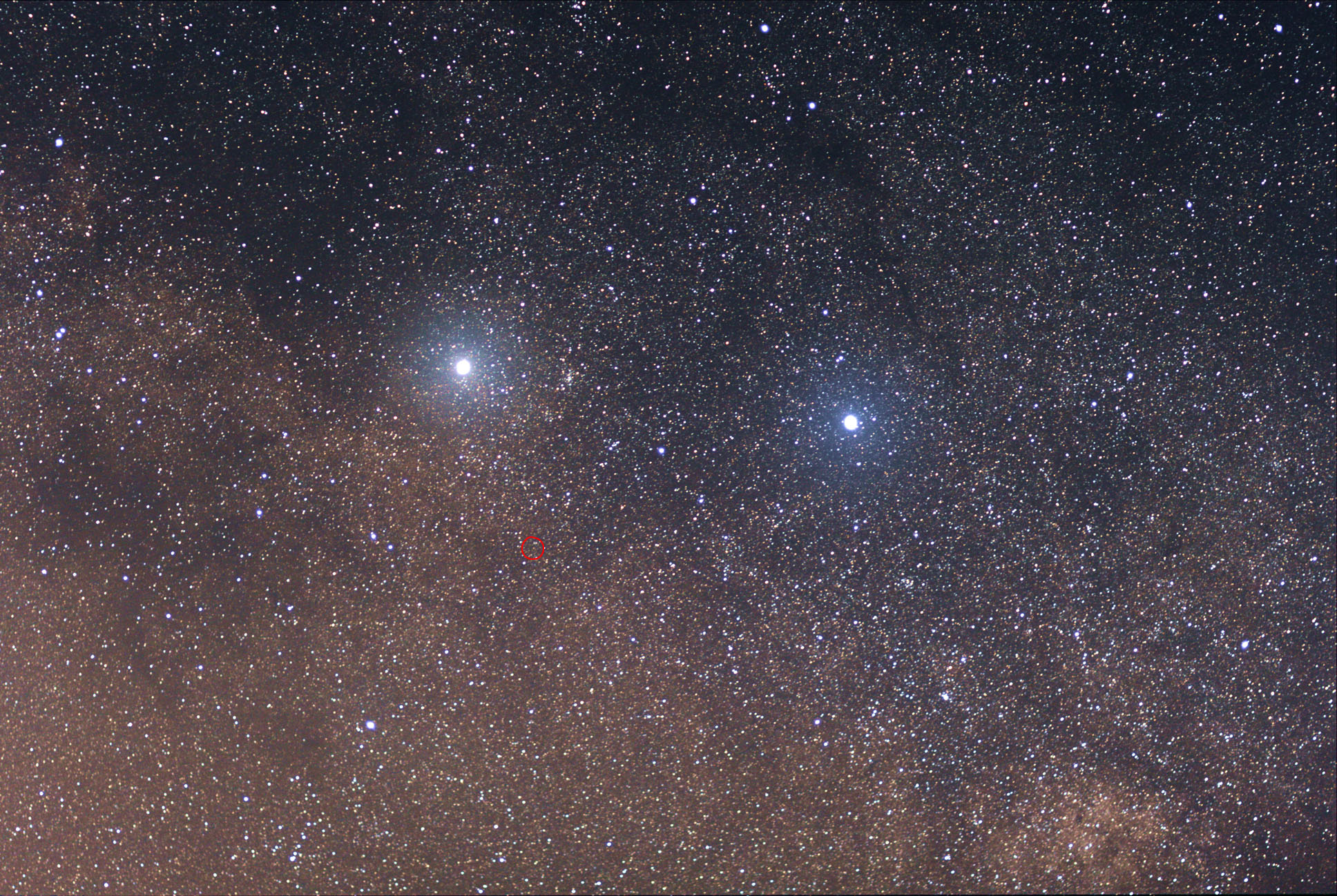
 Relative sizes and distances of Alpha/Proxima Centuari stars from the sun
For as long as I could, I resisted the temptation to jump on the Proxima b bandwagon and start waxing poetical about habitable planets in light of recent news. A week or so isn't really all that long, but given the alignment of heavenly bodies in my particular cosmos, that's probably long enough. I could not, however, resist at all the inclusion of the rather wonderful artist's interpretation of what the planet might look like, even though it means noting the European Southern Observatory's requirement to credit ESO/Kornmesser as the source:


One reason I felt compelled to mark this moment is that twenty years ago I discovered a terrific novel about Jesuits in space by Mary Doria Russell: The Sparrow, which takes place on a planet called Rakhat in the Alpha Centauri system. (For Russell's take on the coincidence, see this article on her website.) The book, and its sequel, Children of God, was the first thing that came to mind when I heard about the discovery of Proxima b.

The little red circle under the star on the left marks the location
of Proxima Centauri in relation to the other two. 

As if to punctuate this coincidence, my bi-weekly pilgrimage to Half Price Books netted a novel by Stephen Baxter called Proxima (2013), and then New Scientist featured a cover story on the discovery on 27 August. I'm still wandering around on Green Mars (I'm rereading Kim Stanley Robinson's trilogy because I can't really remember much about it), so I haven't had time to get into the Baxter book. Quite frankly Baxter's been knocking novels out so quickly that I can't keep up. I've got two or three others on my shelves that I haven't even looked at. At any rate, it now goes to the top of the heap under Blue Mars. (For movies that have used the Alpha Centauri region as a remote--ahem--location see this post on the Discover magazine blog, Dbrief: Alpha Centauri, The Hollywood Star System.)

And then there's the new Coursera MOOC I started a month ago, "Imagining Other Earths" taught by Dr. David Spergel out of Princeton's astronomy department. This one's twenty-four weeks long and is described in its blurb thus: "Are we alone? This course introduces core concepts in astronomy, biology, and planetary science that enable the student to speculate scientifically about this profound question and invent their own solar systems" (the grammar isn't mine). I thought it would be a good idea to get better at the science if I'm going to keep working on stories about old bats in space. So far I've learned tons, and it's helping me keep my invented planets straight.

Then, as if all that weren't enough, a message comes through the SETI board to look out for media blather about a "Candidate SETI SIGNAL DETECTED by Russians from star HD 164595 by virtue of RATAN-600 radio telescope." The board moderator/SETI project scientist Eric Korpela poked a hole in that balloon, noting that "of course, it's been announced to the media" and that reporters "won't have the background to know it's not interesting." So even though folks are looking at it, it's not coming from the constellation Centaurus, and thus it's probably not worth calling up the Father General of the Society of Jesus to see if he can arrange to buy a hollowed out asteroid to use to mount an expedition.

Good thing, too, since humans would probably screw it up.

As expected, however, my science fiction feeds on Flipboard were full of announcements about "interesting" signals, and I imagine that the less skeptical among space-fans will be glued to the interwebs for a while. Meanwhile, there's more substantial fare available at The Pale Red Dot, and a nice article on EarthSky by Larry Sessions on the composition of the Alpha Centauri system.

I do so love this stuff.

The reason I enjoy this sort of thing quite as much as I do is because "outer space" is the ultimate "nowhere"--the ou (no) topos (place), with the potential to be the eu (good) topos. When Thomas More made this marvelous pun in the sixteenth century, he tapped into a human longing that goes back to ideas of Eden in the Judaeo-christian tradition, or of a golden age imagined in classical antiquity. Nowadays, of course, modern technology invites us to look for "nowheres" that at one time would have been inconceivable except as fantasy. Most of us with any science background at all know that living on other planets still belongs in the realm of fantasy, but every little frisson of hope implied by a nearby habitable planet (or even a more habitable moon or Mars) where we could do a better job of living with each other than we do now is potential nectar to the hopeful. And I think hope really is the underlying impulse among utopians.

Especially now, when we increasingly seem to be on the verge of dystopia, at the hands of the greedy, the willfully ignorant, the misguided, the bigoted, the fanatic, the atavistic--essentially all of the enemies of ideals like tolerance, wisdom, and justice that utopias are built on.

Of course, even in fictional "noplaces," things don't always turn out well. It almost seems that whenever we try to imagine something better, the reality of who we are and have been creeps in and muddles things up.

And still we dream on. I'm not sure what all that dreaming means, but it does keep me from falling on my sword, and provides me with a reason to get up every morning, take the dog for a walk, and get back to the business of wondering what it would take to actually make things work.

Image credits: "Pale Red Dot" (J. Mencisom) and Alpha Centauri region image (Guy Vandegrift) from Wikimedia Commons. "Artist's Impression of the planet orbiting Proxima Centauri" ESO/M.Kornmesser, originally found on Wikimedia Commons.

Wednesday, September 2, 2015

The Carrington Event


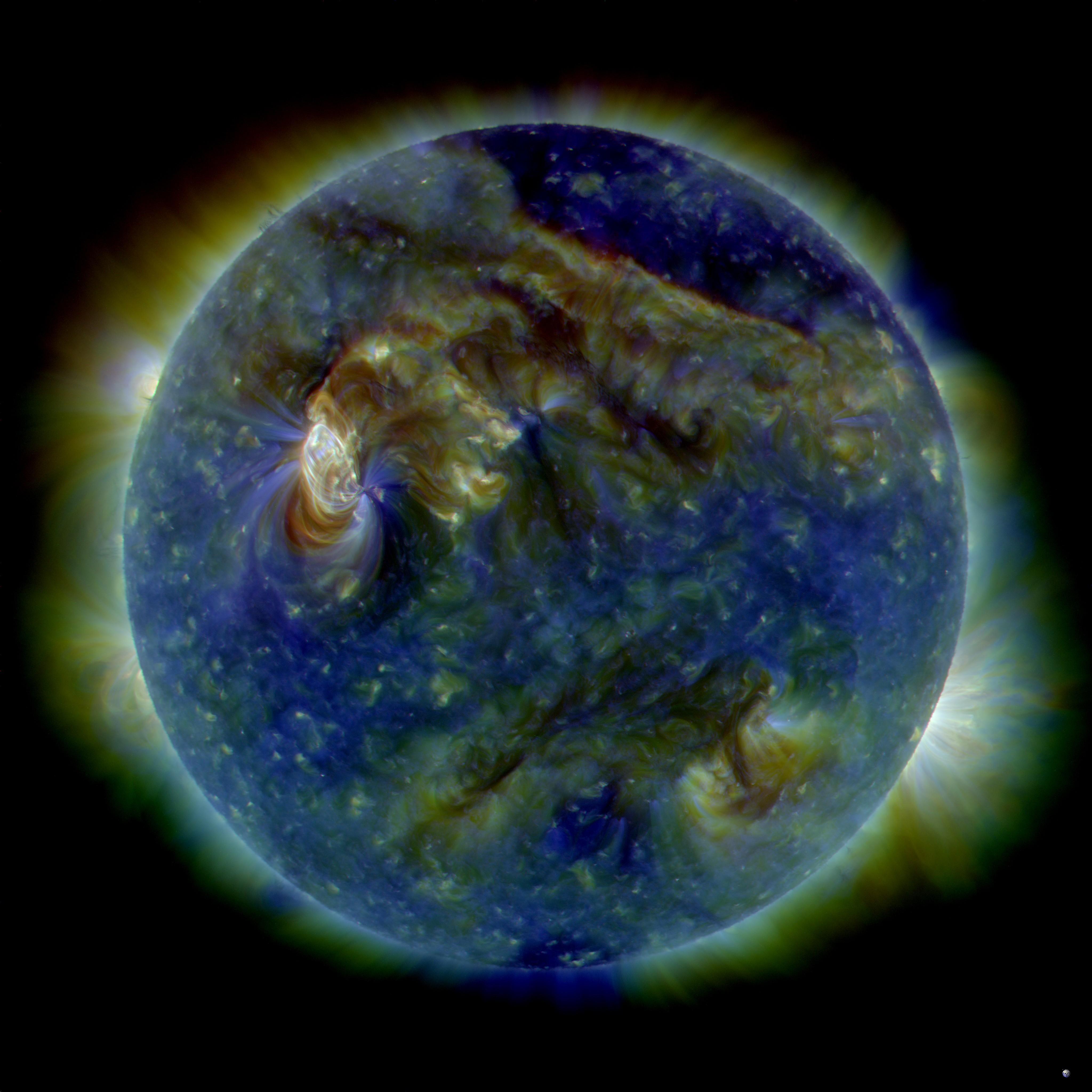
One of my favorite science fiction scenarios is the production of an EMP (electromagnetic pulse) that wipes out our digital technologies and transforms society as we know it.  I first learned about this phenomenon many moons back in connection with the Carrington Event which occurred on this day 156 years ago and caused all manner of discombobulation around the globe. I was reminded of it this morning through Spaceweather, which celebrated the anniversary by pointing out that we had only just escaped an equally devastating CME (coronal mass ejection) in July of 2012. The eruption was massive--apparently as strong as the 1859 event, but missed us. What it did, however, was remind us (according to the Spaceweather article) "that extreme space weather is not a thing of the past."

Richard Carrington was by all accounts a wizbang astronomer, and on that fateful day was busy drawing the sunspots he was observing in his private lab. As he watched, the spots coalesced and disappeared--but only after erupting into "a white-light solar flare--a magnetic explosion on the sun." (NASA Science News)

The NASA article also describes the aftermath:

Just before dawn the next day, skies all over planet Earth erupted in red, green, and purple auroras so brilliant that newspapers could be read as easily as in daylight. Indeed, stunning auroras pulsated even at near tropical latitudes over Cuba, the Bahamas, Jamaica, El Salvador, and Hawaii. 

 Even more disconcerting, telegraph systems worldwide went haywire. Spark discharges shocked telegraph operators and set the telegraph paper on fire. Even when telegraphers disconnected the batteries powering the lines, aurora-induced electric currents in the wires still allowed messages to be transmitted. 

The article goes on to reassure us that flares of this magnitude seem to be rare, but also notes that our current electronic technologies are all at risk--as are our satellites and astronauts (if they're doing EVA when it occurs). This is where the science fiction fodder comes in, because although world-wide space agencies are busy studying flares, Spaceweather notes that a Carrington-grade flare could effect damage on the order of a trillion dollars worth "and require four to ten years for complete recovery." I should note here that CMEs and solar flares aren't the same thing, but often occur together (Christensen). The July 2012 event, in fact, began with a flare that was followed by a CME (Anthony).

Nor, as I've only recently discovered, are EMPs and CMEs the same thing. EMPs can be manufactured, and the effects of a CME are in some ways like those of an EMP, but there seems to be a great deal of controversy on the interwebs about which would cause what. 

What this teaches me is that if I want to use these kinds of events as a backdrop to a story (as I actually already have, but the story isn't about the science; it's about the people and what they do to survive, which could happen in any number of scenarios), I need to bone up on both.

At any rate, there seem to be a number of books/movies/stories already out there, which gives me more stuff to read (if any of it's any good; one promising book is by Roger Zelazy and Thomas T. Thomas, Flare, from 1992). And of course there are all those Prepper websites that I've already run across in my real estate porn forays into Land For Sale In Montana.

Anyway, happy Carrington Day. And remember to sign up for Spaceweather (especially if you live in Montana and points north; they notify folks about auroras). Also, read the cited articles, both with more information and quite interesting.

Sources:

Anthony, Sebastian. "The Solar Storm of 2012 That Almost Sent Us Back to a Post-apocalyptic Stone Age." 24 July 2014. ExtremeTech. Ziff Davis, L.L.C. Web. 02 Sept. 2015.
"August 2010 CME SDO Multi-Wavelength." Multiple contributors. Wikimedia Commons. (There are multiple CME images in the Commons, but this was the prettiest.

Christensen, Bill. "Shock to the (Solar) System: Coronal Mass Ejection Tracked to Saturn." 05 Nov. 2004. Space.com. Purch. Web. 2 Sept. 2015.


Wednesday, October 1, 2014

Coming of Age in the Twenty-first Century


Early on, in my misspent youth, I aspired to be both good-looking and smart. So I read Vogue magazine when I could afford it, looking for interesting ways to dress on my embarrassingly meager salary, so as to attract interesting men. I didn’t get very far with this ambition, but I was apparently attractive enough so that after my first divorce I dated highly intelligent men with Good Prospects.  As it turns out, though, it might have been the other aspiration that attracted them, rather than my questionable gorgeosity.

To foster the “smart” end of the equation, I pretentiously read The New Yorker (again, when I could afford it), and made sure I picked up the latest issue whenever I found myself flying home for a holiday.  This act was only partly a sham, because I really did enjoy many of the articles, and actually appreciated their length.  I read prose by Ursula LeGuin, Pauline Kael, and others whose work I admired, while seatmates on the plane read Time (articles in which were already getting shorter and shorter). If I wanted a news magazine, I chose U. S. News and World Report, because it seemed more heady—but also because the articles were more thorough than those of its competitors.

Although my motives may not have been entirely pure, I did learn a great deal, and was pointed toward interesting writers, topics, and points of view.  By shamming intellectualism, I actually became an intellectual.  I continued to pursue my part-time Ivy League degree, and have enjoyed an intellectually challenging and rewarding life ever since.

And so it was with some amusement that I added The New Yorker to my Newsstand subscriptions on my iPad a couple of weeks ago.  My one regret now, however, is that I’ll probably never have the time to read everything I’d like to, now that my interests are so much broader and deeper than they were during my callow years.  I’ll probably have to cancel it when I finally retire, because it’s awfully pricey—although its digital features are quite wonderful—but for now I’ll use part of my Social Security check to keep it going.

What brought all this to mind was an article by A. O. Scott in the New York Times magazine (to which I also subscribe online), called “The Death of Adulthood in American Culture” (September 11, 2014). In it Scott bemoans the deaths of “the last of the patriarchs” (in television shows like The Sopranos, Breaking Bad, and Mad Men, none of which I have seen, although I kind of wish I had watched Mad Men, and may yet someday).  He doesn’t miss the sexist aspect of patriarchal authority, but notes that in progressing beyond patriarchy “we have also, perhaps unwittingly, killed off all the grownups.” He goes on to note the popularity of “Young Adult” fiction among so-called grownups, between the ages of 30 and 44. (Oddly enough, though, anything labeled "adult" fiction tends to be pornographic).

Now, while I’ll admit to being geekily fond of comic book movies, I haven’t been able to bring myself to pick up copies of the Divergent or Hunger Games books. I never did get into Harry Potter, either, beyond the first chapter of the first book.  The plots and characters of all of these franchises are so familiar and so borrowed from older, wiser works that I read while I was earning the aforesaid degree, that I can only see reading them as an effort to get inside the heads of my “young adult” students.  And to them I always recommend Ursula LeGuin's books written for younger audiences, because she's pretty egalitarian in her treatment of her readers.

It took me eight years to get my B.A., and during much of that time I was also working as an admin around scholars at Penn—many of whom are now dead, but from whom I learned how to become (eventually) an adult. So I find myself trying somewhat desperately (and perhaps pathetically) to find ways to lead my own students toward at least a few more worthy literary endeavors.  They will probably never read War and Peace.  But how about a bit of Dickens?

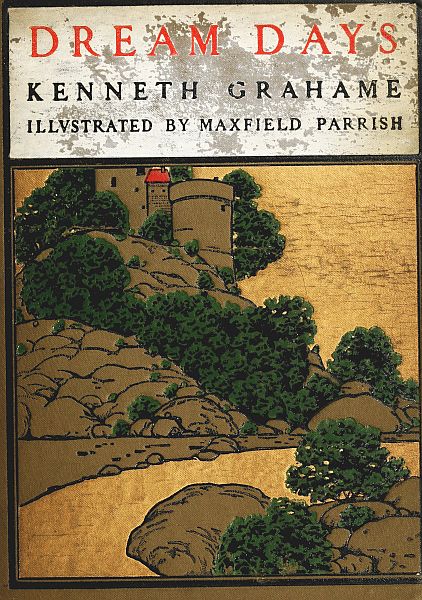
The Beloved Spouse and I watched David Suchet’s tribute to Agatha Christie the other night on PBS and wondered at Christie’s ability to write lucid, careful prose as a very young child.  It shouldn’t be all that surprising, once one is familiar with what children read in those days: Lewis Carroll’s Alice stories, J. M. Barrie’s Peter and Wendy, Kenneth Grahame’s Dream Days. The prose in these “children’s” books is so rich, complex, and erudite that they’re well worth reading by adults today—rather like some of the cartoons we watched as kids (Rocky and Bullwinkle, anyone?) that amused both children and parents. 

It seems a bit ironic to me that some of the animated films out today offer more intellectual stimulation than do novels aimed at teenagers. But The Box Trolls, which is amazingly animated and richly written, is far less juvenile than what I’ve seen of the Harry Potter movies. I’m not talking here about the Disney princess movies (however engaging they might be) that make me happy I don’t have a small daughter today and don’t have to deal with the princess phase. Rather, it’s Lemony Snicket and Despicable Me that seem to harken back to Kenneth Grahame’s hilarious, luminous story, “Its Walls Were Made of Jasper.” I tried reading the latter to my Art History students when I was teaching about manuscript illumination. But they didn’t get it: too many unfamiliar words.

Scott reminds us in his essay that Huckleberry Finn is commonly relegated to the children’s section of libraries, and that’s about as close as most of today’s students get to literary depth.  Numerous attempts to ban it suggest its potential power to do just what Socrates died for: corrupt the minds of the young by teaching them how to think. I’m pretty sure they don’t read Moby Dick anymore, and if they get any Shakespeare at all, it’s Romeo and Juliet.

Another irony exists in all this, and it has to do with J. M. Barrie.  Peter Pan didn’t want to grow up. The Disneyfied Peter Pan never did, and he lives on in popular culture’s reluctance to offer few if any grownup models.  In the end, Scott’s essay has explained to me why I watch so few television series today, and perhaps why most of the contemporary literature I read is science fiction or works about science.  I’ve long held that some of the most compelling prose comes wrapped in covers that depict galaxies far away.  One of the first science fiction novels I ever read was Wilmar Shiras’s Children of the Atom, which sparked an interest in science and speculative fiction that hasn’t left me even in my dotage.  That particular novel probably inspired the X-men comics and characters, and although aimed at the young, treated its readers as if they were—at least potentially—adults.   

Image credit: The cover of Kenneth Grahame's Dream Days, illustrated by Maxfield Parrish, via Wikimedia Commons.

Monday, August 6, 2012

Happy Mars Day!

Work on the house is proceeding apace, but I'm waiting for the exterior to be completely finished before I go back to posting on the restoration.

Meanwhile, my space-groopieness is being rewarded handsomely with today's successful landing of the Mars Science Laboratory rover, Curiosity.  I might have liked it to be called Serenity instead, but Curiosity is more apt, and I'm glad it was a kid who thought it up.

I couldn't manage to stay up last night to hear the breaking news, but the NASA channel provided some information this morning (awkwardly, though, with audio from one end of the conversation and not the other), and as soon as the rover starts broadcasting in earnest, there should be mounds of pictures.

Wikipedia's article (from whence I pinched the opening image) is helpful for the uninitiated, but the faithful will be using the NASA mission website and/or the Jet Propulsion Laboratory pages to keep up. For the young at heart, who might want to play along with Curiosity, I highly recommend installing the Explore Mars software. It explains the mission and will enable us to go along for the ride as Curiosity starts its exploration of Gale Crater.

To celebrate the impending landing last night, we watched the so-so film Red Planet with Val Kilmer and Carrie Anne Moss (not to be confused with the other movie from 2000,  Mission to Mars with Tim Robbins, which was also mediocre and a notch up on the silliness scale).  I hope Robert Heinlein's estate got a bunch of money for the title, since the plot had nothing at all to do with his 1949 novel. This, along with Wilmar Shiras's Children of the Atom (which may have inspired the X-men stories), was one of the first SF novels I ever read--and it hooked me on the genre for a lifetime, even though I probably got the expurgated version of the Heinlein book (the restored edition is available through Amazon).

I'm a real softie when it comes to space operas in general, and nearby-planet stories in particular, but to the less fervent, there's a whole website devoted to Mars Movies, complete with garish web design. Ever since my father first mentioned to me, in 1957, that there would come a time when the sky would be full of satellites and we'd at least get to the moon, I've been hooked.  I follow space missions like a fan girl, and really do hope I'll hang around earth long enough to see folks actually walking around and doing science on Mars.

We're one small step further along the way, thanks to Curiosity, and the crew that got her safely to the Red Planet.  Congratulations to the entire outfit, the support facilities, and especially to the person whose own curiosity got this mission started in the first place.

Image credit:  This color image from NASA's Curiosity rover shows part of the wall of Gale Crater, the location on Mars where the rover landed on Aug. 5, 2012 PDT (Aug. 6, 2012 EDT). This is part of a larger, high-resolution color mosaic made from images obtained by Curiosity's Mast Camera. NASA/JPL-Caltech/MSSS

Friday, December 3, 2010

Look! Up in the Sky . . .

Or, even better, "Look! Down in the Mud!"

This is a shameful weasel of a Skywatch entry, but I needed to get two things done--put up a couple of the photos I took during our Thanksgiving break, and celebrate the news of "alien" life on earth found in none other than my beloved Owens River Valley.

First, the shots are nothing special, but they are evidence of the lengths I will traverse in the name of Skywatch Friday. The Beloved Spouse and I spent nearly two hours out enjoying the unseasonably balmy weather on November 24 waiting for a sunset. Enough leaves had fallen so that we could actually see the sky whilst sitting out in Grandma Clarice's old metal lawn chairs (which we'd had to move the day before because a huge branch was dangling overhead; once it fell, gifting us with a day's supply of firewood, we moved the chairs back). This is always the best place on the property to enjoy sunsets and the evening glass of Chateau Thames Embankment.

At any rate, I spent those hours wandering about and shooting up (ahem). But the longed-for sunset never came. The light, however, was luminous, and so the photos at least provide a record of a pleasant evening. The weather changed fairly dramatically the next day (and the Thanksgiving sunset, during which we were en route to our daughter's loft and therefore didn't photograph, was spectacular), and the leaves are pretty much gone. There will be a great deal of raking happening this weekend.

Far more interesting is NASA's announcement about a nifty bacterium found in Mono Lake, north of Bishop, California. The discovery of amazing biotic flexibility is the best news science fiction buffs have head since Sputnik was launched. It's such a big deal that the Daily Poop even ran the story on the front page, and we're not exactly known for our love of science around these parts.

Mono Lake (pronounced "moe-noe," not "mah-noe" as the newsies have been calling it) occasionally makes news related to the old Owens Valley water controversy (about which I've written in earlier posts on The Farm). For some time the water level lowered ominously due to the diversion of water to Los Angeles, and the seagull breeding site on a tiny island in the middle of the lake was threatened by coyotes via an emerging land bridge. In the '90s, however, efforts began to avert dessication of the lake and the demise of the gulls. Here's a good shot of the lake by Michael Gäbler:

Skywatch Friday folks are probably already familiar with Martha Z's photos of the site; for some of these, see her Sunset at Mono Lake post from September 8.

The newest chapter in the Saga of Mono Lake just makes my little SF-loving heart go pitty pat. According to John Matson's article in Scientific American, a bacterium found in the lake uses arsenic (poison to life as we've known it) in the same way other life forms use phosphorous--in photosynthesis and other life-processes. The fact that one element can replace another in DNA like this opens up the possibility that similar replacements might occur to produce different forms of life than those with which we are familiar.

'This study really drives the point home of how adaptive life can be and that we should go out expecting the unexpected,' [astrobiologist Dirk] Schulze-Makuch says. 'If you look at other places, from the hydrocarbon lakes of Titan to the subsurface ocean of Europa to the deserts of Mars, we really should not underestimate the abilities of life to adapt to these places.'

Yum! There's just nothing to rev up the old creative juices like confimation that one's speculations about the universe have at least some scientific grounding. I have long (and boringly to my friends) insisted that life "out there" is probably (or at least possibly) very much different than it is here on earth. This confidence was sparked long ago by SF stories involving silicon-based life instead of carbon-based, and by thought experiments about what might have happened if that pesky meteorite hadn't plowed into the Yucatan sixty-three million years ago. It's hardly an original notion, but even though I've managed not to feel too smug about driving a hybrid car or not shopping on Black Friday, I will not hold back now.

To all the doubters and skeptics and people who've rolled their eyes and smirked, "there she goes again," I told you so!

I'm really happy for Felisa Wolfe-Simon and Ronald Oremland, who authored the study, and admire their curiosity and persistence more than I can say. But I'm even happier for those science fiction writers who have been inspired anew; I can't wait to see what kinds of "nowheres" appear as a result.

Image credit: Lakeside of Mono Lake, by Michael Gäbler, via Wikimedia Commons.

Thursday, July 2, 2009

Who Can Really Save the World?

I've decided not to post a Skywatch Friday photo this week, not just because I don't have one (the summer sky has been relentlessly blue this week), but because like many aspects of the new web technologies, it's become oppressive. Of course, this isn't the fault of the Skywatch crew, for whom I'm eternally grateful; they created a wonderful meme that's brought me new, like-minded readers, introduced me to some terrific blogs, and made me smile more times than I can count.

But as Thursday approaches each week, I find myself becoming increasingly anxious. What will I post? Is there anything in my photo library I can use? Since I tend to post thematically, what kinds of connections can I make? And then, except for the handful of genuinely interested folks, most of the comments aren't even as long as a text message, and I remember that the main reason for activities like these in the blog-o-sphere are to attract visitors (as well, of course, as to share lovely pictures of beautiful skies). If one is not that "into" jacking up one's web presence or dealing with gazillions of comments, the added attention isn't always welcome. I'll still post a shot or two occasionally, but I can't let skywatching become The Farm's raison d'etre.

That's not to say that I don't appreciate the thoughtful responses I've received--the ones that get the reasons, and hold similar views about life and the universe. I do. They've broadened my perspective and introduced me to some lovely people. And their dogs and mogs.

This morning, as I sat in my garden and opened my new issue of Orion magazine (which I received a week ago and haven't made time to read; there are always excuses, even when one is technically on holiday), I realized that I've strayed from my original path (topophilia, utopia, and dystopia), and have been plagued by twinges of guilt for several weeks.

I am not, however, free of guilt as a result of not being preoccupied by pretty pictures of the heavens. Instead, I'm more aware than ever of human frailty and the inefficacy of small measures in addressing the real problems that plague this planet. Derrick Jensen drives this home forcefully in his essay for the "Upping the Stakes" segment of the July/August issue of Orion: "Forget Shorter Showers: Why Personal Change Does Not Equal Political Change." If we are counting on doing this all by ourselves, he contends, we might as well give up now.

He's done it before. His masterful critique of the "simple living" movement in the May/June issue, "The World at Gunpoint" demolishes the individualist response to making change happen:

A few months ago at a gathering of activist friends someone asked, “If our world is really looking down the barrel of environmental catastrophe, how do I live my life right now?” The question stuck with me for a few reasons. The first is that it’s the world, not our world. The notion that the world belongs to us—instead of us belonging to the world—is a good part of the problem.

Individuals, according to the new article, can't do jack squat to "save the world." But we're Americans, steeped in our radically individualistic ethos, and thus have, collectively, come to the decision (those of us who see the problem, that is; there are many who don't acknowledge any difficulties at all; America, they imply, is utopia as long as we've got our property and our guns) that recycling plastic bags and water bottles, taking shorter showers, and driving less will do the trick.

I think it's telling that so many of my students and colleagues, and so many in the various news media use "individual" as a synonym for "person." "Individuals" don't disconnect from one another, they exhibit "a disconnect" in the ways they respond to the world. Jensen himself uses this new noun in "Forget Shorter Showers":

We so often hear that the world is running out of water. People are dying from lack of water. Rivers are dewatered from lack of water. Because of this we need to take shorter showers. See the disconnect?

He goes on to point out that "actual living breathing individual humans" use less than a tenth of the water used by human beings in general--the rest is divided between industry and agriculture (Orion July/August 2009, 18). So much for my various water-saving strategies of shallow dishes in the garden to gauge the sprinkler, washing dishes without running water, and taking showers only when I go out in public.

Because I'm something of a hermit when not "on stage" in front of a class, I'm probably even more guilty of this blindness than the people who shop at the Container Store for storage but at least participate in municipal policy-making. I spend much of my time thinking about how I can lower my own impact on the environment, but my participation in anything political is limited to buying my electricity from Green Mountain or using Credo wireless service for my husband's cell phone. (I'm still a slave to ATT because of my iPhone choice, even though I held out against owning a mobile phone for years longer than most people I know.)

Now that I'm into my seventh decade on this planet, and beholden to economically and environmentally expensive technologies for my very existence (not to mention my never-ending dependence on the pharmaceutical industry to keep my arteries unclogged and my blood flowing properly), I am deeply troubled by the fact that I like my life inside the old wire fence of our little compound; I like my job, even though I've sold out to America's odd notion of corporate-based, for-profit education. But the idea of spending my limited free time in further activism (beyond my considerable involvement when I was younger) is nearly unthinkable. I'm just tired. Jensen himself wrote a rather eloquent essay on activism in Orion a few years ago (May/June 2006) called "Beyond Hope," which I highly recommend if you're young enough to get out there and do something about your own future.

As it turns out, what I "do" about all this stuff is to write. And I guess I even, perhaps naively, write about hope. Besides More News From Nowhere, I write other stories and am working on a science fiction novel about people who live differently than we do, in a universe where capitalism doesn't really exist, and people (not individuals) refuse to act precipitously. They think things through. They possess sophisticated technologies, but they don't use them to despoil planets. They don't sit around watching TV or playing video games all day; they interact with one another, they do useful work, they create, and they enjoy and explore the worlds they inhabit without screwing them up.

I'm now thinking of publishing this latest book (at least when I've decided on a name) in numbers, much like Charles Dickens did in the nineteenth century on the More News website. If I don't have the time and energy to join those in the trenches, perhaps the best I can do is to suggest alternatives, or at least discuss what others are suggesting, both on this blog and in my imaginary future universe.

Of course, my low-level sense of urgency may lie in the fact that I'm not exactly passing my bad genes (or the good ones, for that matter) on to a future generation. I have no grandchildren, and may never have them. That's okay with me, since a vast majority of the people who do have them don't seem to be all that concerned with anything but the financial condition of generations to come. They're worried about the deficit, but they're not all that worried, it seems, about what the planet will look like, or what kind of air these generations will breathe.

Okay; I'm through. For now. If you've managed to slog through this post and need some cheering up, check out Skywatch Friday. These folks are always good for a smile.

Photo credit: View of contour buffer strips on farm land in the United States, a conservation practice to reduce erosion and water pollution. From the USDA, Natural Resources Conservation Service page on the practice, via Wikimedia Commons. The future of water resources will depend on integrated water management practices in agriculture, and among other industries responsible for 90% of the water used in the world.

Tuesday, November 18, 2008

A New Hope

Sorry about the sappy title, and apologies to George Lucas, but there's an odd conundrum developing in the usually pessimistic corners of my brain. On the one hand, I look at the current economic mess and wonder, "What next?" just as the newest SNAFU hits the fan. Automakers, who have for decades ignored dwindling gas supplies and rising prices, resisted the need for less polluting vehicles, and who have been feeding the greed frenzy with the likes of Hummers and other fuel-insatiable monstrosities, have suddenly decided that they need help to carry on, or the entire country is going to drown in a tsunami of unemployment and related ills.

Or the banking industry, which has fed its own appetite for luxury and excess to such an extent that its CEOs and other executives have driven venerable institutions into a quagmire of bad loans and unspeakable debt, requires us to fork over 700 billions to help fix things--and some of the companies are apparently using it for bonuses they otherwise couldn't afford, or dividends, or other payouts that have nothing to do with saving the economy, and then bitching when somebody suggests using part of the windfall to provide an antidote for some of those "toxic" mortgages that caused the industry to implode in the first place.

On the other hand, however, I find myself waxing optimistic as I watch the new administration taking shape. The world as a whole seems pleased with American's choice of president, and some of the saber-rattling has calmed down. In this country, I hear positive comments on both the right and the left at the possibility that Hillary Clinton might become Secretary of State (something, by the way, I predicted to Beloved Spouse after she conceded the nomination to Obama), and there are increasingly audible noises about a Republican cabinet member. McCain seems to be in a conciliatory mood, and pundits are welcoming back "the old John McCain"--the one who brokered deals on campaign finance across the aisle, not the one who inexplicably chose rabidly partisan Sarah Palin as his running mate.

Abraham Lincoln is back in the news, thanks to Doris Kearnes Goodwin's almost prophetic book, Team of Rivals, which Barack Obama seems to be using as something of a guidebook in deciding how to populate his cabinet. Wisdom is back in style, and intelligence has been resurrected as a badge of honor, rescued from the dung heap under which it has been buried for the last eight years. I don't mean to be crabby about this, but the denigration of the intellectual in recent years has caused me more angst than any single issue aside from the war, and has made my job --and the job of teaching in general--immeasurably more difficult.

And therein lies the rub. It's really hard to be a utopian when things are going well. But for the first time in a very long time, I'm not sure the world is going to end before I die (my 65th birthday, December 21, 2012, notwithstanding). Even my daughter, who had grown increasingly disinclined to raise children in the world as it has been, decided after the election that maybe I will be a grandmother someday, after all. So despite the economy's current downturn, I can't help but see the possibility, at least, of a rebound if Obama can construct coalitions of people who really want to save the world--or at least help the world save itself. Perhaps fear of abject economic collapse is a good thing: an impetus to finally create workable solutions.

Of course, if things really do get better, the sequel to More News From Nowhere will look a little silly, based as it is (in its planning stages, at least) on the probability of near-future catastrophe.

The discussion in New Scientist I mentioned in my last post, about the future of science fiction, is also relevant here, because utopias spring from the same impulse: wondering about what can and/or will be. Economic difficulties are not the only ones we face, of course, and Kim Stanley Robinson is spot-on when he says "we have to do the impossible and imagine the next century. The default probability is bad - not just dystopia but catastrophe, a mass extinction event that we will have caused and then suffered ourselves. That's a story we should tell, repeatedly, but it's only half the probability zone. It is also within our powers to create a sustainable permaculture in a healthy biosphere." So perhaps the task of science fiction and utopian writers alike will be to imagine conditions that either stave off or ameliorate the catastrophic possibilities.

Immersed as I am with the current academic quarter, and in working on a myth course I haven't taught in years (but get to in January), I don't have much time for writing now, anyway. But I will, at least for the moment, enjoy the possibility of peace, economic recovery, and/or positive changes in the environmental situation. And if, in future, I'm out of a job in terms of plot devices or blog fodder, so be it. I think it will be well worth the price.

Note: just in time to help me celebrate, Wall-E is out on DVD today. For anyone who hasn't seen it, I can't say enough to recommend it. Pixar may have produced the single most hopeful film released in recent years, and this is the perfect moment for its wide release for home viewing.

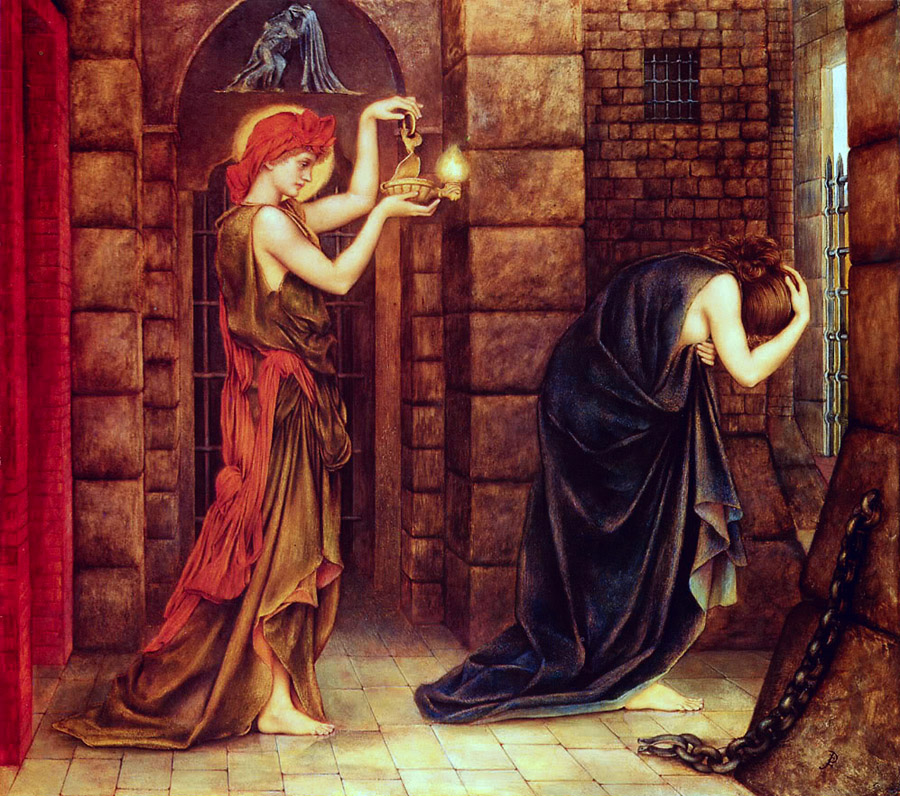
Image credit: Evelyn de Morgan's Hope in a Prison of Despair, 1887, via Wikimedia Commons.

Saturday, November 15, 2008

Hard Times and Imaginary Worlds

Now that midterm madness is over, I can get back to thinking about things that keep my aging brain from degenerating too much. This time, I'm concerned about the future of entertainment in general, and in imaginary worlds in particular.

The current concern was brought about by the sudden demise of WizKids, a company that manufactured wonderful collectible card games, tabletop board games, the very popular Hero Clix series, and several film-related card and model games like Pirates of the Caribbean, and Star Wars Pocket Models. In the interest of full disclosure, my son was a designer for the company, which was bought out a few years ago by the giant trading-card conglomerate, Topps, which was itself acquired last year by Michael Eisner's media conglomerate, Tornante Group.

Topps, according to the abrupt announcement (reported to me not by my son, but by a former student who keeps track of such things), "will still actively pursue gaming initiatives" but feels that "it is necessary to align our efforts more closely with Topps current sports and entertainment offerings which are being developed within our New York office." Since the games seem to be really popular, judging from the number of forums and other web-presence, I was a bit curious about the company's reasoning.

But the answer seems to be fairly simple, according to Jeff Grubb's blog: plastics. "The sudden and unexpected demise of Wizkids has many likely causes, and if I knew anyone still there, I might even find them out. But since I worked for the about five years back, most of the original team have left, voluntarily or involuntarily or in a combination of the two. So while I can guess about what goes through the Topps' executives minds, I can't really speak to it. But I do know that oil prices have shot up in the past few years, and with the price of oil, the price of plastic. And that cannot be good for a company's bottom line."

Grubb goes on to link a BBC story about the emptying of the Chinese city of Guangzhou, where the plastic pocket-model games were manufactured, due to job loss. So the impact of the Topps decision reaches far beyond the city limits of the WizKids home base, Seattle.

A comment on the GeekDad post (on Wired.com) about the announcement notes the popularity of the Pirates and Star Wars lines, so it will be interesting to see what unfolds over the next few weeks.

American business's short attention span seems to be at work here, and it operates on a number of levels. Entertainment media of all varieties are affected by corporate bottom lines, and their need to make big profits quickly. Unless vast numbers of people latch on to a product in a short period of time, the product disappears or gets dumped--no matter how high its quality or how promising it is in the long term.

This is most apparent in television, where terrific programs get canceled because they don't build up an audience soon enough. Two of my all-time favorite shows, Firefly (cancelled after only eleven episodes had aired) and the award-winning Nero Wolfe (which enjoyed two seasons--but deserved more), got the ax because although they had loyal (and in the case of Firefly, almost fanatic) followings, the numbers just weren't big enough. Both shows were smart, witty, and beautifully imagined, but that wasn't sufficient. Instead, we get season after season of inane reality shows that are cheap to produce and popular with the great unwashed.

You'd think that production companies and networks would be interested in mature people with disposable income, who are attracted by good stories and good quality, but that doesn't seem to be the case. Maybe it's because we're smart enough to see through advertising ploys and don't fall for every pill-shill that comes on the screen--but that doesn't explain why the guys who make the stuff we would buy don't advertise on these programs.

Since many of my students will end up working for advertising companies, I'll be curious to see what happens after the fallout settles from the current economic mishegoss. I'm sanguine enough about the future to think that we will come out okay, if our new President is able to assemble a solid team of advisors and can steer us toward some sanity. But as smart as he is, he won't be able to save us from ourselves if we insist on instant answers and results, and if we continue to act as if tomorrow is the deadline for everything.

Games and television are, of course, only two of the media we use to speculate about the future and work through ideas about what comes next. If we stop fostering the imagination that supports invention and creativity through visual media, books, and game-playing, we'll end up limiting future possibilities. Fantasy and science fiction, instead of simply being escapist strategies to help the disaffected cope with our angst-ridden world, offer a kind of laboratory experience, where different possibilities can be explored. And if reading declines (though I'm not convinced it's going to), TV and games are going to become even more important.

This week's New Scientist ran a special feature on the future of science fiction, and some of the responses (from some of today's best writers) are telling. Stephen Baxter points out that "science fiction has - rarely - been about the prediction of a definite future, more about the anxieties and dreams of the present in which it is written"-- and that may well be its primary value. I especially liked Margaret Atwood's response: "Not all of science fiction is 'science' - science occurs in it as a plot-driver, a tool, but all of it is fiction. This narrative form has always been with us: it used to be the kind with angels and devils in it. It's the gateway to the shadowiest and also the brightest part of our human imaginative world; a map of what we most desire and also what we most fear." Science fiction are us.

I'm really going to miss the Star Wars Pocket Model games and the Pirates games, not because I played them but because I liked the idea of them. Of course, I enjoyed the idea of having a son who designed space ships and pirate ships for a living, but I also liked the ships themselves: tiny little objects made to fit in miniature worlds, like the imaginary landscapes of Charles Simonds or of the dollhouses we played with as kids. They add a physical dimension to imagination, and help us map out strategies, or re-imagine the past, or simply to play--a vital ingredient in figuring out how to survive the present and invent a viable future.

Images: Some of the WizKids loot I've collected; a screen shot from the television series Firefly, via Wikipedia.

Monday, July 28, 2008

WALL-E and the Pale Blue Dot

The moment in which I actually entered the twentieth century, despite the fact that I'd already been on the planet for 33 years by then, can be traced back to September of 1980 and the day we brought home my first color television set.

It was only a 13-incher, and I would have been happy with black and white for quite a bit longer if it hadn't been for Carl Sagan, and his series Cosmos. I just couldn't imagine watching what promised to be the best astronomy show ever, in black and white. And I was right. It was gorgeous, and well written, and had me and my kids (even though one of them was only a year old) riveted to that tiny set.

A few days ago, Beloved Spouse, who's not usually impressed by much, came home abuzz about a show he'd heard on XM radio on his way home from tennis. It was an interview with Nick Sagan, Carl's son (the one whose voice was recorded on the "golden record" sent out on Voyager I, with greetings from the children of planet Earth) in which he talked about his book You Call This the Future, and (with his mother, Linda Salzman-Sagan) about making the "record." I didn't hear the broadcast, but apparently they also played "The Pale Blue Dot" (which is floating around on YouTube with quite a number of tribute videos), in which the late Sagan reminds us of the utterly amazing nature of our planet's very existence, and the fact that it may well be unique in the universe. I for one hope not, but don't expect to stay alive long enough to find out differently.

In the usual manner in which coincidences work, we finally got to see Pixar's WALL-E on Sunday, and it's now my official all-time favorite American animated film. Of course its environmental theme and its engaging, rather gentle, but nonetheless pointed exploration of modern popular culture resonated like crazy with the Sagan video. The little pale dot that is us is, for all we know, all we have. And, unlike the folks who built WALL-E and sent the Axiom out into space, we don't have a deus-ex-machina to rescue us; nor do we have time to develop the technology at the rate we're going.

After all, we don't even have flying cars yet, as Sagan the Younger points out in his book. We're still trying to figure out how to get past the internal combustion engine, making me think that because of our insoluble bonds to Big Oil and Big Power, we're stuck with an eternal, infernal combustion engine. The fires of our own human-made hell, anyone?

What surprised me about WALL-E, though, was not the way it dealt with the trashed out-planet, or even the "Buy n Large" conglomerate that runs everything (after all, I'm a Chuck fan, and the "Buy More" jokes are already part of my vocabulary). The most telling aspect of the vision of the future represented in the film was the end product of our "plug in; tune out" culture, which is now only in its infancy. But at the rate we're going, it really isn't hard to imagine a bunch of balloon-like humanoid creatures floating around in mag-lev barcaloungers sipping frankenfood ("pizza in a cup!") through a straw.

When WALL-E accidentally bumps a couple of the Axiom's inhabitants out of their chairs, they suddenly start noticing what's around them, and it's as if a spark's been lit. Wonder happens. The same wonder I'm beginning to miss in many of my students. And we don't even have flying chairs . . . yet.

Our kids already have drastically shortened attention spans (except when they're playing video games), only read online (and what they read is really problematic), socialize as if they were attached to E. M. Forster's Machine, and are becoming obese (and developing related infirmities) at an alarming rate. Our best and brightest are becoming limited by increasingly impoverished environments, even as the amount of information they're asked to process increases exponentially.

WALL-E is a sweet, poignant movie that disturbs me in ways I never expected it to. While paying homage to our pale blue dot, and reminding us of Carl Sagan's lesson, it also pines wistfully for an awakened consciousness about over-dependence on technological toys. It makes me look back on the days when I truly appreciated my tiny color TV--my only entertainment source besides a stereo, a Victrola, and a couple of pre-schoolers--in innocent ignorance of what the future had in store, flying cars or no.

Photos: WALL-E wallpaper from Pixar; Pale Blue Dot from Wikipedia.

Monday, June 2, 2008

The Age of Endarkenment

I stole the title of this post from an article by Michael Ventura in the Winter 1989 issue of Whole Earth Review. He focused on the lack of rites of passage among adolescence in the modern world, but I'm beginning to think of "endarkenment" as a pretty good description of the growing anti-intellectual attitude in this country in particular. More recently, Susan Jacoby (following in the footsteps of Richard Hofstadter) has described the problem fairly clearly in her new book, The Age of American Unreason.

Of course, predicting the fall of Western civilization at the hands of the unthinking is nothing new. H. L. Mencken and Jonathan Swift, writing about the "boobocracy" and the "Yahoos" respectively were describing earlier manifestations of the phenomenon (then in its nascence, as it turns out) in the previous two centuries. The problem, it appears, is not at all new, but consequences much more dire than those imagined previously now loom darkly. That's because we had only begun to destroy the environment by then, and our demise only seemed imminent.

The promise of the eighteenth century, of the Age of Enlightenment (particularly in Scotland, where they didn't send a bunch of their intellectuals to the guillotine as they did in France during the "sleep of reason"), was fulfilled in the rise of capitalism (thanks to Adam Smith's description of the process in The Wealth of Nations--which should not be read without also reading The Theory of Moral Sentiments) and the scientific and industrial revolutions. The seeds of everything we're living through today were sowed then. I'm pretty sure the guys talking about this stuff over beers with the fellas in Scottish pubs had no idea what would unfold.

If market capitalism had gone no further than the streets of Edinburgh, where folks kept an eye on one another and the "invisible hand" could actually work, maybe things wouldn't have gotten out of hand. But human beings don't seem to be able to think very far ahead, or imagine consequences very well, and so ideas that seem terrific at the time end up going afoul when we don't exercise the imagination we're also born with.

What bothers me is not so much general ignorance; there is simply so much information flooding the culture these days, that it's not surprising that people can't keep up--let alone spend much time wandering around in the past. The real problem is a fundamental lack of curiosity, the absence of wondering--which is where, according to Plato, philosophy begins. How can one become wise (that is--again according to Plato--arrive at a place where you're aware of what you don't know), unless one wonders enough to formulate questions and seek answers?

I'm writing this as I'm watching shenanigans on the Discovery shuttle (STS 124), where gleeful scientists spent part of yesterday turning somersaults and making videos of their activities in preparation for docking with the International Space Station today (where they're going to install a new lab and fix a toilet). None of this would have been possible without the Enlightenment, of course. But what I worry about is whether or not the Endarkenment will threaten future space exploration, one of my abiding interests as a child of the Sputnik era and sometime writer of science fiction.

Science education is also on the decline in this country, as children become less and less well prepared for the maths involved, and as their attention is drawn increasingly away from intellectual activities toward the seductions of popular culture and its various media. In some ways, science itself is making it more difficult to attract kids to basic learning experiences. A recent post on the Science of Battlestar Gallactica blog noted that kids are so used to seeing the enhanced-color shots from the Hubble Space Telescope that they're disappointed by what they can see in backyard telescopes.

But the real culprits are the activities that take them away from time to think--the multiplicity of extracurricular sports and "lessons" of all kinds that occupy every waking moment that's not taken up by watching television or playing video games. Many of us used to be able to get away from the doldrums of schooling and go home to read, or romp with our friends, or just sit and stare out the window, letting our minds wander. Now, however, children's lives are far more orchestrated, perhaps to keep them away from more sordid temptations, and/or to compensate for lack of genuine family interaction in two-income households. Whatever the reason, imagination seems to be suffering, and science is just another "boring" class they have to take in order to pass a "skills" test.

For what it's worth, I advocate the "Only One Thing" rule. Children can participate in one scheduled activity and that's it. Early on, the parent decides (music lessons were our choice; both kids took piano lessons until they couldn't stand it any more). Then the child gets to choose. My son chose orchestra in high school, and my daughter decided to get a job when she was fifteen. They both participated in "Odyssey of the Mind" events as well, but it involved the whole family, so it fell within the spirit of the Rule, and it only lasted a few weeks per year. The rest of the time was devoted to studying when necessary, and to fooling around whenever possible. Both kids had mediocre high school grades, but went on to creative careers. I will, alas, never attend a Nobel Prize award ceremony, but my kids are smart and happy and brimming with imagination.

All I really want these days is for kids to be able to have the same thing: a life filled with creativity and interest in what's going on around them. The future is theirs, and what I fear today--in the country where the word "intellectual" is a put-down more devastating than "whore" (which I've hear little girls call one another with glee)--is that our generation is stunting their creative development by vilifying actual thinking. When children can watch "educational" television shows that vastly misrepresent evidence and provide spurious interpretations (such as the recent Secrets of the Dead episode on the Minoans), or suggest (uncritically) that "crystal skulls" (which we know are fake) could never have been made by human beings (on the Discovery Channel feature), they grow up thinking that Indiana Jones is a real archaeologist and that stuff he finds is really stored at a secret warehouse and that Roswell isn't just a town in New Mexico.

Until we wake up and realize as a culture that we're putting reason to sleep and creating monsters that our kids are going to have to battle, we're not doing them any favors. We owe them the opportunity to be bored, and to seek avenues of intellectual stimulation that aren't programmed from babyhood. How will they ever understand the natural world if they never see it up close? How will they understand the wonders of advances in scientific technology if they don't look through a basic telescope? How will they ever be able to adjudicate between reason and unreason if they're fed predigested pabulum through a textbook that dumbs ideas down into formulaic "concepts" designed to be spit back on standardized tests?

I admire the mom in New York who gave her kid car fare, phone change, and a map, and sent him out to find his way home. When I was about his age (ten), my parents gave me free rein in a foreign country where I pretty much wandered at will, taking pedicabs to the movies in Taipei, or wandering trails on the mountainside outside the city. I spoke only enough Japanese (I never did learn Chinese) to communicate with the old guys who'd lived through the Japanese occupation, but I knew my address and that's all I needed. I remember being ill-at-ease when my kids were out doing who-knows-what when they were growing up in pre-cellphone America, but I lived through it and so did they.

We do live in dangerous times. But we're probably making them even more dangerous by trying to cocoon our children out of fear, and suffocating them with good intentions. Rather than occupying every second of their time and hovering over them, maybe we could start by throwing away the television set, assigning "media hours" and following the "Only One Thing" rule. If we parents turned out okay, shouldn't we give our kids the opportunity to develop the imagination and the real life skills it's going to take to stave of the forces of Endarkenment?

Image: Francisco de Goya, The Sleep of Reason Produces Monsters, courtesy Wikimedia Commons.

Tuesday, April 22, 2008

Surviving Plutopia

Now here's a series of coincidences for you. My husband (who is usually spot-on in these matters; after all, he led me to Firefly) casually mentioned during our Sunday morning newspaper-read that "you might find this interesting; Alan Cheuse liked it," referring to Jeanette Winterson's newest novel, Stone Gods. Part of the novel takes place in ancient, pre-environmental-disaster Easter Island, which also happened to have been featured in the Sunday Travel section of the paper. Anyway, after reading the review, I looked her up on the web and opened up yet another window in my serendipitous world.

I read her biography, and discovered that she's another arrogant, cranky middle-aged writer (we should start a club!), but one long-published, with an interesting rep, and recipient of an OBE (now I'm really impressed). I read an excerpt from the new book--which is now on my to-buy list--and then wandered over to her essays, where I hit on "Society for the Preservation of Ancient Buildings." This, of course, raises a bright flag, because this is the organization William Morris founded in 1877 to prevent the wholesale tearing down of historically important buildings, and/or their cheap and nasty "restoration" or "modernization." Lo and behold, Winterson had purchased an eighteenth-century derelict in Jack The Ripper territory and restored it, complete with a ground-floor shop that now houses a Continental deli run by chef Harvey Cabaniss (of whom I had already heard). Moving on to an essay called "Good Housekeeping" I came across this gem:

We are eating too much and we are paying too little for our food. . . . My philosophy is to eat modestly and buy the best you can afford. In our crazy world a chicken costs less than a cinema ticket. Our obsession with cheap food has destabilised farming throughout the world, polluted our soils, driven small producers and small shops into the ground, allowed the supermarkets to monopolise our lives, and made us fat.

Had I "met" Jeanette Winterson before I had finished More News From Nowhere, I'd have pinched her for a character.

In an essay about Philip Pullman, author of the series His Dark Materials, she describes Pullman's attitude toward modern education:

For Pullman, the obsession with invented standards, pointless testing, endless form-filling and a moribund National Curriculum are killing the joy of learning, and driving the best teachers out of the system. 'I used to teach the things that excited me', he says, 'and when the teacher is excited, so are the children. What do we want to do? Stuff them with facts or open their minds?'

Had I read The Golden Compass (or, as it's called in the UK, The Northern Lights) and met Pullman before MNFN, he'd be in there, too. As it is, I've only read the one book, and seen the disappointing film based on it, but I'm already a lifelong fan.

Both of these writers share my disdain for two important constituents of "plutopia" (my new name for the greed-based economy in which the West now wallows. It's not wholly dystopic--yet--but our attitudes toward both food and education are symptoms of increasing intellectual and ethical impoverishment, portending further ill for the future). Our lack of education--of desire (in terms of what and how we eat), and of the mind (in terms of how we teach our young)--have helped to build plutopia, and only by addressing these failures can we hope to replace it with anything that even vaguely resembles a world in which everyone can be accommodated in some measure of fairness, justice, and peace.

Only by adjusting our own perceptions of "need" vs. "want" can we begin to understand the true nature of poverty. And I am getting sick to death of pundits who describe anyone who lacks electricity as "living in abject poverty." (For my perspective on the larger questions, see "Rethinking What it Means to be Wealthy" and "Rethinking What It Means to be Poor.") The line usually runs something like "They're so poor they don't even have electricity"--as if this particular technology is necessary to the very notion of civilization. But it's not. It's perfectly possible for people to work the land, provide sufficient food and clothing for themselves, and dwell in thriving communities without ever having seen a light bulb!

Although knowledge of electrical principles has been around since antiquity, and had come under serious study by the eighteenth century (remember Mr. Franklin's kite and key experiments), it wasn't until the nineteenth century that it became practical to bring electricity into commercial and domestic use. It may be "necessary" to modern life--hence the science fiction scenario of an electromagnetic pulse as the threshold of disaster--but it is certainly not necessary to life itself, nor even to "civilized" life. Plenty of civilization happened before the nineteenth century. Of course, that's also when things started falling apart, what with the industrial revolution, Blake's "dark Satanic mills," Ruskin's hated locomotive, and the end of pastoral life as we knew it.

But few people even know these things these days, because we're so intent on stuffing our children's heads full of factoids we can measure on standardized "assessment tools" that only test what they can memorize--not their ability to think, interpret, translate, imagine, create, or use what they've learned. "Irrelevant" information isn't taught because it doesn't fall into the current catchment basin of what education "experts" think kids need to know. Knowledge doesn't actually happen until the child has managed to integrate information into some kind of cultural context--so most of the information they commit to memory only long enough to spit it back on the exam is useless anyway. And of course the reason they need to know anything at all is in order to be successful in the marketplace.

We in the US complain bitterly and loudly about the price of gasoline and food, both of which cost more in the rest of the West than they do here. But if we truly understood what's involved--if we were better educated about economic realities instead of having been spoon-fed the pabulum we get predigested into sound bites from media sources--we'd be complaining that they cost too little. The true cost, in lives and life ways, is profoundly higher than most of us realize--or want to realize. But plutopia has taught us to think only in terms of monetary cost, and even the word economy doesn't mean what it once did, since it's now synonymous with "market economy" and any other use of the term is suspect.

I'd really like to spend Earth Day in my "nowhere"--without electricity or formal education. But since I can't, I'll keep prowling through Winterson's lively website, and dig into the second segment of Pullman's series (The Subtle Knife). I'll spend a couple of hours this morning in my little carbon sink, amidst the wild grasses and the primroses, and hope that the birdsong drowns out the traffic from the highway. There I can celebrate a smaller footprint, and be grateful for what I don't have.

Addendum (7 May 2008): This month's Orion Magazine contains an excellent and highly relevant article, "The Gospel of Consumption, and the Better Future We Left Behind." I'm encouraged both by the content of the article, and by the discussion that follows.

Photo: A lovely carbon sink at a bend in the Owens River, near Lone Pine, California.