Showing posts with label environment. Show all posts

Tuesday, April 22, 2025

Earth Day 2025: On the cusp of change

An early spring sky in North Texas

It's been so long since I last posted, that it took me several tries just to access this account. My cognitive skills (especially the technology-related ones) take longer and longer to ramp up, so that every effort seems almost Herculean. But I can't remember the last time I didn't post on Earth Day, so it seems like a good time to try and get back into the habit of writing more frequently.

The recent death of my step-mother (who was 93 and had led a pretty admirable life) has prompted a family get-together at the cemetery in Big Pine, California, where most of the ancestral bones and ashes are buried. This means a full-fledged road trip west in Porco Rosso, our little retro-style caravan, giving us a chance to test all the recent earth-friendly(er) modifications The Beloved Spouse has made to it: swapping out the gas hob, oven, furnace, and water heater for solar-supported battery-friendly electric alternatives; a new portable loo that acts as a cassette toilet and rids us of having to use a black tank; substantial upgrade to our solar capacity to keep our Bluetti power stations topped up and the on-board batteries charged. Porco now sports new tires and brakes, which should make towing easier for the new-ish Jeep 4xE we'll be using to haul us all out to the first family gathering on the auld sod we've managed since my brother died in 2019.

Most of the trip will involve staying at state parks and boondocking, which would have been much less feasible without the new solar capability. We'd rather be able to stay at parks and off-grid campgrounds with minimal "amenities," and to reduce our load on park services (which are under duress at the moment due to the vagaries of the federal overseers). And precisely because of the current uncertainties regarding the future of the Republic, it's hard to tell whether or not we'll be able to take another such trip before it's my turn to be gathered around and remembered over beer and pizza.

Uncertainty is a constant source of angst among most of the people I know these days, but it does tend to spark the necessity to enjoy what one has whilst one still has it. So, in the midst of the ongoing Swedish Death Cleaning efforts, we're both finding the time to enjoy the pleasures of our little piece of the planet. We're working on converting most of the formerly lawned areas into a prairie garden, and although we've got a long way to go, we're progressing with the overall design, and have given over a fair amount of the garden to native perennials and naturalized border plants and bulbs. Some years ago, I found a small patch of wild Byzantine gladioli under a Nandina hedge, and the gorgeous fuchsia-colored blooms have since taken over large swaths of the back yard and are creeping around to the front. Although the Nandinas themselves are invasive non-natives from Asia, I'm keeping them for now, but will cut off the berries as soon as they begin forming to keep them from spreading. The berries are reputedly toxic to birds and cats, so I'll go ahead and enjoy the blossoms--but will eliminate the problematic bits.

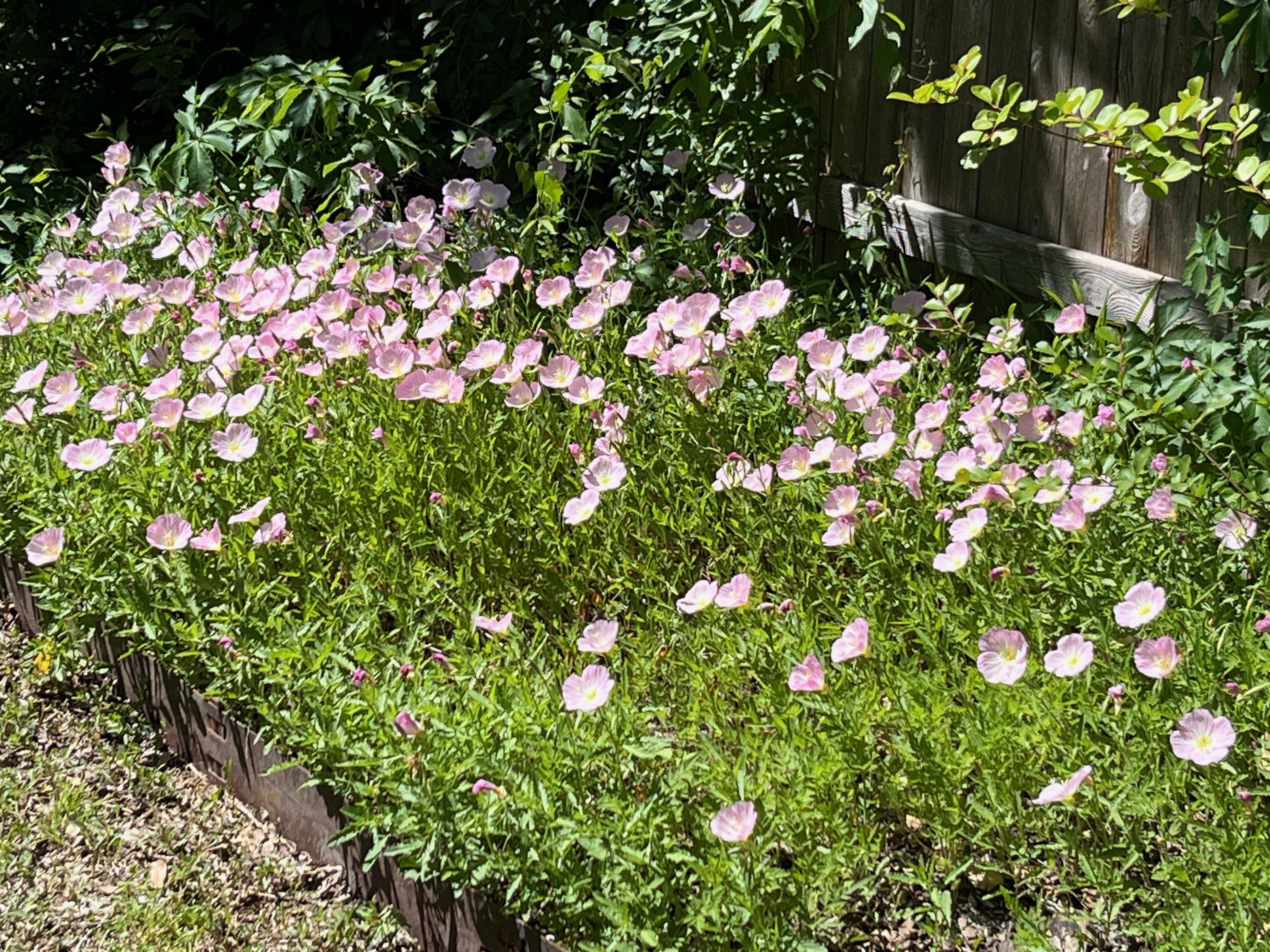
Our greatest success so far is the large patch Texas primroses that has taken over the area on the north side of the house that I used to reserve for tomatoes. Here are a couple of shots that include both (gladioli and primroses--not tomatoes):

I've been nurturing a couple of tiny stands of blue-eyed grass for years, but if I want more, I'm probably going to have to sow seeds, since they're not nearly aggressive enough for my needs. But I do love them. They pop up amidst the myriad "weeds" we foster instead of turf grass, and we mark them before we mow so as to give them a chance to self-sow. 


Visiting wildlife is always welcome here, and we've created many areas that have fostered rabbits and occasional raccoons and opossums. In recent years we've enjoyed regular visits from northern green anoles, which have all been named "Harry" after the lizard in Death In Paradise. Ours are actually Anolis carolinensis, the males of which can change from green to brown, and back again. The photo may be of a female Harry, since I couldn't see a dewlap, but I loved the perch on top of the rebar designed to help support the potted bougainvillea I like to grow each year next to the greenhouse.  (Click to enlarge if you'd like a clearer view.) In past years I've included some of this Harry's ancestors, and caught a couple of his/her progenitors in flagrante delicto--making more little anoles. If I can find the post, I'll link it here; but that's as bawdy as things get here on the Farm--although a past Earth Day post has featured mating kites. Our newest regular visitor is a chubby opossum, who likes the apple cores and other fruit bits we leave out. We've caught her (we think she's the one who once trotted her babies across the front yard hanging onto her rail) on our back-door camera several times.

Which brings me to the best wildlife event of our year so far: the appearance on April 2 of a pair of Yellow Crowned Night Herons in our yard, engaging in artful mating displays and graceful saunterings across pecan the limbs that create a corridor over our yard to next door. The day was cloudy and rather drear, and their features were difficult to capture on our phones (we didn't expect them to be around for long, so we didn't haul out the real camera; lesson now learned). But searches on Cornell's "All About Birds" site (at the link) and Wikipedia gave us a positive identification, so we sat out watching as they moved from tree to tree. They left for a while, but came back later, just before it started getting dark. We never saw them again, and wondered why they were even here, given their preferred diet of crustaceans and coastal locales for year-round living. But we are within their breeding range, and the neighborhood does provide a number of creeks for crawdads and such. Our recently pruned trees may also have offered them room for showing off their pretty crowns and feathers. Sad to say, neither of us could get clear enough shots to use for illustration purposes, and my video-editing skills are abysmal anyway. So it turned out to be one of those occasions for which we will have to rely on our own visual memories to relive.

Speaking of living: News from old friends indicates that we're still managing to survive the current upheaval of democratic institutions around the country. Of course, we're all white, home-owning, educated pensioners with (for now) stable (if not voluminous) incomes. We don't have tattoos that could get us identified as Venezuelan gang members, and I don't think that any of us speak enough Spanish to get us misidentified as border-hopping immigrants. But even if we don't get sent to a Salvadoran prison for what's left of our lives, and even if our woefully inadequate defense department manages not to get us nuked, the equally under-qualified interior department may well land us with an irreparably damaged ecosystem--one that even acquisition of Canada or Greenland would be unable to ameliorate. In all the years of the Cold War spent hiding under desks and practicing air raid drills, it never occurred to me that we might be undone not by hot-war adversaries (although they're still around), but by our own profoundly ignorant, unimaginative, race-obsessed, and  rapacious (in all of its senses) elected leaders: Not with a bang but some kind of "administrative mistake." 

I can't end this without expressing immense sadness at the loss of Pope Francis. As a practicing Cynic/Skeptic, lapsed Catholic, and secular Jew, I appreciate him more than almost any modern leader  because he truly embodied the values he taught, with grace, humor, philosophical rigor, and true charity. As I mentioned to a dear Catholic friend yesterday, we are all richer for his presence, and poorer for his loss. 

So, Folks, have the best Earth Day and spring you can muster, do what you can to protect the planet from the ravages of stupidity, and maybe together we can help stave off apocalypse--at least for now.

Photo notes: As I looked over previous Earth Day posts, I found that the images I have chosen are  often similar--if not downright repetitive. But we've lived on our little half acre for nearly twenty-five years, and it has become a haven of contentment in a problem-infused world. Taking pleasure in small moments provides some respite from all the turmoil underway, and suggests the possibility of better days--kind of like sunlit clouds emerging after a storm, as they did in the opening shot.

Sunday, April 22, 2018

Earth Day 2018: Doing More, And Less

Volunteer wild gladioli, the bee bath, and a broken pot as a snake refuge
Every year I try to post on Earth Day and reflect on what we've been doing to try to improve the state of the planet on a very local level. And I always wonder if we'll ever do anything really significant.

Some concerned folk may wonder how much more we can do to lower our carbon footprints and help change things, especially given the current political climate. So far I'm really doing all I have the psychic energy for, even though it's still not nearly enough.  And since much of the news just seems to get worse, one really does tend to wonder if small gestures can help at all.

Despite all my grousing on this platform, though, I really do think they can. And, as the years go by, I seem to be noticing that more people are tuning in, becoming aware of at least some of the problems. Even the local barbecue joint has started sourcing their meat from sustainable and humane farms, and packaging their takeout food in compressed cardboard and paper: not bad for a Texas-grown business that prides itself on maintaining tradition.

In the news this week is plastic. This is to some extent because the Earth Day people are focusing on eliminating plastic pollution as the central theme this year. It's actually difficult to remember a world before plastic became a problem. Once upon a time it was tin cans and paper on the roadway that got folks riled up about messing with Texas and got the anti-litter campaigns started. Some of us may recall the famous scene in The Graduate, where Mr. McGuire pulls Benjamin aside and offers him one word of advice ("Plastics!"), which then sounded preposterous. Really? Plastics were the future? (Thought she who wanted a Greek-patterned set of Melmac as a wedding gift in 1968. And probably a set of Tupperware, too.) But those were the days before ubiquitous plastic packaging, bubble wrap, blister packs, and bottled water.

Throwaway plastics have become the symbol of an impending dystopic future. Shredded plastic bags float out from shrubs, trees, and fences along highways, and blow about like sad, limp balloons through the air; plastic water bottles show up everywhere (including along my back fence, where people who walk through the alley behind the house toss them); and gyres of plastic garbage the size of islands collect in the oceans. David Mastio of USA Today (apparently I wasn't the only one to connect The Graduate scene to this topic) and several science-related organizations blame this on Asian countries and untidy fishermen; Mastio suggests that we not feel guilty about our part in the mess and points out that a large proportions of medical advances have been facilitated by plastics. But those aren't the plastics that get tossed into rivers, streams, and oceans. And I've seen enough gulls flying around over landfills to know that we do indeed have something to do with the presence of plastic trash in the oceans.

So there's plenty of guilt to go around. It's not just fishing buoys and lines and tsunami-transported trash that fill the piles. A trip to the local park pond indicates that people still think nothing of tossing their plastic food containers when they're finished with them, or stuffing them haphazardly into open trash bins that allow the ultra light-weight containers to blow about or get scattered by foraging wildlife. It shouldn't be that difficult for us to stop buying water in plastic bottles.  We could also boycott polystyrene cups and give up plastic straws.

For some time now, efforts to upcycle plastic bags and bottles have produced reusable tote bags with store logos on them. But just the other day I stopped in at a grocery store I used to frequent (before the appearance of Trader Joe's in the neighborhood). The clerk was amazed by my recycled-plastic-water-bottle wine bag, and by the fact that everything I bought besides wine fit into two canvas totes. The guy behind me bought about ten (doubled) plastic bags worth of food and other stuff, so it's clear that not everyone's a convert.  But it's really easy to avoid some of the plastic crap by using alternatives: mesh bags for produce, stainless steel water bottles, glass and ceramic fridge and freezer storage containers.

Locating alternatives to plastics has become a minor obsession in this family. With the exception of storage containers for the garage and closets to keep out mice and silverfish (nothing else seems to work), we try really hard to avoid bringing any plastics home. The apparently unavoidable ketchup bottle or yogurt tub goes into the recycle bin. But I could even remedy this necessity by making my own ketchup and yogurt, or buying Bulgarian yogurt in glass jars; at some point I probably will. And we have managed to reduce the setting out of blue recycle bins to once or twice a month, and the big green trash bins to less than once a month.  Mostly what gets recycled now is paper and wine bottles, a we've been trying not to accumulate much throwaway trash at all. If we could get Costco to stop over-packaging so many of the staples we buy, we might be able to become like those folks whose monthly non-recyclable debris can fit in a mayonnaise jar.

The reduction in trash goes hand in hand with a reduction in buying. This has engendered a bit of a political labeling paradox in our house. We're not particularly progressive, since we're not all that fond of progress for its own sake (except in social equality and fairness), and I've become especially conservative when it comes to my innate materialism. I still buy stuff, but--except for food--it's mostly "pre-owned." Or when it's new, like the big quilt I bought yesterday, it's to make something old last longer--like the chair I bought the quilt to cover. Were I a better person, I'd have used my stash of old fabrics to make a quilt, but I still haven't managed to learn to manage my time better. The quilt-making will follow planned mending of existing quilts and blankets, and cushion recovering, and the repurposing of various objects to use in the garden.

Our best effort this year has been to eliminate food waste. The smaller fridge has been wonderful for keeping us both aware of what needs using up, and we've had little except pits, skins, seeds, and coffee grounds to pitch into the compost bin. Even the skins and coffee grounds we often use for augmenting garden plantings. In the last year, only one or two things in the fridge have gone off before they were eaten, and at some point I'm wondering where our compost is going to come from, since we mulch our grass and rake leaves into litter piles to make soil.

The big purge will come this summer, when we rid the garage of what we've been stuffing in there so as not to feel like hoarders in the house. What can be recycled or repurposed will be, and as much as possible of we can't use or don't want will be donated. The plan is to eliminate what we don't use and to use the space for more creative endeavors. Beloved Spouse wants to learn about Japanese joinery and accomplish his own repairs on the house, and I want to get back to painting and potting (both plants and ceramics).  And so, perhaps, by the next Earth Day, we'll have found more, and more effective, ways of lightening our footprints, carbon and otherwise.

For anyone who's still trying to figure out where to start, the New York Times is featuring a good series on "A Year of Living Better," with sound advice on How to Reduce Your Carbon Footprint. The Earth Day network site has a nifty calculator for determining how much plastic you consume, and I'm going to use it to increase our own awareness.

And in case you need reminding about who really got this whole effort started, look back at Rachel Carson's three-part series for the New Yorker, "Silent Spring," which began running in the June 16, 1962 issue.

Happy Earth Day, Folks. We've spent a good chunk of the day working in the garden, fixing things, tidying up, and hanging out with the animal people. So far it's been a good day, and I wish the same to you.

Image information: The bees have taken over the old copper birdbath, and are busy swarming amongst the voluptuous blossoms on the wild gladiolus volunteers that increase yearly. They started out as "found" plants under a shrub, and I've just let them take over. We're working on building habitat for pollinators, including solitary bees, bumble bees, and butterflies. Some mornings are just glorious in the garden.

Sunday, September 7, 2014

Celebrating--and Questioning--Wilderness

On September 3, the Beloved Spouse and I celebrated (or at least acknowledged) our twenty third anniversary. As it turns out, the Wilderness Act marked its fiftieth anniversary on the same date--unbeknownst to me until I read a message from Orion Magazine, which is my main source of environmental commentary these days.

My mention of the occasion, however, won't rank up there with the joyous celebrations of tree huggers everywhere, because I'm rather skeptical about the whole notion of wilderness in the first place. I'm pretty sure it doesn't really exist in the present day, because there is almost no place on earth that isn't (as Wilhelm Dilthey would put it) human affected (with the possible exception of volcanoes in the remote hinterlands of Iceland).

More true now even than it was in the nineteenth century (Dilthey's Introduction to the Human Sciences was published in 1883), there isn't even a tiny corner of this planet that doesn't bear at least a chemical imprint of human activity. Not only that, it's difficult for many people to even imagine what real wilderness, truly unaffected by so-called homo sapiens sapiens (the wise wise human species), would look like.  In my first-level art history class I ask my students to choose a photograph of an object (animal, vegetable, or mineral) as untouched by humans as possible, and I have to warn them that a picture of an elephant in a zoo, or a trail through a forest, or a field with a fence, or even a single rose is not a good choice. But there's an obvious irony connected with the task, because a photograph in itself is evidence of human interference.

In the midst of my pondering the notion of the wild, this morning I read Rob Nixon's review in the New York Times of Diane Ackerman's new book, The Human Age. The book seems to be both potentially fascinating and terrifying, and I'll probably buy it for the iPad--but I'm not sure I really want to be reminded just how much we're interfering with the future of the world.  Looking up Nixon's recent Slow Violence and the Environmentalism of the Poor led me to a June 2011 article in the Chronicle of Higher Education, "Slow Violence: Literary and postcolonial studies have ignored the environmentalism that often only the poor can see" which advocates moving the locally-focused understanding of environmentalism away from Thoreau and other members of our national canon (including those like Wendell Berry who are often invoked in this blog) outward: toward the rest of the world, far less cushioned from the ravages of human power than we are here.

As Nixon points in the article, there are other voices to be heard:
Figures like Wangari Maathai, Indra Sinha, Ken Saro-Wiwa, Abdul Rahman Munif, Njabulo S. Ndebele, Nadine Gordimer, Jamaica Kincaid, Arundhati Roy, and June Jordan have recorded the long-term inhabited impact of corrosive transnational forces, including petro-imperialism, the megadam industry, the practice of shipping rich nations' toxins (like e-waste) to poor nations' dumping grounds, tourism that threatens indigenous peoples, conservation practices that drive people off their historic lands, environmental deregulation for commercial or military demands, and much more.
While some of those enshrined in the American pantheon are now dead, none risked the fate of those like Ken Saro-Wiwa, who was executed by the Nigerian regime of General Sani Abacha for defending his people not against some marauding heard of infidel-purging jihadis (which might have garnered some coverage on CNN), but by us: big oil in America and Europe.

Earlier in the week I'd been reading about the current discussion on GMOs and whether or not they're "safe" and whether or not people have a right to know if they're in our food or not.  As the general controversy involving GMOs has developed, I've frequently thought that we might not be asking the right questions when it comes to allowing their use in the first place.  Just as I think that the question about preferring organically- vs. conventionally-grown food isn't whether or not it's "healthier," but rather if it's culturally better for us (more sustainable, economically more equitable, etc.), I wonder if the real question behind gene-manipulation in our food crops isn't more about whether it's ethically defensible and environmentally sustainable than whether it's going to poison us or cause birth defects or some such.

The question up for debate at the moment is really about labeling. Science seems to be bolstering the notion that modified foods do not pose a danger to our health. One long-time opponent of GMOs, Mark Lynas, has recently switched sides in the argument against their safety (as did Neil deGrasse Tyson), and is now advocating that we embrace them in order to stave off the looming cloud of hunger related to population growth. As both of these guys point out, the science backs the safety claim; not only that, if we're going to blast the climate-change deniers and the creationists for ignoring scientific evidence, we out not to base opposition to GMOs on unfounded skepticism.

For my part, I'm not particularly bothered by crops like Bt cotton--because we don't ingest it (and it's one of the most pesticide-dependent crops human beings grow, so that spraying chemicals significant harm both to the environment and to those who harvest it), but I'm also not so sanguine about our ability to ensure that food crops will never develop consequences down the line.  The people who develop and test the modifications are, after all, human. And we can be utterly blind at times, unable to foresee potential outcomes. Two words: atomic bomb. Or maybe one: thalidomide. Or an acronym: DDT.

Simply labeling products so we can make choices doesn't seem like it should be such a big problem, but "folks" (corporations are people, after all) like Monsanto, Bayer, and Dow are afraid that labeling will imply lack of safety and discourage people from buying their RoundUp-ready products.  Well, I already don't buy them for economic and ethical reasons; I don't like the fact that altered genes are escaping the plants they've been manipulated into the environment and generating unforeseen consequences (see this 2012 Mother Jones article). I don't buy milk with hormones in it because I identify too closely with those poor engorged cows I've seen in feedlot dairies.

In the end, though, it seems a bit luxurious to even be able to question our food sources, and to make choices at all because so many people in the world have to take what they get--some of which may be imposed upon them by the denizens of rich, still-imperialistic countries like our own. And while environmental consciousness seems to have risen here over time (as people become more aware of how what we do to the planet is hurting them), we don't seem to hold the same regard or concern when it comes to developing countries with resources we want to exploit.  So any benefits GMO foods might produce may come with cultural and economic costs in other realms.  And even with science currently able to proclaim the safety of genetic modifications, our track record isn't stellar when it comes to predicting future consequences.

Although humanfolk have been using artificial selection to manipulate crops since the beginning of agriculture (the very word implies manipulation), as Tyson points out, we're now messing with Mother Nature in ways that go far beyond simply mixing pollen from different species to increase the food supply.  And even though some GMO crops (like golden rice) might well help keep some people in Asia from debilitating malnutrition, the encroachment of Big Agriculture, like Big Oil, and the like isn't exactly sustaining human cultural traditions. It sure as hell doesn't bode well for the preservation of the wild.

I'm just not at all sure that we're actually capable, as a species, of making particularly wise decisions about the future. Wilderness as an idea is still with us, but as an actual, existing phenomenon I'm pretty sure there will be little left in another fifty years.

Image credit: The Bardarbunga volcano erupting in Iceland on September 4, 2014. The coincidence of this eruption and the idea that volcanoes are one of the few truly wild, non human-affected natural phenomena in existence was too much to resist. The image originally came from the Wikipedia article on the volcano--where you can also learn how to pronounce it. Blogger didn't like the coding, so I couldn't post a link.

Tuesday, November 20, 2012

Well, Here I Am

Even though I haven't been posting lately, I've been preoccupied with events and notions closely related to typical Farm content. The combined influences of Hurricane Sandy, the recent election (and the particular Texan brand of whining that accompanied the results), and my continuing ambivalence about where I want to spend the rest of my life have brought me to the point where I've just got to get some stuff off my chest.

As much as I sympathize with those who lost land and property as a result of Sandy and its aftermath (the "superstorm"), I can't help but wonder why we do this to ourselves.  Human beings seem incapable of choosing wisely where we live. We like mountains, we like proximity to water, and we like nice views--whether or not there's enough potable water to support a substantial population. So we live in earthquake- or avalanche- or fire-prone foothills and valleys, or even in cabins on mountainsides. Or we build lovely beach houses on earthquake- or hurricane-prone seashores. Or we build in sunny deserts with little or no water, and have to import it. Or we build in impossibly beautiful river valleys and suffer devastating floods.  Or we live in Tornado Alley.

Of course there's no perfectly safe place to live. Anywhere.  And civilization makes it even worse, because if we should happen upon an area with little potential danger from major disasters, we pipe natural gas into our houses, or build them with wood shingled roofs that catch fire when neighborhood kids shoot off bottle rockets on the Fourth of July.  Or we build a house on a prairie and then dig that up, precipitating a dust bowl in times of extreme drought. (Yes, I have been watching the new Ken Burns series.)

Climate change appears not only to be real, but really caused by us, and it looks as though we're going to suffer increasingly over the next fifty years or so, no matter what we do now to mitigate the damage.  Sandy, it seems, was probably a harbinger.

Before I began this post, I spent some time looking at YouTube videos of Sandy's impact on Long Island, where I lived when my son (now 36) was born.  We lived in a tiny town about halfway out toward the Hamptons, and later moved to a little resort house on  Lake Panamoka nearer the north shore.  We withstood a couple of hurricanes in situ without much damage back then, and the area doesn't seem to have been much harder hit this time. I could have lived there forever, in the middle of the Pine Barrens, on the glacial moraine that marked the outermost edge of a Pleistocene glacier.  But the necessity of work drove us to Texas, and (as Jubal Early says so poignantly at the end of the final Firefly episode) "Well, here I am."

I was born on a major earthquake fault, near some dormant volcanoes, and moved to others (Japan and Taiwan) as a child.  These latter islands presented a possible triple-whammy: earthquakes, volcanoes, typhoons.  We never were in any danger of a volcanic eruption--even on Yangmingshan, near Taipei, which simmers visibly.  The mineral and sulphur springs that fed our bathtubs and made for luxurious soaks apparently vented enough of the volcano's energy that only minor earthquakes occasionally reminded us of what lay beneath.  I do have photos of post-typhoon flooding in Taipei, but in those days houses were built behind eight-foot stone walls, with three-foot forgiveness under the floors.  Folks seemed to know what needed to be done to keep the water from washing the whole city away.

Now, at the southern edge of the tornado belt in north Texas, the biggest danger we face is wind, hail, and other such weather-related damage.  During the renovation this past summer, we had a high-impact, fire-proof roof installed (paid for by our homeowner's insurance because of several years' worth of hail dings), but we still face the possibility of having a tree fall on the house during a storm.  Things would be a lot more worrying if we lived out in the open on flat prairie land, but the bit of topographical relief we enjoy in this area makes us slightly less prone to direct tornado impact.  So I pay for my relative safety by sacrificing my innate longing for big sky.  The house is surrounded by, in my father's estimation of any place not in the desert, "too many trees."

And I do long for the desert.  During my frequent romps into real estate porn ("owens valley california real estate" pops up in my search window if I simply type "o" into it) I can almost smell the granite sand of acreage in places like Olancha, Lone Pine, or Benton.  I can hear the crunch under my feet as I walk through clumps of sage brush and old jackrabbit bones.  Sometimes I ache for it--but never manage to arrange my life for even a visit.  I think I might be afraid that going home could make it even harder to come back.

So I do understand why people will rebuild in Rockaway, Staten Island, and on New Jersey's barrier islands.  The Beloved Spouse knows well that if I go to a beach I will wander off for miles along the shore, completely losing track of time and any sense of needing to be somewhere else for any reason at all. I've spent hours walking along beaches from Fire Island, to Tamsui (Danshui) near Taipei, to Galveston, to Virginia Beach, to Big Sur, to Bermuda (although I was so young there that I fell in the surf and almost drowned).  Even though I'd rather live in the desert, I could use a good long stretch of time on a quiet island in the middle of an ocean, and surrounded by sand.

Only, I live here. In north Texas, where a not-insignificant portion of the population now wants to secede from the Union and doesn't want to provide health care for the less fortunate among us.  But McKinney is also #2 on Money Magazine's list of Best Places to Live. It does, in fact, have some nice amenities, like an historic downtown and a decent used bookstore. It's also a little easier to live in, now that the house is painted, there's a perfectly delightful bathroom upstairs, and the living room has gone all wabi sabi  (I'll explain that in a later post). But I'm still coming to terms with the fact that my little half-acre oasis is just that: a tiny space in an intellectual desert without the charm of the real thing.  Sandwiched between hostile neighbors, we work (when we can) to shore it up, and hold out against the local universe.  But as long as my daughter's around, the dogs are happy, the Beloved Spouse has the tennis coaching to alleviate the pain of trying to teach philosophy, and I'm still (mostly) enjoying what I do to earn the mortgage payment, I'm okay.  For now.

When a colleague asked me yesterday how I was doing, with my usual snark I replied, "Well, I ain't dead. Any time I wake up not dead, that's a good day."  Fuss as I might, my troubles don't amount to much when compared to those whose house on the beach is no longer there.  I'm thinkin' that they should probably rebuild elsewhere, but I do understand why they might want to chance it one more time.

Image note: This was created in the kids' app, "Drawing Box" for the iPad.  I played around with two others--Paint Tools and Art Set--both of which are less silly, but I liked this one best.

Saturday, April 21, 2012

Earth Day 2012, Part 1: Hunkering Down

I can't say that this Earth Day finds me particularly sanguine about the future of this planet.  My puny efforts to shore up my half acre and shield it from encroaching doom seem almost like a bad science fiction novel about the end of the world.  Continuing efforts to learn to love the prairie (of which there is really very little left) aren't working especially well--and I frequently find myself indulging in "real estate porn," looking for affordable properties in the desert west.

In the meantime, the carbon sink is wilder than ever except for the patch I've cleared out for tomatoes. We'll have to do a bit of work tomorrow to open up a little more sunny space, but if I can remember to water them, they should do well enough.  But the abundant rain this spring, along with the lack of a true winter, have both meant that the whole place is lush and jungley. I'll have to clear out a mass of mint soon, because it's taking over the entire potager. A lettuce plant from last year has taken over the entire pot, is now nearly three feet tall, and has bolted, producing rather lovely yellow flowers.  The leaves, alas, are too tough to eat.  My Swiss chard is massive and not particularly tasty, but pretty to look at.  The few things I've planted seem to be doing well, and there will be banana peppers for salads along with the tomatoes--but I'm skeptical about my ability to get anything else in before it's too  late. But all this what's going well.

The truly depressing news has to do with oil and gas and tar sands and fracking. There seems to be no end to the American lust for fossil fuels, and the Obama administration is too interested in re-election to buck it.  I'm not sure anyone there really wants to anyway.  I do have to laugh at the far-right characterization of Obama as a Socialist, because he wouldn't know one if it bit him. Hard. On the nose. The Keystone pipeline has been delayed, for "further study," but the lower half of it has received a go-ahead. So now we can expect a large chunk of what's left of the prairie in East Texas to be plowed under in service of transporting oil to the Gulf for processing and (inevitably) to be shipped off to China.  So much for ensuring the energy future of the United States.

I truly long for some really convincing report to announce the arrival of Peak Oil and Peak Natural Gas so that the oil industry (which is, of course, a Person, with rights equivalent to mine--or better) might finally put its mighty weight behind alternative energy sources. But it most likely won't happen in my lifetime, and I'm becoming quite thankful that I won't have grandchildren who'll have to deal with the consequences.

Last year's Earth Day post was far more optimistic, and I apologize for being so gloomy this time. But the evidence for climate change mounts daily, and its increasing rapidity is daunting.  All that old crabby utopian social-anarchists like me will be able do do in the future is to sit baking in our lawn chairs under the ravaged no-longer-bearing pecan trees and say "I told you so."

When I think back to that first Earth Day nearly forty years ago, I remember some of the cranky folk I knew then: long-haired hippies crying doomsday slogans and warning of environmental devastation if we continued on our wicked, planet-destroying paths.  For much of the last thirty years we've been wrapped in a cocoon of possibility, insulated against reality, and even gigantic oil spills (the most recent Gulf spill, as Rachel Maddow pointed out on her show last night, has taught us no appreciable lessons) and devastating weather can't shake us out of our complacency.

My only recourse seems to be to build a thicker cocoon.  I've already let the birds plant a perimeter forest around this small plot, and during the summer I can hide out in the back yard between teaching assignments. In the winter I can draw insulated curtains to hold out the cold, if it ever really gets cold again. In a couple of years I can retire and take a trip out west, because Vera's 56 miles per gallon  will probably be enough to make one last visit possible.  At the rate we're pumping oil, there should be more than enough for another decade, especially if the price keeps rising and fewer people drive. 

But it's difficult to muster any optimism at all when the real price of all this pumping will be smuttier skies, less breathable air, smoggier sunsets, and universal lung problems. 

Ever hopeful,  however, I'll spend Earth Weekend in the garden, communing with the bees and butterflies that are still around, enjoying the sultry southern aromas of spring, mowing down prairie grasses, re-reading Morris, and dreaming of utopia. 

May the next year prove me wrong and provide us with a path toward change.

Sunday, February 19, 2012

Fracking the Future

Americans seem to be so deeply mired in oil culture that we're never going to escape.

As I wandered through various websites on my Sunday morning catch-up-with-the-news efforts, several stories caught my attention--from Good, Grist, the Times, and other sites that keep me apprised of the world's goings on (since I can't really rely on the Daily Poop to cover much that doesn't happen locally). I tend to focus on energy issues out of habit, and a number of stories resonated with what I've been noticing about a general reluctance to take alternative energy sources seriously in this country.

I was watching Bill Maher's Friday night show on HBO, Real Time, only because there was absolutely nothing else on, and both the Beloved Spouse and I were too tired to do anything but veg. I find Maher mildly amusing at best, and more often irritating, but his guest was Alexandra Wentworth who is both very funny and married to George Stefanopolis. We stayed with the show until the end, mostly out of inertia. Maher's peanut gallery (consisting of Eliot Spitzer, Erin McPike, and Steve Moore) went on to comment on various news items as Maher brought them up. Moore (a Libertarian, co-author of Return to Prosperity) [note: I originally, and mistakenly, referred to this as "Return to Posterity], when talking about clean energy (wind and solar) kept insisting that it's "not economical" and we have to keep fracking and pumping in order to fuel (pardon the pun) future economic recovery. But as any good logic teacher knows, simply asserting something over and over again doesn't make it true; and Moore lacked the time to back his assertion up with any evidence.

But this general notion--that the only "economical" solution to our dependence on foreign oil is to pump more of our own, or find a "bridge" (like natural gas) to tide us over--seems to be embedded in the "conservative" world view at the moment (which doesn't seem all that conservative, upon reflection). Pundits and politicians alike consistently dismiss renewable resources as not cost-effective, or uneconomical. Then they bring up Solyndra as a whipping boy: see what happens when you fund this sort of thing?

Well, according to David Roberts's article in Grist from Friday, the whole Solyndra episode seems to amount to nothing more than a bad call on the part of the Obama administration. The year-long investigation into the loan has turned up, in Robert's words, "Bupkis. Nothing." All efforts to locate wrong-doing have produced nothing more than evidence that it was "a decision made based on merits, undone by economic shifts in the international solar market, with embarrassing political optics. There has been no evidence of wrongdoing. There is no 'scandal.'"

Opponents to alternative fuel sources seem to want this to turn out badly for purely political reasons. Prove that the administration proceeded with this deal for corrupt reason, and it'll tar (again, pardon) the whole industry.

Another story that gave me pause (and reminded me that folks are constantly trying to invent alternatives to fossil fuels) came from Good: Fuel Gets Fruity: Converting Produce Scraps into Gas. Biofuel made from readily available materials seems to be popping up all over the place. Someday, perhaps, we'll all have home scrap-digesters instead of LP gas tanks or natural gas lines running into our homes. As much as I like cooking with gas, I'm working on eliminating the need for it, since I really do think we're running out, and it bloody well terrifies me anyway. Recent evidence also points to the possibility that natural gas isn't as clean as we're being told it is, and is thus much less promising as a cleaner "bridge" fuel that can help us wean ourselves from oil and coal.

The recent move to take another, closer look at the Keystone pipeline drew the ire of the right (we need the jobs and the oil, they say, even though most of the jobs would be temporary and the oil itself would be exported). But according to another article in Grist, by Jess Zimmerman, anti-Keystone folks are finding new allies in the Tea Party: those who don't like the fact that if the pipeline builders can't buy your property from you, they'll just take it via eminent domain.

If only people could see that reliance on fossil fuels is every bit as dangerous to our rights as the taking of property against our will. Don't basic rights to clean air and water come under the notion of a right to life and liberty?

Perhaps because there aren't measurable price tags attached to the breathability of air or the drinkability of water, we can't see them in the more concrete sense that we can property values (even though these are tied to issues of clean air and water). And how do we begin to attach economic value to the ability of future generations to grow crops on land radically altered by changing rain patterns and mean temperatures, or to make a living from polluted fisheries?

What if the idea of prosperity had more to do with well-being than with cash? A transformation in the national psyche from a monetary model of the good life to one based on sustainability and long-term viability seems to be in order. But there seem to be only small glimmers of hope that our national preoccupation with the cash value of what we're leaving our kids (rather than the kind of a planet they're going to inherit) is going to change any time soon.

Image credit: The photo is of the Urban Planet building at Shanghai's Expo 2010. According to its designers, "The exhibition was characterized by a dichotomous structure illustrating the two-faced character of the city as both a consumer of environment and as a place for innovation and technology in the service of an ecological renewal for the future." (via Wikipedia)

Tuesday, July 26, 2011

The End of Plutopia?

I wrote about the United States as a "plutopia" back in 2008, and what follows is my latest take on the subject.

Recent political shenanigans regarding the debt ceiling have brought some interesting responses from thoughtful folks who have somehow risen above the snark and recognized a very painful but evident truth: We cannot go on as we are.

Last Sunday's Opinion section in the Daily Poop ran a reprint of David Leonhardt's New York Times article on consumer spending and its role in the current economic stagnation. In it he notes the chicken-or-egg dilemma: which comes first? Consumers spend less because the economy's bad, or the economy's bad because of consumers' new-found frugality?

This has been a burning question for many, and for some time. I know I'm not spending as much and am putting much more into savings, paying down remaining debt, and being much more mindful about what I buy. But for me it's not so much a cash issue as an environmental/philosophical one. I'm trying to practice what I preach, especially in my consumption choices: higher quality, more sustainably raised food; adhering to Morris's dictum about not having anything in my house I don't consider beautiful or useful; being miserly about utility use. I can't tell you when I last went shopping without a particular item in mind, and I've lost track of the number of things I haven't bought because I decided (after much contemplation) that I really didn't need it. That's, in fact, why I'm typing this post on my three-year-old Gateway PC notebook instead of a nice shiny new iMac.

I do still slip occasionally, but mostly it's small change: an app for the iPad (now over a year old), a new DVD (we tend to watch movies more than once, and don't go to the cineplex much because of the cheesy background music you have to listen to and ads you have to watch before the feature starts), a few books from Half Price. In Whole Foods the other day, I made my first impulse purchase in quite some time--three bars of lavender goat milk soap. I fell for the smell.

Even my support for the wine industry is dwindling, because I recently realized just how much we were spending, and just how much sleep I was losing (and weight I wasn't losing) thanks to an extra glass or two above my supposed limit of one glass per night. So now we're opting for fewer bottles per week, focusing on the highest quality we can afford.

But that's just it. Frugality on one end breeds job losses on the other. Mind you, I don't think my old friend Matt Lavelle is going to personally suffer if I cut back on the fermented grape juice (especially since I don't have easy access to his wines). But if everybody got this stingy (or perhaps this thoughtful?), it would make a huge difference. Which is why I wish people would start boycotting the crap loaded onto shelves in supermarkets and demanding better quality, more nutritious, less environmentally degrading stuff.

"Wait!" they say around here. "If we stop buying our high-fructose corn syrup beverage of choice (the one with no nutritional value at all, and enormous cost to the rest of us in terms of land-use and consequential medical costs), what happens to all those poor folks who work for Dr. Pepper (or Frito Lay, or whatever)? They'll lose their jobs!" Not to mention the fact that doing anything to deter folks from buying said liquid uselessness (like taxing it) means more nanny-statism, more big gummint interference in my god-given right to make stupid choices.

Well, maybe not. The other day, having not had time to drop by Starbucks for my weekly venti non-fat latte (major indulgence), I went to the school bistro for something with a tad of caffeine in it to get me through the afternoon. For a while they stocked HonesTea, but that was gone. Ultimately, the only thing I could find that wasn't simply vitamin-enhanced sugar water or HFCS laden anything (or ginseng-augmented "energy drink"), was "all-natural" Snapple Lemon Tea. A bit too sweet for me, but it only had water (filtered, of course), tea, lemon, and sugar. I'd have been happier with it unsweetened (having long ago weaned myself from sugary drinks), but at least this offered an alternative to the rest. Snapple, of course, is owned by Dr. Pepper. And get this; the company has a manifesto ("social responsibility report") that includes, among their five year goals, "Continue to provide a full range of products, with at least 50% of innovation projects in the pipeline focused on reducing calories, offering smaller sizes and improving nutrition."

I'm a bit suspicious of their motives for offering smaller sizes, for which they will probably ask current prices, but hey. It's a step.

Frito Lay, another big local employer, has already started marketing more healthful choices, although I've yet to take them up on any new, more nutritious offerings. I'll have to wait until I run out of Clif bars and have to run down to a machine for a snack. At any rate, Frito Lay, too, has a section on their website devoted to "Our Planet," and it includes 43 things they're doing or going to do to help save the earth (they apparently started recycling their packing materials back in 1939), including using renewable energy sources and other fairly expensive investments. There's also a "your health" section which is somewhat less convincing (potatoes and corn, although "all natural," are, after all, pretty low-quality carbs to load up on--especially since we all know that "you can't eat just one" chip). You can also pretty much bet that the farms that corn and those potatoes come from are laden with chemical fertilizers.

Given that we're not, as a still comparatively wealthy population, going to give up ours snacks, I guess all this represents a small step in the right direction. Especially when one considers the under-served poor in areas where few supermarkets exist and a cheap way to fill your stomach is to buy a bag of Fritos or down a slug of Snapple from the local ice house (Texan for convenience store).

When we look at what confronts a large part of the world, however, we're still an absurdly wealthy country. For example, we don't generally die of intestinal diseases because almost everybody has access to a toilet and we don't have raw sewage running through our neighborhoods. I actually attribute my iron gut and resistance to tummy upsets to my childhood in then-underdeveloped Asia, where I was exposed to all manner of bugs I'm now apparently immune to. But appallingly huge numbers of children and adults elsewhere die every year of diseases that could be eradicated with decent sanitation (and it doesn't have to be water-hungry flush-toilets, either).

What I do want to question here is the basic premise that in order to be a great nation, or even a fully-employed nation, we have to keep buying stuff. And we have to keep employing people to make stuff. And this stuff should be big and/or expensive: refrigerators, cars, washing machines, dishwashers, houses, computers. But in order to keep these folks in jobs, we have maintain the whole planned obsolescence ethos we bought into, probably as far back as when Henry Ford started turning people into automatons on assembly lines. None of this big stuff can last so long that we only buy it once, or twice, or even three times in our lives. We have to keep buying new ones, the more frequently, the better.

Now, I can see trading in the old energy-inefficient fridge for a shiny new one with LED lights and that uses far less electricity. I can even see trading in the ten-year-old Civic that gets 35-40 mpg (if you drive like an old lady) for a new hybrid that gets 50-55 (again, if you drive like an old lady). But there are people who buy or lease a new car every couple of years and actually go through dozens of automobiles in a lifetime. These folks are also more likely to buy bigger, more expensive vehicles that get much poorer mileage on a tank of gas. But that's what the Plutopian economy requires: buy more, more often.

But alternatives do exist, and before I go off on this any further, I'd like to recommend that folks take a look at Juliet Schor's web page on Plenitude. Her suggestions are rather radical--for example, perhaps we should work less rather than more to create a better economy--but I think truly promising. I've mentioned her before, but I'm in the process of re-reading her book (the first one I bought for the iPad) and she makes even more sense now than she did a year ago.

Your homework, Dear Reader, is to go to her blog and meander through it. That alone should give us more to talk about . . . And while you're at it, check out this week's Owls' Parliament for a related article, and a superb comment by one of my former students. It offers me hope for the future, because these folks are the ones who're going to have to live in it.

Image credit: A US Food & Drug Administration poster promoting corn, from 1918. Via Wikimedia Commons.

Monday, January 24, 2011

Good News Amidst The Bad

Since the benefits of urban life have begun to come to those of us in the hinterlands of north Texas, unexpected pleasures have emerged. The recent opening of a Whole Foods Market just to the south (and thus on the way home from school for both of us), has meant that the Beloved Spouse is now increasingly involved in home keeping--in that he's doing much of the grocery shopping because most of my classes are at night, and he gets off early enough for a foraging stop.

I used to be the one who succumbed to the magazines at the checkout counter, frequently picking up the latest issue of Cook's Illustrated despite my efforts to cut down on the number of magazines that litter our coffee table. But since he's the one tending to the shopping these days, the BS is the one who gets snagged by an interesting article. For the past two months, issues of the Utne Reader have shown up in the canvas bags that are supposed to contain food. I am thankful that he's not one of those husbands who gets seduced by improbable snacks or unnecessary goodies. But he does like his alternative press, and Utne's the best source of it.

So this morning, after I'd finished the Daily Poop, I settled down to read an article on the marshlands in Iraq, in the January/February issue featuring Marge Simpson as Rosie the Riveter on the cover.

My interest in the people referred to as the Marsh Arabs began back at Penn, when I took an archaeology class on Near Eastern prehistory, and then took a geology course that required a research paper on the interactions between people and their landscapes. The work I did then has stayed with me because the people themselves were so interesting, and their way of life almost a model for sustainable living. The pictures in the Utne article are astonishing, considering what things had looked like after about 1991 (then a veritable desert where once had flourished the probable inspiration for the idea of the Garden of Eden).

The update includes scenes the likes of which I haven't encountered since I conducted my research back in the '70s--when the marshlands around the Shatt al-Arab (the river formed by the confluence of the Tigris and Euphrates rivers) had covered thousands of square kilometers: people pushing their boats around reed-filled marshes dotted with small islands of land on which the Maʻdān (as they are sometimes called in Arabic) build reed houses and raise livestock.

The interior of a Mudhif, a traditional reed-built guest house.

By the time I wrote my paper, the life of the Marsh Arabs was already at risk, due to expanding irrigation to the north, and because of increasing political conflict among Muslim factions in Iraq, and growing tensions with Iran. For an account of what happened next, see this article from Human Rights Watch, documenting Saddam Hussein's program to to punish the population in the south for supporting a Shiite uprising by draining the marshes and destroying the local culture.

The good news is that the marshes are beginning to recover, and their champion, Iraqi American Azzam Alwash, is optimistic about its future--even though potential problems still lurk: Turkey's erection of dams at the sources of the Tigris and Euphrates, as well as continuing political instability in the region.

The fact, however, that the marshes are recovering at all gives me some hope that wetland restoration in other areas, including the Everglades in Florida, and the lower Owens River Valley, might succeed more rapidly than one once might have hoped.

For folks interested in pursuing this topic, there are two good articles available from the Penn Museum of Archaeology and Anthropology (from the Museum journal, Expedition). One is from the fall of 1962, E. A. Speiser's piece on the connection between the area and descriptions of Eden in Genesis (perhaps of particular relevance to my Technology and Utopia students), and a more recent (but before Saddam's devastation project had taken its highest toll) essay about "Life on the Edge of the Marshes" by Edward Ochsenschlager (1998), which focuses on connections with the ancient Mesopotamian past. For good historical photos, see the archive of Wilfred Thesiger's evocative photographs at the Pitt Rivers Museum of Oxford University. The Google image pages for "Marsh Arabs" is chockablock with rather lovely pictures from all kinds of sources.

The update in Utne Reader, "Birds Not Bombs," by Samiha Shafy for Der Spiegel, is a welcome bit of news--even if the situation is still fraught with danger.

Image credits: Both photos are from the U.S. Army Corps of Engineers Digital Visual Library, via Wikimedia Commons.

Saturday, July 31, 2010

Hope

I was amused by some of the responses to the Skywatch Friday post, about how easy it is to be distracted by the sky whilst driving. In fact, I almost had two separate accidents on two different days simply because I was overwhelmed by immensely beautiful goings on above me: big billowy cumulus clouds, wispy cirrus feathers, gorgeous colors and rays of sun highlighting brief bits of prairie. All this was almost enough to take me away from the world. In more ways than one. Of course, then I read the newspaper and my euphoria quite quickly evaporated.

Those of us who aren't prayin' folk are sometimes asked how we can keep going on in tough times if things are as bleak as the news makes them seem.

I mean, only this week the Population Reference Bureau forecast 9 billion inhabitants on this small, endangered planet, by 2050 (7 billion by next year). Couple with this the prospect of there being not nearly enough young people to help take care of the old (the birthrate is falling, despite the projected population increase, so that the old will vastly outnumber the young), and the prognosis is grim.

And then there's the Gulf. After 100 days, the Deepwater Horizon well has been capped, and the "kill" is to begin next week. The font of oil has been stanched, at least for the moment, but stay tuned in China, Michigan, the Red Sea--oh, and Louisiana again: Barataria Bay, where a boat hit an oil well and caused a new leak of oil and gas into an extremely sensitive area already compromised by the BP spill. The New York Times recently ran a good slide show on the Environmental Impact of Oil Spills, in case anybody's been hiding in a cave for the last three months. If that makes you want to get out the checkbook and fund something, try Stop the Drill at Oceana.

The "slow" economy figures in all this, of course, but the whole picture presents such a damned if you do, damned if you don't conundrum that I'm not sure how anybody can get out of bed these days.

I mean, think of the pickle: We stop spending ourselves silly, and the economy stops growing fast enough to create jobs, which adds to the recessional outlook. We stop drilling and killing wildlife, and more jobs are lost. The ultimate quandary in the Gulf is instructive: vast numbers of people along the coast make their living from oil (drilling, refining, exploring, supporting)--but they're all now suffering the consequences of the country's insatiable oil-thirst, which threatens the livelihood of other inhabitants, who depend on fishing, shrimping, and tourism.

Sometimes, homo sapiens sapiens seems an absurd name for our species. We're hardly wise. If we were, we'd think things through, not see constant growth and accumulation of "wealth" as worthy goals, and think far enough ahead that we don't arrive at crises of our own making. All those people shouting about the deficit we're leaving our grandchildren would do well to think about how much they've contributed to the real legacy: a crowded, polluted, hot planet--and the consequences thereof. Forget about the money. Think about the quality of life. Forget about satisfying wants, and think about what it will take simply to satisfy basic needs.

As conscious as I am of all this, however, I do not contemplate throwing myself off a cliff in the Grand Canyon or other colorful and poetic means of ending myself. Instead, I get up every morning, have a good cup of coffee, and go about the work of educating young designers--in hopes that they'll somehow, someday figure it all out.

Family members have asked me how I can possibly exist without having faith that some god (well, actually, a particular one) will somehow take things in hand--if only we can believe enough, or pray hard enough, or trust in his wisdom to sort things out (it's always a he). How can I go about my daily tasks with no sense of ultimate purpose?

The simple answer is hope. I hope that we will become smart enough and generous enough over the next few years to see that constant, unrelenting growth does not provide a path toward a sustainable future for our children. I hope that we will become better assessors of new technologies so that we don't keep feeding greedy corporations that exploit poor workers in third-world countries, who mine dangerous minerals to construct the newest, fastest, sexiest digital machines. I hope we slow down, anchor ourselves in our environments, and begin to really see and experience the world we're poised to lose within a couple of generations. I hope we stop playing with our children's education and start teaching them what they need to know in order to survive in a depleted world.

After Bill McKibben wrote The End of Nature, one of the books that helped to raise our consciousness about what we're doing to the planet, he wrote another, less celebrated work: Hope, Human and Wild, in which he describes several communities that live in ways that offer promise for a different kind of future. He tries to "imagine a future vastly different from the present, one where people consume much less and restrain themselves much more. Where 'public' is no longer a curse word, and 'growth' increasingly is" (1). He contrasts hope with mere "wishing" that things will get better on their own. "Real hope," he says, "implies real willingness to change" (3).

I wrote More News From Nowhere as a descriptive act--a speculation about (as William Morris put it) "how we might live." But McKibben's book focuses on actual communities living actual lives: Curibita in Brazil, and Kerala in India, where people are actually doing, rather than just talking.

To this list, one could add Gaviotas in Colombia, although the population is quite small. But check out the Sustainable Cities website for larger efforts. And for an even bigger lift, search Google for "sustainable cities" and more pages on efforts around the world.

If I have any faith at all, it's that the human brain is wired for survival; that the instincts we've developed over the last couple of hundred thousand years will kick in and we'll realize that if we don't ramp down we're out of the game. To me the ultimate act of despair would be to go on as if nothing has happened.

The United States seems to be mired in American exceptionalism these days, comfortable in our cocoon of assumptions about who we are and what we're entitled to. I'm not sure how many oil spills or other disasters it'll take before we wake up and notice what we're doing to ourselves--let alone what we're doing to the rest of the world by exporting our excesses.

Still, I hope. I do what I think I can, although certainly not all that I probably could. As long as efforts go on somewhere to address the problems, I'll keep hoping and keep doing--even if, at this point in my life "doing" has more to do with driving a fuel-efficient car and going without air conditioning than with real political action. And if y'all who pray want to go on doing so, I'm pretty sure it's not going to hurt.

Image credit: this today's Wikimedia Commons's "photograph of the day," Hazy Blue Hour in Grand Canyon, by Michael Gäbler (take a look at some of his other contributions at the link). I went to the Commons to find an evocative photo of our home planet, and this came up. I thought it provided a good reason to hope that we manage not to screw it all up.

Thursday, May 13, 2010

Why Are We Still Talking About This?

Actually, the title ought to read, "Why are we still talking about this?" Rather than doing something about it? Because we're getting stupider and stupider; that's why. Stupider (I know my grammar's off, but that's the result of getting stupider) in the sense that we aren't ignorant (the answers are out there and we know about them), but we collectively, and willfully, seem to be making really uninformed, unwise choices about very important problems.

For the last couple of weeks the news from the Gulf of Mexico has gone from horrific to potentially disastrous. The economies of all Gulf coast states--not to mention the economies of nations to the south, west, and east of the spill--are at risk of collapse as the mess inches toward vital fisheries, oyster beds, wetlands, and beaches. The coverage from the New York Times alone demonstrates the seriousness of the situation, and the potential for environmental apocalypse.

Back in March, President Obama caved into Big Oil in a compromise effort to convince bidness-folk that he isn't a tree-hugger, and so they should come on board with his pragmatic energy policy that will use oil, natural gas, and nukes to wean ourselves from foreign oil dependence and give us a chance to build alternative energy sources.

Trouble is, what makes the compromise necessary at all is that the United States is so mired in fossil fuel dependence we're like oil junkies who can't bring themselves to go into treatment. Withdrawal is too scary, and we're afraid to even try.

The oil industry is, as Joe Romm points out on his Climate Progress blog, one of those "too big to fail" operations--and BP is rather like the Goldman Sachs of fossil fuel production.

The reason we need to wean ourselves from this who approach to energy now is precisely because it's too big to manage, it's too destructive to the environment, and it's completely unsustainable.

People who scream at anti-Obama rallies that we're leaving our grandchildren trillions of dollars of debt don't seem to mind that we're also leaving them a substantially damaged planet and atmosphere, and we're failing to educate our kids well enough for them to be able to solve the problems we're bequeathing them.

Just this morning I read in the Daily Poop about Neil Armstrong's claim that President Obama's new space policy will remove us from our position as the leader in space exploration, and we'll end up taking a back seat to foreign countries' efforts in the development of big space-related projects. But as much as I love the space program, I don't particularly see why we have to be the biggest players. If the Russians, the Chinese, the European Space Agency, or private investors can do the job, I don't have a problem with that. We're not exactly preparing our own kids to go mine asteroids or visit Mars, anyway, so why not let somebody who can steer take the helm.

Where we should be striving to be first and best is in the area of energy policy, innovation, and transformation. We use huge amounts of energy (take a look at the World Bank's data to see how we compare to others, using several indicators), and we emit pollutants of all varieties at an alarming rate, so we should be the ones who focus our remaining big brains on this issue. If this country can't properly manage offshore oil wells, I'm not really all that confident that we won't screw up something in space.

Alternative energy sources already exist, and the technological means to design, manufacture, and distribute non-petroleum-based power is available. There are still smart scientists and engineers out there perfectly capable of coming up with ways to fix things. But we, as a voting populace, lack the political will to loosen the hold oil companies and related businesses have on the national economy.

Perhaps the gulf spill will open some eyes. The oil execs sitting in their posh office towers and lounging by the pristine pools in their mansions aren't really the ones being hurt here. BP will end up shelling out a huge chunk of change to help mitigate what it's unleashed, but the fisherman, the tourist industry, the retirement communities, the beach lovers, the shrimpers, the oystermen, the brown pelicans, the wetlands, the estuaries, and the cities all along the perimeter of the Gulf will suffer the impact of this mess for years.

Forty years ago, Earth Day was born in part as a result of an oil spill near Santa Barbara. We should have really learned our lesson after the Exxon Valdez disaster, and after several decades of fighting oil-related wars in the Middle East. We know what oil dependence costs. But in spite of all this, the word out today is that the problems in the Gulf notwithstanding, gasoline prices will be going down over the summer, encouraging more and more people to drive their Hummers around town.

Even if going cold turkey isn't an option, we should now be doing everything we can to wean ourselves not only from oil itself, but from an economy that is clearly doing more harm than good. If alternatives did not exist, the situation would be different; but they do, and investors need to start pulling their money out of petroleum and using it to build a home-grown, future-conscious alternative to messy gobs of crud, toxic fumes, dead birds, ruined lives, and environmental degradation.

One doesn't have to be a Peak Oil "believer" to see that we're in trouble. I'm not naive enough to think that choosing a 100% wind-based source of electricity is going to change the world. But the more subscribers sign up companies like Green Mountain, or with "green plans" through other local distributors, the faster distributors and politicians get the idea that we want out of the oil business.

What really saddens me about the whole situation is that it takes an actual or potential disaster to make us change our ways. We should be altering our way of life significantly because it's the right thing to do, and because it makes moral and practical sense--not just because the economy collapses or because the oil slick is lapping at our front door.

Image sources: Both shots are from NASA; go to the Image Gallery page on the oil spill for more.

Wednesday, March 3, 2010

Is Resistance Futile?

As usual, the latest issue of Orion Magazine is chockablock with pithy, thought-provoking material, including another entry from that cranky young upstart, Derrick Jensen. This time he's on us about not sitting on our butts while the rest of the planet's inhabitants (i.e. non-human species) are being lost at the rate of about 120 a day.

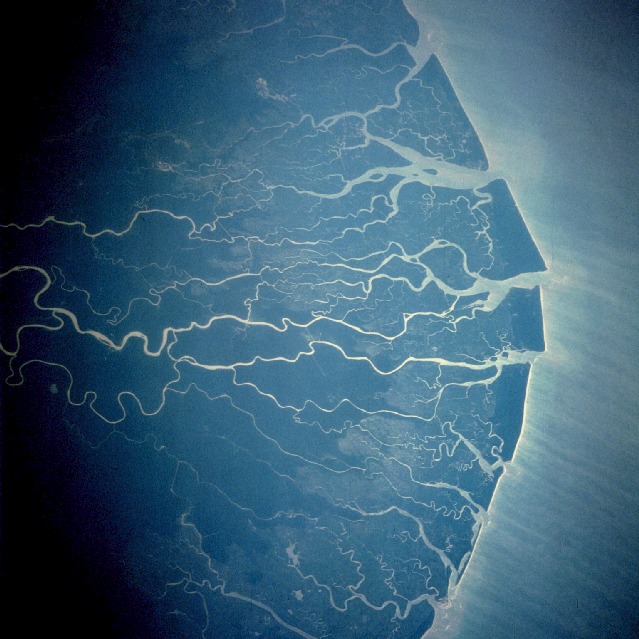
And he may be right that if we don't get a whole lot more active about making significant change, we may well end up being one of those species one day. Jensen doesn't happen to think that the answer lies merely in composting or driving less or buying into the green economy, however. He thinks we have to get together and actually force changes in policy and practice, like the Movement for the Emancipaiton of the Niger Delta (MEND) has done in Africa against Big Oil (for some photos of the impact, see this article from National Geographic). Of course, one man's liberator is another man's terrorist, and the tactics used by MEND militants might be described as either, depending on the context. The people of the Niger Delta have indeed been exploited persistently and often brutally over the last fifty years, and their environment has been trashed just so folks in this town can drive whatever behemoth internal combustion-run vehicle they want to (it's a free country, after all), using fuel that costs less than a gallon of milk does.

The conversation about Jensen's article is running rather mildly (so far) compared to those about earlier essays, but I'm somewhat heartened that people generally seem to think that we can both be more active about how we pursue change and continue to make "lifestyle changes" that lessen our own personal impact on the planet. The armed rebellion option probably won't emerge, because Orion's readers tend to be a peaceful lot, and even though that's really the only way revolutions have occurred in the past, most of us don't cotton to violence--even the fairly mild kind exhibited by the more obnoxious tea-party types.

Violence these days brings with it too many complex consequences. We're still reeling from 9/11, and have since begun to realize that our collective response (kill the bastards) has not ended the threat of further violence. While a goal to end abortions might be laudable, killing abortion doctors accomplishes nothing, and seems counter intuitive if killing is what you want to stop. (Yes, I know that the argument pits the "guilty" doctors against the "innocent" unborn, but that's about as simplistic an idea as one can invent.) We are what we do, and if we do violence we invite violence.

So while I think Jensen is right that we need to be much more assertive in our political and social efforts to effect change, I don't really think we should start manning the canons. And in some cases we have to be rather subtle about how we approach problems, because every other guy on the street seems to have a concealed handgun permit. We can vote, we can join community groups, write letters, participate in environmental campaigns, volunteer, and practice what we preach. If you want to resist Big Oil, buy a hybrid vehicle or an electric car the next time you're in the market, and drive it to the nearest public transportation node whenever you can. (I say drive because the nearest DART station is fifteen miles away. Those of you who have one nearer might be able to walk.)

I don't think that the efforts more and more of us are making--composting, growing your own veg organically, buying renewable energy, increasing energy efficiency, consuming less, recycling more, driving fewer miles in less-polluting automobiles, conserving water--are futile acts of spitting in the wind. They may not be enough, but they're better than nothing. If we can, by example, convince more and more people that change can happen this way, perhaps it really can.

But, as Jensen reminds us, another 120 species went extinct today; we may, thus, eventually run out of time.

Image credit: NASA photo of the Niger River Delta from space (north is on the left), via Wikimedia Commons.