Showing posts with label tikkun olam. Show all posts

Saturday, February 15, 2025

Perhaps Resistance Isn't Really Futile

A North Texas winter sky

Since my last post, I've been experiencing what many like-minded folk have, when practical solutions to current political chaos seem, well, futile. I've often joked that with all of the artificial gadgets that now occupy my body (chief among them an artificial aortic valve--but also stents in old bypass grafts and interocular lenses in both eyes) I'm well on my way to Borghood. The Collective's warning upon meeting any new species is that resistance to assimilation is futile. Try as one might, becoming a fellow cyborg is inescapable. 

Now that this country is in the process of being overwhelmed by the Collective-like apparatus of the fomenters of Project 2025 (including our current president and his minion-in-chief--or is it the other way around?), finding ways to escape the doomsday scenarios that emerge daily seems unlikely, if not (yet) a completely futile effort.

And so, rather than give in to the probably-inevitable cultural and political emergence of true dystopia, and given that most of us (especially fixed-income retirees with ties to hearth, home, and animals) aren't well fitted to actual Revolution, I thought I'd share some of the strategies I've been pursuing to combat utter depression and ease unavoidable anxiety. If you are in a position to actively Do Something (or, as Revrunner advised in a comment after reading my last post, to follow Nancy Pelosi's advice to stop agonizing and start organizing), please do. Please do. Alas, my days of protesting, marching, and sitting in are long behind me, so I have to content myself with sending a few bucks to worthy causes. And--as a few of my loyal readers have advised--keep blogging.

It's probably a very good idea to keep reading, as well, since there are so many wonderful writers and websites and newsletters out there that I keep running across during my weekly exercises in rabbitholery. In terms of actual strategy, here's an idea that's working wonders with my attitude and with keeping my brain from shriveling up and crawling somewhere dark and dank: Re-read the people whose work got you where you are today, intellectually, politically, religiously, or whereverly. For example, I'm currently in the midst of rereading Ursula K. Le Guin's Earthsea works.  Shortly after her death in 2018, I was given the collection of her stories (in the volume at the link). It's a heavy tome, and so I've taken to reading it downstairs in my living-room comfy chair, then continuing with individual volumes upstairs when I go to bed. The troubled universe she describes in the books is disturbingly like ours in its current configuration, minus the mages and magic. But her astonishingly wise take on human frailty--race, gender, economics, art, craft, and the nature of wisdom itself--is both frighteningly prescient and reassuring at the same time. Even though I generally prefer science fiction over fantasy, I have long enjoyed these books and stories. But the science fiction segment of her work explores many of the same themes, which novels such as The Left Hand of Darkness, The Dispossessed, and The Telling consider in equal depth. [Even though I haven't joined their affiliate program, I would urge anyone who wants to buy these books to order from Bookshop.org, or directly from the publishers, rather than to enrich Mr. Bezos more than we have to. Another option: buy them used from a local bookshop.]

I also plan to revisit Octavia Butler's Parable of the Sower, which begins in what was then the "near future" of 2024 (the book was first published in 1993) and in the very LA neighborhoods (Altadena and Pasadena) that have been devastated by the recent fires. Although Butler died in 2006, her legacy has survived in part because of her own prophetic vision--and the diligence with which her readers preserve her work and its messages. 

In addition to reading, I urge folks to write--to blog, to start a Substack, to send letters to the editors of local newspapers, and to avoid the attention-culture as much as possible. Although I do have an Instagram account, I only use it to follow a few writers and a local prairie gardener. I use Pinterest only as a curatorial tool for myself; I don't engage with anyone on it. I visit Quora less and less, and usually just to answer questions about cookery and being old. I've avoided twitterhood entirely, and see no reason to subscribe even to Bluesky--although if you find such a platform necessary, it's probably the best available choice at the moment. I try to subscribe to media populated only by folks who think and write about what they're thinking, but when I do, I resist requests to follow platform "recommendations." I will shortly be going through my own blog roll to make sure any links are active, relevant, and worthwhile. If you're interested in the cultural can of worms the Attention Economy has dumped on us, try reading Jenny Odell's How to Do Nothing [a web search will turn up videos, workshops, and discussions on the book] or Chris Hayes's The Sirens' Call: How Attention Became the World's Most Endangered Resource. [Again, there's a great deal online about this book, including interviews and Hayse's own podcast.] 

The benefits one can derive from keeping a journal in dark times seem, at the moment, immeasurable. In part because of what I often describe as "sleep-related marble-leaking" I tend to forget things quickly. It does, therefore, help considerably to spend an hour or so several times a week trying to record things that might be needed at some point in the future. My father's deathbed advice to my children was to "write at the end of your stint," which I've taken in earnest during the last decade or so. But don't wait! Do it now! My son will be fifty next year, and although I can plainly remember the jollity with which he posted a sign on my office door (during his brief studenthood at the Art Institute) announcing my own fiftieth birthday, that's just another indication of how quickly it all goes by. And keeping journals (I now have several, on reading/thinking, cookery, gardening, and design ideas) helps organize the brain, provides a creative outlet, and gives you something to do with all the free time you have if you give up futzing around on Tik Tok or Instagram or Facebook. If you need to keep in touch with people, write them letters in email and keep a record of the correspondence. I still have the letters my father and I wrote to each other via email from about 1997 to 2004. I copied them, printed them out, and cherish them to this day. They're like journals, only with more dimensions.

Finally, try a bit of Tikkun Olam--the Jewish practice of finding ways to heal the world. The link is to a page on the Orthodox understanding of the term, and it provides some useful ways to think about taking care of an increasingly endangered planet.  Every little thing we do, especially if multiplied by others, helps to stem the tide of of demise. Keeping even a little garden, providing even a tiny bit of habitat for wild critters, home-keeping, spending time in the out-of-doors, helping neighbors, buying less stuff, driving less, using less energy,  paying attention to the planet--even simply sky-watching. 

We really do need to enjoy what we have while we have it--and to do what we can to keep from losing it. 

Thursday, September 5, 2013

Reaching The Season


Last night I played hooky, sort of, by meeting with my visual anthropology students only long enough to make sure they were working on projects due next week. Then I lit out for home in order to get there before sunset.  As ambivalent as I am about the notion of "home" in Texas, I wanted to be there to see in the new year.

Mind you, we are not a terribly celebratory family. Not only are we not religious, but we don't even mark many secular occasions.  For example, Tuesday was the twenty-second anniversary of my marriage to the Beloved Spouse.  We were married at the Cook County courthouse in Chicago, the day after Labor Day in 1991.  We had decided only the previous Thursday that we should make honest people of ourselves after three years of co-habitation, so we applied on Friday for a license; by law we needed a two-day cooling-off period, and the following Monday was a holiday, so we had to wait for the Tuesday.  So, on September 3rd, we got hitched by a lady judge who miss-heard my intended's name as "Ronnie" (later on we did wonder if we were legally married, since his name isn't "Ronnie"--but the certificate listed him correctly, so we decided we were actually wed in the eyes of the law). She also seemed disappointed that we didn't have a camera with us, but sent us on our way when it was all over. We had lunch at a really bad steak house that showed soap operas (coincidentally, "Ronnie's"), and I went back to work at the Terra on Michigan Avenue. The newly-minted Beloved Spouse went home to write a paper.

In the intervening years, he's finished his Ph.D., I've abandoned mine, we've moved back to Texas, and come to miss Chicago terribly.  The Terra Museum of Art is no more, and most of the bookstores we loved are no longer in business. The Cubs are still doing badly (except for that one blip a few years back), and the skyline has changed dramatically. So, when my daughter reminded me on Sunday that the anniversary was coming up, we reminisced about old times. But we didn't do anything else to commemorate the day.

Nor do we celebrate holidays much. Birthdays get noticed more than any other occasion, and we do try to get whatever family is available for Thanksgiving. But religious holidays, whether Jewish or Christian, tend to go by without much fanfare. So there are no big family Seders any more (my daughter goes to Minneapolis for Passover most years, to celebrate with her much more religious father), and I'm the only one who even notices when the High Holy Days arrive in fall--not because they're holy, in particular, but because they mark the passage from year to year.  I like the idea of an autumn (or, in this case, late summer) new year, at the New Moon, with the season changing from hot to less hot, late tomatoes, the last of the hatch chili crop, Mexican avocados, and pomegranates.  The garden is spent, wilted, and sadly neglected except for an occasional (and often illegal, due to drought restrictions) watering of the potager.

I arrived home in time to watch the sun sink and tint the sky pinkish.  I poured myself a glass of pomegranate juice and San Pellegrino and went out to catch the end of the year. The dogs loved going out after having been cooped up all day, and we spent a few minutes enjoying the cooling temperatures (it had gotten up to 100 F, but was down in the low 90s) and the dropping humidity before we went back indoors. The rest of my evening was spent being nostalgic about Philadelphia, because the current issue of my alumni magazine had arrived in the mail.  I was happy to note that nobody I'd known had died since the last issue. Another (non) event to celebrate.

Sometimes I wonder about my basic optimism.  As cranky an old bitch as I pretend to be, I really like the fact that I'm still alive. I don't have many friends, but my spouse and my children count, along with my first husband (or, as I think I've referred to him in the past, The Initial Spouse--who recently sent me photos of our wedding in honor of its 45th anniversary) and an old chum from Taiwan days, both of whom still keep in touch. Work keeps the TBS and I from socializing much, but I really do enjoy just thinking and reflecting when I have time--things I'm not sure I appreciated when I was younger.  Whenever I say anything about wanting to live as long as I'd like to (I'm hoping to beat my grandmother's record and make it to 105 or so), folks ask me why--and I just say something about wanting to see how things turn out.  Maybe I'm waiting to see if the flying cars ever get here. But I'm not pessimistic enough to expect Armageddon--just realistic enough to think that we might somehow muddle through without killing ourselves off by being too stupid. 

The potential for improvement keeps seeping into the conversation:  ways to produce energy without smothering the planet, ways to make peace possible, ways to explore the universe, ways to feed the hungry, ways to stabilize global population and sustainably raise the standard of living for the severely impoverished.  I'm not terribly sanguine about the public will it would take to do any of this, but I am hopeful.

So perhaps its the utopian impulse that kicks in when seasonal milestones take place: why I celebrate (by at least noticing) solstices, equinoxes, and seasonal changes.  They remind me that I've made it through one more cycle.  I could have been dead twenty years ago, or five years ago, but I'm not. I'm still here. I still have students who remind me that what I do for a living has some meaning, I have children I'm glad I brought into the world, and I ended up married to a tennis-coaching philosopher who makes me laugh and who's terribly fun to be around.

Who knows. Maybe before this time next year someone will start working on the idea of smaller energy grids (when enough people vote down huge high tension wires in their neighborhoods), or a blight will wipe out all the GMO corn crops, or somebody will invent a space drive that makes travel to other planets or solar systems possible before I'm 105. There's always hope for tikkun olam: healing of the world.

Jews mark most transitions with a blessing: "Blessed are You, Lord our God, Ruler of the Universe, who has granted us life, sustained us, and enabled us to reach this season." It's my favorite brucha (blessing), in part because it's not a prayer in the sense of a petition. It's an acknowledgment, an expression of gratitude, that can be addressed to the universe as a whole, even if one isn't a believer. At Rosh Hashana, it's generally said upon eating a fruit for the first time since the previous new year. I say it over figs in the spring, and sometimes over pomegranates in the fall.

To anyone who still reads this blog, Jewish or not, l'shana tova--I wish you a good year, happy, peaceful, and with many years to come.

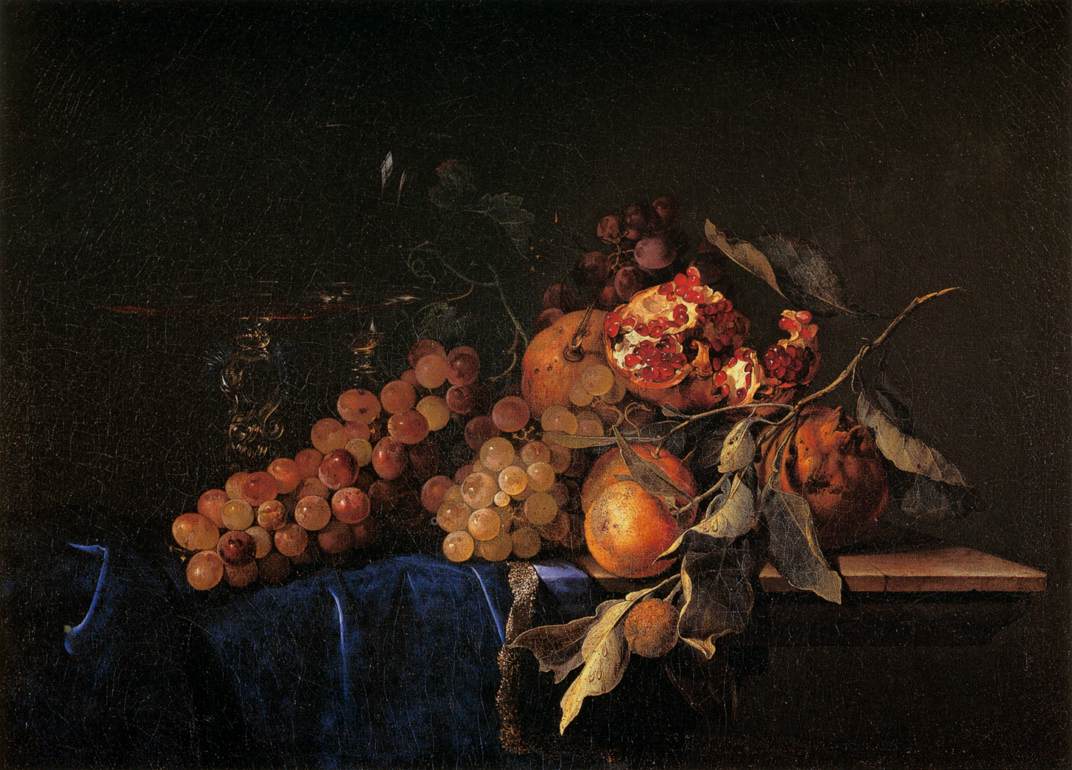
Image credit: Pomegranates are rife with symbolism in ancient cultures. Their multitudinous seeds can represent fertility, fecundity, wealth--all appropriate concepts at the passing of seasons. This painting, Still-Life with Fruit and a Crystal Vase is by the Baroque Dutch artist, Willem van Aelst (ca. 1650), via Wikimedia Commons.

Monday, January 18, 2010

Heal Haiti, Heal the World

I guess it's because of my geographical roots (I was born on a major fault, where a 7.2 magnitude quake occurred in 1872), but earthquake stories always seem to evoke a combination of fascination, dread, and gratitude that I wasn't there, where it happened. So when Haiti suffered its first major earthquake in two centuries, I was struck by the enormity of the catastrophe and like many others wondered why this had to happen in Haiti, of all places. Hadn't this tiny island nation suffered enough?

Last Thursday I left school in time to catch the last few minutes of The World on PRI. Amy Bracken was reporting about recent, pre-earthquake hopes for improving the lot of millions of Haitians, and about U. S. efforts to reduce disease and poverty in this embattled country. She described an interview with Dr. Paul Farmer, who (along with former President Bill Clinton) has been helping to spearhead investment in the country and to alleviate the effects of Haiti's long history of neglect by the rest of the world.

As Bracken said goodbye to Farmer after the interview, he reminded her of the "hermeneutics of generosity"--an inclination to give. The "H of G" as he calls it, involves a much deeper concept than this shorthand definition, but I was intrigued enough to pursue it. Hermeneutics is part of what I do (it refers primarily to what might be called a "science of interpretation," the theory behind the translation process), although it's most commonly used in a theological context: biblical hermeneutics, for example, which involves interpretation of scripture. This sense is, I think, the source of Farmer's usage--the grounding of generosity in the Christian tradition; it's also a vital component of Jewish teaching and lies behind the notion of the mitzvah.

I discovered, while looking for the exact phrase, that it informs the communitarian focus of some churches and synagogues, and expresses the fundamental concept of charity toward others.

This impulse may explain my tendency to scour the dregs of my bank account in response to global disasters, like the Indonesian tsunami of 2004 and last Tuesday's earthquake. Almost my first response to an event like this is to send what I can off to Doctors Without Borders. And millions of others do the same, within minutes of news reports. Others join their fellow relief workers and jump on the next boat or plane to help out physically.

Amid all the destruction and sheer misery, it may be grasping at straws to see these responses as reflecting any great human truth. Nonetheless, the idea that human beings have an innate capability to translate one nation's suffering into something palpable enough to engender a useful response is reassuring. Perhaps we aren't all so wrapped up in our own D/depression that we can't feel the distress of others. Perhaps this kind of understanding--the hermeneutics of generosity--is more a part of who we are than the greed and churlishness that has characterized the news so much of late, and more reflective of our true nature than the usual "God did it to punish them" response that also emerges.

Our metaphor-making capabilities as human beings allow us to understand something--if only a little--of what people experience when disaster strikes. Few of us have first-hand knowledge of what it's like to endure a severe earthquake or a tsunami, or even a massive hurricane or typhoon, even though these do strike us periodically. Even when a Katrina devastates an entire region of the United States, and even as badly as the relief efforts turned out there, we didn't end up with thousands tens of thousands dead in the streets. Our infrastructure may be in need of repair, but the means exist to do make it better. Haiti is much less well prepared to withstand this latest blow. (Edit 01.19.10 after this morning's headlines.)

Those of my colleagues who think I'm the quintessential pessimist may be surprised to know that I actually do harbor hope that if Haiti can withstand the inevitable chaos that follows disaster in an already politically unstable region, it may well be that the attention attracted by the massive (and unfortunately ill-coordinated) relief efforts will lead to an effective political and cultural rebuilding.

If you search Wikimedia Commons for pictures of Haiti (specifically Port au Prince) it's easy to be reminded of the continuous insults inflicted on the entire island both by natural disasters and by an almost constant political unrest. Before the earthquake, it was Hurricane Jeanne (2004) and then Ike (2008), in addition to all of the political woes experienced by a nation that's been both exploited and neglected for over two centuries. But the same search will indicate the ongoing effort over the last several years to improve Haiti's physical and economic health.

Everything I've heard about the Haitian people over the last week has pointed to their liveliness of spirit and their creative energy. Perhaps implementing a hermeneutics of generosity and extending it into the future, beyond the immediate need, can help save them and help them save themselves.

If you want to participate in the drive to help Haitians, and haven't yet done so, I have two charities to suggest: Doctors Without Borders (Médecins Sans Frontières) and Heifer International. The former is a fairly obvious target, because they're almost the first people on the ground when something like this happens. Heifer, known more for helping families to help themselves, has 16,000 participating families in Haiti who have been actively involved in raising animals and improving agricultural practices to provide both sustenance and income. Programs like these address both health and economic well being, and provide living, breathing examples of the hermeneutics of generosity at work.

I talk a great deal about ways to heal the world (tikkun olam); it seems to me that helping Haiti to heal itself would be a good place to start.

Photo credits: A view of Port au Prince in 2008, U.S. Navy photo by Chief Mass Communication Specialist James G. Pinsky; a United Nations Development Programme photo of Downtown Port au Prince after the earthquake; and another U. S. Navy photo of flooding after Hurricane Ike.

Monday, February 9, 2009

The Reader in the Garden

There's currently something of a stew about the future of newspapers (and see this article in The Economist), but this morning I realized just what I would miss if even our local rag were to disappear.

Due to other preoccupations yesterday, I failed to read the "Points" section of the Sunday Dallas Morning News. But since I actually remembered that I'd forgotten to read it, I pulled it out of the recycle bin this morning to catch up, and took it out with me to the garden to enjoy in the unusually clement weather apparently caused by global warming. Since I've been blogging, this has been my favorite section of the paper, because it frequently brings me new items about which to get my dander up, and keeps me apprised of both local and national opinions on matters both great and small.

And so it is that I came upon an especially relevant essay, "Hard Compromise for a Rural Jew," and an even more relevant blog: Casaubon's Book. Mind you, I might well have tripped over the blog in my travels around the web, and been attracted by its intriguing title (George Eliot's Middlemarch is one of the books I read young and that literally--in the literary sense--changed my life), not even knowing about its focus: oikos. As its author, Sharon Astyk, notes,

The problem isn't just the economy, or our energy use, or global warming - or rather, they are all part of the same larger problem.

The overall content is focused on some of the same things that get ranted about here on the Farm (and occasionally on the Cabinet), but she's been at it a lot longer (since 2004), and she's a real farmer (in upstate New York), and a real Jew (as opposed to whatever I now am), and an actual published writer. Her aim, like mine, however, is tikkun olam, and she writes about how to do it.

In the article (an adaptation of a blog post) Astyk discusses the difficulties of being an observant Jew who lives in rural New York in order to farm. Now, since Jews are by nature community-bound folk (she points out that Jewish practice requires others--a minyan is needed for almost everything important), the fact that she has to drive thirty minutes on Shabbat to get to a synagogue requires a compromise she's not comfortable with. In fact, this is why it's harder to be Jewish than it is to be Amish, because the Amish are still a farming people, whereas Jews (who were once a farming people) have all moved to cities and suburbs. Over millennia, in fact, Jews have systematically been deprived of farms, making them especially leery of investing their wealth in land--either that or it has driven them to see owning land in Palestine as a divine right and causing a rather ironic set of problems.

Astyk's blog is erudite, wide-ranging, literate, and funny. The article reprinted in the News doesn't let on that she's also a Peak Oil activist--which might lead some readers to think she's some kind of apocalyptic nut. But she's no nuttier than Mormons who keep a year's supply of food in their pantries, or than anyone who wants to be as self-sufficient as possible, and her advice on gardening and storing food is fun to read and highly instructive. In fact, I plan on reading her garden design posts rather seriously to help me overcome some of the problems I've been wrestling with over the years. I don't have a farm, but I would really like to make the part of my garden that isn't consciously accidental (is that an oxymoron?) more productive than it has been in the past.

The trouble with reading the newspaper in the first place (and watching the increasingly pessimistic economic news on the telly) is that the Peak Oil people make more sense every day, especially as some of their predictions begin to pan out. I've been aware of oil reserve depletion since I heard King Hubbert speak to geology students at Penn back in the seventies, and have never been convinced that he was being overly pessimistic. Regardless of whether these folks are right or wrong, however, Astyk's discussions on how to preserve and store food, how to grow it in the first place, and how to preserve community at the very least offer an anodyne during times of economic confusion and discomfort. Her practical advice also makes a great deal more sense than the "ten things you can do to save the earth" remedies.

To top it off, she also considers the conundrum faced by print news, especially papers that also host free online editions: Why Buy the Cow When I’m Giving Milk Away for Free? The Problem of Newspapers (and includes in her consideration those of us who publish online for free).

In parting, I'll add to the problem by posting a link to the list of 2008's ten best online newspapers, according to the Bivings Report. The Dallas Morning News wasn't on the list (with good reason, since the Points section and the funnies are its best parts even in print, and the online version is difficult to navigate, to put it kindly)--but my other morning (online) paper was #1: The New York Times.

Saturday, May 24, 2008

Feeding and Clothing the Future

This is my final post on the Tikkun Olam (healing the world) project that began last week, and it's a difficult combination of topics to discuss. It's hard because the culinary arts and fashion design are both professions involved with basic needs, but both can also be seen as emblems of greed and excess (to many reformers, at least).

Mind you, I don't really teach culinary students much any more (except for the occasional graduating student in desperate need of an elective, and who thinks art history might be an easy grade), but some of my favorite former humanities students are now chefs, and the new BFA programs in fashion design and merchandising have meant an influx of students I'm not used to teaching. I've been enjoying them immensely, though, because they've so far proven bright, creative, and interested--and their superior grades have reflected these qualities.

Those who know me probably chortle at my having the chutzpah to discuss fashion, since my chief criterion for garments is comfort, and I'm not what you'd call a fashion maven. My priorities are such that clothing falls fairly far down on the great chain of being, although if I had my druthers (and a great deal more time) I'd make all my own out of sustainably harvested fibers woven and dyed (naturally) by well-paid garment workers in airy, pleasant surroundings.

And this is where the healing question comes in: why is it that Americans would rather pay bottom dollar for clothes and food whenever possible, despite the fact that the production of cheap food and clothing means that workers are exploited and the environment degraded in order to supply these markets? Food sustains us, clothing protects us, and both allow us to reflect our cultural affiliations and creativity, and yet we are extremely reluctant to pay real wages to the people who grow and harvest the basic materials. As Jubal Early would say (in the Firefly episode, "Objects in Space"), does that seem right to you?

While it's true that factory farms are raking in the dough and that high-dollar clothiers are rolling in it, most of the people who do the legwork (farmers, farm workers, stockers, cashiers, waiters, bussers, clerks, tailors, etc.) often do so for minimum wages or less, are seldom provided with insurance plans, and frequently work well beyond a forty-hour week. Some of these people are even experiencing situations that closely resemble slavery (see especially the information and links on the Alliance For Fair Food page). "The Working Poor" has become a buzzword, but the fact remains that too many of the people who work harder than the rest of us are paid much less and earn barely enough to survive.

I can't fix this, and neither can my students. But we can help by being much more mindful about how we use our talents and how we spend our money. We can, for example stop buying fast food altogether. We can eat less meat, and make sure what we do eat is humanely raised and killed and safely prepared, even if that means changing our eating and buying habits radically. For example, most of the world uses meat as a flavoring--not a honking great steak on a plate as the main course. A few bites of chicken in a well-prepared sauce heavy on the veg and eaten over a bowl of brown rice or other whole grain is not only more healthful, but pretty tasty as well. Cook up some rice to keep in the fridge for a couple of days, and you've got the basis for a number of quick meals that are better for you than stopping by McD's on the way home.

But "I can't," I hear my students say. "I can't live without meat." "I can't live without hamburgers." "I can't afford anything better." Baloney. Years ago, I lived (on purpose) for several months on a welfare mother's budget. It was another of my social experiments, designed to help me figure out what I need and what I merely want. Not only did I succeed, but my husband and son were better fed after I began to cook everything from scratch. When I began to grow some of my own fruit and veg, the repertoire expanded, and I managed to re-educate our tastes so that we were able to accumulate enough money for the down-payment on a house with what we saved on food alone. I'll admit that I was not working at the time (stay-at-home mom), but that meant I had no income of my own, and I was also going to grad school part time. And while my students may not be able to grow anything in their apartments, they certainly can learn how to feed themselves more healthfully and more economically. All one needs is will and education.

I've actually discussed questions of mindfulness and food on three other posts, Utopian Pizza, The Raw and the Cooked, and Tangled Webs, all of which consider cultural aspects of food and eating in greater depth. It's harder to rethink fashion, because the whole industry is founded on a couple of problematic principles: a designer's job is based on the idea that clothes go out of style, and the merchandiser wants those clothes to go out of style as quickly as possible in order to keep the industry profitable. I do, however, wonder what the world would be like if we were to design for sustainability instead: styles that never get "old" made from earth-friendly fabrics and dyes by people who aren't exploited.

"Style" based on comfort, practicality, and ethical considerations would be far more appealing to many of us than what's being turned out so frequently today: breast-, butt-, and belly-exposing designs that titillate and seduce, clothes that glorify less-than-desirable human foibles such as drug-use, war, or other forms of excess. Plenty of cultures rely on a few basic clothing items which vary in color and fabric, but little else. But just look at tribal designs in parts of Africa, or saris on a street in India, and you can see that clothing can be expressive without being simply trendy.

What if the quest for the latest fad were replaced by a quest for durability, originality, practicality, and true beauty? Wouldn't it be better to own a few garments that make us feel good, move with our bodies, keep us appropriately warm or cool, and express our sense of color and style without making us all fit into somebody else's idea of what a man or woman should look like? Wouldn't it be better to dress our kids in comfortable, durable, colorful clothes that enable them to move and play freely without trying to make them look like baby soldiers or hookers?

Clothing and feeding are two of the most important things we do for ourselves, in addition to finding a place to live. If we're going to keep this world working for the next few generations, we're going to have to start being much more mindful about how we address questions about how we go about satisfying our needs. And it's precisely because these are needs that they deserve the careful consideration of those who will be working in directly-related professions. Fashion designers and chefs will have a great deal of impact on our economic future. It would help, I think, to remember that "economics" refers not only to the financial well-being of the country, but to the the cultural and ecological well-being of our oikos--our home: this planet.

For resources on these topics, see the "Education of Desire" sites linked on the left. They're good places to start.

Addendum: It occurs to me, a day later, that my remarks about food's costing too little may seem facile and naive when many of the nation's working poor have to choose between spending money on food or on rent--or make any number of equally difficult choices. But a significant number of these same people are the ones who are providing food and food services to the rest of us. It's precisely because they're paid so little that food is relatively inexpensive in this country--especially compared to what it costs in other developed areas of the world, such as Europe. If people received pay equal to the value of their labor, and if profit weren't the major incentive for everything we do, a more equitable economy might result. A good article on the topic by Darra Goldstein can be found in the current issue of Gastronomica.

Photo: Female vendors sitting on the ground at a fruit and vegetable market in Kuchaman, Rajasthan, India. By John Haslam, on Wikimedia Commons.

Monday, May 19, 2008

Graphic Healing

I am amazed, every day that I teach, by the sheer variety of talents my students possess. A large number of them are budding (or even working) graphic designers, and most of them are thoughtful people with ambitions that range from the practical to the lofty, and have discussed with me what they perceive as a sort of "moral danger" attached to what they do, a concern a thoughtful person might have about any field in which technology and money are involved.

What are designers to do, after lumbering themselves with a five-figure debt that will, with interest, most likely run into six figures before it's finally paid off (depending on how they've financed their education)? The easy answer is to sell out to the highest bidder, ask no questions, and do what they're told for the next few years. After that, who knows?

But some of these people are already asking tough questions. How can I do what I love without adding to the myriad problems now facing this fragile planet? Graphic design as a profession is, after all, replete with potential problems. Printing can still involve the use of toxic chemicals, not all of which are disposed of properly (although alternatives are now available). Computers themselves are hardly "green" by nature--and even the most environmentally friendly of them may outsource jobs, impact wildlife habitat, and contain chemicals and materials that will eventually find their way into the waste stream. Not only that, but advertising in particular is a field that all too frequently preys upon human insecurities by manufacturing desire. Human beings like stuff, and most of the businesses that hire designers are involved in making stuff that advertisers are hired to help them sell: whether or not it's necessary, truly useful, or environmentally benign. In the worst cases, advertisers and designers are involved in promoting causes with which the individuals involved may disagree on moral, political, or religious grounds.

It's truly difficult to make choices with the potential for world-healing in an economy that seems to be bleeding away chances for decision-making. While the supermarket shelves may be stocked with seemingly limitless choices among breakfast cereals, there's no telling how long many jobs in the companies that sell these products will be available. Not that selling sugary, chemical-laden breakfast cereal is an ideal job--but it's the kind of job agencies produce.

If you're willing to take a little longer to retire the debt, several options present themselves. Working for non-profit institutions, especially those engaged in bettering the lives of others, may not pay as well as working for Big Advertising, but it generally does pay a salary. You get to meet like-minded people, and work for change at the same time you get to use your skills and talents. But if you do have to settle for a job with The Man, you can still help by doing pro bono work for something you care about. If you freelance, you can build a clientèle of nonprofit groups by charging on a sliding scale, offering your services at lower rates for groups doing work you believe in. You can also focus a portion of your portfolio on "good works" that show off your skills and your commitment at the same time. This runs the risk of alienating folks who don't agree with your causes, but you probably wouldn't want to work for those people, anyway--right? Your portfolio should not just show off your skills; it should provide potential employers with an idea of who you are, and what motivates you.

Asking the right questions can also help make decisions about jobs. During interviews, designers can certainly ask about a company's mission, about the diversity of its workforce, about its clients. Many companies are developing "greener" policies and jumping on the environmental bandwagon as a way of promoting themselves; discussing these issues can help you determine whether their interest is superficial (purely for promotional purposes), or whether they're truly committed to lessening the company's impact on the planet.

In other words, as corporations become more and more concerned about their public images, it may be easier and easier to find jobs that don't compromise designers' priciples. When you have choices, and the best among you will always have choices (well, unless the economy completely tanks, and then we're all in trouble), opt for the job that not only matches your skillset, but is also compatible with your philosophical understanding of the world--even if it doesn't pay as much as a company that doesn't fit as well.

Employment in the field of graphic design is not, by any means, restricted to advertising. Web design, illustration, technical drawing and design, communications media, and education are all fields graphic designers enter, and some offer fewer moral challenges than others. Even if your life's ambition is to design skateboards or teeshirts, you can find yourself in a position to choose materials, and these choices can be made in terms of environmental and/or social impact. Small efforts can often produce significant results.

Think of the promotional possibilities: Joe's Earth-friendly Skateboards, sustainably built, using 85% recycled materials, or Emily's Earth-Shirts: 100% Organic Cotton and Natural Dyes. Donate part of your profits to the World Wildlife Fund or Heifer International, and you'll double your impact! Hell, I'll even buy one (tee-shirt, that is . . . don't think I'll ever get on a skateboard again).

Better yet, think even more deeply about what you're doing, and choose a path that leaves the world less full of stuff. We probably don't need more tee shirts and skateboards, after all, or at least not all that many of them. But surely we can find ways of using design talents to foster sustainable living, by reducing waste and increasing the longevity of what we manufacture. In order to find ways of living that minimize our impact on the planet, and jobs that don't add to the problems that already exist, the first step involves thinking carefully about what we want, what we need, and how we can achieve an appropriate balance between the two.

This is what education is about, and why my students have to take general education courses that introduce them to philosophical concepts related to their fields. In view of this mission, as a general studies instructor I'm assigning the following to get my graphic design and web folk headed down the right path:

In addition to my blog, please see this one: Slow Making, which considers craft as lifework, not just as employment. You might also read "Fear of Not Having Had" in the most recent issue of Orion magazine, which explores the culture of accumulation to which we belong, and raises questions that should be part of your career decision-process.

More discussion to follow. See you in class.

Photo credit: First Aid in 1920 and 1929, from the Meyers Blitz Lexikon, via Wikimedia Commons.

Sunday, February 10, 2008

Things Are Looking Up in the Year of the Rat

My students often accuse me of being “cynical” (which most of them think means “negative” or “pessimistic”) in my outlook on the world. I somehow doubt, however, that a person with a fundamentally negative or pessimistic world view would spend ten years writing about how it could be better. Anyway, cynical literally means “dog-like”–essentially suspicious, rather than merely “negative.” I will admit to focusing very often on what’s going wrong, if only to articulate my own perceptions about the modern (or post-modern) world and provide suggestions for improvement. A blog about how happy and cute the world is (like the rather precious lai shi, or red packets in the photo) would not only be out of character, but probably really boring as well.

Nonetheless, in honor of the Lunar New Year, I thought I’d point out a couple of heartening events brought to my attention by the local news-rag, The Dallas Morning News. Both involve religion (an appropriate focus for an essentially religious holiday), a topic I tend to avoid because it has a tendency to raise my blood pressure to dangerous levels; but both offer me some hope that all is not lost and we’re not all going to eventually fall into tiger-traps dug by well-meaning but narrow-minded folk who think their way is the only way.

It's not that I have anything against religion as a human cultural phenomenon. In fact, I have participated happily in two ancient religious traditions (pre-Vatican II Catholicism and Conservative Judaism) and also admire many aspects of Eastern faiths and Islam. I am grateful for what they all have taught me. I have lots of very religious Christian relatives and Jewish and Muslim friends who are very reasonable people. But modern evangelical Christianity, extreme militant Orthodox Judaism, and radical Islam have all contributed to my current anxiety about the future of the planet. So when I read these two articles this weekend, my Doomsday Blood Pressure Monitor was set back to healthier levels, at least for a while.

The first is local commentator Steve Blow’s column for today’s edition, “Finding room for evolution in the pulpit.” Now, I have never understood why archly conservative Christians and Jews have a problem with Darwin’s description of natural selection and species-change. I have always seen the evolutionary process as a grandly beautiful scheme, profound in its efficiency and complexity. If ever anything were to convince me of the existence of a Supreme Being, in fact, evolution would be a considerable factor. So my consternation about “Creationism” and “Creation Science” has stemmed from a view that their proponents simply lack interpretive skills. It’s okay, it seems, to see the sexual innuendo in the “Song of Songs” as metaphor, but creation itself had to take place in exactly seven days in 4004 BC(E). Not only that, but God planted fake fossils in the layers of the earth to fool us and/or test our faith.

Coincidentally enough, the same edition of the paper, in the main section, carried an Associated Press story, “Anti-evolutionists target Europe,” about how those godless Europeans are now the focus of a campaign by “Answers in Genesis”—a group out of Kentucky that wants to inflict its particular brand of biblical interpretation on folks in England and on the Continent. My hope, of course, is that reason (given to us by God, right?) prevails, as it seems to be among local Methodists, at least those under the guidance of Senior Pastor Timothy McLemore in Kessler Park (in Oak Cliff, an old southern suburb of Dallas). Dr. McLemore is participating today in Evolution Sunday, according to Steve Blow’s column, because he’s concerned about the injection of religion into the teaching of science: “‘I think the Bible gives us a great creation account, and I think it's profoundly true,’ he said. ‘I just don't think it was ever intended to be scientifically true or even historically true.’” Blow notes that Evolution Sunday emerged from The Clergy Letter Project, which is designed “to demonstrate that religion and science can be compatible and to elevate the quality of the debate of this issue,” according to its website.

It was pretty heartening to discover that the Clergy Letter Project has over 11,000 signatories, all of whom believe that “the timeless truths of the Bible and the discoveries of modern science may comfortably coexist” and that “that the theory of evolution is a foundational scientific truth, one that has stood up to rigorous scrutiny and upon which much of human knowledge and achievement rests. To reject this truth or to treat it as ‘one theory among others’ is to deliberately embrace scientific ignorance and transmit such ignorance to our children. We believe that among God’s good gifts are human minds capable of critical thought and that the failure to fully employ this gift is a rejection of the will of our Creator.” Were I a believin’ man, and a clergyperson, I’d sign it, too.

In Saturday’s Religion section—a shadow, I regret to say, of its former award-winning self (it used to be an entirely separate section, but has dwindled to a single page), special contributor Mary Jacobs interviewed Brian McLaren on the occasion of a conference he’ll be holding in Dallas on February 22 and 23. McLaren is touted everywhere he’s mentioned these days as having been designated by Time Magazine (in 2005) as one of “25 Most Influential Evangelists”—right up there with Rick (Purpose Driven Life) Warren and Douglas (Fellowship Foundation) Coe.

That’s some pretty scary company in my book, but I found myself intrigued by much of what McLaren says in his interview and after having looked through his website and blog posts. His message describes a Christianity much closer to that I was introduced to by Franciscan and Benedictine friends of my mother in Taiwan, and much more closely attuned to contemporary environmental and social realities than that professed by most highly vocal evangelicals. He seems to have little patience for what he calls “fans of Jesus . . . who seek to be adherents to the Christian religion, believers in certain doctrines, consumers of religious products and services, and attenders of religious meetings without being radical disciples of Jesus in their daily lives” (from his “Faith and Action” outline). He puts an entirely new spin on the “what would Jesus do?” conundrum.

What I find most interesting about McLaren’s message as it’s being presented in conjunction with his new book, Everything Must Change and its associated conferences, is that many of his points coincide with aspects of the “conversations” that I work through in More News From Nowhere. Descriptions of the “prosperity” crisis and the “equity” crisis (both of which I’ve talked about in a couple of blogs on being poor and being wealthy) resonate with many of the issues I’m concerned about. He also recommends real-world solutions, such as buying, eating, working, and investing ethically (with practical suggestions on how to go about doing so). If you can get around his somewhat inflammatory buzzwords (“suicide machine” and “covert curriculum” are especially irritating) and suppress suspicion regarding the conferences (they cost $109 to attend, $79 for students, so one can only hope that the proceeds are supporting the mission rather than the missionary), I think much of what he has to say is important to hear, especially for Christians. The fact that he mentions the Hebrew concept of tikkun olam (earth-healing, world-transformation) is also appealing, because it ties his mission in with a longstanding movement among Jews (best articulated in Tikkun magazine).

Maybe all this is a sign of better things to come: a more reasonable, sustainable, year of the Rat. Gonxi facai, everyone—the Chinese equivalent of “Live long, and prosper” (ethically, of course).

Photo credit: “New Year's items being sold at Dihua Market, Taipei, Taiwan” by BCody80, Wikimedia Commons. Note the infiltration of Disney into the traditional “red packets” for sale.