Showing posts with label EMP. Show all posts
Wednesday, September 2, 2015
The Carrington Event
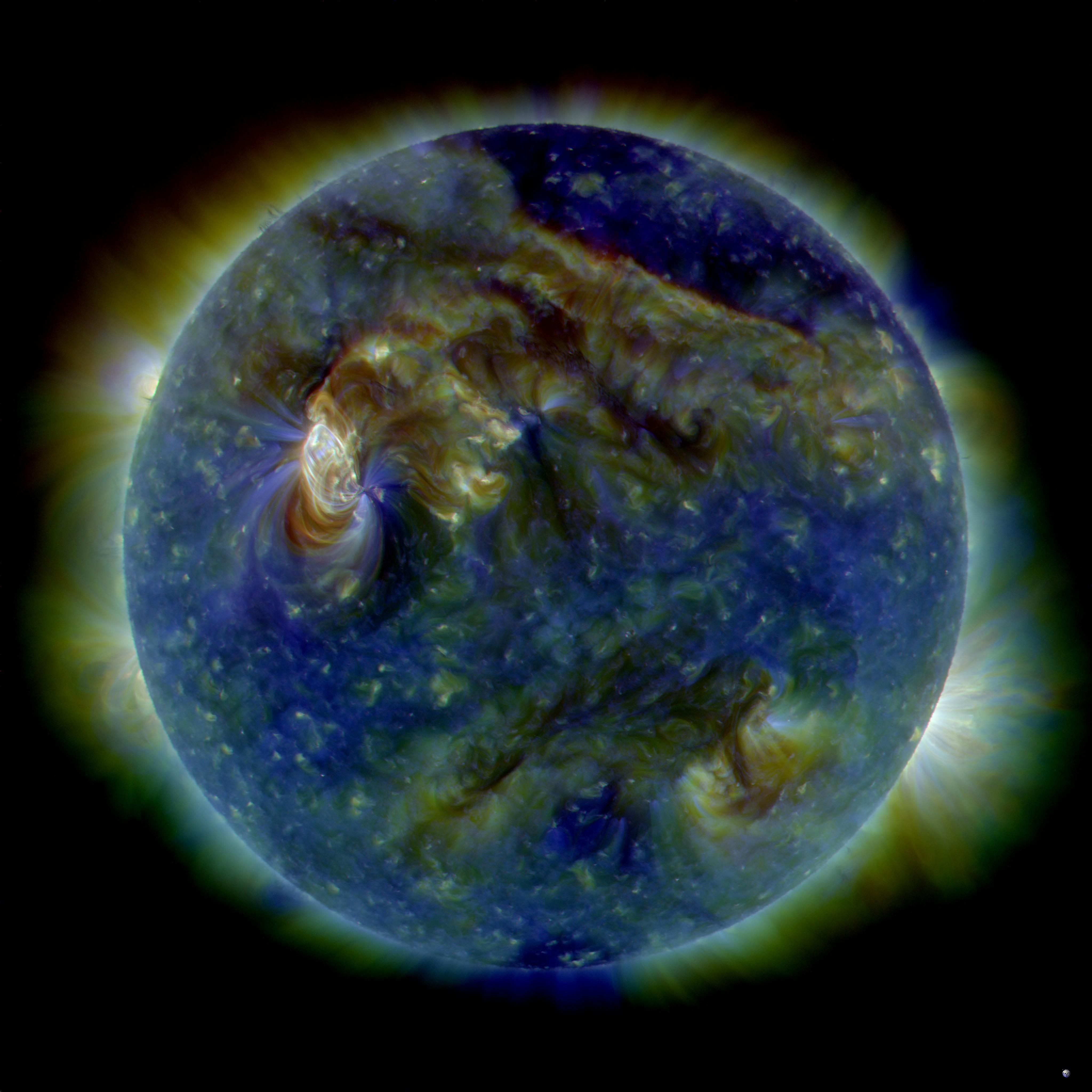
One of my favorite science fiction scenarios is the production of an EMP (electromagnetic pulse) that wipes out our digital technologies and transforms society as we know it. I first learned about this phenomenon many moons back in connection with the Carrington Event which occurred on this day 156 years ago and caused all manner of discombobulation around the globe. I was reminded of it this morning through Spaceweather, which celebrated the anniversary by pointing out that we had only just escaped an equally devastating CME (coronal mass ejection) in July of 2012. The eruption was massive--apparently as strong as the 1859 event, but missed us. What it did, however, was remind us (according to the Spaceweather article) "that extreme space weather is not a thing of the past."
Richard Carrington was by all accounts a wizbang astronomer, and on that fateful day was busy drawing the sunspots he was observing in his private lab. As he watched, the spots coalesced and disappeared--but only after erupting into "a white-light solar flare--a magnetic explosion on the sun." (NASA Science News)
The NASA article also describes the aftermath:
Just before dawn the next day, skies all over planet Earth erupted in red, green, and purple auroras so brilliant that newspapers could be read as easily as in daylight. Indeed, stunning auroras pulsated even at near tropical latitudes over Cuba, the Bahamas, Jamaica, El Salvador, and Hawaii.
Even more disconcerting, telegraph systems worldwide went haywire. Spark discharges shocked telegraph operators and set the telegraph paper on fire. Even when telegraphers disconnected the batteries powering the lines, aurora-induced electric currents in the wires still allowed messages to be transmitted.
The article goes on to reassure us that flares of this magnitude seem to be rare, but also notes that our current electronic technologies are all at risk--as are our satellites and astronauts (if they're doing EVA when it occurs). This is where the science fiction fodder comes in, because although world-wide space agencies are busy studying flares, Spaceweather notes that a Carrington-grade flare could effect damage on the order of a trillion dollars worth "and require four to ten years for complete recovery." I should note here that CMEs and solar flares aren't the same thing, but often occur together (Christensen). The July 2012 event, in fact, began with a flare that was followed by a CME (Anthony).
Nor, as I've only recently discovered, are EMPs and CMEs the same thing. EMPs can be manufactured, and the effects of a CME are in some ways like those of an EMP, but there seems to be a great deal of controversy on the interwebs about which would cause what.
What this teaches me is that if I want to use these kinds of events as a backdrop to a story (as I actually already have, but the story isn't about the science; it's about the people and what they do to survive, which could happen in any number of scenarios), I need to bone up on both.
At any rate, there seem to be a number of books/movies/stories already out there, which gives me more stuff to read (if any of it's any good; one promising book is by Roger Zelazy and Thomas T. Thomas, Flare, from 1992). And of course there are all those Prepper websites that I've already run across in my real estate porn forays into Land For Sale In Montana.
Anyway, happy Carrington Day. And remember to sign up for Spaceweather (especially if you live in Montana and points north; they notify folks about auroras). Also, read the cited articles, both with more information and quite interesting.
Sources:
Anthony, Sebastian. "The Solar Storm of 2012 That Almost Sent Us Back to a Post-apocalyptic Stone Age." 24 July 2014. ExtremeTech. Ziff Davis, L.L.C. Web. 02 Sept. 2015.
"August 2010 CME SDO Multi-Wavelength." Multiple contributors. Wikimedia Commons. (There are multiple CME images in the Commons, but this was the prettiest.
Christensen, Bill. "Shock to the (Solar) System: Coronal Mass Ejection Tracked to Saturn." 05 Nov. 2004. Space.com. Purch. Web. 2 Sept. 2015.
Labels:
astronomy,
Carrington Event,
CME,
EMP,
science fiction,
space,
technology,
the future
Monday, September 5, 2011
Useful Work: A Labor Day Meditation
Several headlines screamed at us this week, scaring the bejeezis out of common folk, but reflecting the realities presented by today's labor market. The "news" that no new jobs were created this month should actually come as no surprise, given the fact that corporations have figured out how to squeeze more hours and more work out of fewer people, and for lesser-skilled jobs have opted to seek labor from beyond our shores from those who will work for pennies.
Why should any of us be shocked by this? Those Americans who have jobs seem to be so afraid of losing them that they will work extra hours at no increased pay. Nobody likes unions any more, it seems, and "collective bargaining" has become code for "socialist policy" (although few actually know anything about what socialism is except what the far-righties tell them), so the over-worked and underpaid will likely not find their lot improving any time soon.
His Holiness, the Governor of Texas (HHGT), who is now running for President, touts his job-creating record in the state, neglecting to mention just how many of these are minimum-wage (of which he disapproves) labor involving fast food and cleaning up other peoples' messes. Yes there are high-wage, high-tech jobs in Texas. But our fair state also boasts a miserable educational record, and had I more time to check into it, I might find that many of those graduating from higher ed institutions consist of foreign students who will be taking their skills back home.
I frequently snort, impolitely, that my students know how to use all manner of techno-gizmos, but none of them know how to fix them. So if something goes wrong, they've got to call "Peggy" in Mumbai for tech support. Should something major happen--like the big EMP I keep promising--there aren't that many people around here who could figure out how to get the grid back up, let alone manufacture the toys to which we have all become addicted and upon which we have all become dependent.
But instead of properly educating our students (to think both creatively and critically) and putting them to work devising ways to fix the country and save the planet, and instead of valuing trades like plumbing and woodworking and home repair, we seem to be training people to be CPAs and tax lawyers whose main job is helping people to get out of paying their share of keeping the country running.
It's worth noting that even though no jobs were created last month, many of the potential job creators were sitting on their corporate earnings (which are in many cases at record levels), presumably "jittery" about the market. The simple equation is this: people need jobs to earn money to pay for stuff, and the stuff is being made elsewhere rather than here where it's consumed. But the companies that make the stuff don't want to have to pay a living wage because it would cut into their profits. Americans, its seems, won't work for crap wages, so I guess it's our fault that so many are unemployed. You hear it all the time: there are jobs out there for anyone who wants one. Yeah. Try supporting a family on 20 grand a year these days.
All this has been said before, and I really don't have the answers because thinking about it makes my brain hurt and raises my blood pressure. Other people, like Paul Krugman and Juliet Schor and Warren Buffett, offer solutions that nobody wants to hear, but might help turn things around. My only suggestion involves figuring out a way to get investors to stop treating the stock market like a casino and start putting money into promising, necessary industries with potential to help rather than harm--like alternative energy, local farming, regional grids, and less destructive forms of transportation. But as long as Wall Street is fueled by fear, rumor, and hedge funds, nothing will change and things can only get worse.
The President is scheduled to reveal his plan to get Americans back to work on Tuesday. I have little hope that it will address many of these issues, and I'm absolutely confident that the far-righties will shoot it down like so many clay pigeons being flung across the skeet range.
What we really need is meaningful work that serves a genuine purpose, whether it's farming sustainably, repairing necessary equipment, managing waste, educating young people, building thoughtfully, manufacturing responsibly, or simply finding ways of promoting the common good. What we don't need is more fast food, more cheap and/or disposable tschochkes, more expensive toys, and more ways to speed up environmental degradation.
Here's to a future in which workers are paid what they're actually worth, rather than what some over-paid CEO thinks they should earn; where we focus more carefully on needs rather than on desires or on what advertisers try to convince us that we absolutely must have; where people live comfortably without reducing the probability that their grandchildren will have to suffer from smog, drought, or other hazards that could be avoided if we change our ways now; where our representatives actually recognize that no state is an island unto itself, and that what we spew into the air or the waterways affects us all; and where people think carefully, evaluating innovations and choices instead of simply adopting the next big thing.
Happy Labor Day--especially for those who remember why this day was set aside in the first place.
Image credit: "Fruit Store," a Works Progress Administration poster created between 1938 and 1941, via Wikimedia Commons. I thought it fitting to use a poster that promoted something I'd love to see more of: fruit stands full of local produce.
Labels:
economics,
economy,
EMP,
Juliet Schor,
Labor Day,
Paul Krugman,
sustainability,
Warren Buffett,
William Morris,
work,
WPA
Sunday, November 14, 2010
Reconsidering Electricity
While doing research on the effects of EMPs (electromagnetic pulses) on Life As We Know It for a short story this week, I kept coming across comments about how we'd be jerked back to 5000 BCE were one of these events to knock out electricity.EMP survival is a staple on the armageddon/end-times/survivalist websites and blogs, and it's really the only potential catastrophe I worry about because there is some real possibility that it could happen--whether as a result of a terrorist explosion of a nuke over the US or in space, or as an effect of an especially large solar coronal ejection (CME), as occurred in 1859 (now referred to as the Carrington Event). I've been getting quite a lot of CME chatter in my mailbox from science news feeds, so this stuff is on my mind.
I won't go into the details, because the dangers are nicely outlined in the Report of the Commission to Assess the Threat to the United States from Electromagnetic Pulse (EMP) Attack. But I do want to consider the claim that modern civilization would come to a screeching halt, and we'd be consigned to neolithic lifeways (I refuse to say "lifestyles" in contexts like these--because of the element of choice implicit in our current use of the word) if we were to suddenly lose access to electricity.
In the first place, the real danger is to solid state electronics and all the fancy computer devices (like the laptop I'm using to write this post, and the internet I'm using to publish it) that rely on sophisticated infrastructural and telecommunications technologies upon which the United States and other first-world countries have come to depend. As the report points out, less well-developed countries are potentially in much less danger of collapse than we are:
"Our vulnerability is increasing daily as our use of and dependence on electronics continues to grow. The impact of EMP is asymmetric in relation to potential protagonists who are not as dependent on modern electronics." (Report of the Commission, 5)
In fact, simple electrical devices would still work--or could easily be developed--but almost everything we do these days depends on more complex systems. Most doomsday scenarios follow similar assumptions about how we'd end up in the aftermath of an EMP: cultural collapse, mass rioting and mayhem, takeover by one militia or another (foreign or domestic), rampant chaos, and eventually we'd be consigned to small pockets of "good" survivors at the mercy of "evil" ones.
Really? Good, helpful neighborly folk will turn on one another, co-operation wouldn't even be considered, the gun-toters would rise triumphant and ascendant, and shoot all the tree-hugging liberals and/or rape all their women folk and steal all their stuff.
To me this all amounts to a pretty dismal view of human nature (not that I really think there is any such thing). I can sort of understand the Apocalyptos who think the end is near and that god's going to rain tribulation down on all us non-believers (and on those who don't truly believe in their hearts according to one website I'm not going to link), smite us with hellfire and brimstone, set loose the beasts to devour us and all that. I mean, these folks rely on their literal interpretation of the most metaphorical text in the literary pantheon (fortunate choice of word, that), and they've been waiting for something like this since Jesus died, so they're actually looking forward to it.
But the rest of us? Wouldn't we be able to band together and sort things out? In the worst of times, don't we tend to work together--even when our government drops the ball (as with Hurricane Katrina)? And without electricity?
It's no coincidence that in my own view of utopia the occupants choose not to use electrical devices--and they get along fine without them. Of course, they've planned their lives around the complete absence of electricity (it's the first thing they decide they don't need), but they end up living pretty well, and with technologies that surpass those of the neolithic to some significant degree. Bronze Age, maybe, but not neolithic. In truth, there are degrees of technological sophistication that don't require any electricity at all, such as steam power. Just remember how much fun people are having with Steampunk these days.
Today's edition of the Daily Poop, in the "Lifestyles" section, there's an article by Alison Miller called Recovering Lost Arts: Brazos de Dios carefully crafts cheese, furniture, community--and a way of life. This is another reason why I still read the newspaper, and why I so enjoy coincidence. Just last weekend, as we drove south on I 35 to San Antonio, I noticed for the first time ever (after twenty years of making this drive) a sign for a town called "Elm Mott." I joked about how British it sounded, and wondered why I'd never seen it before--and then here it is: the very spot where Brazos de Dios is located.
The subject of the article consists of a community of about a thousand people on five hundred or so acres who "place great value in traditional craftsmanship, doing things by hand, and gathering ingredients from the earth and animals that surround them" (Miller E1). Begun in the seventies (like so many other intentional communities, only a few of which still exist) by a group of New York Christians, they now operate as Homestead Heritage and provide educational programs in crafts from cheese-making to boat building to letterpress printing. Their beautifully designed website offers this evocation of ideals that William Morris would have loved: "Our Traditional Crafts Village showcases a community of craftsmen who have returned, not to the past, but to the enduring values exemplified in handcraftsmanship. True craft requires more than skill: it expresses the craftsmen's care and concern, their personal investment in everything they do."
Now, I know that places like these are relatively scarce, although I'm going to spend some time finding more of them (before I lose the use of my electrical devices), because this kind of effort gives me hope for the future. I've been laboring under the illusion that my views of the good life are alien to most Texans (hence my continuing sense of exile). It's good to know that I'm wrong, at least to some extent.
It's also good to know that I'm right about the attractiveness of simple technologies. The folks at Brazos de Dios use electricity. But I don't imagine for one minute that they couldn't carry on just fine without it.
If, of course, they could also manage to keep the zombies and whackos from invading their farmstead in the event of an EMP.
Image credit: The Aurora Borealis, or Northern Lights, shines above Bear Lake, U.S. Air Force photo by Senior Airman Joshua Strang, taken at Eielson Air Force Base, Alaska in 2005. It was the Wikimedia Commons Featured Picture of the Year in 2006. The photo has been manipulated a bit, but the original is posted on the commons. For an artistic interpretation, see the painting by Frederic Edwin Church, below, from 1865--also from Wikimedia Commons. Some really good photos and videos of solar activity in general are available from the Telegraph (UK) page on solar flares, coronal mass ejections, and aurora borealis in pictures.
Subscribe to:
Posts (Atom)
