Showing posts with label the future. Show all posts

Saturday, November 11, 2017

Looking Backward, Going Forward


As I begin to transform my old website Owldroppings into a more complete exploration of the concerns that show up in this blog (which will become a component of a newly realized Owl’s Farm: The Website), I keep running into questions about what I really want to think and write about.

After all, I’m about to turn seventy, an age I never thought I’d reach. So what does a seventy year-old former academic, wannabe political economist, sometime philosopher of technology, lapsed archaeologist, retired art and design history teacher, and compulsive writer do with what remains of her life?

Early on in my musings I realized that I want to stop being so grumpy. Even though I don’t have grandchildren, my siblings do, and so I do have a small genetic investment in the future. It might behoove me, therefore, to begin to consider better alternatives than seem to be available in the present political moment.

Owl’s Farm: The Blog has always been about utopia. It was inspired by two of the best utopian thinkers I ever ran across: William Morris and Yi-Fu Tuan. Morris was a celebrated designer and an early socialist, and Tuan is a humanistic geographer with a profound understanding of place. Both developed creative visions of the notion of home, which led to my explorations into its many meanings.

As I searched for a focus for the new iteration of the website, I realized that it still had to be about education, and should still embody the “teaching philosophy” I was required to articulate for my annual evaluations as a college instructor.  But it also needs to spend less time on the current state of education and more on locating what could improve it—especially since there are good models available.

In addition, instead of just complaining about current economic conditions, perhaps I should focus on locating bright spots on the horizon, like alternative energy solutions or promising community developments.

The website should also continue to provide resources for the curious, since former students still occasionally use it for the links. I’ll also archive my topical essays for courses I taught (not just art and design history, but philosophical perspectives on food, anthropology, culture, and the Arts and Crafts movement), and see if I can stay on top of issues relevant to them.   

All along this blog was meant to be an adjunct to my novel, More News From Nowhere. That, too, is in the process of being revised somewhat—now that I have the time to revisit its reason for being.  As a lifelong interdisciplinarian, I want to use the novel (and others in various stages of development) and the blog(s) as outlets for the results of curiosity. It’s often difficult to compartmentalize my many interests, but occasionally I can focus on a single aspect (museums, for example) and develop lines of inquiry that can be labeled. Hence: Owl’s Cabinet of Wonders. Other attempts (like The Owl of Athena, a blog on educational concerns) kept leaking into The Farm, and so were abandoned (although they, too, will be archived on the revised site). 

The ultimate aim now is fun—as much as is possible in this moment. I’m too old to keep wasting time being a complete curmudgeon. I can’t promise that I won’t ever go off on another grumpy rant again, or that sarcasm won’t sneak into my commentary on life, the universe, and everything. I am by nature a cynic, in its original sense. I’m dog-like: suspicious, reluctant to trust without reason (see my post from The Owl of Athena on the topic). But also both faithful and curious, and willing to explore new ideas and approaches.  

And yes, I can be a cranky old bitch. But I’ll try to do more Frisbee chasing and romping around in the garden, and less pissing on the flowers. I hope what I’ll have to offer is interesting, entertaining (in a very broad sense of the word), thoughtful, and educational. I also hope it will provide a sense of hope for the future, and tools for building more of a eu-topia than an ou-topia. I’d rather that we move toward a good place than continue to imagine what can only be a no-place, a place possible only in the imagination.

Wish me luck.

PS: owlfarmer.com is “live” but practically devoid of content. Design work will progress as I have time, depending on concurrent pursuits.

Image note: The photo is of Mount Whitney, taken in the Alabama Hills outside of Lone Pine, California, during our winter trip in 2015/16. Whenever I stayed with my Grandmother, I could see a more distant version of this image from her living room window.

Wednesday, September 2, 2015

The Carrington Event


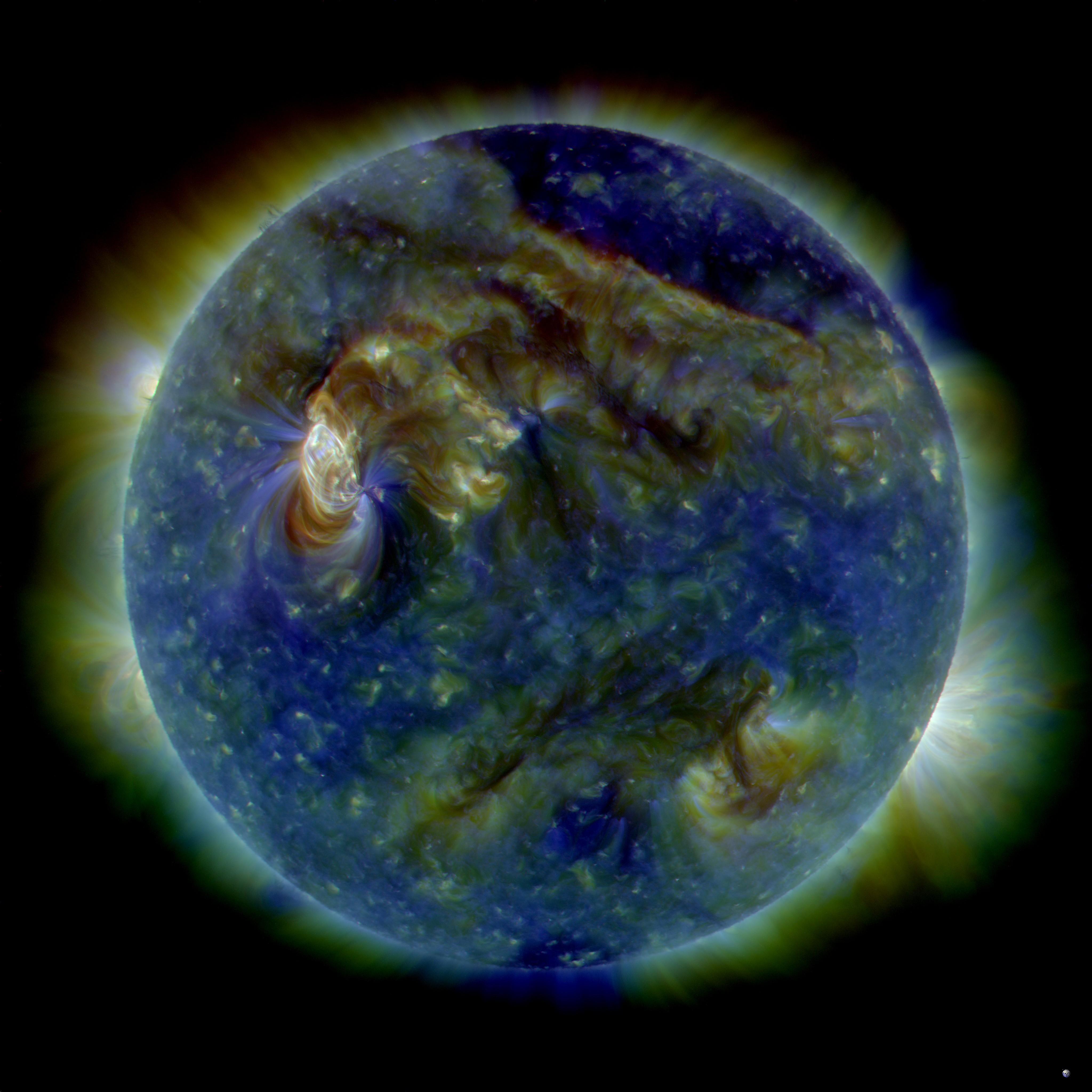
One of my favorite science fiction scenarios is the production of an EMP (electromagnetic pulse) that wipes out our digital technologies and transforms society as we know it.  I first learned about this phenomenon many moons back in connection with the Carrington Event which occurred on this day 156 years ago and caused all manner of discombobulation around the globe. I was reminded of it this morning through Spaceweather, which celebrated the anniversary by pointing out that we had only just escaped an equally devastating CME (coronal mass ejection) in July of 2012. The eruption was massive--apparently as strong as the 1859 event, but missed us. What it did, however, was remind us (according to the Spaceweather article) "that extreme space weather is not a thing of the past."

Richard Carrington was by all accounts a wizbang astronomer, and on that fateful day was busy drawing the sunspots he was observing in his private lab. As he watched, the spots coalesced and disappeared--but only after erupting into "a white-light solar flare--a magnetic explosion on the sun." (NASA Science News)

The NASA article also describes the aftermath:

Just before dawn the next day, skies all over planet Earth erupted in red, green, and purple auroras so brilliant that newspapers could be read as easily as in daylight. Indeed, stunning auroras pulsated even at near tropical latitudes over Cuba, the Bahamas, Jamaica, El Salvador, and Hawaii. 

 Even more disconcerting, telegraph systems worldwide went haywire. Spark discharges shocked telegraph operators and set the telegraph paper on fire. Even when telegraphers disconnected the batteries powering the lines, aurora-induced electric currents in the wires still allowed messages to be transmitted. 

The article goes on to reassure us that flares of this magnitude seem to be rare, but also notes that our current electronic technologies are all at risk--as are our satellites and astronauts (if they're doing EVA when it occurs). This is where the science fiction fodder comes in, because although world-wide space agencies are busy studying flares, Spaceweather notes that a Carrington-grade flare could effect damage on the order of a trillion dollars worth "and require four to ten years for complete recovery." I should note here that CMEs and solar flares aren't the same thing, but often occur together (Christensen). The July 2012 event, in fact, began with a flare that was followed by a CME (Anthony).

Nor, as I've only recently discovered, are EMPs and CMEs the same thing. EMPs can be manufactured, and the effects of a CME are in some ways like those of an EMP, but there seems to be a great deal of controversy on the interwebs about which would cause what. 

What this teaches me is that if I want to use these kinds of events as a backdrop to a story (as I actually already have, but the story isn't about the science; it's about the people and what they do to survive, which could happen in any number of scenarios), I need to bone up on both.

At any rate, there seem to be a number of books/movies/stories already out there, which gives me more stuff to read (if any of it's any good; one promising book is by Roger Zelazy and Thomas T. Thomas, Flare, from 1992). And of course there are all those Prepper websites that I've already run across in my real estate porn forays into Land For Sale In Montana.

Anyway, happy Carrington Day. And remember to sign up for Spaceweather (especially if you live in Montana and points north; they notify folks about auroras). Also, read the cited articles, both with more information and quite interesting.

Sources:

Anthony, Sebastian. "The Solar Storm of 2012 That Almost Sent Us Back to a Post-apocalyptic Stone Age." 24 July 2014. ExtremeTech. Ziff Davis, L.L.C. Web. 02 Sept. 2015.
"August 2010 CME SDO Multi-Wavelength." Multiple contributors. Wikimedia Commons. (There are multiple CME images in the Commons, but this was the prettiest.

Christensen, Bill. "Shock to the (Solar) System: Coronal Mass Ejection Tracked to Saturn." 05 Nov. 2004. Space.com. Purch. Web. 2 Sept. 2015.


Sunday, April 22, 2012

Earth Day 2012, Part 2: Living Here, Living Now

 
 As an antidote to yesterday's depressing assessment of the State of the World, I thought I'd offer a second look. I seldom stay down for long, and it didn't take much to set me on a more optimistic track this morning.

After slogging though the Sunday edition of the Daily Poop, I picked up the February/March edition of Mother Earth News (in preparation for a day in the garden), and read this from the "News from Mother" column:

These days, if you find yourself feeling negative about the future of humanity, you may find some solace in looking at the past.

Well, looking at the past is something I do for a living, so the invitation is a natural for me.  In fact, my Art History 2 lectures just last week focused on conditions in nineteenth-century England at a time when folks like William Morris, John Ruskin, the Pre-Raphaelites,  and other admirers of the Medieval world were all themselves looking to the past for better models of how to live.

As the Mom article pointed out, however, there are many aspects of human life that have actually improved since both the Middle Ages and the nineteenth century: life expectancies are way up, violence is (amazing, but true) way down, and we're generally kinder than at any previous moment in recorded history.  We don't hold slaves, we don't sanction cock fights, and we generally don't kill people we don't agree with (even though we might talk about doing so during election years).

The article ends with an acknowledgement that we've still got a way to go, but instead of throwing up our hands in despair (which is what I probably seemed to be doing yesterday) it notes that we actually have examples of how we've improved things in the past:

. . . looking at what we've achieved, it doesn't seem unreasonable to think we can solve present and future challenges. We can live on this planet in a sustainable way. We can preserve its health and vitality for future generations. And we can make the lives of future human beings even better than the lives we lead today--we have a track record for that kind of achievement.

So, instead of whining about what we haven't accomplished since 1970, perhaps it's time to note that some significant changes have occurred, and to relish them rather than keep complaining about what we still need to do. At least for today.

For example, when I first became a vegetarian back in the late seventies, I did so because I didn't like the way animals raised for food were treated.  I figured that if I couldn't take the responsibility for killing an animal myself, I didn't have the right to eat it.  Eventually, I relented when my kids started insisting that they were being deprived, but we still ate meat sparingly, and I did the best job I could in finding humanely treated animals.  Nowadays, we still eat meat infrequently, but when we do there are numerous outlets from which we can buy "happy" cows, pigs, and chickens.  I can buy eggs that are expensive but come from chickens raised more like the ones we had when I was a kid.  I'm quite willing to pay a premium to do so, even if it means that most of my diet needs to come from grains and vegetables (all organically and/or sustainably raised, some home-grown).  In truth, however, we could largely solve our national obesity problem by doing just that: changing our diets substantially, and weaning ourselves from overly-processed foods.

When I drive to buy my food, I can now do so in a fuel-efficient car that sips gas and causes far less particulate matter to enter the atmosphere than any car I've ever driven.  The good thing about high gas prices is, after all, that manufacturers are producing more and more automobiles with higher and higher levels of fuel economy and lower emissions.  These days I'm watching the highway fill up with hybrid cars, even though in this part of the world pickups will probably rule in perpetuity.

Advances in medicine, although expensive, mean that I got an extra twenty five years with my father, and have myself lived eighteen years longer than I might have done (and another three years than I might have from the valve problem).  New drugs have kept me essentially healthy, and will probably prevent my daughter from ever having to endure bypass surgery at all, even though she shares my crappy genes. Cures for various cancers are being developed, and we've already seen declines in occurrences based on improved ways of life; as drugs and diets and living habits improve, fewer people will have to suffer from them, and those who do may well see even more cures developed in the next several years. 

As much as I might rail against technology, I'm always aware of what I owe to innovation. We have lived in an old house (celebrating its 90th birthday this year) for the past twelve summers, relying on its solidly-built bones and dual attic fans to help keep us cool.  We've gotten by with three small air conditioning units for three rooms, and have stayed relatively comfortable.  This year, thanks to tax rebates and technological availability, we're hoping to install a geothermal heating and cooling system, in part to replace the aging gas furnace installed when we bought the house.  The plan is to wean ourselves as much as possible from fossil fuel consumption.  Of course, even ten years ago, this option would have been a mere pipe dream--so our fuel consumption options are improving rather rapidly.

These changes are, in truth, rather insignificant in light of the challenges that lie ahead.  Big Oil is still in charge, Big Consumption is still the economic model, and much of the world still has no access at all to any of the improvements we enjoy.

War, pestilence, pollution, and greed are all still there, lurking.  But we may be getting better at ridding ourselves of their threats--or we could be, if we can figure out how to meet the challenges of educating our kids well enough so that they can ensure their own futures.  As much as I complain about how little my students know, I can't help but think that they'll work it all out, as long as we can help them develop the tools. 

Image notes: this shot was taken facing east one evening last month with the Nikon D80.  We've had an abundance of rain this spring and the skies have been lovely.  Yesterday's post features a view west, probably taken later that same day.

Saturday, April 21, 2012

Earth Day 2012, Part 1: Hunkering Down

I can't say that this Earth Day finds me particularly sanguine about the future of this planet.  My puny efforts to shore up my half acre and shield it from encroaching doom seem almost like a bad science fiction novel about the end of the world.  Continuing efforts to learn to love the prairie (of which there is really very little left) aren't working especially well--and I frequently find myself indulging in "real estate porn," looking for affordable properties in the desert west.

In the meantime, the carbon sink is wilder than ever except for the patch I've cleared out for tomatoes. We'll have to do a bit of work tomorrow to open up a little more sunny space, but if I can remember to water them, they should do well enough.  But the abundant rain this spring, along with the lack of a true winter, have both meant that the whole place is lush and jungley. I'll have to clear out a mass of mint soon, because it's taking over the entire potager. A lettuce plant from last year has taken over the entire pot, is now nearly three feet tall, and has bolted, producing rather lovely yellow flowers.  The leaves, alas, are too tough to eat.  My Swiss chard is massive and not particularly tasty, but pretty to look at.  The few things I've planted seem to be doing well, and there will be banana peppers for salads along with the tomatoes--but I'm skeptical about my ability to get anything else in before it's too  late. But all this what's going well.

The truly depressing news has to do with oil and gas and tar sands and fracking. There seems to be no end to the American lust for fossil fuels, and the Obama administration is too interested in re-election to buck it.  I'm not sure anyone there really wants to anyway.  I do have to laugh at the far-right characterization of Obama as a Socialist, because he wouldn't know one if it bit him. Hard. On the nose. The Keystone pipeline has been delayed, for "further study," but the lower half of it has received a go-ahead. So now we can expect a large chunk of what's left of the prairie in East Texas to be plowed under in service of transporting oil to the Gulf for processing and (inevitably) to be shipped off to China.  So much for ensuring the energy future of the United States.

I truly long for some really convincing report to announce the arrival of Peak Oil and Peak Natural Gas so that the oil industry (which is, of course, a Person, with rights equivalent to mine--or better) might finally put its mighty weight behind alternative energy sources. But it most likely won't happen in my lifetime, and I'm becoming quite thankful that I won't have grandchildren who'll have to deal with the consequences.

Last year's Earth Day post was far more optimistic, and I apologize for being so gloomy this time. But the evidence for climate change mounts daily, and its increasing rapidity is daunting.  All that old crabby utopian social-anarchists like me will be able do do in the future is to sit baking in our lawn chairs under the ravaged no-longer-bearing pecan trees and say "I told you so."

When I think back to that first Earth Day nearly forty years ago, I remember some of the cranky folk I knew then: long-haired hippies crying doomsday slogans and warning of environmental devastation if we continued on our wicked, planet-destroying paths.  For much of the last thirty years we've been wrapped in a cocoon of possibility, insulated against reality, and even gigantic oil spills (the most recent Gulf spill, as Rachel Maddow pointed out on her show last night, has taught us no appreciable lessons) and devastating weather can't shake us out of our complacency.

My only recourse seems to be to build a thicker cocoon.  I've already let the birds plant a perimeter forest around this small plot, and during the summer I can hide out in the back yard between teaching assignments. In the winter I can draw insulated curtains to hold out the cold, if it ever really gets cold again. In a couple of years I can retire and take a trip out west, because Vera's 56 miles per gallon  will probably be enough to make one last visit possible.  At the rate we're pumping oil, there should be more than enough for another decade, especially if the price keeps rising and fewer people drive. 

But it's difficult to muster any optimism at all when the real price of all this pumping will be smuttier skies, less breathable air, smoggier sunsets, and universal lung problems. 

Ever hopeful,  however, I'll spend Earth Weekend in the garden, communing with the bees and butterflies that are still around, enjoying the sultry southern aromas of spring, mowing down prairie grasses, re-reading Morris, and dreaming of utopia. 

May the next year prove me wrong and provide us with a path toward change.

Monday, February 27, 2012

Looking Backward(ly)

One, almost palpable, aspect of growing older is the increasing amount of nostalgia that permeates one's view of the world at large.

As we grow older, and as change becomes a significant feature of the presentness of the world we inhabit, we begin to remember the past almost as a physical space: houses, landscapes, objects, people. Historians and archaeologists probably suffer more than most, because we "remember" not only our own pasts, but those of others. Whether or not we bathe our visions in some kind of gauzy, golden light, masking difficulties, injustices, or even horrors, we nevertheless tend to paint our ideas of the future with the palette of the past.

Several recent events and observations have brought all of this to mind, the most recent of which is the Academy Awards ceremony (with its focus on early cinema), coupled with Pat Buchanan's departure from MSNBC.

Mind you, I've never thought much of Buchanan's picture of the world which, as Brian Stelter mentions in today's New York Times, is firmly rooted in the idyllic Ozzie and Harriet past that coincides with my own childhood in the fifties. But while my childhood was populated by multi-racial people and multi-cultural life, Buchanan's was white, straight, Catholic, and (in his mind, at least) hewed to those fine Republican values inherited from our Founding Fathers. In my case, although both of my grandmothers and one of my grandfathers were of Canadian extraction, immigration wasn't really part of our background; both my father's and mother's families had been in North America since the Revolutionary War. I'm not sure how long Buchanan's people had been in this country, but like many of his fellow (Tea Party) Americans, he seems to think that early immigrations from Europe were somehow different from those occurring now.

Buchanan's beliefs and politics were informed by Catholicism as practiced in America the Beautiful, while mine were informed by Catholicism practiced in Japan and Taiwan, preached by priests from Italy and China, and were severely tested by Vatican II. By 1963 I had left the Church, primarily because it had rejected many of the traditions it had accrued through time (Latin masses, smells and bells) and that had kept me "faithful" for as long as I was. Having not grown up in suburban America, however, I never did form an attachment to its mythical elements. Not being exposed much to television probably helped.

I try to be a realist, and to ground my hopes for the future in a clear sense of what has actually happened rather than some imaginary Golden Age. In doing so, I am constantly reminded of the criticism directed at William Morris's Medievalist socialism. Whenever I mention his work (at least when the immediate response isn't "Oh, yeah, the wallpaper guy"), the comments that follow usually point out that the Middle Ages he so admired had been radically depopulated by plague, and, besides, who would want to live that way, anyway? And post-apocalyptic films and fiction play on the notion that "Medieval" equals "Stone Age." Get rid of what we have now, the novels all suggest, and we'll be wandering down interminable roads, eating one another, living in squalor, and/or we'll become victims of one or another rampantly repressive ideology. (Update, October 24: a terrific new example is the television series, Revolution.)

All of the above will, according to the Buchananesque prognosis, be caused by lowered birthrates among the middle class (due to the use of abortion as birth control), increasing immigration from third-world countries, rising diversity in the armed forces (gays, women, folk of color), godless humanists, and all manner of plagues and diseases brought on by our increasingly wanton ways. Liberals in general, and Barack Obama in particular, are "destroying America," as I've heard over and over again from participants in the Republican caucuses As Seen On TV. What can only follow is the end of Western Civilization, or at least of American Exceptionalism, as we know it.

Of course, I'm not at all convinced that this is a bad thing. A smaller, multi-racial, more culturally diverse populace might well lead to innovative solutions to economic and social problems. If the self-described Conservatives want smaller government, the only way we can accomplish it is to decrease our population. If we want to increase self-reliance, we need to lessen our dependence on fossil fuels, foodstuffs, and technology from foreign sources, and re-learn how to make many of the products we now buy from others, such as textiles.

Pat Buchanan's idyllic mid-century America was only half the size of the current one. Women were only just beginning to acquire the ability to pursue careers other than child-rearing, and Blacks were still being seated at the back of the bus. We were involved in or heading into an interminable series of conflicts (Korea, Vietnam, the Cold War, Iraq and Afghanistan), and barely averted World War III more than once in subsequent years. Divorces were rarer (although not in my family), but perhaps only because they were harder to get. Infant mortality has declined significantly since 1950, but minority children die at a much higher rate than whites, and the overall rate in the US is rather embarrassingly higher than for any other developed country. The effects on BabyBoomers' lives may not have been as devastating as the Black Death, but neither are they all that laudable.

If nostalgia is, at best, an ambiguous condition, I'm not sure that future generations will be affected by it much at all. As I struggle to reach new crops of students by instilling an interest in the past and what it can teach us, I find myself swimming in a rip-current of apathy, if not antipathy. Fewer and fewer of my pupils consider the past as particularly valuable; instead, they wonder what it has to do with them, now. "How is this information going to help me in my career?" they ask. The question is genuine rather than churlish. They really do want to know what utility I can offer, but I'm never sure how to answer them. The old saws about how general education will make them better people, or how knowing the past will help them avoid making the same mistakes don't hold much truck with a group hell-bent on fame and fortune in the game or fashion industries. The best I can offer is that the past, especially in the visual arts, represents a gold mine of ideas and images. At least as long as you cite your finds properly.

From an archaeological perspective, the present is the surface, under which lie immeasurable treasures. Education provides only what amounts to a surface collection of odds and ends that indicate what one might find underneath. The more practical contribution schooling makes to our future lives is to provide us--if we're fortunate to have decent teachers--with the tools we need to excavate the past, connect the ideas and objects we locate there with our contemporary needs and desires, and interpret them carefully and fairly. My parents and grandparents told me stories about my ancestors that made me want to know more about "the olden days." But they also insisted on telling me how hard it had been, and ultimately how unfair things were for others who didn't fare as well as we had.

If real knowledge and wisdom don't somehow emerge from the massive piles of information being heaped on this generation, in their future nostalgia might simply become a dismal undertaking, rather than a potentially rewarding exercise in plumbing memory. Rather than longing for imagined, distant glory, we should be showing our kids how to reflect critically on what they remember in order to faithfully craft the stories they tell their own children.

Note: This essay has concurrently been posted on Owl's Farm.


Image credit: In truth, I don't know where I got this; it was just in my archives for use in class. But the image is a bas relief designed by Philip Webb and executed by George Jack on a cottage in Kelmscott, Oxfordshire. I think the relief was commissioned by Jane Morris, in memory of her husband, and certainly captures his pensive demeanor. I have a copy of it at my desk at school.

Sunday, February 19, 2012

Fracking the Future

Americans seem to be so deeply mired in oil culture that we're never going to escape.

As I wandered through various websites on my Sunday morning catch-up-with-the-news efforts, several stories caught my attention--from Good, Grist, the Times, and other sites that keep me apprised of the world's goings on (since I can't really rely on the Daily Poop to cover much that doesn't happen locally). I tend to focus on energy issues out of habit, and a number of stories resonated with what I've been noticing about a general reluctance to take alternative energy sources seriously in this country.

I was watching Bill Maher's Friday night show on HBO, Real Time, only because there was absolutely nothing else on, and both the Beloved Spouse and I were too tired to do anything but veg. I find Maher mildly amusing at best, and more often irritating, but his guest was Alexandra Wentworth who is both very funny and married to George Stefanopolis. We stayed with the show until the end, mostly out of inertia. Maher's peanut gallery (consisting of Eliot Spitzer, Erin McPike, and Steve Moore) went on to comment on various news items as Maher brought them up. Moore (a Libertarian, co-author of Return to Prosperity) [note: I originally, and mistakenly, referred to this as "Return to Posterity], when talking about clean energy (wind and solar) kept insisting that it's "not economical" and we have to keep fracking and pumping in order to fuel (pardon the pun) future economic recovery. But as any good logic teacher knows, simply asserting something over and over again doesn't make it true; and Moore lacked the time to back his assertion up with any evidence.

But this general notion--that the only "economical" solution to our dependence on foreign oil is to pump more of our own, or find a "bridge" (like natural gas) to tide us over--seems to be embedded in the "conservative" world view at the moment (which doesn't seem all that conservative, upon reflection). Pundits and politicians alike consistently dismiss renewable resources as not cost-effective, or uneconomical. Then they bring up Solyndra as a whipping boy: see what happens when you fund this sort of thing?

Well, according to David Roberts's article in Grist from Friday, the whole Solyndra episode seems to amount to nothing more than a bad call on the part of the Obama administration. The year-long investigation into the loan has turned up, in Robert's words, "Bupkis. Nothing." All efforts to locate wrong-doing have produced nothing more than evidence that it was "a decision made based on merits, undone by economic shifts in the international solar market, with embarrassing political optics. There has been no evidence of wrongdoing. There is no 'scandal.'"

Opponents to alternative fuel sources seem to want this to turn out badly for purely political reasons. Prove that the administration proceeded with this deal for corrupt reason, and it'll tar (again, pardon) the whole industry.

Another story that gave me pause (and reminded me that folks are constantly trying to invent alternatives to fossil fuels) came from Good: Fuel Gets Fruity: Converting Produce Scraps into Gas. Biofuel made from readily available materials seems to be popping up all over the place. Someday, perhaps, we'll all have home scrap-digesters instead of LP gas tanks or natural gas lines running into our homes. As much as I like cooking with gas, I'm working on eliminating the need for it, since I really do think we're running out, and it bloody well terrifies me anyway. Recent evidence also points to the possibility that natural gas isn't as clean as we're being told it is, and is thus much less promising as a cleaner "bridge" fuel that can help us wean ourselves from oil and coal.

The recent move to take another, closer look at the Keystone pipeline drew the ire of the right (we need the jobs and the oil, they say, even though most of the jobs would be temporary and the oil itself would be exported). But according to another article in Grist, by Jess Zimmerman, anti-Keystone folks are finding new allies in the Tea Party: those who don't like the fact that if the pipeline builders can't buy your property from you, they'll just take it via eminent domain.

If only people could see that reliance on fossil fuels is every bit as dangerous to our rights as the taking of property against our will. Don't basic rights to clean air and water come under the notion of a right to life and liberty?

Perhaps because there aren't measurable price tags attached to the breathability of air or the drinkability of water, we can't see them in the more concrete sense that we can property values (even though these are tied to issues of clean air and water). And how do we begin to attach economic value to the ability of future generations to grow crops on land radically altered by changing rain patterns and mean temperatures, or to make a living from polluted fisheries?

What if the idea of prosperity had more to do with well-being than with cash? A transformation in the national psyche from a monetary model of the good life to one based on sustainability and long-term viability seems to be in order. But there seem to be only small glimmers of hope that our national preoccupation with the cash value of what we're leaving our kids (rather than the kind of a planet they're going to inherit) is going to change any time soon.

Image credit: The photo is of the Urban Planet building at Shanghai's Expo 2010. According to its designers, "The exhibition was characterized by a dichotomous structure illustrating the two-faced character of the city as both a consumer of environment and as a place for innovation and technology in the service of an ecological renewal for the future." (via Wikipedia)