Showing posts with label food. Show all posts

Thursday, January 19, 2017

Sunrise, Sunset

Although I'm not terribly happy about this photo (I generally avoid power lines and try to frame photographs without stray house bits, like the corner of the gable on the upper right), it and its companion below represent this post rather nicely, and were taken on the same day about a week ago. The "Sunrise" shot (above) was taken from the front porch with my new iPhone 7.


The "sunset" shot, taken in the back yard, also includes power lines, so there's an additional aspect of symmetry; I usually stand atop chairs and other furniture to try and avoid them. However, I wanted to submit something to Skywatch Friday for the first time in ages [as usual, thanks to the crew--and do go see what folks from all over have posted], so here we are; what you see is what I got, and I'm making do.

As I am with all manner of things these days. I will not be viewing any of the inaugural festivities tomorrow, and since the weather should be warmer, will instead be doing some early garden prep, reading some Wendell Berry and Joseph Wood Krutch, and watching a couple of episodes of Netflix's wonderful adaptation of Lemony Snicket's A Series of Unfortunate Events. I can't imagine anything more appropriate, given the state of the Union. Thus, the photos seem to hold out a little promise for a not completely bleak future, but I won't be holding my breath.

Despite my usual less-than-optimistic view of things, I've decided to find ways to muddle through the next four years. I'll be rethinking and redesigning my website (and changing the name from Owldroppings to Owl's Farm; this blog will be linked to it), clearing out the detritus in the garage and attic (in case we decide we just can't abide Texas any longer), and finding more ways to live more sustainable lives.

Inspiration for all this has come from several places, including my new subscription to Australia's Slow magazine, ecopoets like Krutch and Berry, and even the latest issue of American Craft. The editor, Monica Moses, has written a wonderful little essay on the role of craft in keeping one's sanity in uncertain times: "The Tough Make Art," in which she describes her own plan:
 
Like a lot of us, I’m looking for ways to cope with the discord, to feel hopeful again. I’m returning to the basics: eating well, exercising, trying to sleep, spending time with loved ones. But I’m also doubling down (as the pundits would say) on art. (American Craft, Feb/Mar 17, p. 10)

My own map of the next few months includes efforts to accomplish much the same sorts of things, including the art part. Her sentiments are in tune with much of what I read among the thoughtful writers whose works I frequent, now that I find myself sticking to the Arts & Life section and the funnies in the Daily Poop,  and the Books and Trilobites sections of the New York Times. Never have I felt more grateful for the library we've amassed, because it should prove most valuable over the next four years, reminding me that sanity might well prevail.

So, for what it's worth, here's what I have in mind:

Eat Real Food. I stole this designation from my Whole Foods Market newsletter, which offered its customers meal plans in several categories. But it's really what I've been trying to do for years, with the help of Michael Pollan and Mark Bittman and others. I've become rather more serious about it since my retirement awarded me with more time for contemplating and planning. We also recently invested in a smaller refrigerator, which facilitates consciousness of how much we buy and where we have to store it. It's also a terrific deterrent to food waste. The Beloved Spouse gave me Lidia Bastianich's new book, Mastering the Art of Italian Cuisine, and The Big Book of Kombucha for the holidays (plus Cooking With Loula, a lovely Greek cookbook I noticed while shopping for other people's gifts). I have always loved cookbooks that are more about history, philosophy, and culture than technique, and these are all inspirational additions to the "food" segment of our aforementioned library. Over the last two weeks I've spent more time planning meals and enjoying the process than I'd been able to do for several years.

Get Real Exercise. The realization that the new, pricey drug I'm taking is likely to prolong my life significantly (and my favorite cardiologist's reminding me that exercise won't do squat for my cholesterol but will do massive amounts of good for my brain and overall well being) has made me more conscious than ever of movement. What finally got me perambulating the neighborhood was the death of our sweet dog Woody last summer. His brother Arlo no longer had a reliable source of exercise, so I started walking him, dropping him off at the house when he got tired, and then continued on my own several times a week. TBS would join me on weekends and holidays, and we've gotten to know the topography of the neighborhood better than we had in the previous sixteen years. Over his winter break from teaching we kept up the dog walking, but neighborhood exploration slacked off due to weather and family obligations.  But a movement-tracking app on my phone has helped keep me from being completely sedentary, and as the weather warms up and I get into the garden more (as I plan to this afternoon), I should hit the "active" category much more frequently (now "lightly active" rescues me from couch potatohood). The goal is to use my body better, get stronger, and get out much more.

Make Stuff.  Some time ago I bought a lovely journal with a William Morris design on it (actually, a sketch for a wallpaper design) in which I've been writing down and sketching out ideas for art books and other little projects. I'll try to get some of these done--including the redesign of my web pages. But I've been wanting to go back to painting and "making" things,  which I haven't done since my children were small. This includes working on the house and garden--painting and plastering and staining and the like, along with general homekeeping, mending, knitting, and quilting. Using one's creative juices seems to be a particularly satisfying way to make it through trying times.

Write More. Having received my first rejection slip (for a story in a science fiction anthology), you'd think I'd have sworn off any desire to publish more than for myself  (and my one or two faithful readers). But I've decided to do what I used to urge my students to do: take the criticism to heart, and use it well. I'm not sure I agree with all of the comments, but I'll have them in mind when I revise the story and submit it somewhere else. I also need to work on More News From Nowhere, and to go back to the old-bats-in-space novel I started working on a couple of years ago. I actually posted on the Cabinet recently, and have lots of ideas for more entries. Letters to friends are on the list, too.

Read Even More. I probably read more than I do anything else, but now that I've made it through the entire run of Midsomer Murders twice on Netflix, I've got no afternoon distractions from the telly. TBS and I have stuff we watch when he gets home (because he's too brain dead after teaching to accomplish anything more impressive), but when I'm not out moving and growing things, I have a huge stack of books to begin or to finish. And then there's always Cat-watching time in the garden, which will need to be extended as the weather improves. Emma likes company when she's out, and I can't leave her entirely unsupervised. In  addition, there's nothing quite as peaceful as watching a cat and a dog snoozing away in the afternoon sun.

This is all very ambitious, I know. But since I'm too old and tired to be politically active any more, if I get even a little of it done, I'll have accomplished something. And so, Dear Reader(s), may the future be better than we have any right, at this moment, to expect.

Thursday, June 26, 2014

Summer Is Icumen In

Rather than celebrating the coming of this particular season with Medieval rapture, I'm tempted to substitute Ezra Pound's snitty little salute to winter ("Lhud sing goddam!") in place of "Lhud sing cuccu!" This is, after all, Texas, and it's only by the grace of some current climatic weirdness that we're not slow-cooking in our own juices already.

I'm generally a bit ambivalent about summer anyway, because I fully realize that what's actually happening is that the daylight hours are now beginning their long decline toward the winter solstice,  the "darkest evening of the year," and the end of my 67th--even though I'm "only" 66 (and a half) at the moment.

Until I read Akiko Busch's op-ed post in the New York Times last Friday (The Solstice Blues), I thought I was alone in not necessarily seeing this moment as some grand seasonal celebratory event:

The moment the sun reaches its farthest point north of the Equator today is the moment the light starts to fade, waning more each day for the following six months. If the summer solstice doesn’t signal the arrival of winter, surely it heralds the gradual lessening of light, and with that, often, an incremental decline in disposition. 

In North Texas, the end of June is usually marked by the onset of 100-degree days; but this year we've been treated to a bit of rain and temperatures hovering around 90 during daylight hours and low enough at night to sleep without air conditioning. Even the dogs don't seem all that uncomfortable with the humidity--although we do tend to hole up in a small room with a window unit to watch TV in the late afternoon/evening, by which time the house has heated up enough to make the humid air a bit heavy.  Still, by bedtime, it's tolerable again; with a breeze it's even better, because the bedroom has windows on three sides.

When I was looking for an image to illustrate this post, I had wheat in mind for several reasons. For one, a search for "summer" on Wikimedia Commons inevitably produces photos of wheat. In addition, I'm working on a new philosophical perspectives course called "Food and Culture," and my first lecture involves the early history of human victuals--inevitably involving the ancestors of modern wheat. Since a later topic in the course will consider food and art (or food in art), I snapped up the Carl Larsson painting (which I've probably used before) because it touches on both, and because his stuff always makes me think of utopia.

The Food and Culture course has been (ahem) cooking in my brain for several years, but it was only recently that I realized I could teach it without having to go through the bureaucratic effort involved in getting a new course accepted.  Years ago, when I helped design the general studies offerings for our baccalaureate program, I pinched an idea from SUNY Stony Brook and crafted a course called "Philosophical Perspectives," thinking that whatever philosophical types we might hire could then teach what they knew, from within whatever intellectual context they were trained.  I've taught several topics under this catch-all rubric (The Arts and Crafts Movement, Pioneers of Modern Design, and Technology and Utopia), and it finally occurred to me last quarter that Food and Culture could easily fit under the umbrella.

As it turns out, I'm only catching up with a trend that's been evolving since the '90s, and even in the immediate region there's a Philosophy of Food project developing out of the University of North Texas. What this means is that although I'm not exactly on the cutting edge of things, I can take advantage of the work people are already doing in order to locate resources for my students (30 as of the last time I checked). It also means that thinking about food and its cultural meanings is being taken more seriously than it was at first. In a Chronicle of Higher Education article I had saved from 1999, it was clear that the scholarly value of food-studies was somewhat suspect. Since then, however, a looming variety of food crises (scarcity, waste, obesity, malnutrition, and myriad others) has forced folks to start talking about the many ramifications of food consumption, including the effects of global climate change on the future of food.

William Morris's effort to move the education of desire into the center of our consciousness about how we live (and how we might live) fits squarely into the aims of my course: to get students to start thinking about the difference between need and want, and how understanding that difference can inform sustainable futures.  I'm not sure how this lot will respond to having to read and write and think about something most of them don't consider except at mealtime. But there's some potential here to poke a stick into complacency.  Since most of those enrolled are in a culinary management program, the results could be quite interesting.

We will, of course, be suffering through the worst part of this region's summer weather. But we'll be doing so within an overly air-conditioned classroom, sucking down cold bottled water, iced tea, diet sodas, and energy drinks--matters I'll have to design another course to deal with.

Image credit: Carl Larsson (1853-1919),  Summer (date unknown). Uploaded to Wikimedia Commons by Niklas Nordblad.

Saturday, April 20, 2013

Earth Day 2013: Small Steps

Over the past five years I've managed to post on or about Earth Day (last year there were two essays), in an effort to recognize a significant moment in U.S. environmental history, and to reflect on themes that prompted me to create Owl's Farm in the first place. In my current state of time-deprivation, it's difficult for me to post more than a few times a year, but this seems as good a time as any to think about change in general, as well as particular changes over the last twelve months. 

The first celebration I actually remember took place in Philadelphia in 1970, and I still have the poster I bought during those festivities. Today it happily adorns my kitchen wall and reminds me that in this little corner of the universe, every day is, in some way, Earth Day.

If I've learned anything over the years, it's that we can't really afford to lose our focus on what needs to be done, and I'm occasionally heartened by the fact that celebrants are no longer just cranky old folks like myself, but a include a much broader spectrum of citizens.  I don't actually go out and march or dance in the street anymore, but I do spend time out on the property, taking inventory, and reflecting over the past year.  This time, the view from the back yard toward the house is far more pleasant than it used to be, thanks to some major renovations last summer.  New paint, a new bathroom and work on the old one (including new, very low-flow toilets), R50 cotton insulation in the attic, and solar screening will make the coming summer more livable.  Plans for a geothermal heating and cooling system had to be abandoned because the cost would have made the rest impossible. But our energy bills are fairly low anyway, and we bought a portable air conditioner that works more efficiently than our old window unit. The attic fans have been repaired, which will double the air flow through the house, so our bills will probably be even lower, and our power use reduced even more.

Over the last few months, as I've talked with students and colleagues about what we've been doing with the house, I've realized that there are some fairly simple strategies involved with lightening one's impact on the planet that most people never really think about.  None of them require much cash outlay, they do some significant good, and they confer a bit of peace and satisfaction upon their practitioners.

Shorter showers  A couple of years ago a conversation on Orion's forum took this one on, and many writers saw it as purely symbolic.  Real activism, they suggested, needed much more significant action.  But think about it.  If most people take daily ten- or twenty-minute showers, and then cut those in half, common sense (plus a bit of math) tells us that it all adds up. I'm talking water-savings here, in a drought-stricken region, rather than money, because monetary savings are small ($9/year or so).  A four-person family can make a bigger dent if everyone's on board.  Subtract the cost of a cute kitchen timer, and you're still saving water even if the timer costs a tenner.

Even better, take fewer showers.  In her terrific 2010 book, Green Barbarians, Ellen Sandbeck (her blog is here) noted many ways in which our overly sanitized society wastes water and money on all manner of stuff designed to eradicate every possible germ (good or bad) and make us not smell like human beings. But we don't actually need to shower every day in order to be civilized or even healthy.  It's thus quite possible to forgo a shower without contaminating the earth. 

Rain Barrels We bought four (we had one) when we had new gutters installed last summer, and the only problem we foresee is keeping them from becoming mosquito breeding farms when they're over-filled after a rain.  But BT mosquito dunks take care of that problem (as does a judicious lowering of the water level), and there's enough water in each one to take care of gardening needs quite easily.  They won't help much with the lawn, but I'm also working on minimizing the amount of non-productive farmland.  We do need romp space for the dogs, but over the next year or so I'll be replacing as much St. Augustine as I can with fruiting shrubs and low-maintenance ground covers.  Since the non-productive area still provides ground-water recharge,  I won't feel guilty if every square inch isn't edible.  But many herbs make good ground covers anyway, and I can always give extras away to needy culinary students.

Compost Anything edible can be composted and turned into soil and/or fertilizer.  For about a hundred bucks last year I snagged two bins for making Bokashi compost--a Japanese technique that essentially ferments your food waste, including protein sources like bits of meat and cheese.  The ongoing investment in the probiotic granules needed in the process is the only expense after the bins.  I bought two, and rotate them. When one is "done" it sits for a couple of weeks, and the contents then buried in the garden.  If, like us, you've vastly reduced your food waste,  the process can be rather leisurely.  It might take a month or more to fill up a bin (even when spent flowers and other non-food plant materials are added). In the meantime, you also drain off liquid that can be diluted with water to use as a liquid fertilizer.  The areas in the garden where the first two batches were buried are now lushly verdant.  Some stuff still ends up in the big compost bins (weeds, mostly), and most of our coffee grounds are used on the roses, but we end up with about four Bokashi "crops" a year. We're also considering a method called hugelkultur, which involves burying our brush pile and covering it with the excavated dirt to form raised beds.  This would solve the problem of having to use the chipper-shredder (the only gas-powered yard appliance we own). We get a large amount of brush from the trees on the property (rain + wind = downed limbs), and seldom have the time or energy to deal with it.  Some gets used for firewood, but the rest is just sitting there. Being a brush-pile.

Note: This week's explosion in West reminds us all too painfully of the price we pay for depending on chemical fertilizers.  This world really needs to find ways to feed its population without relying on toxic and potentially disastrous combinations of chemicals.

Growth Even folks who don't have large sunny spaces suitable for food crops can grow herbs.  Many herbs are perennials, and also flower, so they can take the place of ornamental annuals.  I now have a large, expanding crop of Greek oregano growing in the front border, and have started taking bits of it to plant in obscure corners of the property.  I'm also thinking very seriously of planting the parkway with peppermint, which is otherwise pretty invasive and has to be grown in isolation or in pots.  But a few strategically placed mint transplants next to the street will look better than the weeds that grow there now, and will smell nice when dogs walk on them, and when their owners clean up after their poopy pooches.

The abundance of shade from our 18 trees (not counting the ones growing along the back alley, which have been planted by birds and squirrels and left to flourish by us, since they mask the houses behind us and offer some considerable privacy) means that our veg-growing success is mixed.  I'm hopeful about the tomatoes, peppers, and tomatillos I have planted, and will try beans and radishes as well.  Now that we have some sunny space in the side yard (which was fenced by a cranky new neighbor last summer), I may try something there--especially since that's where one of the Bokashi batches was buried, and where the next one will be as well.

Anything green we grow lowers our carbon footprint, and if we're smart it will also lower our food bills without contributing to Big Agriculture.  People with kids can accomplish even more, because growing things provides all manner of lesson-material and connects children with the planet in ways they'll never forget.  As I'm fond of mentioning, all the talk about the financial deficit we're leaving them ignores the environmental mess they're inheriting if we don't radically alter our habits, soon. Financial deficits and surpluses are ephemeral; they can be eradicated as fast as they're incurred or accumulated. Environmental deficits, on the other hand, can take millions of years to correct.  And that's if we get started today.

Image note: The photo was taken a couple of years ago in what was once called "the accidental garden" in the southwest corner of our half-acre property. It later turned into our own personal carbon sink, after years of purposeful neglect turned it semi-wild.  It will regain some of its garden-ness when we reclaim some of it as cropland after attempting to establish a hugelkultur patch this summer.

Tuesday, February 26, 2013

Food, Culture, and Common Sense

 
The latent Scotswoman in me keeps popping up, with David Hume whispering in one ear, and Thomas Reid in the other.  Those of you who haven't downed enough Scottish Enlightenment philosophy along with your Macallen or Lagavulin won't know what I'm talking about, but I took a memorable course with Victor Worsfold many long summers ago and what I learned then is creeping back into my consciousness now.  The empiricist argues with the pragmatist. Almost daily.

"Common sense" today refers to a kind of received knowledge tempered by reason, as in a "common-sense approach to government" or "for crying out loud, use your common sense." Trouble is, there doesn't seem to be much sense among the common folk these days, and what might seem to be evidence of actual common sense appears to come as a surprise to many.

Take diet.  Real common sense would suggest that if a large population of people suffers significantly less heart disease than another, perhaps we should compare lifeways: diet, activity, occupation, etc. You may remember that several years ago, the "Mediterranean diet" hit the news, and the foodie faddists went at it energetically. I certainly didn't need much encouragement (fully one half of my 300-odd cookbook collection already included books on Spanish, Italian, Greek, French, Israeli, Turkish, Egyptian, and North African cuisines; the rest are about culinary history, much of which involves the ancient Mediterranean), and quickly added The Mediterranean Diet, The Slow Mediterranean Diet, A Mediterranean Feast, and The Essential Mediterranean to the shelves.

Of course, diet is only part of the equation.  People in Crete, whose food-traditions go back to the Minoans, ate lots of fruits, veg, unprocessed meat (chicken, lamb), fish and seafood--the usual culprits. What often got left out of the discussion, however, was that these same people toiled on their farms from dawn to dusk, drank Retsina, and didn't sit around on their duffs playing video games all day.  Nor did they keep a supply of Twinkies stashed in the root cellar (where they kept their root crops, dried fruits, etc. for use during the not-terribly-cold winter).

So, when the newspapers fill up with articles on Startling Discoveries, such as connections between general bad health and highly processed foods, or the "surprising" (to whom, exactly?)  results of the recent Mediterranean Diet study, or that type 2 diabetes afflicts more, younger people every year, or that gluten intolerance is rising precipitously, or that sitting on one's duff playing video games is bad for us, I just get the vapors and reach for a glass of Zinfandel.

Are we, collectively, so flaming stupid that we can't see the equation: 16 oz. Slurpee = potential diabetes?  Highly processed foods with four different kinds of sugars, two days' worth of sodium, and multiple unpronounceable "ingredients" (none of which is actual food) = potential heart disease? Foods so far removed from their natural state as to be unrecognizable = rare diseases becoming far more common?  Hormones in our meat, hormone-disrupters in our air fresheners = premature puberty in children? 

One then wonders about the very notion of common sense, because it seems to be so, well, un-common.  I can't, however, help but assign at least part of the blame to Big Agriculture, Big Pharma, relentless advertising on behalf of food processing conglomerates (Big Everything Else). Big Food is a huge part of the American economy, and we're spreading the "wealth" everywhere else (witness the Big Mac effect in China)--including the Mediterranean region (if that's not irony, I want to know what is). I used to think that folks in other countries were just smarter, or at least more practical than we are, but now, not so much.

The trouble is, at least in part, that in the modern world, an abundance of meat, fat, sugars, and other once-rarer commodities are all emblems of wealth.  Another moment of high irony: cucina povera, essentially Italian peasant cooking (literally "cooking of the poor") is hot stuff in foodie world. Popularized by Mario Batali,  who's a food conglomerate unto his own self (if you're a fan like I am, read his cookbooks; don't visit his website), it's nevertheless an admirable approach to food. One cooks well what one has, as most poor people in the increasingly distant past once did.  This is another example of real common sense at work--what we used to be good at.  I've recently been making an effort, tied to reducing food waste, to finish up what's in the fridge, using staples from the pantry. This often involves making what I call "Leftover Soup," an amalgam of whatever leftover meat and/or veg are available, with broth, onions, and anything else that seems fitting.  Sometimes I add pasta or rice if it needs body, but essentially dinner is what's there, cooked up with some herbs and flavors that make it appetizing. Of course, this frequently leads to irreproducible results, but unpredictability has its own charms.

One of the real problems in America is that bad food tends to be cheaper than good food, and urban food deserts (with little access to supermarkets with fresh produce) are nonetheless seldom without a corner fast food joint.  

Anyway, the world's quest for questionable evidence of wealth may be killing it. I once wrote about redefining what it means to be poor, because a significant amount of what we now see as "poverty" is really just a lack of the trappings of modernity.  Having electricity, which might, indeed, raise some very poor people out of abject squalor, isn't consequence-free.  Producing electricity without polluting the environment irreparably is a continuing problem.  Cheap electricity breeds waste, because if the energy source is inexpensive, people pay less attention to need than to desire.  More access to stuff inevitably generates more waste. (The links are to previous posts on these topics.)

I'll undoubtedly return to this subject in future, but I've probably vented enough for today.  I would like to note, however, that all this advice we're getting through various media, as results from various tests and studies roll in, amounts to a plea for moderation and--yes--common sense.  It makes so much more sense to eat what we love, and if it's not terribly good for us, limit it rather than exclude it.  If what we love, however, is Twinkies and Doritos, it's time to re-educate our desire. What's good for us can taste really good, and it's not all that hard to cook like a poor person. All you really need is a few basic ingredients, a pot, a spoon, and a heat source.

And a good bottle of olive oil. And a decent bottle of wine.

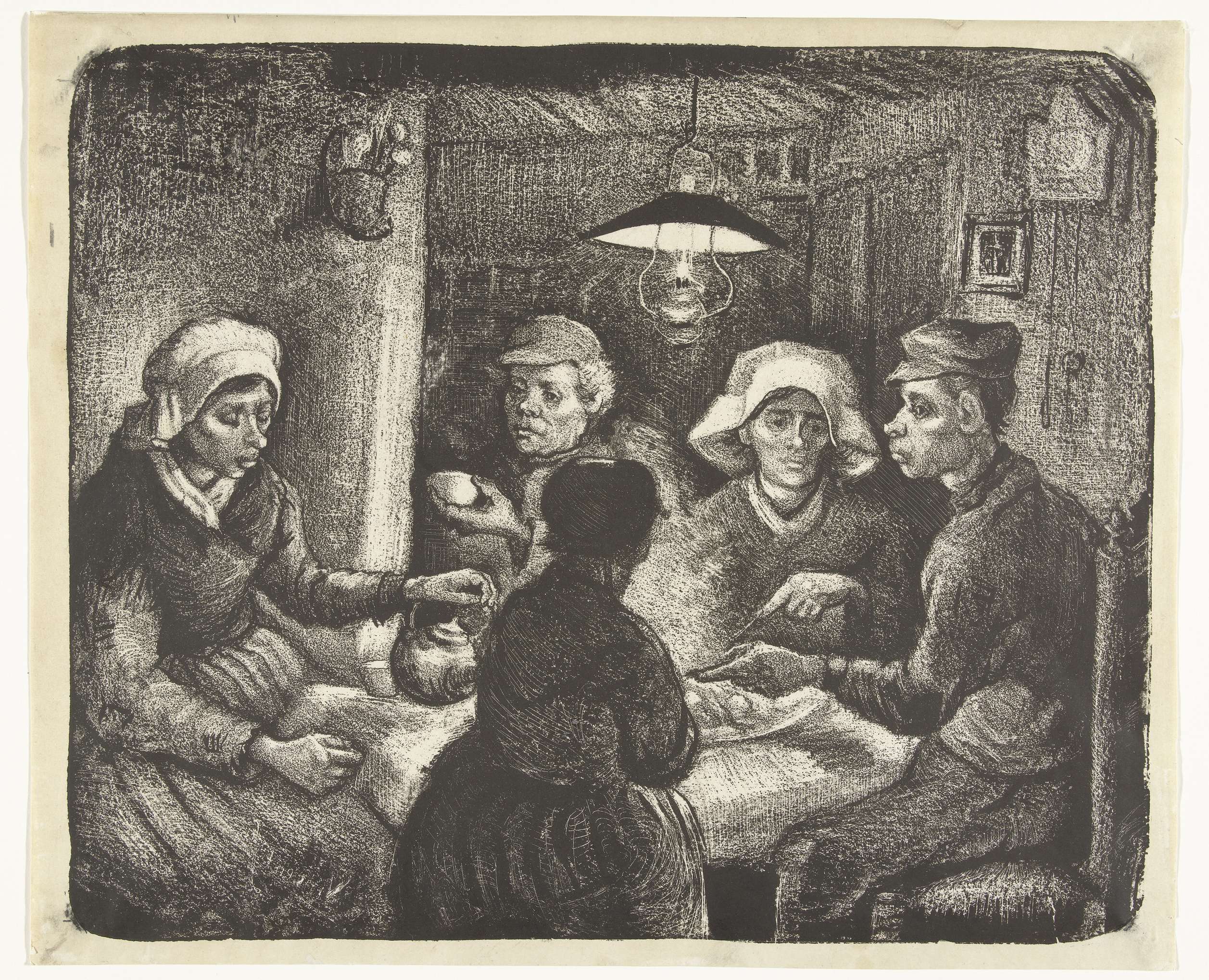
Image credit: This is a lithograph of Vincent van Gogh's The Potato Eaters, courtesy of Wikimedia Commons. For the painted version, see the Google Art Project page. Although not one of his most popular works, the subject is appropriate to the topic of this post: peasants eating food they dug from the ground.  It captures many of the artist's different influences: genre painting, realism, post-Impressionism, and even hints at his expressionism.

Tuesday, September 4, 2012

The Education of Desire: We are what we do, we are what we eat

Perhaps I'm a bit late in jumping on this particular bandwagon, because when I started searching for more information on a couple of closely related problems (obesity and food waste) I found more than I can handle in one post.  Other folks have also been thinking about the irony of this country's enormous waistlines and the equally enormous amounts of food waste making its way to the landfill.  We also hear talk of food deserts that help account for obesity among the poor, but I only recently began to wonder if anyone had been connecting the dots. Clearly they have.

This week's news media also reported on topics that are at least tangentially related to the waste/obesity problem: Herman Pontzer's articles in the New York Times,  pointed out that (as the Daily Poop version of the story put it) "It's the Sugar, Stupid," and that all the exercise in the world isn't going to make us as healthy as our distant ancestors if we're consuming crap. And in this week's New Scientist, the cover story ("Eat Your Way to Dementia") is about the relationship between type 2 diabetes and Alzheimer's disease. 

The last two months of house-renovation have increased my awareness of food waste because the combination of beastly weather, minimal air conditioning, and odd sleeping accommodations has put the kibosh on cooking (I've been way too hot and tired)--with the result that I spent this morning cleaning out my fridge, ridding myself of spoilt food, shriveled limes and carrots, and a couple of mystery life forms.  Mind you, the compost and the Bokashi bins can handle almost all of this, so that I don't really have to throw much away.  But that's not the point. 

This stuff was bought at a premium, represents many folks' labor and time (from farm to market), and bloody well should have been eaten.  Not only eaten, but cooked well and healthfully.  What the news articles have done is to fortify my resolve to accomplish several items in a new program of food-consciousness. 

First, it's really a good idea to plan one's meals and not rely (except on rare occasions) on serendipity.  My daughter bragged in a text message last night that she had planned a week's meals for two and spent $57 on them at Whole Foods. She's also tracking how they use leftovers--which isn't a bad idea either.  Simplifying food preparation in hot weather so that ingredients can be used more than once saves time, energy, and effort, and it helps prevent waste. So I'm going to set aside an hour or so one day a week (probably Wednesday morning) to plan the week's meals in time to shop on the way home from school on Thursday, when I have an early morning class. 

In addition, since before too long I'm going to be pinching food pennies again (i.e. when I retire, which could be as early as a year from now), I'm going to need to be considerably more mindful of how much I spend. I won't scrimp on quality, but if I end up paying $5 a pound for really good tomatoes, I certainly need to make sure that we actually eat them before they go off. 

My biggest challenge will be to address the issues that Herman Pontzer raises about what we've evolved to eat.  This is actually something I've been aware of for rather a long time, having conducted research on breastfeeding and maternal nutrition in hunter-gatherer cultures as a grad student.  I'm also really puzzled by what seems to be an increasing intolerance to the kinds of grains that our Neolithic ancestors domesticated for us.  Purely gathering cultures didn't eat these grains, which came along after people settled down and began to raise animals and crops.  Still, I do wonder if modern modifications to wheat varieties and increased refinement (the quest for gummy white bread) might be at least partly responsible.  I've already started using farro in pilaf and risotto-like concoctions; now I'm thinking of grinding some and trying it in bread. 

Another article, on the effect of modern European diets on Native Americans, makes a similar point,   as does a report on the Westernization of Asian diets. Both of these populations suffer mightily from diabetes in increasing numbers, and at least part of the culprit is radical dietary change over a relatively small amount of time in evolutionary terms.

It just seems like plain common sense to eat whole foods, high in fiber, low in--but not absent--fats, and free of transmogrified sugars and other chemicalized foodstuffs that have been developed to entice us to eat "food" that's not good for us. (See the 60 Minutes programs on "Tweaking Tastes and Creating Cravings" and the toxicity of sugar for examples of how we're being seduced into desiring what's bad for us.)

The simplest path to health seems also to be the cheapest: eat simply, grow herbs to enhance flavors and provide micronutrients, stay away from heavily processed stuff that comes in fancy packaging, and cook from scratch as much as possible.  New information about fermented foods seems to back up the practices of many simpler cultures (sauerkraut, kimchee, miso, cheese), so taking your dairy foods in the form of a good yoghurt doesn't sound all that bad.  Thanks to Mark Bittman, I've recently reduced the amount of cow's milk I drink and have since suffered far less from heartburn.  I haven't completely sworn off the stuff, because I love it (1%) in coffee, and am not fond of completely eliminating things that still offer some nutritional benefits.

While it's clear that eating more like an Archevore or following some version of a paleo-diet might well improve overall health, that's fodder (sorry) for another post. After all, if everyone suddenly abandoned wheat, corn, dairy foods, and minimized fruit consumption because of its sugar content, the American economy would collapse.  But we certainly do need to pay a lot more attention to what we eat and what we throw away, and make decisions that lead producers away from creating more and more junk.  Spending a bit of time reading Dana Gunders's position paper for the National Resources Defense Council, "Wasted: How America Is Losing up to 40 Percent of Its Food from Farm to Fork to Landfill", or Jonathan Bloom's book American Wasteland: How America Throws Away Nearly Half of its Food (the link is to his blog, Wasted Food) can go a long way toward raising our collective awareness of the ironies and inconsistencies in American food-life; obesity, hunger, plenty, over-indulgence, and waste are all tightly woven into a culture riddled with greed, inattentiveness, consumerism, and advertising designed to make us keep doing what we're doing. But we ought not to be doing it, else we will become it.

I vote we stop. Soon.

Image credit: Vincent van Gogh's Wheat Field with Crows seemed appropriate for this post, not least because the crows can be seen as harbingers of his death.  I showed this in my Art History 2 class a couple of weeks ago, along with Akira Kurasawa's short film, Crows, via Biblioklept (from Akira Kurosawa's Dreams); the painting is from Wikimedia Commons.

Sunday, April 22, 2012

Earth Day 2012, Part 2: Living Here, Living Now

 
 As an antidote to yesterday's depressing assessment of the State of the World, I thought I'd offer a second look. I seldom stay down for long, and it didn't take much to set me on a more optimistic track this morning.

After slogging though the Sunday edition of the Daily Poop, I picked up the February/March edition of Mother Earth News (in preparation for a day in the garden), and read this from the "News from Mother" column:

These days, if you find yourself feeling negative about the future of humanity, you may find some solace in looking at the past.

Well, looking at the past is something I do for a living, so the invitation is a natural for me.  In fact, my Art History 2 lectures just last week focused on conditions in nineteenth-century England at a time when folks like William Morris, John Ruskin, the Pre-Raphaelites,  and other admirers of the Medieval world were all themselves looking to the past for better models of how to live.

As the Mom article pointed out, however, there are many aspects of human life that have actually improved since both the Middle Ages and the nineteenth century: life expectancies are way up, violence is (amazing, but true) way down, and we're generally kinder than at any previous moment in recorded history.  We don't hold slaves, we don't sanction cock fights, and we generally don't kill people we don't agree with (even though we might talk about doing so during election years).

The article ends with an acknowledgement that we've still got a way to go, but instead of throwing up our hands in despair (which is what I probably seemed to be doing yesterday) it notes that we actually have examples of how we've improved things in the past:

. . . looking at what we've achieved, it doesn't seem unreasonable to think we can solve present and future challenges. We can live on this planet in a sustainable way. We can preserve its health and vitality for future generations. And we can make the lives of future human beings even better than the lives we lead today--we have a track record for that kind of achievement.

So, instead of whining about what we haven't accomplished since 1970, perhaps it's time to note that some significant changes have occurred, and to relish them rather than keep complaining about what we still need to do. At least for today.

For example, when I first became a vegetarian back in the late seventies, I did so because I didn't like the way animals raised for food were treated.  I figured that if I couldn't take the responsibility for killing an animal myself, I didn't have the right to eat it.  Eventually, I relented when my kids started insisting that they were being deprived, but we still ate meat sparingly, and I did the best job I could in finding humanely treated animals.  Nowadays, we still eat meat infrequently, but when we do there are numerous outlets from which we can buy "happy" cows, pigs, and chickens.  I can buy eggs that are expensive but come from chickens raised more like the ones we had when I was a kid.  I'm quite willing to pay a premium to do so, even if it means that most of my diet needs to come from grains and vegetables (all organically and/or sustainably raised, some home-grown).  In truth, however, we could largely solve our national obesity problem by doing just that: changing our diets substantially, and weaning ourselves from overly-processed foods.

When I drive to buy my food, I can now do so in a fuel-efficient car that sips gas and causes far less particulate matter to enter the atmosphere than any car I've ever driven.  The good thing about high gas prices is, after all, that manufacturers are producing more and more automobiles with higher and higher levels of fuel economy and lower emissions.  These days I'm watching the highway fill up with hybrid cars, even though in this part of the world pickups will probably rule in perpetuity.

Advances in medicine, although expensive, mean that I got an extra twenty five years with my father, and have myself lived eighteen years longer than I might have done (and another three years than I might have from the valve problem).  New drugs have kept me essentially healthy, and will probably prevent my daughter from ever having to endure bypass surgery at all, even though she shares my crappy genes. Cures for various cancers are being developed, and we've already seen declines in occurrences based on improved ways of life; as drugs and diets and living habits improve, fewer people will have to suffer from them, and those who do may well see even more cures developed in the next several years. 

As much as I might rail against technology, I'm always aware of what I owe to innovation. We have lived in an old house (celebrating its 90th birthday this year) for the past twelve summers, relying on its solidly-built bones and dual attic fans to help keep us cool.  We've gotten by with three small air conditioning units for three rooms, and have stayed relatively comfortable.  This year, thanks to tax rebates and technological availability, we're hoping to install a geothermal heating and cooling system, in part to replace the aging gas furnace installed when we bought the house.  The plan is to wean ourselves as much as possible from fossil fuel consumption.  Of course, even ten years ago, this option would have been a mere pipe dream--so our fuel consumption options are improving rather rapidly.

These changes are, in truth, rather insignificant in light of the challenges that lie ahead.  Big Oil is still in charge, Big Consumption is still the economic model, and much of the world still has no access at all to any of the improvements we enjoy.

War, pestilence, pollution, and greed are all still there, lurking.  But we may be getting better at ridding ourselves of their threats--or we could be, if we can figure out how to meet the challenges of educating our kids well enough so that they can ensure their own futures.  As much as I complain about how little my students know, I can't help but think that they'll work it all out, as long as we can help them develop the tools. 

Image notes: this shot was taken facing east one evening last month with the Nikon D80.  We've had an abundance of rain this spring and the skies have been lovely.  Yesterday's post features a view west, probably taken later that same day.

Saturday, October 10, 2009

Six Months Out

Some of the most aggravating pleonasms in use today include phrases like "first-year anniversary" or (even worse, and it's not really a pleonasm) "three-month anniversary." Anni is the Latin root for "year," so "first-year" (or second or third, or whatever) is redundant.

The proper way to mark the date is to say, simply, "first anniversary." Since a month is not a year, any "-month anniversary" is just plain wrong. Years ago, our family coined the term "mensaversary" (from the Latin mensa, month) to mark smaller celebratory events--like a baby's "first mensaversary" at age one month.

What brings the topic to mind is yesterday's sixth mensaversary of my valve replacement. Since I was, at the time, pretty sure I'd never get to this point, it probably is something worth celebrating--halfway to my first anniversary of not being dead (again).

Having already fallen off the rehab wagon (first the heat, and then the rain, and always the mosquitoes), I'm trying to celebrate by starting afresh, now that I've got a schedule that allows for a couple of days in which I can spend mornings gardening and taming the carbon sink, and more mornings I can use to get my butt moving.

As usual, however, I seem to have been waiting for a confluence of inspirations, and they've shown up in spades. First was Richard Wrangham's Catching Fire: How Cooking Made Us Human, followed by Prevention magazine's September issue, which featured an article on fatty acids, a blog post in NutritionData on the benefits of the "Paleo Diet" vs. the Mediterranean Diet, and finally Andrew Weil's new book Why Our Health Matters.

Catching Fire is the kind of book I absolutely relish (and no, I'm not going to launch into a series of food puns). Its about anthropology and things culinary all at the same time. Wrangham's premise is that what makes us human (or "uniquely unique" among a large family of talented apes) is not using tools to make stuff, or using metaphor (as I once thought was the characteristic, until Koko the gorilla started making them), or acquiring language (since Koko and other apes can do that, too). Rather, it's the fact that our distant ancestors tamed fire and learned to cook their food--opening up a much wider variety of culinary sources than were available before somebody accidentally dropped a fish into the campfire and loved the results.

The cultural significance of cooking was recognized in my generation by Claude Levi-Strauss but, as Wrangham points out, Levi-Strauss and his heirs saw cooking as a primarily symbolic act. But Wrangham, a biological anthropologist, digs into the biochemical changes that cooking introduces and reveals some interesting cultural implications that lead up to modern human behavior.

I've been interested in the subject of food and culture (so much so that I've been busy designing a course on it for years--but have so far only managed a "Taste of Tut" presentation with one of the chef instructors in the culinary program) for quite a while. One of my research interests in graduate school was the relationship between breastfeeding and child-spacing in hunting and gathering cultures, and calorie intake turned out to be a major factor. Wrangham confirms the connection and goes on to explore the impact of cooked food and brain development, along with a plethora of other ramifications. The book is fascinating and a wonderful addition to your culinary history bookshelf.

Every week a bulletin from NutritionData (know what you eat) shows up in my e-mailbox, and its blog is on my weekly path through cyberspace. Monica Reinagel discusses various nutrition-related topics, and one recent post asked "Is Paleo the New Mediterranean?" and noted the results of a couple of small studies comparing the long-appreciated benefits of eating like a Greek peasant to eating like a "caveman" (their word, not mine). The paleo-adherants (who eschew all grains, legumes, and potatoes, among other things) improved their glucose tolerance and waist-circumferences far better than did the pasta-and-fava eaters.

So I looked up the Paleo Diet (the Next Big New Thing, as far as I can tell), which differs from the raw-food diet (a less recent entry in the revolutionary diet pantheon) in that food can be cooked. As is usual with such things, there's certainly something to be said about eating fewer of one item or another, or more of another. But I am always suspicious of "diets" that require one to abandon cultural connections or adhere to a strict list of guidelines that completely eliminate certain groups of food from consumption at all. Increasingly listening to the moderate voice, I'm with the Greeks here: nothing to excess. My days of being a Kosher vegetarian are long behind me.

Which is why I was glad to see Dr. Andrew Weil's new book Why Our Health Matters: A vision of Medicine that can Transform our Future on the shelf of the local B&N. I like Weil, because he's the consummate moderate: a traditionally-trained physician who sees value in many alternative or non-traditional (at least in the West) therapies. I'm not an avid follower of any of them, but Weil's critique of our so-called "health care system" is an eye-opener if you haven't already realized that what we're participating in is really a "disease management system."

Part of our ignorance about what's good for us stems from a lack of good information in the past. But we're learning more and more every day about what causes disease--and what can prevent it--and we're running out of excuses for not working to avoid illnesses rather than focusing on curing them.

My health history is a prime example of how different life could have been with the right information early on. Had we known about the dangers of genetically high cholesterol when I was a child, and had we tested for it; had we known what a huge role diet and exercise play in lowering cholesterol levels; had we known about metabolic syndrome and how to manage it when I was young; had we realized that my heart murmur signaled the possibility of valve disease. Had we known this stuff, could we have in fact prevented the necessity of two open-heart surgeries in fifteen years? A simple combination of diet, exercise, and drug therapy might have saved me and my family a great deal of angst and discomfort, and saved my employer, my insurance company, and me a large amount of money. But prevention only entered the picture after a lifetime of bad habits and lack of information had already taken their toll.

The current debate on health care reform needs to address much more fundamental issues than simply how it will affect The Deficit. Monetary cost is only part of the equation. We're living in a world that can't imagine living without plastics, but seems blissfully unaware of what making plastic costs--in environmental and human terms. We drive like maniacs down the highway, spewing particulate matter willy-nilly, and we use power that adds even more crap to the air we breathe. We just don't think about the health-related consequences of economic choices, but we'll never have really effective health care or disease prevention until we do.

In the meantime, there are probably some fairly useful and effective measures we can take on our own, beginning with diet and exercise. And while I can't subscribe whole-heartedly to the Paleo Diet or to the Raw Food doctrine, they do have something to teach us by reminding us that we havent' evolved our big brains by eating Twinkies and Big Macs. Our technologically infused age has turned the food we eat into complicated hashes of chemicals and monocultural, supermarket-focused uniformity.

Our ancestors lived on combinations of raw and cooked, minimally processed foods, hunted and gathered with restraint and care not to exhaust their sources. Their animals were not raised on feed lots and fed alien diets. Cattle grazed, in fact, on grasses rich in Omega 6 fatty acids, but our lot-fed cattle eat corn--leading (according to Prevention's article) to an imbalance between "spring" and "fall" fats and to our current growing waistlines. It certainly couldn't do us much harm to rethink how we eat and where our food comes from. Yes, grass-fed beef and bison are more expensive than conventionally "finished" beef. But we don't have to eat large amounts of it, and frankly I like the leaner (and ethically more comfortable) taste of a cow that's been allowed to graze instead of made to stand in its own excrement for the last few weeks of its life.

And now, on that happy note, I'll adjourn to the kitchen to try a new variation on Grandma Clarice's Applesauce Cake, full of all kinds of healthful ingredients, and if it turns out well, I'll post the results in the Cabinet of Wonders [linked 18 October]. Food--warm, cooked food on a nippy, dreary day in early autumn--is a terrific mood enhancer, and until I see the sun again, I'm going to need something yummy to add a psychological and/or symbolic lift to my sodden spirits. A nice sweet-potato and bean soup is waiting to be made for supper (haven't decided which Neolithic ingredients to add to the stock I made last spring), so things are looking up already.

Image credit: A stereoscopic card with a photo called "Cooking Supper" by Truman Ward Ingersoll, part of the Robert N. Dennis collection of stereoscopic views at the New York Library's Digital collection, via Wikimedia Commons. My grandmother had a stereoscope with a box of images that all the cousins loved to look at. Alas, I didn't inherit this bit of family treasure, but I don't begrudge the cousin who did, partly because images like these are so readily available online. The photo reminded me of the many campfire meals I've enjoyed throughout my life, many of them in Western national parks with my family.

Monday, April 20, 2009

Eating and Being

I think it's time to begin a series of essays that look at what we gain, and what we stand to lose, by adopting behaviors and practices that can help us all heal the world. Tikkun Olam involves continuous rethinking of how our being in the world affects its other occupants, and aims to address that impact with measures that heal rather than continue to harm.

Economists sometimes call this sort of examination a "cost-benefit analysis" but such a notion doesn't work here, because both the costs and the benefits are often hidden (we don't know what will happen, so we can't gather enough beans to count), and so we can't project numbers or statistics--and that's what's wrong with most of these analyses anyway. They're only interested in numbers. If something "costs" (in terms of money, mostly) more than it "benefits" (especially if these are long-term) then what's cheapest wins, regardless of whether or not it's good for us.

In harsh economic times, suggesting an expensive, though beneficially promising, alternative often lands us in the dust bin. We don't have any money to spend, so we sure as hell can't spend that much money now, even if it will clean up our air, our water, or make better food available to us in the long run.

So I thought I'd begin by looking at some of the issues popping up around us. Some come from the President's campaign promises, some come from common sense, others from my particular interests (permaculture, for example). All have been proposed by different people or organizations as means for cleaning up the mess we've made over the last half century or so. The first of these general topics I'd like to tackle is food in general, but I need to divide it up into food sources and food consumption: how we get our food, and what we do with it.

It was a bit depressing that my first trip out since coming home from the hospital had to be to the local Super Target, where I could get the best bang for my buck in terms of picking up most of what I needed to buy in one spot. I can get around pretty well, but I tire rather easily, and I was damned if I was going to scoot around on one of those electric carts (I'm probably still afraid of getting a speeding ticket). So, knowing that I could buy organic milk and eggs, and a few other basics there, as well as some arthritis-strength acetaminophen (onto which I'm trying to wean myself, away from the real narcs) Owlspouse and I sallied forth into the afternoon.

I'm not in the store ten minutes before I'm almost overwhelmed by the depressing amount of sheer crap that's available in these places. The level of food-processing alone represented in one section of Target says more about American gluttony and waste than one would ever need to learn. Every package (over-packaging is the first of many sins committed by food manufacturers in this country) hides a much smaller amount of food than appears on its cover photo, and every ingredient list contains up to hundreds of chemicals added to preserve "freshness" or "maintain purity." Except in parts of the "healthy" sections of the refrigerated zones, every label also includes sweeteners (mostly high fructose corn syrup), way too much salt, and trans- or saturated fats far above reasonable daily allowances. Some of these actually look like they might be pretty good--until you read the label and see the amount of processing that's gone into a simple idea, like lemon-pepper tilapia, or some kind of "Mediterranean" pasta.

In a way this exercise was good for me, because I didn't go home with a couple of frozen entrees like I had planned (so we could eat if I didn't feel up to cooking). I went home with basic ingredients instead: a couple of whole wheat pizza crusts (can't roll my own yet), some fresh mozzarella, and a bit of natural, minimally processed ham. I bought frozen berries to mix with plain low-fat yoghurt. I did spring for some organic ketchup and a new ligher mayo made from olive oil (it had some sugar in it, but no HFCS). At some point I'll get back to making my own of both, but for now (with no tomato garden yet) I have to get 'em off the shelf. So the fridge is now stocked with a versatile collection of dinner possibilities, and I got to leave the store before I needed another nap.

Another depressing element of the trip was noticing the vast number of clearly obese human beings who buy the most inappropriate foods. I'm hyper conscious about my weight now, since I'm progressing toward a point where I can get back to losing the tonnage I've acquired over the last three years of feeling too lousy to get any regular, meaningful exercise. I am painfully aware that my bad eating habits (rather than my diet itself) are to blame for both diabetes and some aspects of my ongoing heart disease. Diabetics need to pace their meals and eat frequently to avoid glucose spikes and shifts--but I had been going entire mornings without eating anything, and then having a quick lunch and then eating again only when I was starving. I know full well, that small, nutritionally dense meals to keep me away from drugs and insulin are what I need, and that effort has begun despite my current wonky taste buds (another reason to get off the narcs).

But many people, even (as I discovered in the hospital) nurses, fall into a similar trap: too busy to eat well. This an issue that needs attention on its own, and I'll probably attack it in future. But for now, we need to become aware--as a nation--that "fast food" almost always equates with "bad food" and because it's often cheap, we end up with poor people in bad health because that's all they think they can afford. There's probably a great deal of literature out there on "the starving fat" and we need more than one book or documentary (Fast Food Nation) to knock some sense into our heads. If the only stores around you are convenience quick-stops and Taco Bueno, it's hard to buy nutritious food; and I don't see a lot of Whole Foods stores opening up in marginal neighborhoods.

Eating habits simply have to change. But how do we do this, bombarded as we are with advertisements that make all manner of grandiose claims about goodness and freshness and giving us "more time to spend with our families," or by all the cutsy promos for animated films that come "free" with a cheeseburger Happy Meal?

Goodness and freshness can only really be achieved by starting out with minimal processing. That means no fancy boxes and cute plastic containers that "steam" your food for you in two minutes in the microwave. If you don't have a way to steam something at work, then take a sandwich and a piece of fruit. Or take a container of soup or leftovers if you want to eat something hot (most offices have access to microwave ovens these days--but we don't need to keep manufacturing ways of making them do what they weren't designed to do if it means increasing the amount of plastic heading for the landfill).

The counter argument to all this is that Americans demand these conveniences and innovations from industry. Baloney. We're taught to demand them! Every day we learn about some new "necessity" on TV that we didn't previously know we "needed." Do people really wake up every morning thinking, "Gee, I wish somebody would invent a way for me to steam food in a microwave because I really need to be able to do this"? The microwave oven itself manages to have won me over by the fact that I can actually save a good deal of energy by "nuking" home-made frozen soup, or cocoa, or last night's dinner for lunch. Even so, if the Environmental Apocalypse came and I had to give it up to save the planet, out it would go.

Human beings aren't stupid. Or we weren't until TV was invented. We've managed to cook food ever since the Paleolithic, and all we've done through all those thousands of years is to invent more complicated, more dangerous, and more expensive gadgets to cook in and on. Yes cooking on a natural gas range is better for the planet than cooking over an open fire. But I doubt if simmering your evening meal on a six-burner Viking industrial model will win you any points in save-the-planet heaven. Cooking out-of-doors seems to spring from some sort of primal recognition of our ancestral roots, but cooking in an "outdoor kitchen" seems to defeat the purpose. Nor have I figured out quite why people find charcoal-lighting fluid a tasty addition to the flavoring of their slabs of brisket.

Once again William Morris's education of desire come to mind: What do we truly need, and what do we merely want?

If all of the fancy gadgets and maximally processed foods available have brought us to the point of being a wealthy nation of very sick people, why is that a good cost/benefit ratio? Sure we have more stuff. Sure it might be easier to whip up a meal. But what do we gain? I mean, besides weight and larger body/mass indices?

So here are my suggestions on how to combat the advertising industry's assault on our brains and our waistlines--without unduly taxing our wallets or decreasing the amount of time we have to spend with family and friends.

1. Invest in a really good cooking magazine. I know this sounds silly, but magazine subscriptions are generally quite cheap, and a single magazine that comes once a month can provide endless inspiration--especially if you sit down and talk to your kids about potential menus, what sounds good, what's in season, etc. My favorite of these is Eating Well, but Cooking Light and others can also be helpful. When you're finished with the magazine, pass it on to your doctor's office or a nursing home, or to a friend. Or (what I end up doing) create notebooks with your favorite recipes and put the remains of the magazine in the recycle bin--after the kids have made collages out of the pretty pictures. Some of these magazines have high-quality websites, too, providing access to recipe archives.

2. Take stock of your larder (pantry). Know what's in it, and focus on tinned tomatoes and beans, plus whole grains in moth-proof containers, whole wheat pasta, a couple of bottles of good pasta sauce, olive oil, dried beans, and ethnic bottled sauces--as well as the food you put up yourself from your own garden, or from shopping at the farmer's market for in-season fruits and produce. Know what's in your freezer, too, especially if you have a chest freezer for keeping the results of bulk buys. Be aware of expiry dates so that you don't end up with stuff you shouldn't be eating but can't bring yourself to toss. (I've had a couple of pounds of fresh--then--tuna steaks since a friend's fishing trip about 6 years ago. I keep forgetting to put it in the trash bin, because that only goes out to the street about once a month.)

3. Most of my readers already know about our adherence to the Only One Thing rule regarding children's activities. If your kids aren't overburdened with lessons and sports outside of school, they can spend more time with you on the design and preparation of meals. At the weekend, prep veggies for weekday meals, bake bread and healthful cookies, make soup, bottle jams, jellies, and seasonal veg. Use the time to plant gardens if you have the space, and involve the whole family. There is nothing about gardening that's intrinsically difficult, and there's something everyone can do--even if they're in a wheelchair. Make sure you have an active compost heap or bin, and that all your vegetable waste, garden weeds, grass trimmings (if you dont' just mulch them), etc. go into it. Put someone in charge of compost care, and then switch off periodically.

4. Stop drinking soda pop. Of any kind, especially diet. There is no earthly reason--beyond addiction--to drink this stuff. It's expensive, it's saturated with high-fructose corn syrup, it's wasteful of raw and manufactured materials, and it doesn't do you any good. Instead of sweet fizzy drinks, buy mineral water by the case (Costco sells San Pellegrino Water for under a buck a bottle when you buy it this way). Then add a bit of lemon, fruit juice, ginger syrup, or other flavoring if you don't like it plain. It won't take you long to wean yourself from your Diet Coke habit. Depending on how badly you're addicted, stopping this one habit could save you piles of money and/or hundreds of calories every day. Or, make "sun tea" from fruit- and herb-infused tisanes--like those made by Celestial Seasonings, or Tazo, or any of a huge number of other brands. If you need these to be sweet, add a little sugar or honey--but try to do without, or wean yourself from "needing" sweeteners. These and both black and green teas taste quite nice with a bit of lemon over ice. The result: no calories (if you don't add sugar), plus some herbal and/or antioxidant benefit.

5. Stop thinking of dessert as a regular part of every meal. There is no eleventh commandment that says "thou shalt have dessert every night or be forsaken by thy god." Desserts should be two things: occasional and nutritious. Perhaps for Shabbat or Sunday dinners, a special occasion, a holiday, a birthday, etc. But not every day. A cookie or two with milk after school, a whole-grain fruit muffin for breakfast, a sweet rather than savory vegetable dish (glazed carrots and mushrooms)--all of these can add sweetness and flavor without huge numbers of calories. One alternative for dessert is a fruit course following the main meal, but there's no reason that fruit can't be part of the meal itself. If it encourages lingering for conversation, a bit of fruit and cheese with the last of the wine might be encouraged. But not the obigatory pie a la mode.

6. Watch the alcohol intake. The general rule with frugal eating and drinking is that the less you consume in quantity, the more you can afford in quality. So instead of buying two $6 bottles of marginal wine, check the sales for a bargain $12 wine (sometimes knocked down from $20 or more), and drink it slowly, savoring it rather than just getting snockered. A little alcohol seems to be good for us, but drinking a bottle a night just adds useless calories. Do you really have to have a glass of wine with your veggie chili? Good beers are generally cheaper than good wines, but again, moderation in all things. It might not be necessary to have alcohol with every dinner, but opt for a nice fizzied fruit juice or glass of mineral water instead.

7. Care about your food. You don't have to have an overly-sentimental attitude about cows to be concerned about how they're treated before they land on your plate. If an animal suffers unnecessarily, why would you even want to eat it? Complete, abstract detachment from food leads to factory farming, disgusting abattoir practices, and an instrumental disregard for the welfare of the animals with whom we share this planet.

8. Minimize meat consumption. If you can't afford free-range chickens or pastured beef, try saving up for it, and make the meat meal a special one, requiring deliberation and careful preparation. We take way too much for granted as it is, but if we make food derived from the deaths of other animals, it should certainly be something particular in our lives. Even if you're not a religious person, realize that a living creature died to make this meal, and show it some respect. If you find the idea completely distasteful, maybe it's time to give up meat altogether. But if you can cut the number of meat meals down to two or so a week, you can afford that happy chicken or happy pig, and you'll support the people who go to the trouble to raise their animals properly.

9. Think about what you eat. Learn about the chemical properties of what you consume, and how it reacts with other nutrients in your body to become you. It's astonishing how ignorant people are about the origins of herbs, spices, fruits and vegetables. So turn suppertime into an exploration of science and culture by discussing where tonight's meal came from. Prepare meals with an ethnic theme and learn about the culture that developed it. Learn to make simple cheeses, and build a meal around a ball of home-made mozzarella. Learn traditional spice combinations from other parts of the world. Preserve a few lemons and experiment with recipes that use them. Cure some olives. Encourage your children to invite their friends (and their families) over for dinner. If the friends come from somewhere else, encourage a recipe exchange.

10. Enjoy your food. There is nothing more basically human than sitting around a table sharing food. If your family has prepared the meal together, you've sacrificed nothing. Your time has been well-spent, and you're acting more responsibly toward both yourself and the planet than if you'd rushed of the Micky Dee's for a couple of Big Macs and a Happy Meal. Oh. And turn off the TV.

End of sermon for the day, but this will continue. Happy eating!

Image credits: Alanya Market, Turkey, by NobbiP. Wikimedia Commons.

Thursday, January 8, 2009

Growing Our Own

As usual, a couple of timely coincidences has prompted another post. This time, we're back to food.

I was grazing through the Orion update I get periodically, where a short piece by Jason Peters about ecological illiteracy points out that ignorance about our almost complete dependence on oil is going to affect us profoundly, and not all that far in the future.

Then, Geoff Isaac on his It Came from the Kitchen blog pointed me to Mark Kinder's article for BBC News, which essentially illustrates the problems that derive from being culturally stupid about how we do things: Food Needs 'Fundamental Rethink.'

The main point Peters makes is that we're so uneducated about the consequences of our oil-addiction that we operate under a quasi-religious faith in the economy, and that "in an increasingly abstract economy we have simply let ourselves live in a kind of blissful ignorance about oil—how it was formed, what we use it for, how we get it, what and whom we destroy in the process."

Kinder's article focuses on City University of London professor, Tim Lang, who notes that (among other problems with the food supply) "We have an entirely oil-based food economy, and yet oil is running out. The impact of that on agriculture is one of the drivers of the volatility in the world food commodity markets."

I think the whole problem is actually even more insidious than oil-dependence, because it seems to be closely related to a kind of blindness about how much we depend on complex energy sources of all varieties for just about everything we do. For example, people concerned about our reliance on fossil fuels (especially those we obtain at great cost from other countries) tout biofuels like ethanol as solutions. But ethanol itself is just one more energy-intensive way of obtaining fuel, and one whose ramifications include reducing the amount of land that can be used for farming foodstuffs. So even when we're not using oil in every aspect of food production, we're using it as a production model even while we try to wean ourselves from it.

Professor Lang advocates a radical rethinking of the way we view our diets, and how we feed ourselves, and he's one among a large and growing number of people who are actively thinking about how we can change both habits and policies to address the ultimate issue: how do we feed a population nearing 9 billions without destroying the planet in the first place?

Britain, according to the article, is beginning to try to answer the question by establishing a Food Council (of which Lang is a member). This is an encouraging step, and one that needs to be taken in the United States. In fact, Rod Dreher (local Christian conservative blogger and author of Crunchy Cons, both the book and the blog) wrote a Thanksgiving piece for NPR in November, after Barack Obama was elected, and noted the need for change here at home: "We have to quit subsidizing agribusiness. We need policies that encourage the building of local food economies, not ones that depend heavily on fossil fuel transport. We need reform of regulatory codes that purport to protect the public's health, but really shield agribusiness from local competition."

Dreher then makes a rather modest, but interesting proposal to the new President:

May I suggest dinner? Let agribusiness lobbyists feed their faces at The Palm. You break bread at the White House with guests like Wendell Berry, Joel Salatin, Michael Pollan and Will Allen, the urban gardener who just won a MacArthur Foundation grant for teaching inner-city folks how to raise their own food. Lend them your sympathetic ear. And by the way, why not set a good example by planting a kitchen garden on the White House lawn?

He goes on to point out that this is one area where social conservatives like himself and tree-huggers like me can work together: "taking care of the land and building traditional food cultures are areas where conservatives and liberals can not only find common ground, but sow seeds in it that will bear good fruit for us all."

What he doesn't mention here is that the more we all become involved in understanding how and where our food is grown, the more quickly we can ameliorate our environmental illiteracy, and educate our communities and our children about ways to break the cycle of high-tech, fuel-greedy technological food production, and replace them with simpler ways of feeding ourselves before we mess things up so completely that choices no longer exist.

In this regard, I tend to be somewhat sanguine, since evidence that a paradigm shift is imminent seem to be popping up every other second or so. Take, for example, movements like Slow Food and the increase in permaculture practices worldwide.

A quick tootle around the internet provided me the following, and there are myriad more where these came from. Signs that things aren't as bad as they might seem:

The Science Barge is a New York effort to educate people about urban agriculture and sustainability.

The Urban Farm: Growing Food, Having Fun Gardening, Connecting with Nature (Phoenix, Arizona)

Jones Valley Urban Farm (Birmingham, Alabama)

Picardo Farm
(Seattle, Washington)

A CBS report on the urban farming movement, linked on City Farmer News.

The MacArthur Foundation page on honoree Will Allen

Urban Habitat Chicago: Demonstrating the viability of sustainable concepts and practices in urban environments through research, education, and hands-on projects.

A Google search on "urban farm" or "urban agriculture" will lift your spirits, because the links I've listed are only a smidgen of a sample.

Photo credit: The victory gardens at Slow Food Nation by David Silver, from Wikimedia Commons.

Tuesday, June 17, 2008

Ruminations on Weaning

I was inspired this morning by an editorial article in the Dallas Morning News on breastfeeding, prompted by the death this week of La Leche League founder, Edwina Froehlich, at the age of 93. Thinking about nursing babies leads to reminiscences of "those days" around 30 years ago, when it seemed that I had a child attached to a nipple for the better part of six years of my life--and I only had two kids. But although I was not a La Leche League member until I moved to Dallas and was searching for some kind of community in this god-forsaken corner of the universe (sorry, Dallasites, but I never have been able to learn to love this place and still think of myself as living in exile), and even though I fondly referred to my fellow members as "the militant milkers," I nonetheless kept nursing my kids until long after "normal people" had weaned theirs and sent them off to pre-school.

I was gratified to learn that about 75% of American mothers now at least attempt to nurse their babies, but not at all surprised to discover that Texas is somewhere near the bottom of the stats. Once, when my daughter was about eight months old and we had visited a mall so my husband could take my son skating, I sat in the observation area happily watching them scoot around the ice, and nursed the baby, who was covered by a shawl so completely that only her little feet poked out. I noticed a woman glaring in my direction from a few seats down in the row ahead of me, and when she caught my eye, she scowled and said "That's just disgusting. Can''t you do it in the bathroom?"

Even then I was a bit of a snark, so I smiled pleasantly back at her and asked, "Why? Is that where you eat your dinner?"

She huffed out of the area, and I felt a bit smug, but also furious that anyone could view such an activity as "disgusting"--as if I had bared my breasts and gone prancing around the arena. Come to think of it, that might have brought on some applause (I was rather a babe in those days).

Remembering this incident also got me to thinking about the fact that because I nursed the kids for so long, they were each a bit difficult to wean. They were no longer nursing for nutrition but for comfort and security, and it was an easy way to get them to sleep. But when it came time, we literally weaned them on books: substituting reading time with Dad for nursing time with Mom.

If only it were that easy to wean ourselves from the comforts and conveniences of modern life: the fast food, the fast cars, the chemically laced products that permeate our daily lives.

My dear friend and former student, Jen, has essentially told me I'm nuts (see her comment on my last post) for suggesting that we wean ourselves from sugar--and so I'm here to defend myself, and to argue not for abstention but for moderation: To wean ourselves from the satisfying (but calorie-laden and nutritionally bankrupt) bowl of Tiramisù, toward a more moderate means of taking care of the culturally-induced cravings for sugar that we've all become prey to.

Every now and then, when I'm feeling my exile more deeply than usual (I need a mountain fix every couple of years, and it's getting near that limit again), I crave something to make me feel better. Usually, it's pie. I love pie: Key lime, lemon meringue, chocolate, strawberry, cherry, pecan--almost any kind of pie. I've been known to call my husband and ask him to pick up pie on the way home. Of course, this becomes more and more difficult as one becomes aware of all the crap that goes into commercially produced pies--the ones available in the freezer case at the supermarket (their in-house bakery versions are usually awful). So the poor, dear, man is confronted with the problem of locating the least environmentally and nutritionally problematic version of pie. Loaded with trans fats and high-fructose corn syrup (usually only one of several sugars), the ingredient list alone usually dissuades me if I'm the one on the pie hunt. But he's more tolerant than I am, and wants to help me out, so he comes home with the most inoffensive choice available.

Lately, however, we've discovered the wonders of nuts. And dried fruit mixed with nuts. Or a square of really good chocolate (preferably with nuts, and even better with a bit of dried fruit). A handful of Nature's Best "Nantucket Blend" from Costco (here's a recipe from the Paleo Recipes blog) will usually do the trick now, but I'm also going to try something else the next time I'm confronted with waves of desert-longing and nostalgia. I'm going to make Gram's Applesauce Cake. This is a spice cake my grandmother used to make, filled with raisins and occasionally walnuts. It calls for an indeterminate amount of powdered chocolate, and uses applesauce instead of fat. Except for the white flour, it's actually a nutritional godsend, full of fiber and wholesome nutrients, and now I make it with a blend of whole wheat and unbleached white flour, and add a bit of ground flaxseed to bump it up even more. I haven't made it in a while, though, so this week, in the cool of the morning, I'm going to make a double batch and freeze segments of it so that whenever I want to feed what's left of my sugar addiction, I can just pull a chunk out of the freezer and save my husband from the frustrating--and ultimately unsatisfying--pie hunt.

The other weaning issue that keeps coming up is this: How do we change our lives so that we depend less on gasoline and other petroleum-based products? Sunday's Dallas Morning News ran a story about how gas prices affect just about everything we buy--and it turns out that it's really hard to find stuff in the average supermarket that isn't in some way dependent on the industry. So the way to wean ourselves from this unhealthful dependence is to become aware not only ingredients (check labels for chemical information), but origins: where products come from, and how far they have to travel. Since everything from shampoo to toothpaste can contain petrochemicals, take a look at Ecology Center's Body Map: The True Cost of Petroleum to discover not only how pervasive these chemicals are, but how they affect our health as well as our economy.

Solutions don't have to involve buying pricey substitutes for fancy cosmetics at Whole Foods. It's fairly easy to make natural cosmetics (especially lotions and creams) from simple ingredients. Same with household cleansers. A few standbys like baking soda, vinegar, witch hazel, aloe gel, and olive oil, are cheap and easy to obtain and can be used to make everything from drain cleaner to night cream. If you need help getting started, Earth Easy has some great information on home-made cleaning products and non-toxic house care.

Since soap-making isn't one of those things we can do all that easily by ourselves (although some folks do it as a hobby), a jug of Dr. Bronner's Magic Soap in your flavor of choice (I was once told that the Peppermint version is "better than sex," and although I don't think that's quite true, the soap's still a treat in the shower). By the way, forget any rumors you've heard about Dr. Bronner's containing a date-rape drug--any true soap will test positive for it as the company's president Michael Bronner shows on this video. Toothpaste isn't particularly easy to make, either, but you can get by with baking soda if you have to. We substituted Tom's Natural toothpaste for Arm & Hammer a few years ago, and our teeth are actually in better shape than they were with the commercially-hyped versions. The toothpaste is a bit more expensive, but Dr. Bronner's is cheaper than most fancy soaps, and is just plain nice to use.

Many of the suggestions I make on this blog are based on the notion of the thought experiment. So no, Jennifer, I do not think you really have to give up sugar--no more than I really think that people have to give up electricity, even though the folks in More News From Nowhere do so. But imagining a different life is a step toward making a different life. We are, after all, metaphor makers. It's one of the things we do that makes us human; we can see things differently and, if necessarily, act accordingly.

Around this house we've made a considerable number of changes over the last few years. The place is becoming a kind of laboratory for working through alternatives to our own personal status quo. We are finding that old dogs, in fact, can learn new tricks. And while I don't insist that everyone make the same changes, I do hope that the blog has begun to inspire folks to deal with the current economic situation with imagination and mindfulness--rather than despair.

Image credit: Stanisław Wyspiański Macierzynstwo, 1905. Wikimedia Commons.